Non DubitoA Mind in Many Languages
Search搜索搜尋
EN

Land, livelihoods & reporting土地、就业与报道责任土地、就業與報道責任

Paying the Land: People Lived Here Before Extraction Began

Paying the Land:在开采之前,这里已经有人生活

Paying the Land:在開採之前,這裡已經有人生活

Dene childhoods, residential-school memories, and development disputes: caring for land and needing wages can belong to the same person.

德内人的童年、寄宿学校记忆与开发争论。保护土地和需要工资,有时住在同一个人心里。

德內人的童年、寄宿學校記憶與開發爭論。保護土地和需要工資,有時住在同一個人心裡。

Joe Sacco · Comics journalism纪实漫画紀實漫畫

Original publication原作首版原作首版 · Metropolitan Books

Han Qin (秦汉) · Guide published导读发布導讀發佈

Based on public original material, interviews, reviews, and institutional records; not a complete reading of the book. Two public pages visually inspected, not the complete twelve-page preview. Includes child abuse, domestic violence, and addiction; no uniform development answer is assigned to communities.

本文依据公开原作材料与相关访谈、评论及机构资料,未通读全书。目读两张公开图页,非完整十二页预览。含儿童受虐、家庭暴力与成瘾经历;不替社区提供统一开发答案。

本文依據公開原作材料與相關訪談、評論及機構資料,未通讀全書。目讀兩張公開圖頁,非完整十二頁預覽。含兒童受虐、家庭暴力與成癮經歷;不替社區提供統一開發答案。

Joe Sacco traveled to Canada's Northwest Territories intending to report on resource extraction. He thought he roughly knew the story: companies wanted oil and gas development, Indigenous people wanted to protect the land, and a reporter would document the conflict.

On arrival, that division failed. Some people opposed development; others needed its jobs. Some feared losing inherited ways of living, while others sought opportunities through education and new occupations. Different views existed not only between communities but within them.

Published in 2020, Paying the Land follows the conversations as they enlarge his inquiry. This work of comics journalism principally records Dene lives, history, and debates over land and development. Paying in the title does not simply mean buying. It concerns giving something back when receiving from the land; translating it too quickly into a property transaction would obscure the relationship.

Known for reporting on Palestine and Bosnia, Sacco encounters no identical battlefield in the north. Yet understanding the meaning of a wage now requires learning how families left land-based lives, children were taken away, and people decades later were trying to learn their own languages again.

First, let someone describe growing up

The book does not introduce Indigenous people through statistics about poverty, addiction, or social problems. It begins with Paul Andrew recalling childhood: family and community fishing, hunting, making camps, with children observing and helping adults.

For unfamiliar readers, this order matters. Beginning with a population needing assistance makes everything afterward resemble a list of deficiencies. Learning about a life that already existed reveals that later changes did not merely add schools, roads, and jobs. They also took things away.

This does not mean the past was easy. Skills were necessary for life to continue. The land offered food and demanded knowledge. Children learned not only techniques but when help was needed and whom to approach with a problem. Andrew's childhood was close to adult labor; the things he gradually learned were things his family needed.

Sacco explains in a later interview that he worried about depicting this earlier land-based life inaccurately. He consulted visual archives and showed the opening to Andrew and others. The drawings are specific, but the childhood was not something he witnessed. He reconstructs it from testimony and materials. Specificity does not eliminate selection, and moving images do not substitute for checking.

The title's return to the land belongs within this life rather than on an interchangeable environmental slogan. For those describing the practice, receiving food, shelter, and the conditions of living does not end the relationship. Gratitude and giving register what sustains them. An actual connection precedes an idea outsiders may choose to admire.

After the plane takes the children away

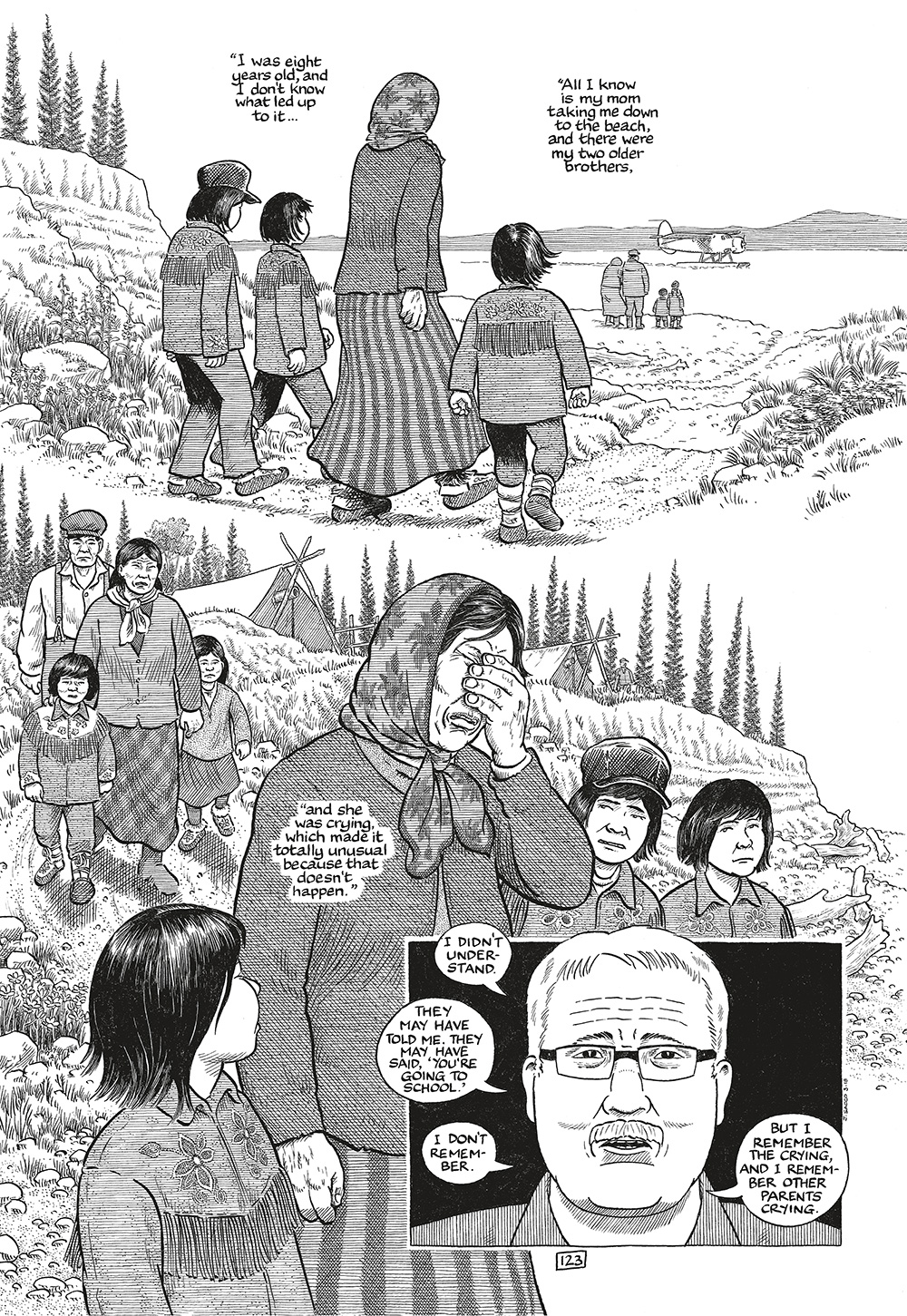
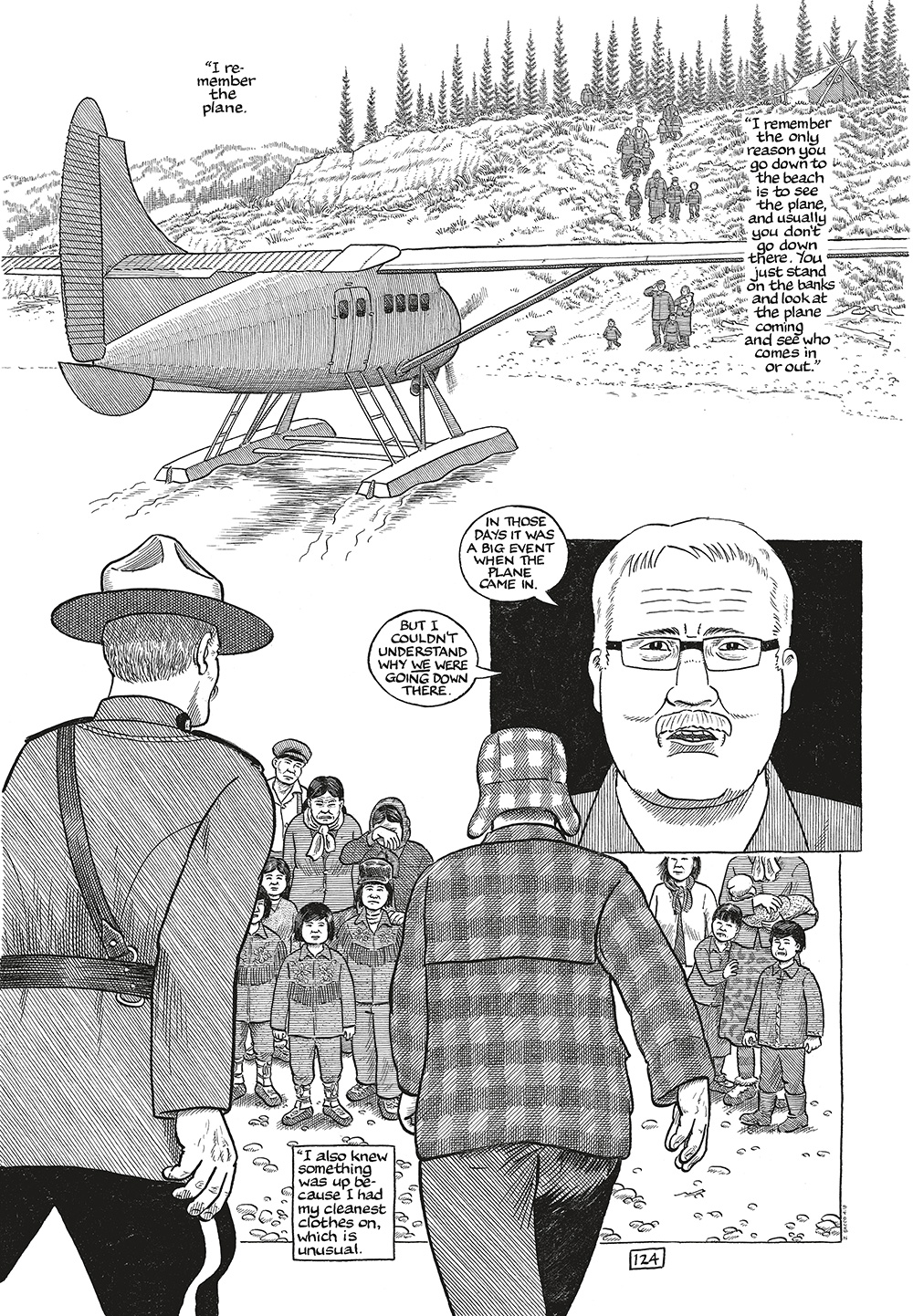
Andrew later describes being taken to residential school as a child. Sacco places children approaching a floatplane, a mother covering her face in tears, and the adult Andrew recounting it on the same page.

Words tell us that an adult remembers. The image prevents the two times from separating completely. The grown man can explain events; the child does not yet understand the preparations or his mother's distress. Understanding arrives much later, but departure occurs that day.

Residential school requires historical context here. This was not simply a boarding arrangement families freely chose. Canada's National Centre for Truth and Reconciliation describes a government- and church-driven system aimed at separating Indigenous children from families and cultures and assimilating them. Their languages could bring punishment; many suffered physical or sexual abuse. The Truth and Reconciliation Commission identified cultural genocide as the policy's intent.

This background does not make every interviewee the same kind of victim. It helps explain why returning home did not restore the former life. Language had become unfamiliar, communication with elders harder, and skills normally learned through living together unavailable. Closing a school building could not close the damage with it.

A review in Canada's History notes difficult details: some speakers remember individual clergy's kindness, while others value having learned English. Sacco does not remove such experiences to keep an accusation uniform. Neither do they balance away institutional harm. Describing something one gained does not authorize others to declare the forced losses worthwhile.

The book must then return to present life. Young people have employment plans, households have expenses, and communities make decisions about land use. History shapes these decisions without preparing a ready-made answer for them.

Wanting to protect land and wanting a job

Extraction brings environmental damage and lasting burdens, but it also supplies wages and business opportunities in the places Sacco visits. Opposing pollution does not make another income easy to find. Distant readers who need only express a position can particularly overlook this.

In his Between the Covers interview, Sacco discusses people who want to preserve oil and gas jobs while insisting on care for the land. Protecting home and supporting a family do not always occupy separate people. One person may have to worry about both.

Supporting a project therefore does not immediately establish that someone has abandoned tradition. Such a judgment can sound supportive of Indigenous people while imposing a standard of authenticity: to deserve sympathy, remain pure and outside money. Paying bills and providing for children are then left to the people being judged.

Real employment needs also do not justify accepting any development terms. Who decides, who bears risk, how long income lasts, and who cleans up afterward remain necessary questions. Multiple views make judgment answerable to those affected, not impossible because everything is complicated.

The reporting enters land claims and internal disagreements. These sections are dense and less readily followed than individual memories. Goodreads reviewer Adam Dalva appreciates the work while sometimes losing its narrative thread. The observation points to a practical expectation: the comics format does not instantly clarify every historical relationship.

The book produces no single final answer on behalf of all Dene people. Self-determination includes disagreement, reconsideration, and changed minds. Listening only when people choose the direction we favor makes support conditional in a severe way.

A reporter who takes stories must answer questions too

Sacco knows he is not outside the situation. He listens, takes stories away, and makes a book. For communities accustomed to visiting researchers, this raises a question: others obtain publications and careers, but what do the people telling their lives receive?

He discusses that unease in his Canadaland interview. Good intentions cannot by themselves separate him from everyone who comes to take something. Listening carefully, seeking accuracy, and enabling people to see the resulting work are obligations, not immunity from criticism.

Paying the Land therefore offers an entry rather than a sufficient library of Dene life. Its outsider author selects interviews, orders people, and chooses experiences for depiction. Some Goodreads readers recommend reading Indigenous authors alongside it. The suggestion does not reject cross-cultural reporting. It prevents even an excellent report from occupying every available position.

Drawings keep faces before us and can make memories harder to bear. The book concerns abuse suffered by children, domestic violence, and addiction. Comics do not turn these subjects into easy reading.

Fortunately, life contains more. Community gatherings include competitions in chopping wood, boiling water, and preparing food. Practiced skills still produce pride and laughter. These passages neither establish that harm is healed nor supply a reassuring ending for outsiders. People continue living, with things they want to do, preserve, and learn again.

Finishing the book may not equip us to judge every local development proposal. But hearing land described as resources awaiting use may now bring people to mind. They did not become relevant only when a project began. Before the first plan was drawn, they were living there and considering how to live next.
Joe Sacco 去加拿大西北地区采访,原本想写资源开采。他以为自己大致知道会听到什么:企业想开发油气,原住民想保护土地,记者需要做的是把冲突记录下来。

到了那里,他才发现事情不能这样分。有人反对开发,也有人需要开发带来的工作;有人担心失去传统生活,也有人正在借助新的教育与职业寻找出路。这些意见不只出现在不同社区之间,同一个社区内部,也会有人想得不一样。

2020年出版的 Paying the Land,便是萨科顺着这些谈话逐渐走远的结果。它是一部纪实漫画,主要记录加拿大北部德内人(Dene)的生活、历史,以及他们围绕土地与开发展开的争论。这里保留英文书名。“Paying”并不只是花钱购买,书中讲到的是,接受土地的给予,也要有所回报。若先把它译成一份土地交易,反而会离书里的意思越来越远。

萨科以漫画报道闻名,写过巴勒斯坦和波斯尼亚。到了北方,他没有遇到相同形式的战场,却发现,要理解今天一份工资的意义,必须先知道一些家庭怎样离开了土地,孩子怎样被带走,以及几十年后,人们为何仍在设法重新学会自己的语言。

先听一个人说,他从前怎样长大

这本书没有先把原住民放进贫困、成瘾或社会问题的统计里。开篇让 Paul Andrew 回忆童年:一家人和周围的人在土地上生活,捕鱼、狩猎、搭营地,孩子跟着大人看,也跟着做。

对不熟悉这种生活的读者,这个次序很重要。如果我们先看到一个需要被帮助的群体,往后就容易把所有事情都理解成他们还缺少什么。先认识曾经存在的生活,才有机会理解,后来的变化不只是添了学校、道路和职位,也可能拿走了某些东西。

这并不是说过去没有艰难。恰恰相反,许多事情必须会做,日子才能继续。土地既提供食物,也要求知识;孩子学到的不只是某一项技巧,还有什么时候需要帮忙,遇到问题可以找谁。Andrew 回想的那个童年,与周围大人的劳动很近,他逐渐学会做的事情,也正是家里需要的事情。

萨科后来在访谈中说,画这一段时,他很担心把以前的野外生活画错,查了影像档案,也把开篇交给 Andrew 等人查看。这个细节值得知道。漫画里的画面十分具体,却不是作者亲眼看到的童年;它是根据讲述与资料重新画出来的。具体并不等于未经选择,画得动人也不能替代核对。

书名所指的回报土地,同样应放回这样的生活里理解。它不是一句方便贴到任何环保宣传上的格言。对于书中讲述这种习惯的人,获得食物、庇护与生活的条件,并不意味着拿走以后就再无关系。感谢和给予,提醒人留意自己靠什么活着。这里首先是一种实际的联系,随后才可能成为外来读者愿意赞美的观念。

飞机把孩子带走以后

Andrew 后来讲到,年幼的自己被带去寄宿学校。萨科把当年走向水上飞机的孩子、掩面哭泣的母亲,与多年后正在讲述的 Andrew 放在同一张图页上。

文字告诉我们,一个成年人还记得那天;画面则使两个时间没有彻底分开。长大的人能够说明发生过什么,当年的孩子却还不知道,为什么大人让他穿好衣服,为什么母亲如此难过。理解来得很晚,离开却在那一天就发生了。

读这部分时,需要稍微停下来认识“寄宿学校”在这里的含义。它不是普通家庭自愿选择的一种住宿教育。加拿大国家真相与和解中心的历史资料说明,这套由政府及教会推动的制度,以使原住民儿童脱离家庭和文化、接受同化为目标。孩子使用自己的语言会受惩罚,许多人遭受身体或性侵害。真相与和解委员会将其目标认定为文化灭绝。

这些背景并非用来把每个受访者都解释成同一种受害者。它让读者明白,回到家为什么不等于回到原来的生活。语言生疏了,与长辈沟通变难,原本应在共同生活中学到的本事,也可能没有机会学。一个制度造成的损伤,不会随着那座校舍关门就一并停止。

《加拿大历史》的书评还提醒了一处不容易处理的细节:书里有人记得个别教士的善意,也有人珍惜自己学到英语的机会。萨科没有为了维持控诉的整齐,把这些经验删去。但它们也不是拿来抵消制度伤害的筹码。一个人能够说出自己获得过什么,并不意味着别人有权据此说,他被迫失去的部分就算值得。

从这些回忆中走出来,书还得回到眼前的生活。年轻人有自己的就业打算,家家有开支,社区也要决定怎样使用土地。过去发生的事情影响着这些选择,却没有替人准备好一个现成答案。

想保护土地,也可能想要一份工作

资源开采确实带来了环境破坏与长期负担,但在萨科访问的地方,它也提供工资和商业机会。一个反对污染的人,未必能轻易找到别的收入来源。对于居住在远处、只需表达立场的读者,这一点尤其容易漏掉。

萨科在 Between the Covers 的访谈中说,他遇到希望保住油气工作的人,也听见他们强调必须照顾土地。保护家乡与养活家庭,并没有总是分别住在两个人心里。有时是同一个人,必须同时为这两件事操心。

因此,不能因为受访者赞成某项开发,就立即说他忘记了传统。这样的判断看似站在原住民一边,实际上先替他们规定了合格的样子:要值得同情,最好始终保持一种纯粹、与金钱无关的生活。至于账单怎么付、孩子怎样生活,则被留给当事人自己处理。

不过,知道就业需要真实存在,也不意味着任何开发条件都必须接受。仍然要问,决定由谁作出,风险留给谁,收入能维持多久,项目退出以后谁来收拾。萨科把多种意见放在书里,不是为了告诉读者事情复杂到无法判断,而是让判断不能绕过承担后果的人。

他的采访还进入土地诉求和社区内部的分歧。这些地方信息密集,未必像人物回忆那样容易读。Goodreads 上的读者 Adam Dalva 肯定作品,也说自己有时跟丢了叙述的线索。这个意见很中肯地提示了阅读方式:不要因为是漫画,就预期它会把所有历史关系迅速讲清。

书里没有替德内人找到一个全体一致的最终答案。真正的自决,本来就包括争论、重新考虑和改变想法。假如只有当他们选择了我们喜欢的方向,我们才愿意听,那份支持仍然附带了很苛刻的条件。

记者带走故事,也需要回答问题

萨科知道,自己并不站在这一切的外面。他来听故事,再把故事带走,画成作品。对于已经见过许多研究者来访的人,这个过程也会引起疑问:别人最后得到了论文、职业机会或一本书,讲述者得到了什么?

在 Canadaland 的访谈中,他谈到这种不安。他不能只凭一片好意,就认定自己与所有前来索取的人截然不同。认真倾听、尽量准确、让当事人能够看到作品,是他需要做的事;这些努力也不是一张可以免受质疑的证书。

这使 Paying the Land 适合成为入口,却不适合成为读者关于德内生活的唯一一本书。作者是外来者,采访有选择,人物如何排列、哪些经历得到画面,都经过他的处理。Goodreads 上也有读者建议,把它与原住民作者自己的书写放在一起读。这样的建议不是在否定跨文化报道,而是在防止一部优秀报道占满所有位置。

画面让这些面孔留在读者眼前,也使有些回忆更加难以承受。书中涉及儿童所受的虐待、家庭暴力与成瘾经历,并不因为采用漫画形式,就读得轻松。

好在生活没有只剩这些。书中也有社区聚会与比赛,人们比劈柴、烧水、做食物,熟练的本事仍能带来得意和笑声。这些段落并不证明过去的伤害已经愈合,也不负责为读者安排一个安心的结尾。它们只是提醒我们,这里的人还在过日子,有自己想做、想守住、想重新学会的事。

读完 Paying the Land,也许还无法对当地每一项开发作出判断。但再听到有人把某片土地说成等待利用的资源,脑中可能会多出一些人。他们不是项目开始之后才出现的利益相关者。在第一份计划画出来之前,他们已经在那里生活,也一直在想,接下来要怎样生活。

Joe Sacco 去加拿大西北地區採訪,原本想寫資源開採。他以為自己大致知道會聽到什麼:企業想開發油氣,原住民想保護土地,記者需要做的是把衝突記錄下來。

到了那裡,他才發現事情不能這樣分。有人反對開發,也有人需要開發帶來的工作;有人擔心失去傳統生活,也有人正在借助新的教育與職業尋找出路。這些意見不只出現在不同社區之間,同一個社區內部,也會有人想得不一樣。

2020年出版的 Paying the Land,便是薩科順著這些談話逐漸走遠的結果。它是一部紀實漫畫,主要記錄加拿大北部德內人(Dene)的生活、歷史,以及他們圍繞土地與開發展開的爭論。這裡保留英文書名。「Paying」並不只是花錢購買,書中講到的是,接受土地的給予,也要有所回報。若先把它譯成一份土地交易,反而會離書裡的意思越來越遠。

薩科以漫畫報道聞名,寫過巴勒斯坦和波斯尼亞。到了北方,他沒有遇到相同形式的戰場,卻發現,要理解今天一份工資的意義,必須先知道一些家庭怎樣離開了土地,孩子怎樣被帶走,以及幾十年後,人們為何仍在設法重新學會自己的語言。

先聽一個人說,他從前怎樣長大

這本書沒有先把原住民放進貧困、成癮或社會問題的統計裡。開篇讓 Paul Andrew 回憶童年:一家人和周圍的人在土地上生活,捕魚、狩獵、搭營地,孩子跟著大人看,也跟著做。

對不熟悉這種生活的讀者,這個次序很重要。如果我們先看到一個需要被幫助的群體,往後就容易把所有事情都理解成他們還缺少什麼。先認識曾經存在的生活,才有機會理解,後來的變化不只是添了學校、道路和職位,也可能拿走了某些東西。

這並不是說過去沒有艱難。恰恰相反,許多事情必須會做,日子才能繼續。土地既提供食物,也要求知識;孩子學到的不只是某一項技巧,還有什麼時候需要幫忙,遇到問題可以找誰。Andrew 回想的那個童年,與周圍大人的勞動很近,他逐漸學會做的事情,也正是家裡需要的事情。

薩科後來在訪談中說,畫這一段時,他很擔心把以前的野外生活畫錯,查了影像檔案,也把開篇交給 Andrew 等人查看。這個細節值得知道。漫畫裡的畫面十分具體,卻不是作者親眼看到的童年;它是根據講述與資料重新畫出來的。具體並不等於未經選擇,畫得動人也不能替代核對。

書名所指的回報土地,同樣應放回這樣的生活裡理解。它不是一句方便貼到任何環保宣傳上的格言。對於書中講述這種習慣的人,獲得食物、庇護與生活的條件,並不意味著拿走以後就再無關係。感謝和給予,提醒人留意自己靠什麼活著。這裡首先是一種實際的聯繫,隨後才可能成為外來讀者願意贊美的觀念。

飛機把孩子帶走以後

Andrew 後來講到,年幼的自己被帶去寄宿學校。薩科把當年走向水上飛機的孩子、掩面哭泣的母親,與多年後正在講述的 Andrew 放在同一張圖頁上。

文字告訴我們,一個成年人還記得那天;畫面則使兩個時間沒有徹底分開。長大的人能夠說明發生過什麼,當年的孩子卻還不知道,為什麼大人讓他穿好衣服,為什麼母親如此難過。理解來得很晚,離開卻在那一天就發生了。

讀這部分時,需要稍微停下來認識「寄宿學校」在這裡的含義。它不是普通家庭自願選擇的一種住宿教育。加拿大國家真相與和解中心的歷史資料說明,這套由政府及教會推動的制度,以使原住民兒童脫離家庭和文化、接受同化為目標。孩子使用自己的語言會受懲罰,許多人遭受身體或性侵害。真相與和解委員會將其目標認定為文化滅絕。

這些背景並非用來把每個受訪者都解釋成同一種受害者。它讓讀者明白,回到家為什麼不等於回到原來的生活。語言生疏了,與長輩溝通變難,原本應在共同生活中學到的本事,也可能沒有機會學。一個制度造成的損傷,不會隨著那座校舍關門就一並停止。

《加拿大歷史》的書評還提醒了一處不容易處理的細節:書裡有人記得個別教士的善意,也有人珍惜自己學到英語的機會。薩科沒有為了維持控訴的整齊,把這些經驗刪去。但它們也不是拿來抵消制度傷害的籌碼。一個人能夠說出自己獲得過什麼,並不意味著別人有權據此說,他被迫失去的部分就算值得。

從這些回憶中走出來,書還得回到眼前的生活。年輕人有自己的就業打算,家家有開支,社區也要決定怎樣使用土地。過去發生的事情影響著這些選擇,卻沒有替人準備好一個現成答案。

想保護土地,也可能想要一份工作

資源開採確實帶來了環境破壞與長期負擔,但在薩科訪問的地方,它也提供工資和商業機會。一個反對污染的人,未必能輕易找到別的收入來源。對於居住在遠處、只需表達立場的讀者,這一點尤其容易漏掉。

薩科在 Between the Covers 的訪談中說,他遇到希望保住油氣工作的人,也聽見他們強調必須照顧土地。保護家鄉與養活家庭,並沒有總是分別住在兩個人心裡。有時是同一個人,必須同時為這兩件事操心。

因此,不能因為受訪者贊成某項開發,就立即說他忘記了傳統。這樣的判斷看似站在原住民一邊,實際上先替他們規定了合格的樣子:要值得同情,最好始終保持一種純粹、與金錢無關的生活。至於賬單怎麼付、孩子怎樣生活,則被留給當事人自己處理。

不過,知道就業需要真實存在,也不意味著任何開發條件都必須接受。仍然要問,決定由誰作出,風險留給誰,收入能維持多久,專案退出以後誰來收拾。薩科把多種意見放在書裡,不是為了告訴讀者事情複雜到無法判斷,而是讓判斷不能繞過承擔後果的人。

他的採訪還進入土地訴求和社區內部的分歧。這些地方資訊密集,未必像人物回憶那樣容易讀。Goodreads 上的讀者 Adam Dalva 肯定作品,也說自己有時跟丟了敘述的線索。這個意見很中肯地提示了閱讀方式:不要因為是漫畫,就預期它會把所有歷史關係迅速講清。

書裡沒有替德內人找到一個全體一致的最終答案。真正的自決,本來就包括爭論、重新考慮和改變想法。假如只有當他們選擇了我們喜歡的方向,我們才願意聽,那份支持仍然附帶了很苛刻的條件。

記者帶走故事,也需要回答問題

薩科知道,自己並不站在這一切的外面。他來聽故事,再把故事帶走,畫成作品。對於已經見過許多研究者來訪的人,這個過程也會引起疑問:別人最後得到了論文、職業機會或一本書,講述者得到了什麼?

在 Canadaland 的訪談中,他談到這種不安。他不能只憑一片好意,就認定自己與所有前來索取的人截然不同。認真傾聽、盡量準確、讓當事人能夠看到作品,是他需要做的事;這些努力也不是一張可以免受質疑的證書。

這使 Paying the Land 適合成為入口,卻不適合成為讀者關於德內生活的唯一一本書。作者是外來者,採訪有選擇,人物如何排列、哪些經歷得到畫面,都經過他的處理。Goodreads 上也有讀者建議,把它與原住民作者自己的書寫放在一起讀。這樣的建議不是在否定跨文化報道,而是在防止一部優秀報道佔滿所有位置。

畫面讓這些面孔留在讀者眼前,也使有些回憶更加難以承受。書中涉及兒童所受的虐待、家庭暴力與成癮經歷,並不因為採用漫畫形式,就讀得輕鬆。

好在生活沒有只剩這些。書中也有社區聚會與比賽,人們比劈柴、燒水、做食物,熟練的本事仍能帶來得意和笑聲。這些段落並不證明過去的傷害已經愈合,也不負責為讀者安排一個安心的結尾。它們只是提醒我們,這裡的人還在過日子,有自己想做、想守住、想重新學會的事。

讀完 Paying the Land,也許還無法對當地每一項開發作出判斷。但再聽到有人把某片土地說成等待利用的資源,腦中可能會多出一些人。他們不是專案開始之後才出現的利益相關者。在第一份計劃畫出來之前,他們已經在那裡生活,也一直在想,接下來要怎樣生活。

Sources & further reading出处与延伸阅读出處與延伸閱讀

Sources distinguish original material, later interviews, reviews, and this introduction’s analysis. Search-only access is identified; individual reviews are not consensus. No verifiable Amazon customer reviews were obtained. Both batches were jointly reviewed on October 7, 2026; the English text is a full corresponding edition.

资料说明区分原作、后续访谈、评论与本文延伸。仅检索可见的材料逐项标明;个别评论不代表平台共识。未取得可核验的Amazon顾客评论。正文经2026年10月7日两批合并复核,英文为完整对应版本。

資料說明區分原作、後續訪談、評論與本文延伸。僅檢索可見的材料逐項標明;個別評論不代表平台共識。未取得可核驗的Amazon顧客評論。正文經2026年10月7日兩批合併復核,英文為完整對應版本。

Follow the links for the original passages and fuller discussions. Distinguish the author’s account, later research, and this introduction’s own questions.

外链提供原作段落与更完整的讨论。阅读时请区分作者的叙述、后来的研究,以及本文继续提出的问题。

外鏈提供原作段落與更完整的討論。閱讀時請區分作者的敘述、後來的研究,以及本文繼續提出的問題。

Author conversation作者访谈作者訪談

David Naimon — Between the Covers ↗

Checking reconstructed images, Andrew’s review, and concurrent concerns about land and employment.

画面重建核对、Andrew审看、土地与就业并存。

畫面重建核對、Andrew審看、土地與就業並存。

Author conversation作者访谈作者訪談

Jesse Brown — Canadaland ↗

Revision of initial assumptions and responsibility for taking stories away.

作者预设被纠正,以及采访带走故事的责任。

作者預設被糾正,以及採訪帶走故事的責任。

Read the original阅读原作閱讀原作

Paying the Land — Public page 123 ↗

Complete public page visually inspected: child, mother, and adult narrator juxtaposed; image not copied.

实际目读完整图页:童年、母亲与成年讲述者并置;不复制图片。

實際目讀完整圖頁:童年、母親與成年講述者並置;不複製圖片。

Read the original阅读原作閱讀原作

Paying the Land — Public page 124 ↗

Second public page visually inspected; no claim to reading the twelve-page preview or whole book.

实际目读第二张公开图;未声称看完十二页预览或全书。

實際目讀第二張公開圖;未聲稱看完十二頁預覽或全書。

Publication details出版资料出版資料

Macmillan — Paying the Land ↗

Current paperback record; 2025 is not the original 2020 publication.

当前平装书目;2025不当作2020原作的初版年。

當前平裝書目;2025不當作2020原作的初版年。

Another reader’s view另一位读者的看法另一位讀者的看法

Dorothy Woodend — The Tyee ↗

Opening, title, school memory, and community contests; unverified statistics omitted.

开篇、书名、学校记忆与社区比赛;不用未另核的数字。

開篇、書名、學校記憶與社區比賽;不用未另核的數字。

Another reader’s view另一位读者的看法另一位讀者的看法

Nancy Payne — Canada’s History ↗

Contradictory testimony retained without offsetting institutional harm through individual kindness.

保留受访者矛盾经验,不用个别善意抵扣制度伤害。

保留受訪者矛盾經驗,不用個別善意抵扣制度傷害。

Another reader’s view另一位读者的看法另一位讀者的看法

Goodreads — Accessible reader reviews ↗

Directly accessible comments: Adam Dalva on narrative difficulty and recommendations to read Indigenous writers.

直接页可读:Adam Dalva的线索困惑及配读原住民作品的建议。

直接頁可讀:Adam Dalva的線索困惑及配讀原住民作品的建議。

Institutional sources机构资料機構資料

NCTR — Residential school history ↗

Official historical context, not current compensation or legal guidance.

官方历史背景,非现行赔偿或法律指南。

官方歷史背景,非現行賠償或法律指南。