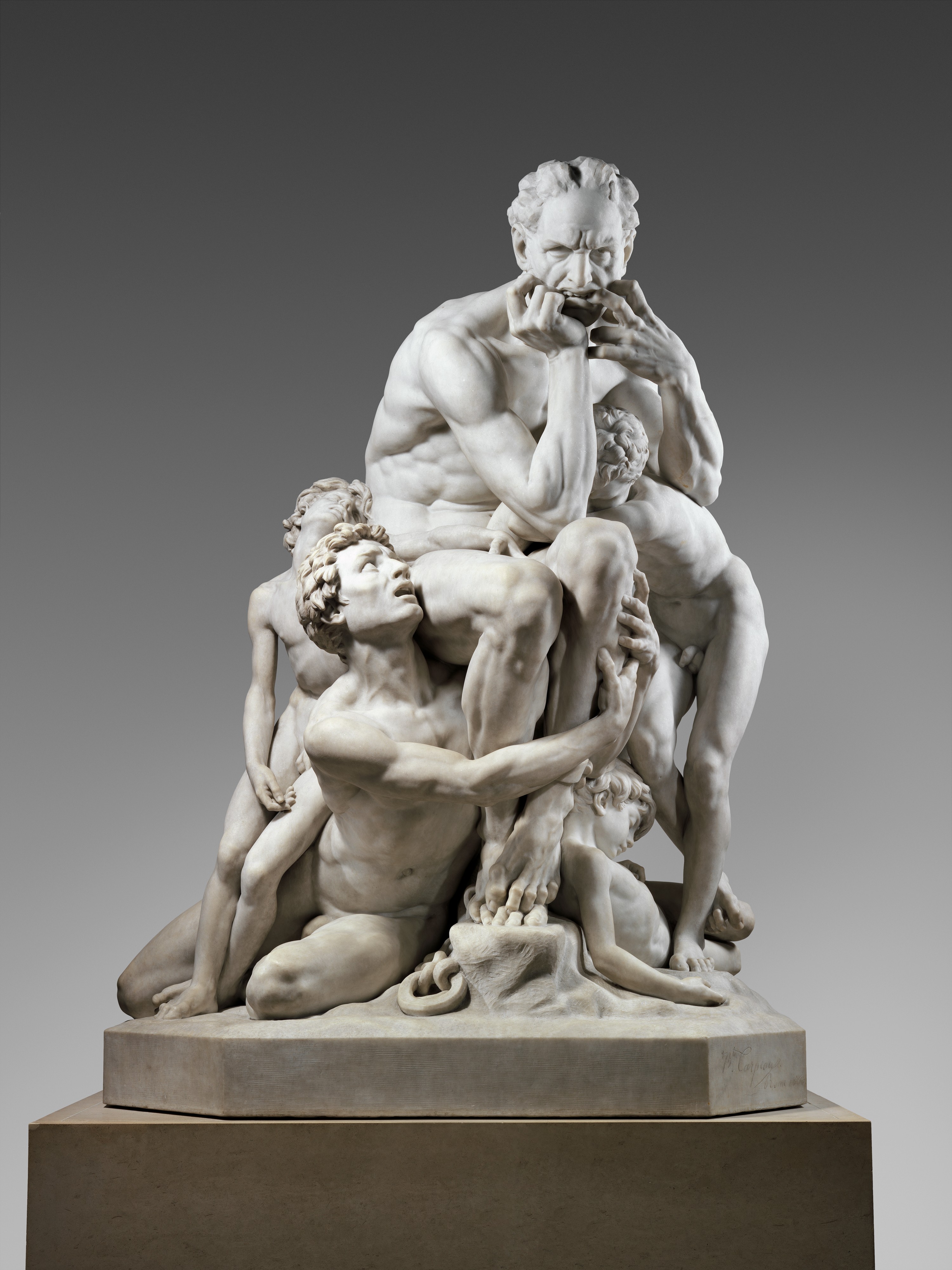
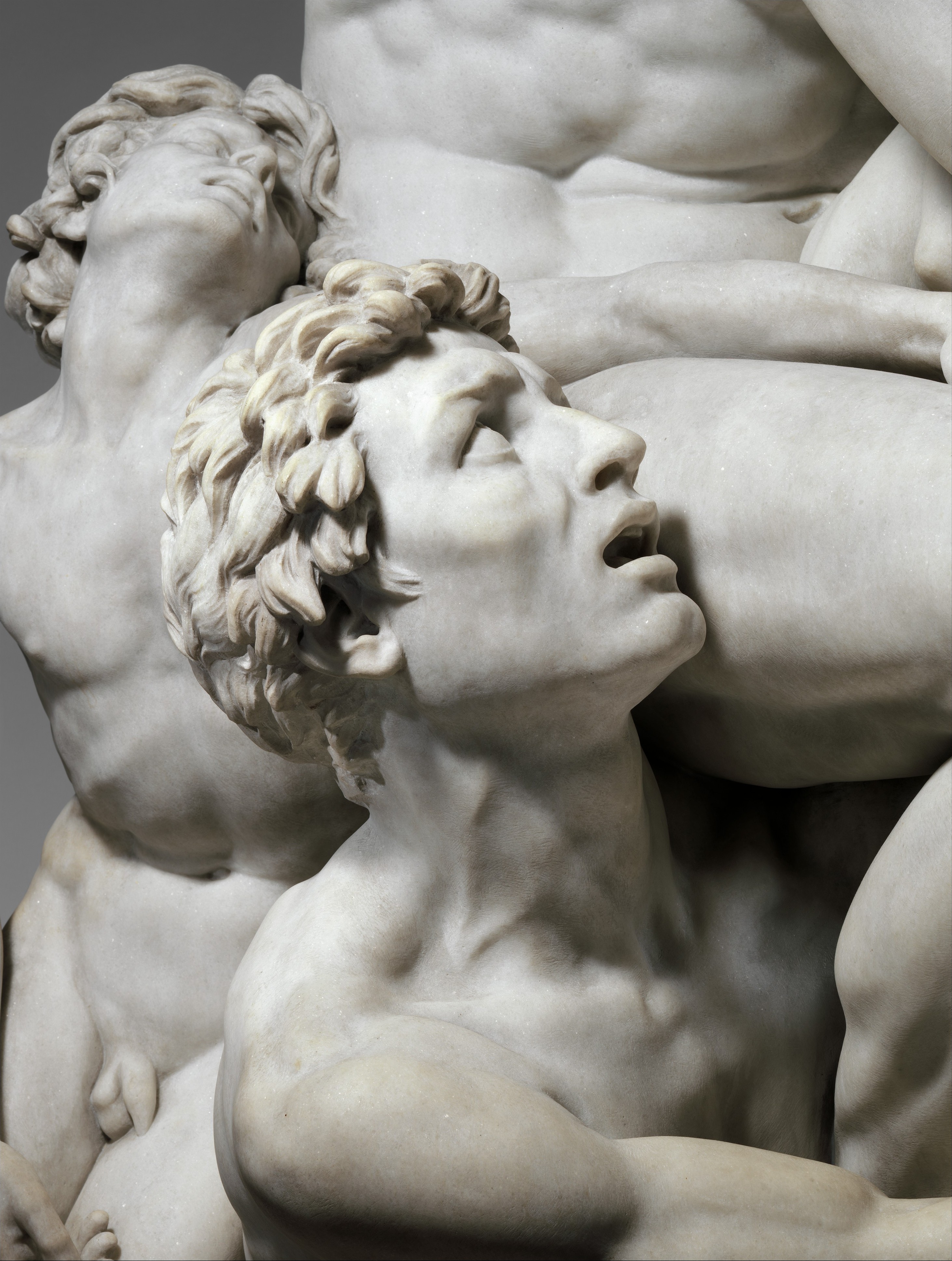
First, find the hands.
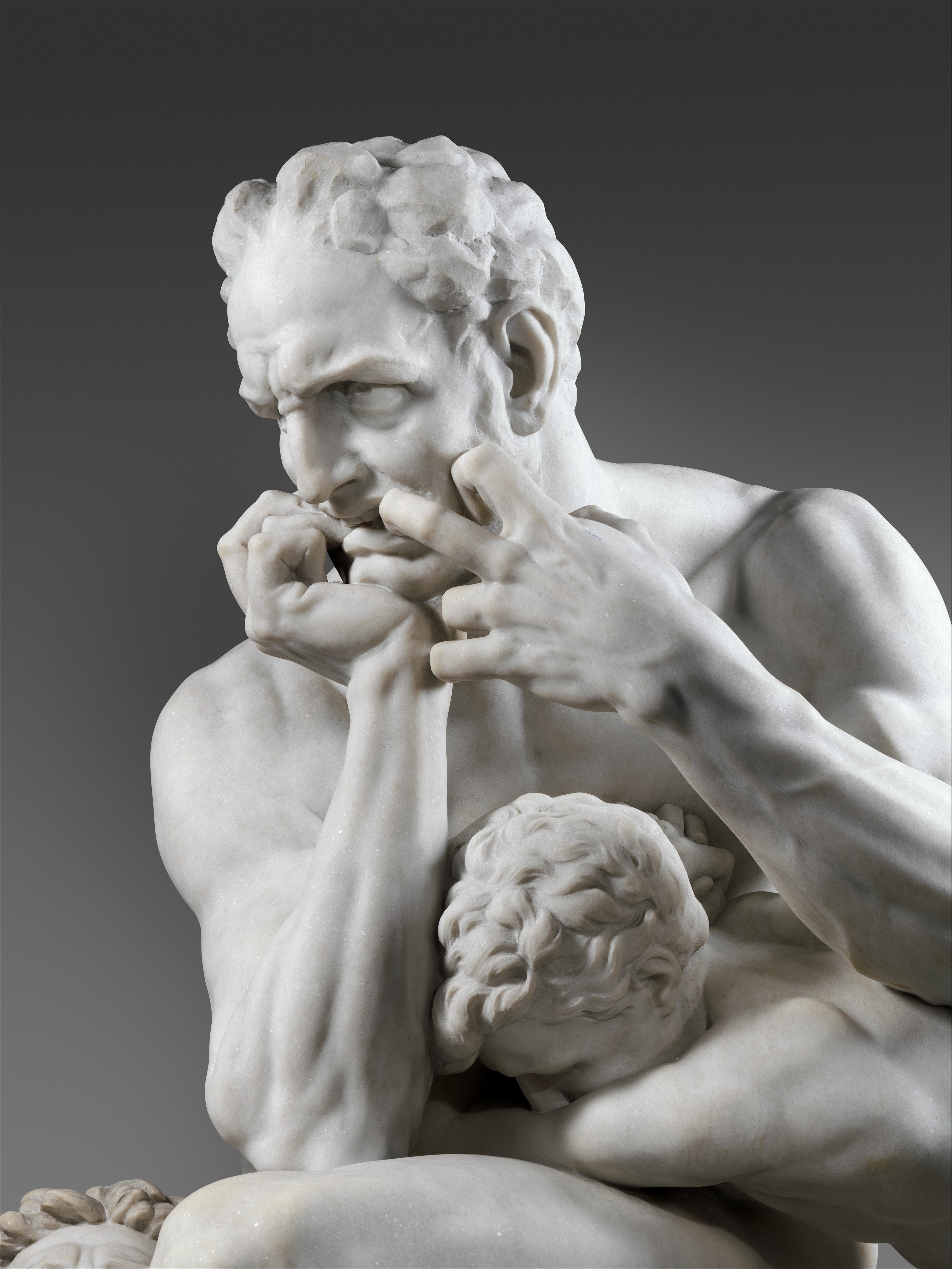
The young man nearest us reaches both hands toward the older man’s leg: one spreads below the knee, the other grasps the shin farther down. Beside him, another young man bends over, burying his head against the older man’s chest, his arm crossing the older man’s knee. The figures are so close that arms, legs, chests, and abdomens almost fill the gaps between them.
Yet the man at the top keeps both hands beside his own mouth.
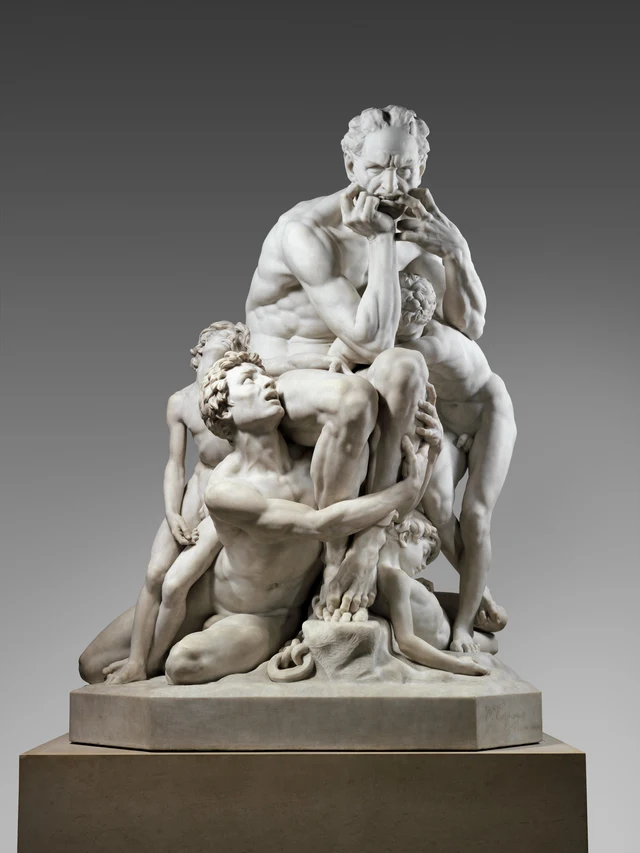
The tension lies in more than that tightly furrowed face. Several arms reaching toward another person finally surround a man whose hands withdraw toward himself. Contact fills the group without naturally becoming a mutual embrace.
The subject comes from canto 33 of the Inferno in Dante’s Divine Comedy. In hell, Ugolino recounts his imprisonment and starvation with his younger family members. Seeing him bite his hands, the children in the poem think his hunger unbearable and offer their bodies for their father to eat. His historical fellow prisoners included sons and grandsons. The sculpture follows the literary father-and-sons grouping; “the children” here refers to the four younger figures, without making a claim about their historical ages or generations. Dante’s original text, canto 33; Princeton Dante Project: Ugolino
The nineteenth-century French sculptor Carpeaux developed this subject while studying in Rome. The marble before us was completed in 1865–1867 and must not be conflated with earlier models or other bronze versions. The museum notes that he studied living bodies and was deeply influenced by Michelangelo. This account of hunger and despair consequently acquired exceptionally substantial shoulders, backs, arms, and legs. How such powerful bodies are rendered powerless is precisely what rewards close looking. Museum commentary and audio transcript
1. Hands Reaching Out, Hands Drawing Back
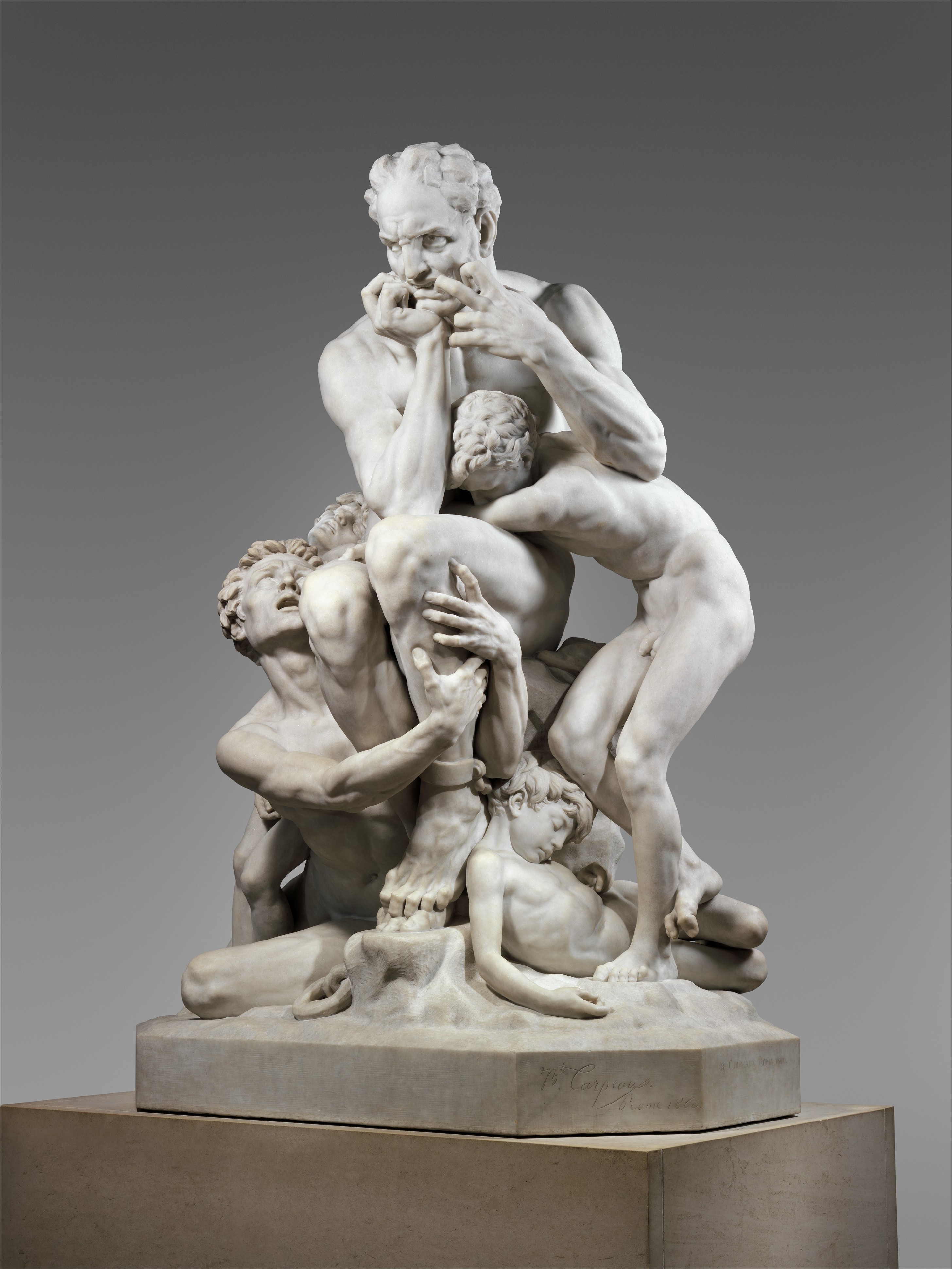
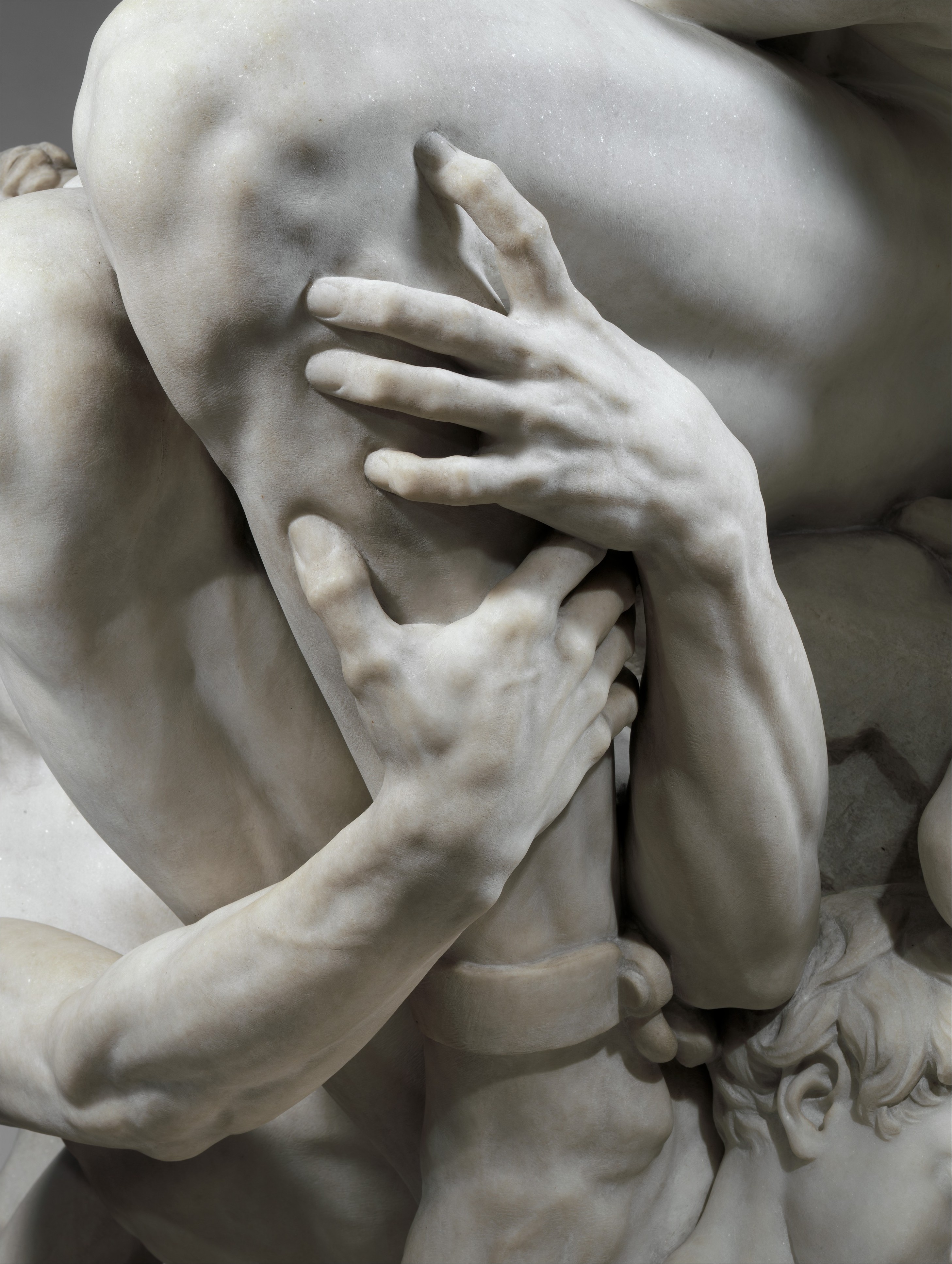
Locate the foremost young man’s hands in Figure 1, then turn to the museum’s close-up.
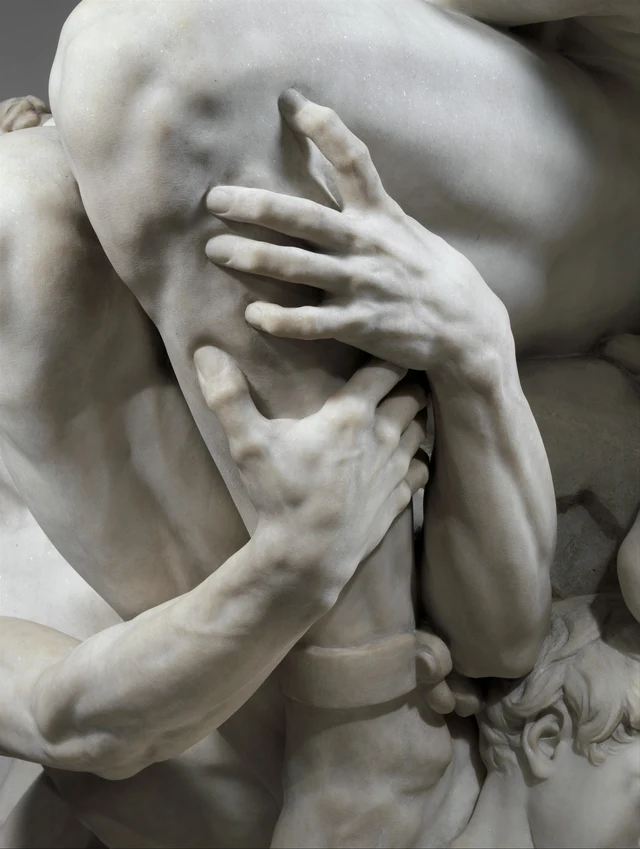
The upper hand does not lie flat like an imprint. Its thumb points up, several fingers spread diagonally to one side, and the turns between knuckles and hand back are clear. The lower hand reaches around from the other side, with some fingers disappearing behind the leg. At different heights, both seem to be seeking somewhere to hold.
This gives “grasping a leg” a specific force. Palms must approach, fingers must separate and bend, and wrists turn because the forearms arrive from different directions. Following the arms back, we find the young man with his head raised and mouth open. More than his hands reach out: his whole upper body advances, shoulder forward, chest turning, neck lengthening upward. One person’s action becomes a continuous approach toward another.
Now look up at the hands beside Ugolino’s mouth.
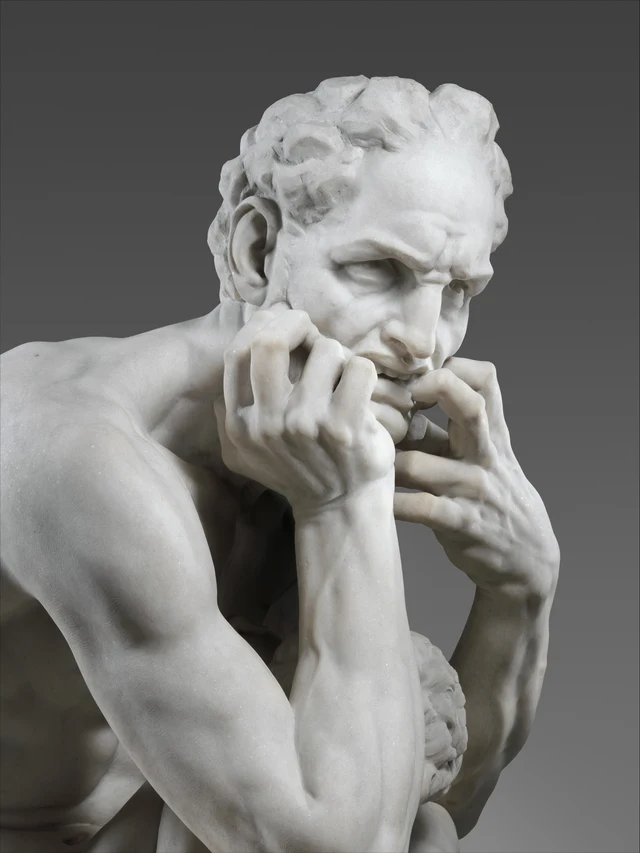
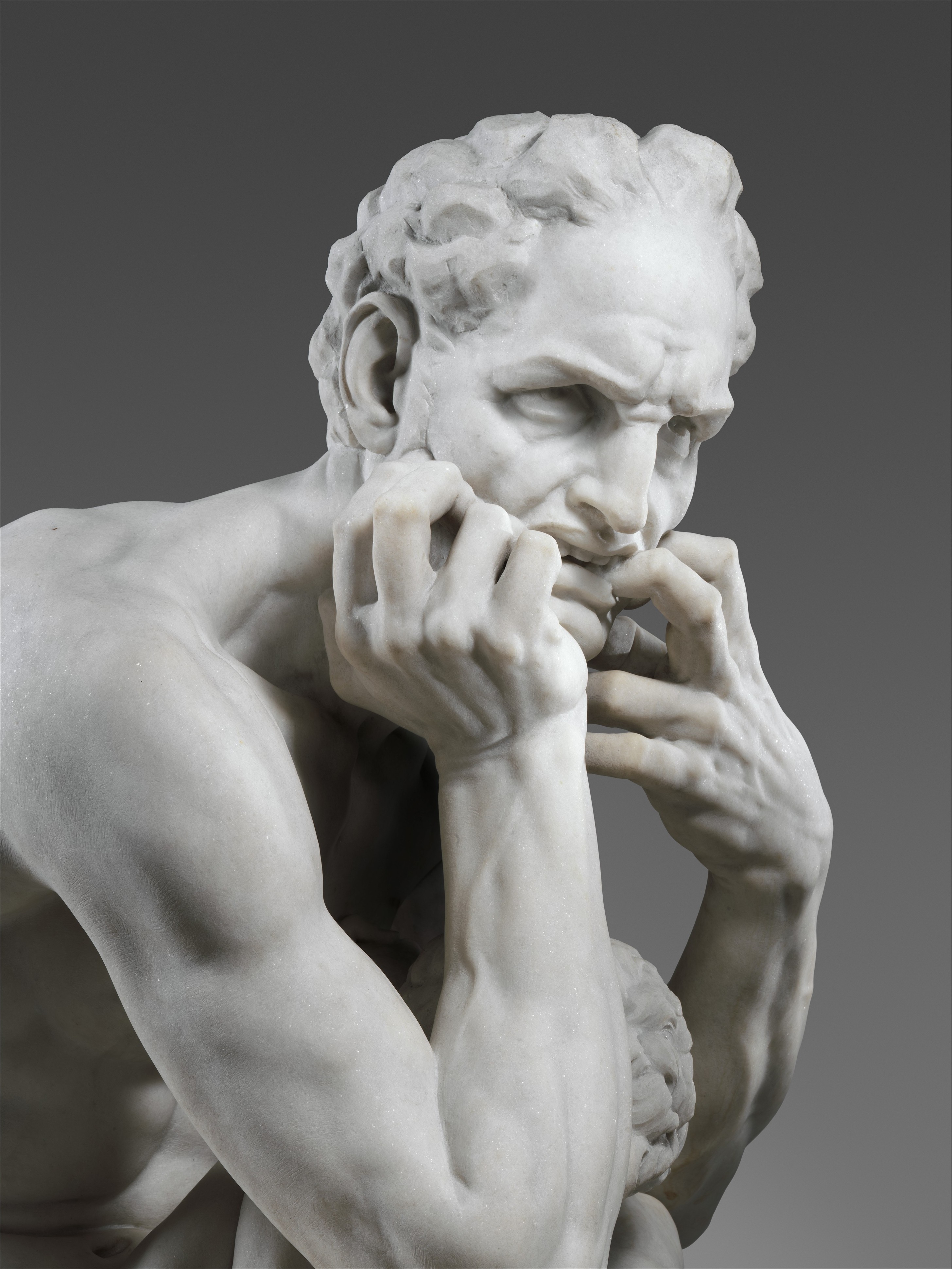
There are spread fingers here too, along with bending and compression, but their direction has completely changed. One hand contracts toward the palm; the other reaches across, its fingers meeting the mouth. Both forearms rise from near the knees, blocking the space below the face. Eyes lie beneath the brows, mouth behind fingers. The face is not an unobstructed expression handed over for us to read.
The hands both perform and conceal the action. We see mouth and hands touching without being able to lay the entire thought open like a completed explanation. The poem states that he bites his hands in anguish, while the children interpret the action as hunger. One action produces a different understanding in someone else. Inferno, canto 33, lines 55–64
Carpeaux gives this literary relationship spatial distance. The hands below have already reached him, while those above have not left his own body. They are not separated by several yards or unable to see one another. The plea and the person who might answer occupy the same place. What remains delayed is the outward movement of his hands.
2. Four Figures Do Not Approach in the Same Way
Calling all four younger figures “suffering children” can quickly make them seem repetitions of one expression. Their actual arrangement is very different.
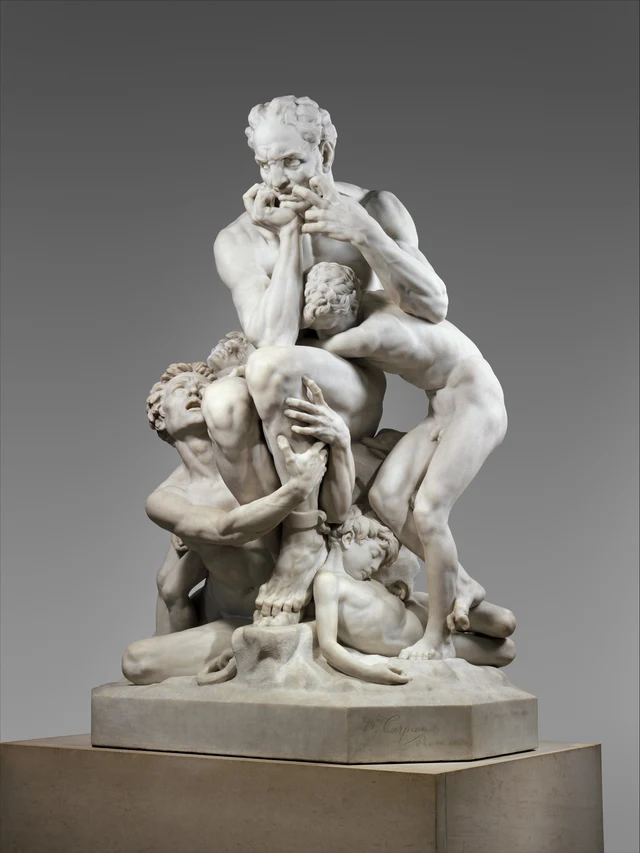
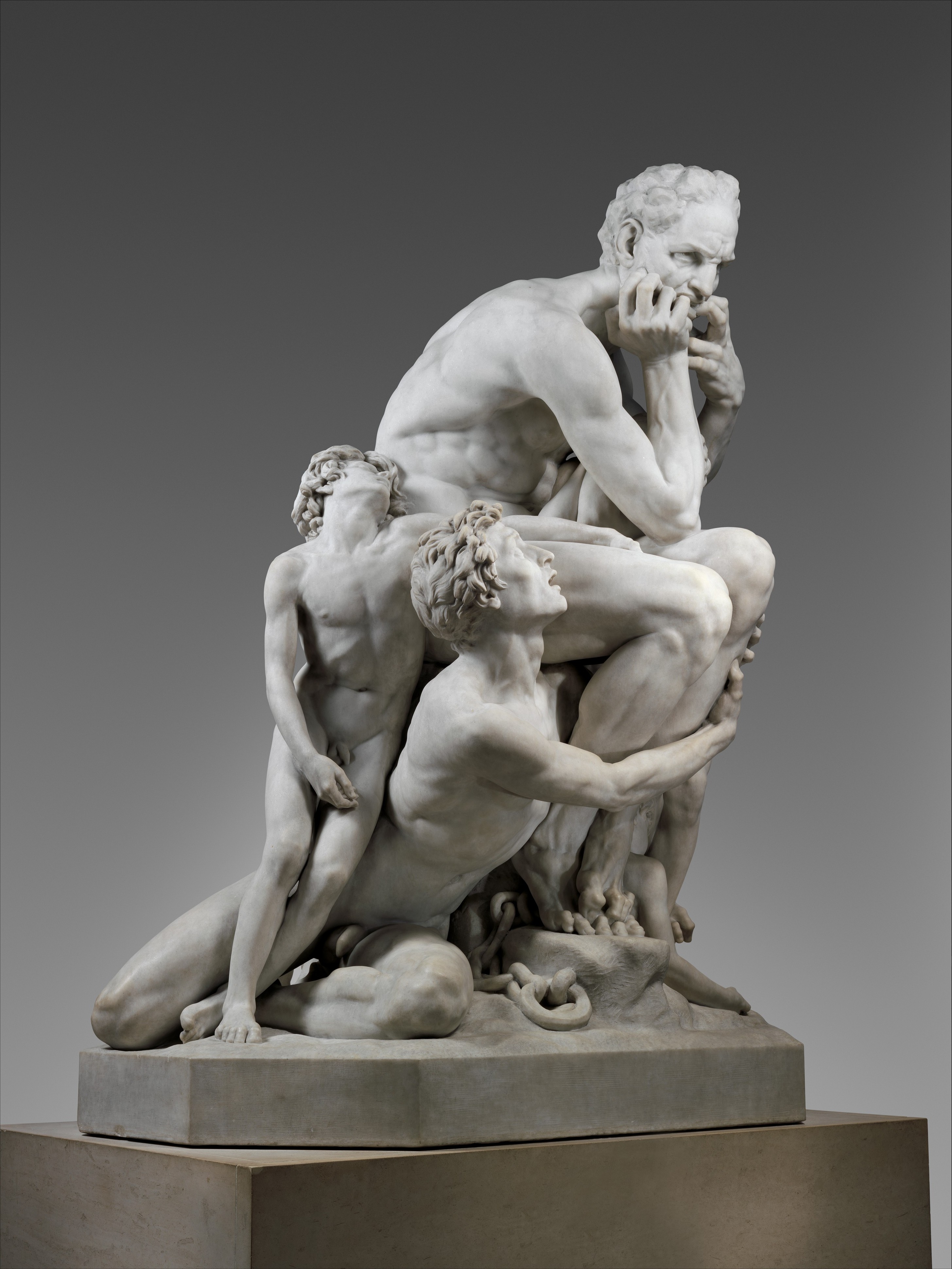
The foremost young man still struggles to raise his face. Another comes in from the side, his upper body almost horizontal against Ugolino’s chest. His head lowers, and his own arm and the older man’s body press his face into shadow. He is closer, but harder to see than the one looking upward.
On the other side, a smaller child tilts his head back, his back and neck making a long curve. One hand hangs before him with the palm slightly open; his arm does not reach actively outward like the foremost figure’s. The lowest child lies across the space beside the feet, head turned aside, one arm dropping low. The bodies sink to differing degrees, but they are not neatly lined up.
This changes the speed of our looking. The foremost, open-mouthed face draws our eyes quickly upward to find whom he addresses. At the buried head, we must stop to distinguish the form. At the bottom, a hanging arm leads toward the stone platform. Reaching upward for help, bowing inward, falling backward, and extending along the ground compete for direction within one group.
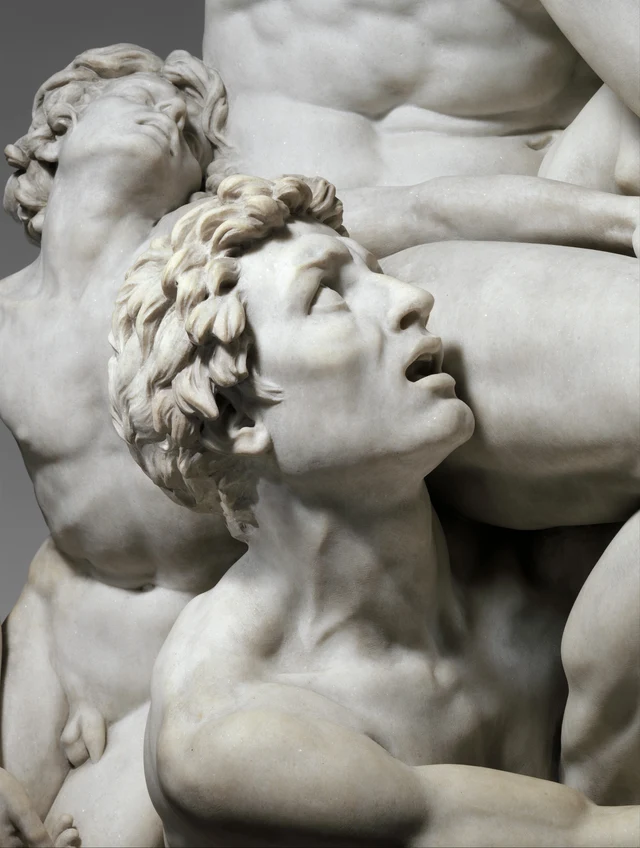
Figure 5 lets us look more closely. The nearer figure opens his mouth, lengthens the front of his neck, and directs brow and eyes upward. The other also raises his chin, but his face retreats farther back. Both could be summarized as “heads tilted upward,” yet one presents his face toward another person while the other seems closer to losing the strength to hold his head. This difference comes from relationships among head, neck, and chest, not merely whether a mouth is open or closed.
In the poem, the children die in succession. The sculpture gathers different bodily states in one place, letting us encounter pleading, exhaustion, and sinking at once. Photographs alone cannot assign a moment of death to each posture. What matters is that Carpeaux has not made four figures accompany the central man in unison. Each body gives a different distance between “still holding on” and “losing strength.”
The more distinct they become, the more conspicuous the central figure’s stillness is. His surroundings are not quiet, so his immobility cannot simply be rest.
3. So Much Muscle, but Action Has Nowhere to Go
The group is roughly six and a half feet tall and five feet wide. Ugolino sits, yet the whole reaches almost two meters. A screen can shrink it into an intricate ornament. The dimensions remind us that these bodies can occupy the space before a person through their actual volume.
Look at the older man’s shoulders. They are broad, his upper arms full; bent elbows send the forearms upward again. Across chest, abdomen, legs, and arms, broad swellings alternate with long narrow grooves. Hunger has not simply been rendered as a group reduced to skin and bone. The central body retains enough substance to suggest the capacity to act.
Yet following his limbs reveals almost every direction turning back. His back bends forward; thighs extend forward, knees bend down, shins return toward his feet. Arms descend from shoulders, reverse at elbows, and rise back to the face. These forces do not combine into standing, pushing away, or stepping out. The large body folds itself into a confined space.
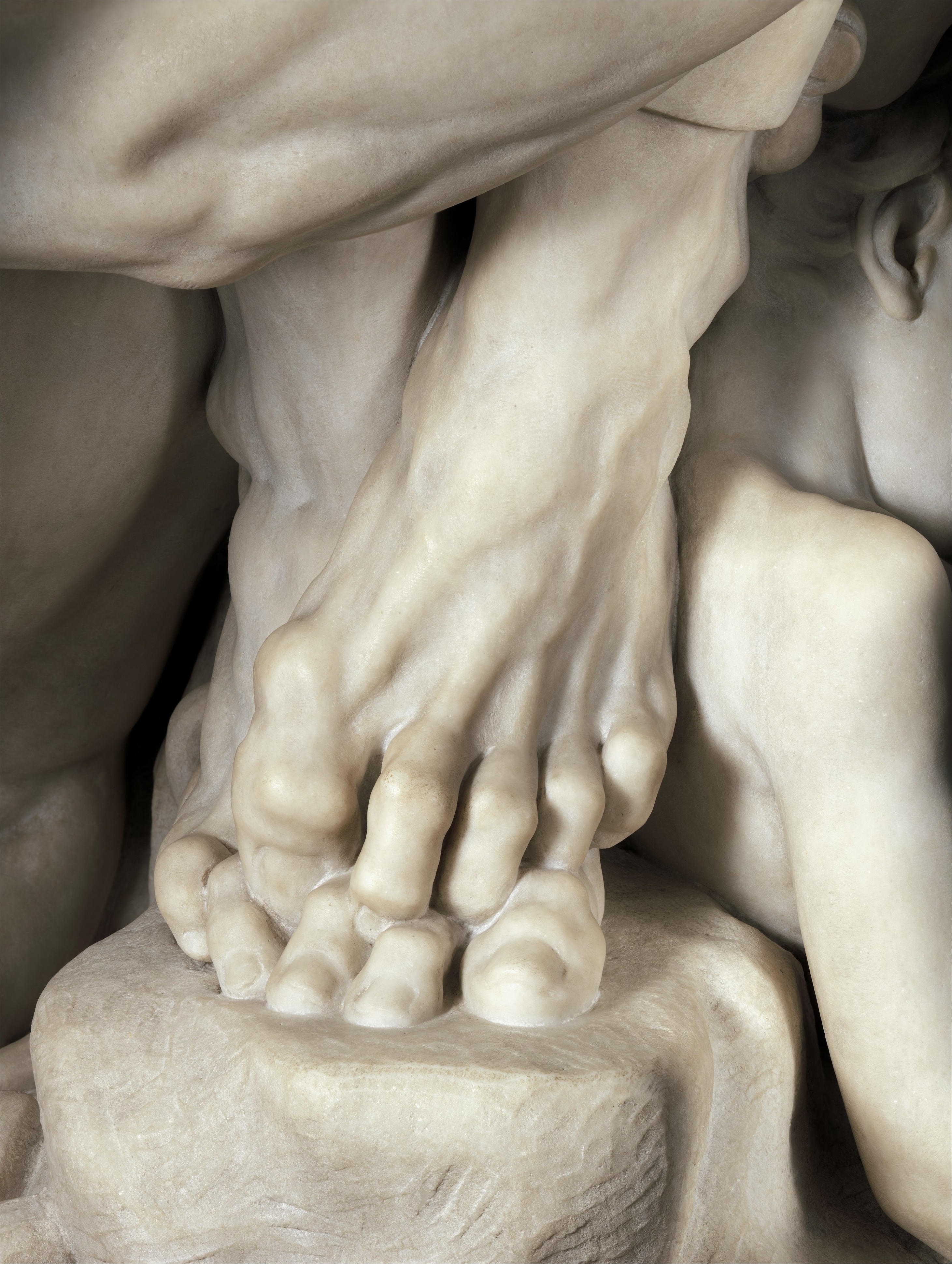
The feet make this contraction especially clear.
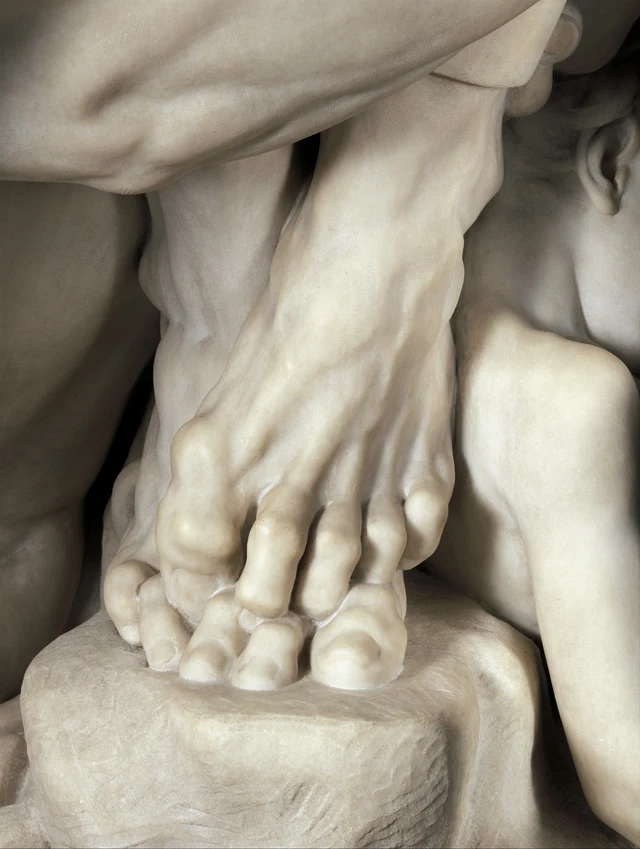
In full-length photographs, feet can easily recede into small details near the base. Close up, the upper toes bend joint by joint, and several long ridges along the instep run toward the ankle. The feet press together above rough stone. The clenching beside the mouth receives a silent echo at the other end of the body: even the feet have not relaxed.
This does not mean we know the amount of actual pain. Sculpture presents contractions, swellings, and contacts the eye can recognize. The museum’s audio account explains that Carpeaux employed models over long periods and studied muscle and bone closely. Here we can see that observation serving the whole group’s posture rather than merely displaying anatomical knowledge. Museum audio transcript
If every fine ridge of the insteps disappeared, we could still recognize feet, but some sense of continuing effort would be lost. If the shoulders became mere outlines, the central man would remain large, yet the conflict between size and constraint would weaken. Bodily details repeatedly tell us that strength has not entirely left these figures. Precisely because strength remains visible, its inability to find action feels agonizing.
The shackles near the ankles and chain at the bottom connect this inability to leave with imprisonment. But Carpeaux has not rebuilt a tower and placed the figures inside. Much of the prison’s spatial confinement is borne by these folding, entangled bodies that cannot extend.
4. At the Back, What Does the Stone Seat Support?
The interwoven arms in front can suggest that the figures are holding one another up and that this mutual support keeps the group stable.
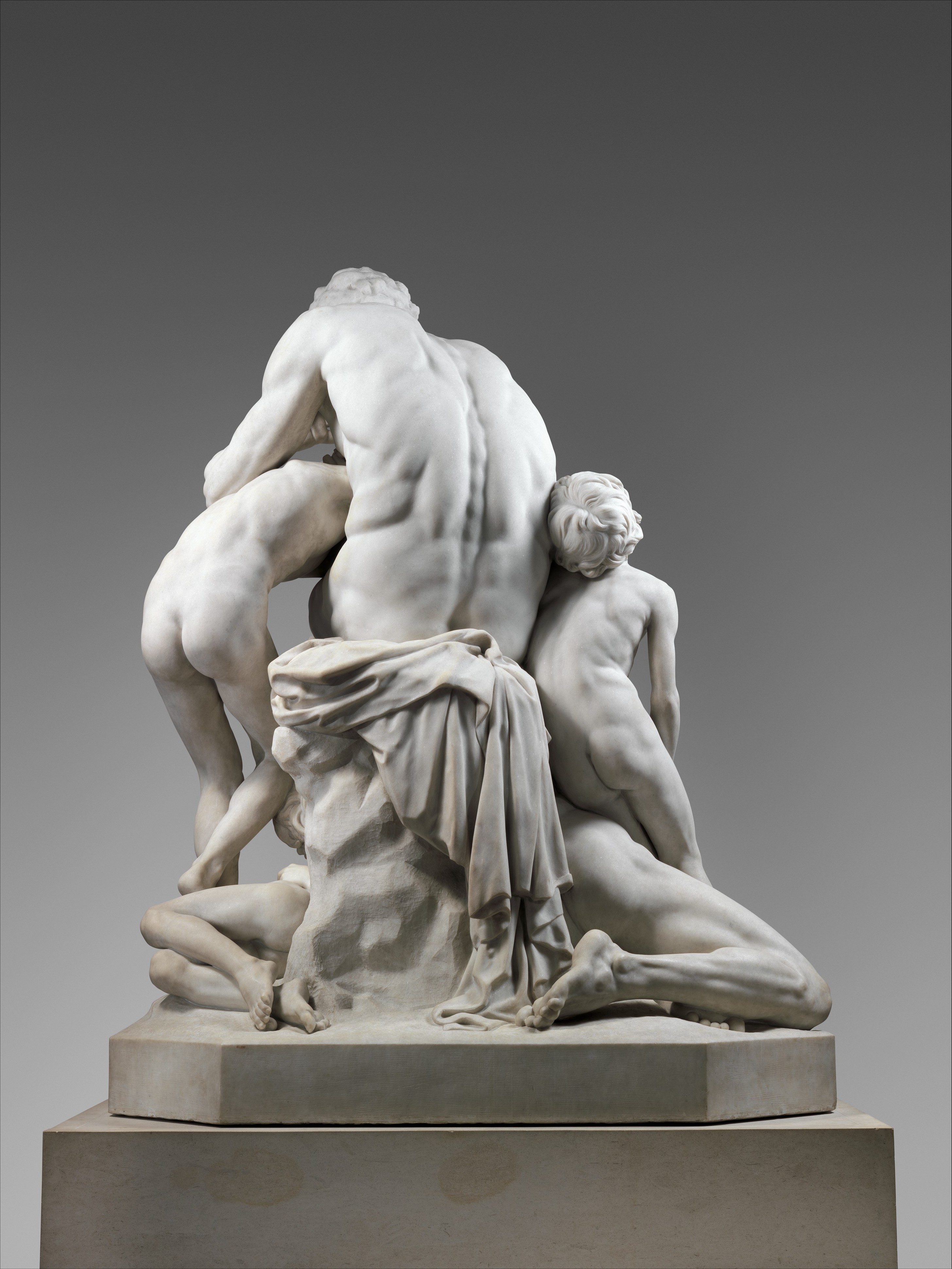
The back reveals another relationship.
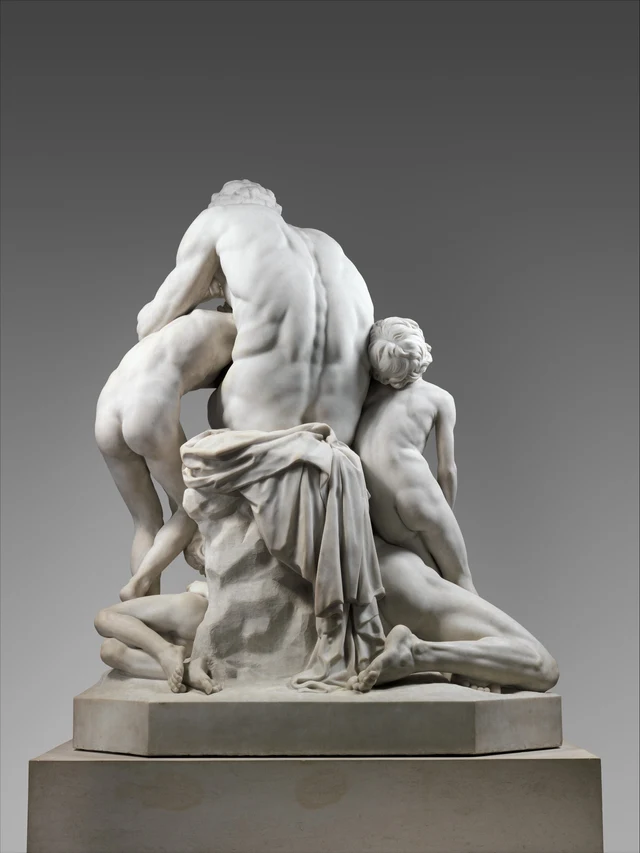
Ugolino’s back occupies a broad area here. A shallow central groove and swelling muscles on either side sustain the upper body’s forward bend. Face and hands withdraw to the other side. The focus shifts from closely interlaced fingers to an entire broad, substantial body leaning forward.
Beneath him is a solid stone seat. Cloth gathers behind his waist, then falls along it. Rough variations in the stone differ from the smoother light and shade across skin. Several bent legs at the bottom extend to either side. Forms that seemed tightly packed in front have their own seat, depth, and way of meeting the ground behind.
This reminds us to distinguish who leans toward whom in the image from how the marble sculpture is supported. The foremost young man’s hands around the shin express a relationship between figures. The seat behind shows that the central body has somewhere to sit. Photographs alone cannot supply a complete structural account of how weight passes through the stone. The visual leaning need not be inflated into “the children support their father with their bodies” to be powerful.
Nor does the seat become a comfortably stable center. It supports the seated man without making him straighten, relax, or turn to receive the children beside him. The central body has a place to sit, yet the others remain crowded around it. Support settles the posture without answering the needs directed toward him.
Thinking back to the front, the tightest place may not be the crowded legs and feet. Contact still happens throughout that congestion. The small space before Ugolino’s face, however, is firmly occupied by his own arms and fingers. Others have reached his body, but the response remains arrested there.
5. The Poem Moves Forward; Stone Holds Several Moments Together
Reading Dante, we follow sentences forward: food is withheld, silence follows, hands are bitten, the children make their terrible offer, and death comes afterward. Actions have an order of appearance. Before this sculpture, that order is rearranged.
The man biting his hands, the upward-looking figure, the lowered head, and the body lying below can all be seen at once. We need not wait for the next page to encounter another condition, and it is difficult to assign the group an instant timed to the second. It compresses impending loss and continuing appeals into a common space through which our eyes must travel back and forth.
The face should therefore not be read as a verdict already reached. Whether Ugolino ultimately ate the children’s bodies is a longstanding interpretive dispute about Dante’s lines, not a fact the sculpture has shown. What is actually carved is hands beside his own mouth and children beside him. Seeing those contacts clearly matters more than supplying his next action. The poem and its interpretive dispute
Remaining here does not mean nothing has happened. The foremost young man has reached out, the lowest child has let an arm fall, and Ugolino’s toes still curl tightly. In different ways, the bodies exhaust what they can still do. Marble preserves no empty “waiting,” but the limits of specific actions.
At first glance at Figure 1, we may have seen only one person surrounded by four. Now the hands each have a destination: grasping another, leaning toward another, falling, or returning to oneself. The group gathers them into a complete form while preventing their actions from combining into effective help. Carpeaux makes “being together” heavy: no one has left this shared predicament, and their closeness has not yet found a way out.
Optional Reading: Two Rays Distinguish What Appears from What We Await
Begin with a small comparison: move between the close-up of hands in Figure 2 and the full view in Figure 4.
In the detail, spaces between fingers, hand backs, and hollows below the knee are enlarged. We can trace individual fingers in their separate directions. In the whole view, the same hands shrink; forearms and lifted head reconnect them into an upward appeal. Both photographs present the same stone, but they do not bring the same thing to the foreground.
SAE’s “perceptual beauty” offers a way into this. Non Dubito’s “As the Light Fades, the Garden Appears Differently” does not propose that stronger sensation is always better. It asks how an object appears under specific lighting and sensory conditions. Light, shade, and the senses are not an expendable outer layer; they participate in what we see now. Read the essay on perceptual beauty
Knowing already that “these hands grasp a lower leg,” we can still distinguish why the upper hand seems spread and the lower hand seems wrapped tightly around. Shadows between fingers, light on knuckles, and the wrist’s turn toward the forearm all contribute. “It is all despair” cannot replace those differences. Framing and lighting also mean that a detail prominent in close-up may not be equally conspicuous at an actual viewing distance. Our close reading should include the conditions of looking on which it depends.
The other ray asks not “what has appeared?” but “what has not appeared, although we are already waiting for it?”
Look at the young man raising his head and reaching out in Figure 4. If everyday experience has taught us to connect such an approach with hands reaching to receive someone, a downward glance, or help getting up, our eyes may await a response from the older man. But his hands remain beside his mouth and his upper body stays folded. The embrace that has not happened may acquire a clear place in our viewing.
Non Dubito’s “The Note Has Not Sounded. You Are Already Waiting.” locates cognitive beauty where memory meets the next moment. Familiar experience reaches ahead, producing expectations that may fail and can be revised. It also reminds us that what we habitually await cannot immediately become a rule everyone should follow. Read the essay on cognitive beauty
We can therefore ask ourselves what we awaited first: the father’s returning embrace or the terrible decision in the story? The first expectation may arise from bodily interactions; the second from prior reading. Both can influence how we look at the hands, but they are not the same. Return to Figure 3 and check what the fingers actually touch; return to Figure 4 and see where the children’s hands have already arrived. Expectation should accept correction from these details rather than complete actions the sculpture never carved.
The rays thus offer different help. Perception lets us examine contact closely; cognition lets us discover the continuation we have prepared for that contact. Both return to the same hands without automatically treating physical proximity as mutual understanding. Hands can meet while meanings diverge. Viewers can feel the pressure of a next moment without declaring an ending already accomplished.
Notes on Images and Sources
This essay draws on nine official Met photographs of the same marble sculpture. Seven appear in the text; two additional overall and upper-body photographs are retained with the image resources. Original JPEGs remain as downloaded, without cropping, color adjustment, recompression, or generation. Light, viewpoint, and apparent proportions are affected by photographic conditions. This close reading of photographs is not presented as an in-person experience or an actual load-bearing test.
Date, material, dimensions, and accession number follow the English collection record. The essay does not mix in plaster, terracotta, or bronze versions in other collections. Discussion of imprisonment and family relationships distinguishes literary narrative, historical people, and sculptural forms; readings of actions and group relationships are this essay’s interpretations. Image sources and permissions are in the image credits; sources are in the references.