The small images below correspond to the photographs analyzed in this essay. Reproduction permission has not been obtained; copyright remains with the respective rights holders. Click to view the official source.
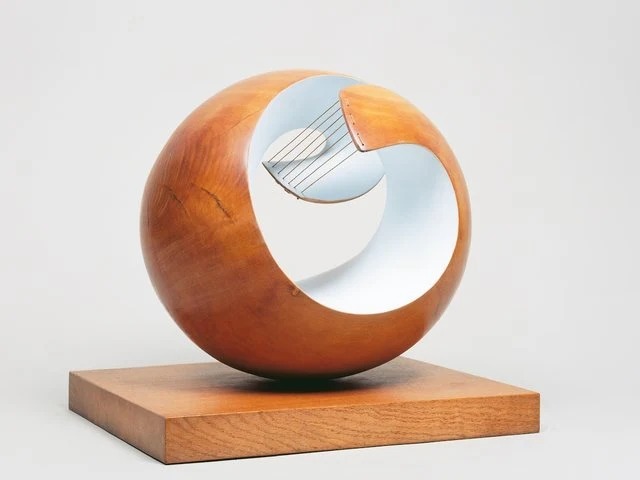
A few fine strings cross the opening diagonally, while the wood turns at either end.
Start by opening the photograph credited to Tate. At the upper right, a golden-brown wooden edge reaches inward, its tip resembling a curled tongue. A little lower and to the left, another curved surface, painted a pale color, turns upward. Strings join one end to the other, crossing the distance between them. Following the broad wooden contour, the eye travels around; following the strings, it can cross directly. Both routes belong to a sculpture less than half a meter high.
Figure 1, viewing guide: A brown, ovoid wooden sculpture stands on a rectangular wooden base. A broad opening faces forward, and the pale inner wall curls back into it. Diagonal strings stretch between two opposing tips above. Look separately at the pale curved surface and the gap through which the background is actually visible.
Barbara Hepworth, Pelagos, 1946. Elm, painted interior, and string, on an oak base; 43 × 46 × 38.5 cm. Tate collection, T00699; catalogue number BH133. The title comes from the Greek word for “sea.” This essay concerns only this wooden sculpture. Work record on the artist’s estate website
The title readily takes us to the coast, but we need not immediately assign each part a coastal name. What deserves our attention first is that the “empty” space does not simply open up into effortless transparency. It contains a returning inner wall, a projecting thin edge, and a few strings that occupy very little volume yet remain unmistakably present. They keep us distinguishing where we can look farther in, where our view is blocked, and where what we see is actually the more distant background.
By 1946, when she made this sculpture, Hepworth had lived in Cornwall for several years. She left London for the St Ives area in late summer 1939 and continued working through the restricted conditions of wartime and their gradual improvement afterward. Estate website chronology
1. Three Pale Areas, Three Distances
The center of Figure 1 is bright and might easily be taken, at a glance, for a white hole. Pause, and it separates into several different places.
A brown wooden rim surrounds the outermost opening, whose outline is roughly tall and narrow. Follow its right side downward: a pale curved surface bends inward from the edge, widening gradually and spreading out below. This pale area is not the background. Light and shade shift gently across it, brighter near the edge and turning blue-gray where it curves deeper inside. We can see a surface turning in another direction.
Farther toward the middle, the pale inner wall ends, leaving an area continuous with the grayish-white background outside the sculpture. Here the opening really does pass through. It does not occupy the exact center like a window frame, nor do its edges run parallel to the outer opening. The elongated opening in front and the open passage behind therefore do not coincide to form a simple ring.
A third pale area lies above. It resembles a shallow pouch, its lower edge swelling downward and its two ends lifting slightly; strings stretch from this curved rim toward the upper right. Behind the pouch, we can still see curved surfaces and gaps of varying brightness. Within similarly bright areas, then, we find at least a nearby edge, an inward-turning wall, and the outside world seen across the interior. Their colors are similar, but their spatial roles are entirely different.
This is one practical effect of the painted interior. Outside, intricate grain runs through browns ranging from gold to deep umber. Inside, the large pale areas reduce the distraction of grain, making the turns of the surface easier to follow. Color does not merely float over the form to add an atmosphere. It helps the eye read depth. Light and dark attract us first; then we discover that a bright area is not necessarily close, nor a dark one necessarily a hole.
Try concentrating on the area at the back that genuinely opens through. The sculpture determines its boundaries, but the grayish white inside them belongs to the photographic background. The sculpture organizes an opening onto the outside without making everything within that opening part of itself. A portion of external space has already entered our viewing of the work, without any help from its maritime title.
2. The Strings Do Not Seal the Opening
Look again at the strings. Each starts at a point on the wooden rim, crosses the gap, and ends on the other side. Their endpoints are distributed along the edges, leaving narrow, clear intervals between the strings. In the photograph they form a diagonally spreading array.
Thin as they are, the strings suddenly make the distance between the two ends specific. If we mentally remove them, we can still see two wooden surfaces facing each other, but we judge the span mainly by how the curves overlap in depth. Once the strings return, that distance is marked out strand by strand. The eye can travel from endpoint to endpoint without going around the substantial outer shell.
At the same time, the strings do not form a solid panel. The pale wall behind them remains visible, with a passage between every pair. One moment we see the group as a thin plane; the next we look through it and recover the curve behind. This thin plane has a direction, but it does not conceal everything inside.
Strings and wooden edges also change one another. The curved wood initially seems weighty and slow; the strings make its two tips appear bound into a relationship. Straight lines could seem rigid, yet the curved edges at their ends arrange them rhythmically. Straight and curved do not occupy separate territories. They meet at every small point of attachment.
“Taut” is an immediate impression here. The strings have a clear direction, while the tips seem to bend away in different directions. This tension arises first from the visible relationship of straight lines spanning curved edges: the eye travels straight across, only to be returned to a curved surface at either end.
The strings may suggest musical strings, the curved cavity an instrument. That association can draw our attention to the space behind the strings, turning an expectation of sound into an awareness of depth. What the work places before us is a connection that takes up almost no volume. The opening remains, but its separated edges are no longer unrelated.
3. The Grain Keeps the Shell Within the World of the Hand
Return to the brown exterior. It is not a perfect spherical shell. Fuller on the left, it narrows on the right beside the opening and gathers inward above. Thickness varies from place to place, giving the whole both a compact roundness and definite changes of direction.
Zoom in on Figure 1. Fine grain follows the curved surface at the upper left, with several deeper, irregular lines farther down. The surface has not become uniformly colored in pursuit of geometric neatness. Its grain does not always follow the sculpture’s contour: sometimes it runs diagonally across it; sometimes it tightens locally. Directions already present in the wood and directions subsequently carved into it overlap on the same surface.
These visible differences preserve the particular character of wood. Looking at the pale interior, the eye moves more readily into broad, continuous curves. Back outside, grain, color, and locally deeper marks hold our attention. The former directs us toward space; the latter more immediately makes us aware of a physical object here before us. The clear color boundary between them keeps sending our gaze inward and bringing it out again.
The rounded shell also invites an imagined hand cupping it. There are curves a palm might glide along, edges it would meet when reaching inward, and delicate parts that seem to call for special care. But the sculpture is 43 centimeters high and 46 centimeters wide, not a small stone that fits in a palm. Our imagined touch adjusts to its dimensions. It can evoke a tactile experience while our body remains outside the work.
The rectangular oak base below matters. Above it, the form keeps turning; the base extends in straight edges, giving the rounded shell a stable resting place. Both woods show grain, but they carry different shapes. One draws the eye inward; the other places the sculpture in a measurable, displayable position.
In the photograph, the rounded form narrows markedly as it approaches the base, with a small dark area near the point of contact. The shell seems to have come gently to rest, yet the base’s thickness and breadth remain evident. This resting point prevents the cavity above from becoming merely a floating design. It belongs to an object with weight that needs to be placed somewhere. This essay does not infer a hidden fixing method from the shadow.
4. How the Coast Enters a Small Wooden Sculpture
When Hepworth first arrived in Cornwall, living space, working space, and time were all limited. She painted at night and also made plaster sculptures. After moving to a larger house in Carbis Bay in 1942, she had a studio and could carve in the garden. Pelagos, made in 1946, followed this period of gradually changing working conditions. Estate website chronology
That background gives this compact work a specific connection to its natural surroundings. Research published by The Courtauld connects Pelagos with the bay at St Ives and situates it within Hepworth’s explorations of color and string during the 1940s. The museum quotes her recollections of this period: color in concavities took her toward the depths of water, caves, and shallows; strings related to the tension she felt between herself and the sea, wind, and hills. Official Courtauld material, page 2
This does not require us to identify every brown part as land and every pale part as seawater. It is more useful to consider how someone standing before a bay gains a sense of space. Nearby terrain extends to either side, with a more distant openness ahead; a contour surrounds the body even as the gaze travels beyond it. Enclosure and a view into the distance can occur together.
Pelagos brings that relationship into a much smaller compass. As the shell bends inward, our gaze follows it closer. The pale curved surface sends our eyes into depth, and the actual opening allows the outside to appear again. The strings connect the interior’s two ends, giving a definite direction to this traversable space. Our eyes do more than inspect the outside of a mass of wood. They experience being drawn in, being restricted, and being able to look farther away once more.
Scale produces an interesting contrast here. Our arms cannot encircle a bay, but this wooden sculpture can enter our field of view in its entirety at close range. The experience of an expansive landscape is preserved through relationships among distances rather than through an increase in size. We stand outside the work, while our gaze is invited to find a position inside it.
This also helps explain why it needs no carved figure. The body can play a role without appearing as a human outline. Looking inward, I am close; looking through the opening toward the background, I become aware of somewhere farther away. The sculpture gives the viewer no face, yet gives viewing itself the direction of “looking over there from here.”
5. A Garden Appears Through the Opening
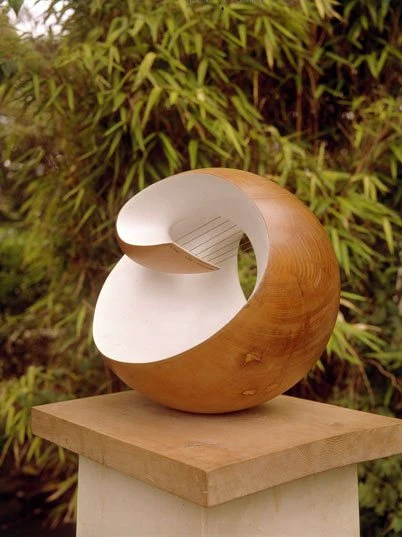
Another official photograph: the garden view on the artist’s estate website
Figure 2, viewing guide: Another side of the same sculpture faces the viewer. The near-white inner wall opens out more broadly and curls back at the upper end. Green leaves appear around the work and through a narrow passage at the upper right. This image is useful for comparing inner wall and opening; it is not a high-resolution detail photograph.
This photograph brings a clear change. Plants replace the grayish-white photographic background, and the sculpture’s orientation and the framing have changed as well. We see a broader inner wall on another side, with an opening in a different position revealing vegetation.
When leaves and branches appear around the wooden sculpture, we readily recognize them as its surroundings. Seen through the narrow opening, the same green seems to have entered the work. The plants are still behind it. The wooden boundary has simply cut out a small place through which they can be seen. The opening temporarily makes an outside scene part of viewing the sculpture.
Meanwhile, the broad, near-white inner wall remains a wall. It has not turned green with the background or become a transparent membrane because we know plants are behind it. The inner wall and background, similarly pale in Figure 1, are more clearly distinguished here. One is a painted solid surface; the other is a line of sight beyond the work.
This change makes “inside” and “outside” more than two nouns. The outside can appear through the inside, while the inside contains impenetrable curves. A few strings connect two ends without completely blocking what lies behind. Each passage and obstruction, each near and far, must be established at a specific edge.
Return to the strings we began with. They still cross the opening diagonally. The shell remains rounded, the base steady. Once these structures become clear, the work’s stillness feels more tangible. Nothing actually needs to move for several distances to hold together. The sea’s expansiveness has been brought close without being turned into a patch of blue we can take in at a glance.
Optional Reading — The Perceptual Ray: The Background Helps Shape This Appearance
Han Qin’s perceptual-ray essay “As the Light Fades, the Garden Appears Differently” begins with a garden at dusk. Color is not a fixed report issued by the flower alone. Light, objects, and sensory conditions jointly affect what we can distinguish at a given moment. The essay also emphasizes that sensation does more than complete a task of identification. Even after recognizing a flower, we can continue attending to how it appears. Essay on perceptual beauty
Looking at Pelagos through this ray, we can narrow the question: what initially made us see an inner wall and an opening as one pale area?
In Figure 1, the background is close to grayish white and the painted interior is very pale, bringing the two visually close in the photograph. Gradations of light across the curves, the wooden edges’ occlusions, and the little gaps behind the strings gradually help us distinguish them. In Figure 2, green plants give the opening a different color from the inner wall, while the differently oriented opening lets that green appear. The sculpture has not just been pierced. Background, orientation, and framing together make its passage to the rear easier to recognize.
This ray lets us specify what supports our spatial judgment here. The sculpture alone does not determine how its empty space appears at this moment. The boundaries of the opening belong to the work, but the color, cues to distance, and textures seen within them also come from the environment. Photography fixes these relationships at a particular moment. What we see is the result of their appearing together on this occasion.
This also calls for care when comparing color. The interior in Figure 1 carries a pale blue-gray cast; in Figure 2 it looks closer to white. Angle, lighting, and photographic color rendering all differ, so two photographs cannot establish a history of fading or repainting. We can still discuss with confidence how the pale interior meets the golden-brown wooden shell and how this distinction helps us read the curves. Original pigments and successive restorations require separate consultation of technical records.
Finally, this ray does not require the work to keep supplying new angles. Having distinguished wooden wall, strings, and background, a reader may still linger over the same photograph: the way one string reaches an edge, a pale area darkens at a turn, or the rounded body leaves a small shadow below. These differences need not provide further evidence for a coastline or be converted into an allegory of freedom or life. Wood, strings, and empty space already offer relationships rich enough to reward close attention.
Notes on Images and Sources
This essay examines two photographs from official sources corresponding to BH133 / T00699: the garden photograph on the artist’s estate website and the grayish-white-background photograph provided by The Hepworth Wakefield on Google Arts & Culture, credited to Tate. The latter was examined at 1200 × 900 pixels. The photographs differ in angle and setting. Image copyright follows the information given on each source page.
Materials, date, and catalogue number follow the estate website; dimensions follow the institutional partnership viewing page. Biographical background follows the estate chronology; the account of the bay, strings, and color follows The Courtauld’s official material. The work was neither viewed from all sides in person nor touched for this essay. Interpretations of how its parts organize distance and bodily orientation in the photographs are this essay’s close readings. See the references and image viewing links.