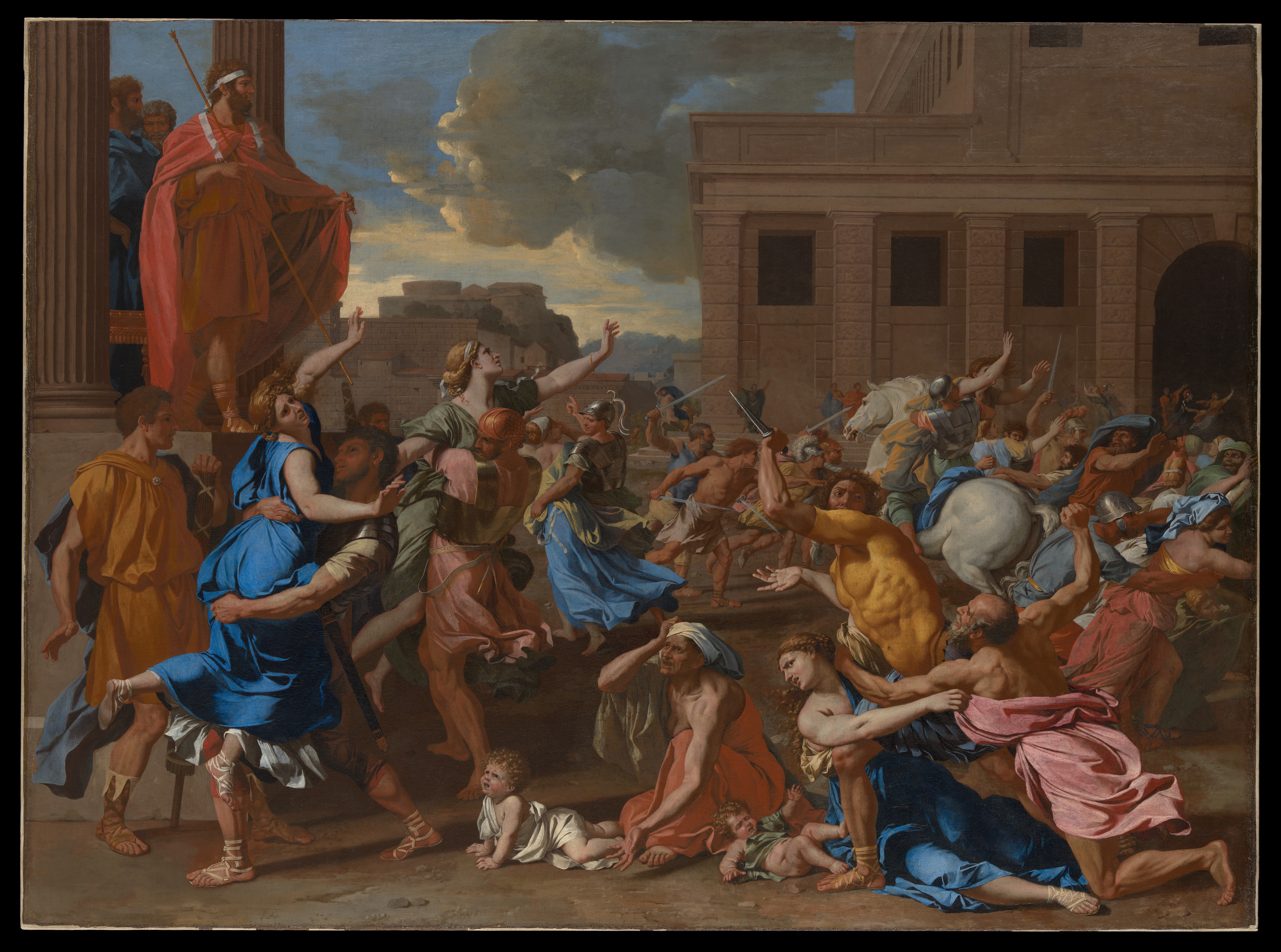
The man at the upper left stands firmly. Two tall columns flank him. A red cloak falls from his shoulder, and one hand lifts a corner of it. The world below his feet has no comparable stability. A woman in blue is carried off the ground; a woman in green reaches upward; swordsmen press into the crowd; small children lie close to the adults’ feet. Looking down from the platform, we encounter an abrupt distance between a command and the bodies made to bear its consequences.
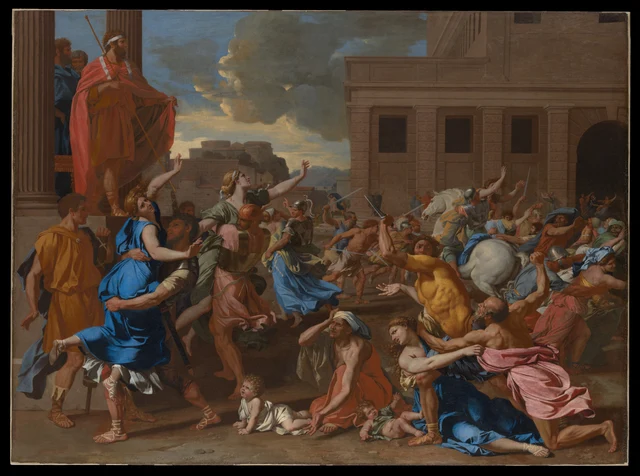
This reading values a particular achievement of the painting: Poussin distinguishes many simultaneous actions clearly enough for us to see how coercion acts upon different people. Architecture, color, and poses organize a mêlée into a picture we can examine. Yet the women’s turned heads, arms reaching away from their captors, and feet deprived of a foothold keep resistance within that order. To appreciate the organization fully, we need to attend to what is being organized.
The subject belongs to Rome’s foundation legends, rather than to an event documented by reliable eyewitnesses. In the ancient story, Romulus and his followers invited the neighboring Sabines to a festival and forcibly abducted their women to make them wives. The lifting of the cloak was the agreed signal. Poussin depicts the seizure itself. This is a different episode from the later intervention of the Sabine women to stop fighting between the two peoples. The Met’s account
Poussin painted this canvas in Rome. Its first owner was Charles de Créquy, the French ambassador there; it subsequently entered Cardinal Richelieu’s collection. Ancient narrative and the language of sculpture thus met a learned, elite audience. A separate treatment of the subject is in the Louvre. Throughout this essay we are looking at the New York canvas, recognizable by the high platform at the left and the building with three dark windows and a large arch at the right. The chronology of the two paintings has been debated; the date used here follows the Met’s current “probably 1633–34.” Met catalog entry; Louvre version
A command needs only a small movement
Romulus has both height and room. His companions do not obscure his outline. A column descends beside him, while sky opens to his right. The broad red cloak can be taken in almost at once: shoulder, arm, and raised corner remain part of a relatively continuous shape. Power first becomes visible as spatial ease. The man issuing the command does not have to enter the bodily entanglement below.
Compare his hand at the edge of the cloak with the raised hand of the woman in blue beneath him. The two are fairly close on the painted surface, but their actions have entirely different consequences. One slightly opens a piece of fabric. The other reaches away from a torso held fast. The woman tips her face upward and twists her upper body; her remaining hand extends beside her captor’s face. Her body is being taken in one direction, while her head and hands establish another.
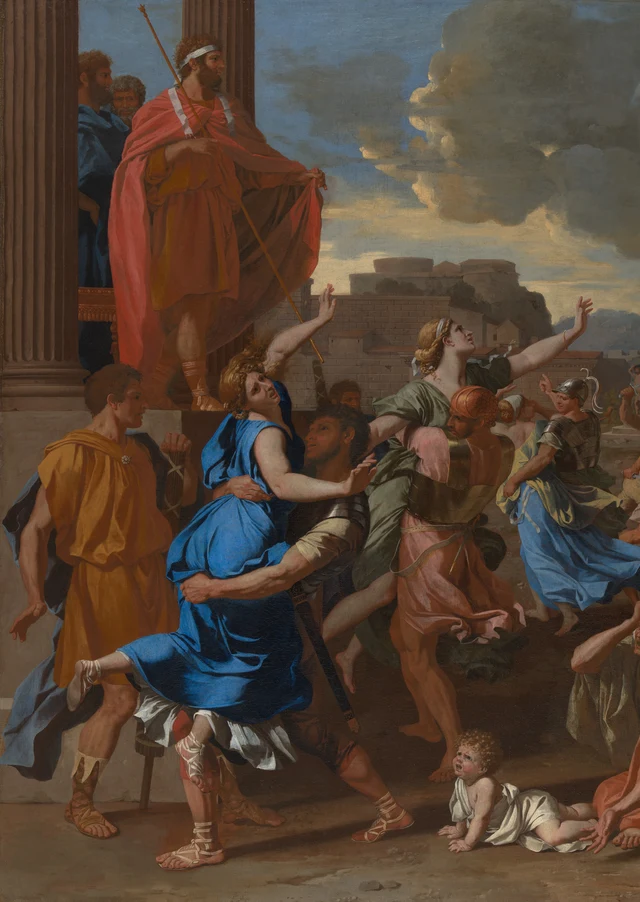
The man carrying the woman in blue has planted his feet apart. His arm around her waist and the other beneath her legs form a supporting structure. One of her feet projects to the left, while the other hangs down. Folds of blue join these two directions. Merely calling the group a diagonal composition would erase the most significant distinction: the captor possesses the support; the captive has lost contact with the ground.
The woman in green creates a variation on the action. Her captor, wearing a copper-colored helmet, turns his back toward us. His armor and pinkish-brown clothing make a substantial mass. Her face emerges above his shoulder, and her hand reaches to the upper right. Although the two groups nearly touch, each retains an outline we can follow. Brilliant blue spreads low in the first group; darker green rises in the second. The men’s arms enclose the bodies they hold. Repetition, adjusted in height, direction, and color, makes abduction legible as several particular acts rather than an undifferentiated disturbance.
Both women bend their raised wrists, and neither raised hand forms a neat fist. These curves do offer the eye an elegant passage from one group to the next. Their context remains unmistakable, however: the women are losing control over where their bodies go. The continuity of the lines cannot change the action to which they belong.
Forces meeting at the right
The right foreground takes longer to unravel. Several kinds of action meet in one knot. A man in yellow armor raises a sword and twists his torso toward us. A gray-bearded man in pink drapery kneels on one knee, showing his side and back; one arm reaches toward the yellow-armored man’s flank, while the other rises. Beside them, a woman in blue crouches low and catches hold of the pink cloth, her head and shoulders inclining leftward. To call this simply another man carrying off a woman would miss the obstruction and conflict within the group.
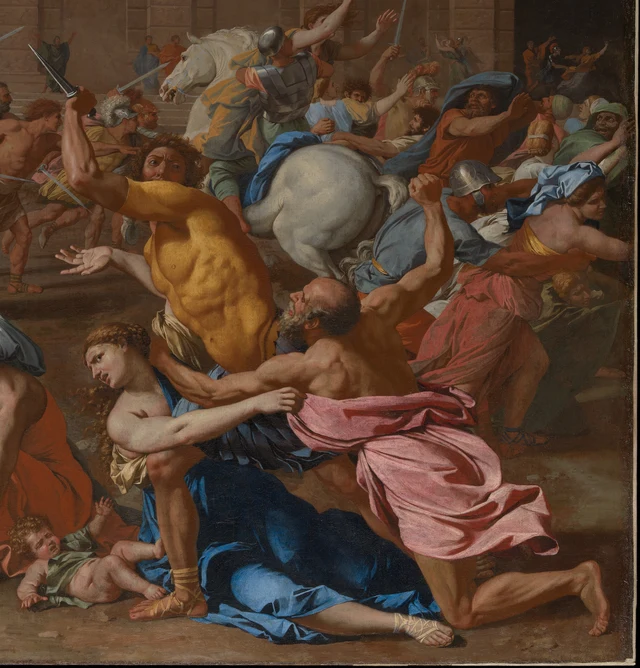
Begin with the pink cloth. It folds away from the woman’s hand, crosses the man’s waist and back, then swells into broad ridges descending toward his knee at the lower right. It clarifies the contact between the two people and anchors the group close to the bottom of the canvas. Follow the yellow-armored man instead, and elbow, forearm, and sword carry the eye upward to the left. These paths press against one another in a confined area. Our eyes can travel along them, but the actions cannot flow together into a single, unimpeded movement.
The blue-clad woman’s exposed leg lies close to the lower edge. Her face turns toward the center, her brows and open mouth conveying fear; her hair falls along her tilted neck and shoulder. An outstretched arm, a curved back, and separated legs narrow the space available around her. Resistance takes different forms here: an arm raised in direct opposition, a grip on fabric, a body held low. Muscular strength alone cannot tell us whose presence matters.
Behind them, the pale rounded hindquarters of a white horse form a larger light area among smaller turns of helmets, arms, and blue cloth. The horse occupies a higher band, separating the foreground struggle from the traffic behind. Farther right, hands and skirts continue toward the edge. The canvas cuts them off; the activity seems capable of continuing beyond it.
The ground changes the rhythm
Looking down between the large groups at either side, we find a lower interval. An older person with a pale head covering sits close to the ground, one hand at the head and the other near the feet. Orange-red cloth gathers around bent knees. Two small children lie to either side, one propped on both hands, the other partly on its side with an arm raised. Adult legs still stride or brace close by.
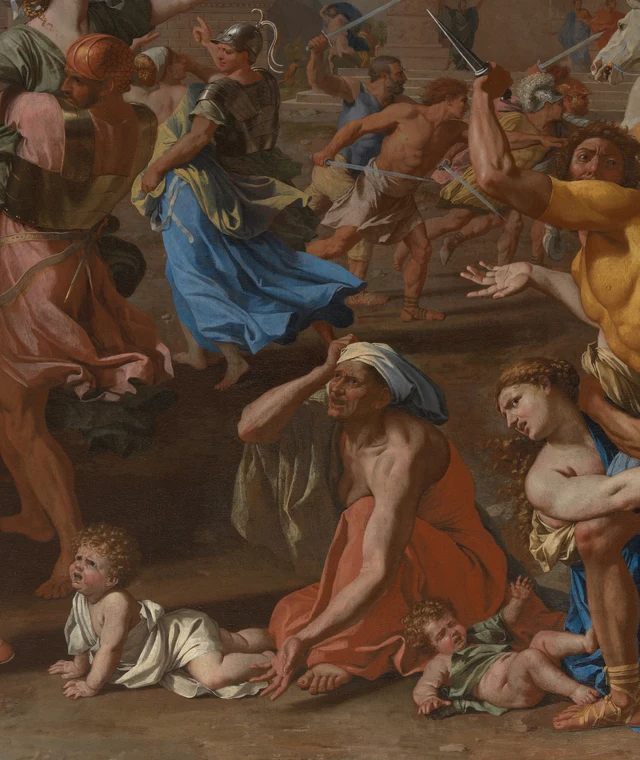
This group asks us to read movement differently. Standing figures throw arms outward and open their stance, indicating flight, seizure, or resistance. The older person’s hand returns to the head; the children’s limbs remain close to the earth, with little room for effective action. The blue-clad woman at the right also inclines her face toward this lower area. The painting does not give every body the same expansive rhythm. At its center it allows for alarm that cannot answer events by running or fighting.
Color slows here as well. The orange-red garment recalls the red cloak above, but gathers at the feet rather than hanging from a high platform. The child’s white clothing becomes a pale patch on the ground. Similar colors link different levels while the people’s circumstances change. Red supplies no consistent code for virtue or identity. It lets the eye discover a connection that the actions then differentiate.
Dark intervals of ground and the clearly smaller runners beyond establish depth. The foreground bodies have not sealed off the square. Farther away, swords still flash in narrow highlights, while some hands and faces have diminished to small patches of color. The nearest contacts can be inspected individually. The smaller figures extend the event into a continuing movement of people whose number cannot be taken in at once. The painting accommodates both scales of attention.
Architecture makes the disturbance readable
The large building on the right remains composed. Three dark windows are spaced at nearly regular intervals, their vertical divisions meeting the horizontal cornice. The great arch recedes into darkness. Against gray-blue sky and heavy cloud, broad brown masonry is more restrained than the blues, reds, and yellows of the foreground. We need not treat it as an exact reconstruction of early Rome to see its function. It gives the dense bodies a framework that does not bend with them.
An arm crosses a horizontal line, and its angle becomes more apparent. The dark windows form a regular band above the varied heights of the heads below. Figures in front of the arch acquire a position in depth. Architecture is integral to the way these bodies become intelligible.
Color also models volumes within the groups. The blue skirt brightens across the knee and darkens where an arm presses against it. Pink drapery whitens along a ridge and deepens to dark red in a fold. Light and shade describe the raised chest and abdomen of the yellow armor. Treating the colors only as flat identifying labels would miss how gripping and pressure change the visible shape of cloth. Light surfaces bring a body forward; narrow shadows separate adjacent parts. Through these contacts, flat paint gives an action a structure we can trace.
At just over two meters wide, the painting offers room for several extended groups and for shifts of attention from large poses to individual fingers. The Met describes Poussin’s use of small wax figures and a theater-like apparatus when working out compositions. Its catalog also relates this painting to ancient sculpture, Giambologna’s sculpture, and a painting by Pietro da Cortona. The bodily language has been studied and assembled from sources spanning antiquity and more recent art. Met commentary and catalog This helps explain the clarity of the poses; it does not prescribe an admiring response to every action they describe.
Poussin’s organization enables us to stop, compare, and retrace our route. That sustained attention exposes the inequalities within the square: the commander stands above the crowd; the men seizing women have support; the women being abducted lose their footing; resistance is pushed down toward the ground. The formal order preserves these differences. The strength identified in this essay is the painting’s capacity to keep them available to prolonged sight. It also asks something of the viewer: admiration for arrangement must remain attentive to the coercion arranged before us.
Optional reading: separating two kinds of assent
In The Beauty of Philosophy, Han Qin’s SAE (Self-as-an-End) framework asks how a distinction can turn a tangled issue into a question, while remaining open to revision itself. Here it suggests temporarily separating “I recognize the organization of the painting” from “I endorse the actions represented.” This is a contemporary viewing exercise, not evidence of Poussin’s intentions. SAE general outline; The Beauty of Philosophy
Choose one group at the left and write a sentence about its form: the blue dress opens against the man’s dark torso, for example. Now supply an accurate verb for the same passage: his arm encloses her waist; her other hand reaches away from him. Read the sentences together. Has admiration in the first quietly omitted the action in the second? Then examine the right foreground. If we describe every male arm as “seizing,” does the arm opposing the yellow-armored man require us to revise the description? The distinction earns its place by making observation more accurate.
It does not settle the matter. We recognize the violence more readily precisely because grip, loss of footing, and opposing gestures have been so carefully organized. Form and represented conduct cannot be wholly detached within the image. A more specific question follows: where does the order help us confront coercion, and where might it encourage us to admire poses at the expense of what they do? An answer requires returning to particular passages. Neither the painting’s canonical status nor a moral label can supply that looking for us.
Images and sources
The visual observations use the Met’s official 4000 × 2973-pixel image. The full image is the unaltered downloaded file, including its narrow canvas edge and surrounding black border. Three details are crops only, retaining original pixel values and the ICC color profile, without color adjustment, sharpening, restoration, or added content. Digital display conditions still differ from viewing the painting itself.
The image is available under CC0 through the Met’s Open Access policy; this does not automatically license the museum’s scholarly prose. Object facts, version identification, and theoretical sources appear in the links and the accompanying references. See image credits for technical records. The interpretations are this essay’s, without implied museum endorsement.