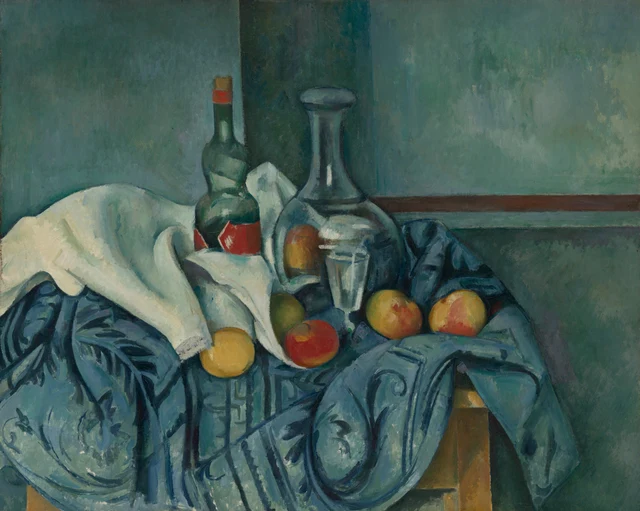
圖1 保羅·塞尚,《薄荷酒瓶》,約1893—1895年,布面油畫,65.9×82.1公分。美國國家美術館,Chester Dale Collection,藏品號1963.10.104。圖像:Courtesy National Gallery of Art, Washington,CC0。館藏記錄前往館方作品頁查看原圖 ↗
1. National Gallery of Art, Washington, The Peppermint Bottle. Paul Cézanne; museum date 1893/1895, expressed in the essays as about 1893–1895; oil on canvas; overall 65.9 × 82.1 cm; Chester Dale Collection; accession 1963.10.104. The object page explicitly identifies its image as free and in the public domain. These are the authority for identification, dimensions and object-level image rights.
2. National Gallery of Art, Open Access Policy. Eligible public-domain artwork images are released under CC0. The policy encourages the courtesy credit used in this package and excludes any implication of museum endorsement. It does not make museum essay text CC0.
3. Official full-resolution image. The supplied original is 4096 × 3271 pixels, 3,339,406 bytes. Its SHA-256 is 911b660a6f6a23bd024ba2b88bf362ed8fa96b42b0020f39bb5757a0fd819bcc. The visual readings are based primarily on direct inspection of this image, not on paraphrase of the museum's visual description.
艺术史背景 / Art-historical context
4. James Voorhies, Paul Cézanne (1839–1906), The Metropolitan Museum of Art, October 2004. Used for Cézanne's participation in the Impressionist exhibitions, Pissarro's encouragement, and the development of adjacent color and tonal strokes as a way of building form. Its comments about perspective in other still lifes are not treated as technical findings about this painting.
5. National Gallery of Art, Cézanne's Still Lifes, A Sense of Place: France. Used for repeated arrangements of everyday studio objects and sustained investigation of form and color. The article's more specific spatial discussion concerns another work, Still Life with Apples and Peaches; it is not imported into this essay. The surviving studio shown in its accompanying film is not identified here as the site of this arrangement.
可选理论 / Optional theoretical reading
6. Han Qin (秦汉), SAE Judgment and Aesthetics — In Tribute to Kant / SAE 判断力与美学 · 致敬康德, second edition as indicated on the source. DOI: 10.5281/zenodo.19296710. The source site identifies its material as CC BY 4.0. The optional section draws on the distinction between personal aesthetic response and the grounds of a revisable aesthetic judgment. Its exercise asks how the cloth’s ornament can be read both as a pattern with its own rhythm and as a cue to folds and volume; this is the essay’s contemporary application, not an attribution to Cézanne and not an established art-historical explanation.
The museum record establishes identification, dating, dimensions, medium, collection and image rights. Close reading rests principally on the full composition and its details. Claims about edges, mark direction, warm and cool colors, pattern and form remain open to checking. The warm shape within the carafe is treated as a cue for transparency and reflection without assigning every passage an exclusive optical cause. No pigment chemistry, actual sequence of execution, single-session history or intentional destruction of perspective is inferred from the digital image.
Paul Cézanne, The Peppermint Bottle, about 1893–1895 (museum date 1893/1895). Oil on canvas, 65.9 × 82.1 cm. National Gallery of Art, Washington, Chester Dale Collection, accession 1963.10.104.
- Collection record - Original image download - CC0 Open Access policy - Courtesy credit for all four images: Courtesy National Gallery of Art, Washington. - Rights verified: 2026-10-15. The object page identifies this image as public domain; the museum's applicable open-access policy uses CC0.
Coordinates use the top-left origin of the original image, in left, top, right-exclusive, bottom-exclusive order. Each PNG preserves the corresponding decoded RGB pixels and original ICC profile. There is no interpolation, resizing, recoloring or added content. All eight essays explicitly identify these images as crops.
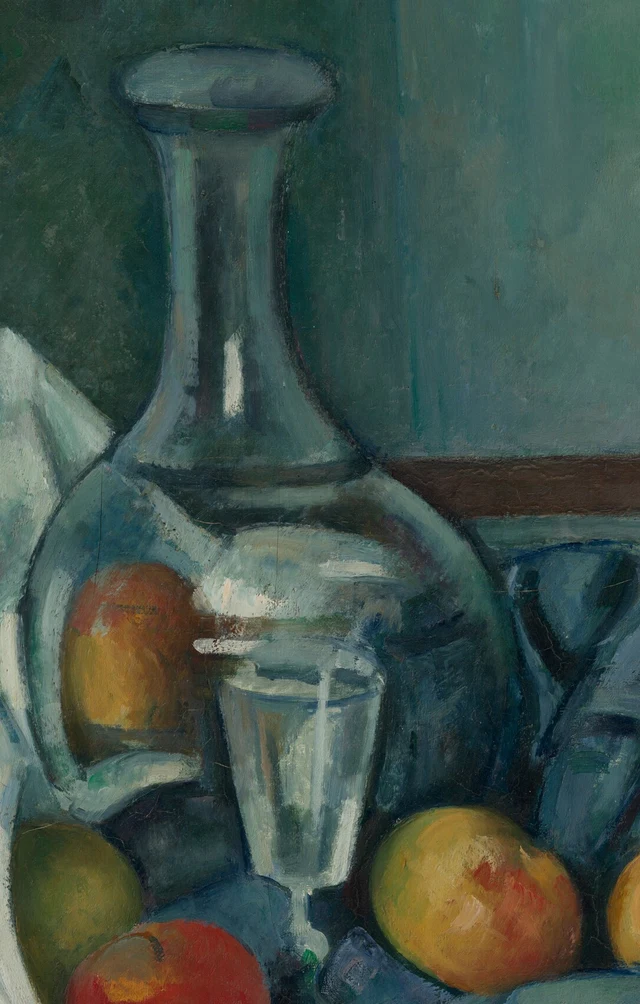
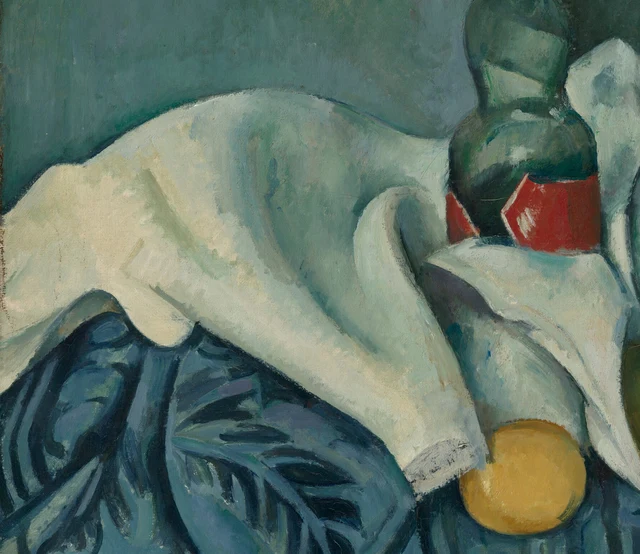
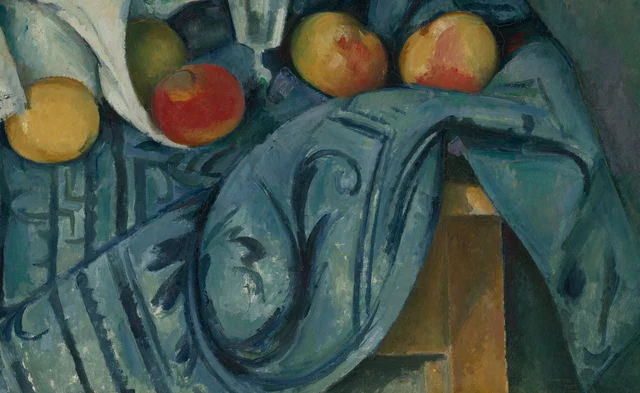
- Figure 2: images/detail_glass_carafe.png. Box (1710, 480, 2800, 2190), 1090 × 1710 pixels. Carafe, drinking glass and adjacent color relations. - Figure 3: images/detail_white_cloth_bottle.png. Box (0, 930, 1780, 2470), 1780 × 1540 pixels. White folds, lower bottle label, yellow fruit and neighboring blue pattern. - Figure 4: images/detail_fruit_pattern.png. Box (1260, 1810, 3640, 3271), 2380 × 1461 pixels. Fruit, patterned textile, large hanging fold and exposed wood.
Open image rights do not grant unrestricted republication of museum articles, and this package does not imply museum endorsement. Cropping changes the field of view without changing the retained pixels. Displays and color management may still affect appearance.