Accessed and read 2026-10-19 UTC. The four source images were actually inspected.
1. Palace Museum, 《明初拓东汉曹全碑》, accession 新00045355 https://www.dpm.org.cn/collection/impres/228534.html Main source for the original stone's date (Zhongping 2, tenth month, 185 CE), Cao Quan's office at Heyang, the stone's present location in Xi’an Beilin, the particular Ming rubbing before the stone broke, and Wang Hongzhuan's former ownership. Also quotes Sun Chengze's “字法遒秀,逸致翩翩”. The article's own close reading is based on the images rather than repeating the museum's general stylistic account. 2. Official high-resolution viewers - Figure 1: https://www.dpm.org.cn/bigimg/32/11 - Figure 2: https://www.dpm.org.cn/bigimg/32/23 - Figure 3: https://www.dpm.org.cn/bigimg/32/21 - Figure 4: https://www.dpm.org.cn/bigimg/32/3 Public Deep Zoom metadata supplies image dimensions and tile coordinates. It was used to assemble and proportionally downsample the photographed album openings. See IMAGE_NOTES.md and IMAGE_MANIFEST.json. 3. 秦汉, 《天暗下来,花园换了一种样子》, ray 08 https://nondubito.net/essays/aesthetics/ray08.html?lang=zh English title and page: As the Light Fades, the Garden Appears Differently https://nondubito.net/essays/aesthetics/en/ray08.html?lang=en Read in full. Used only in the optional appendix to ask how naming and the order of comparison affect continued looking. The concrete exercise compares the broad 于 and the compact internal spaces of 曹, not the writer's personality. 4. National Palace Museum, another Cao Quan rubbing, public transcription https://digitalarchive.npm.gov.tw/Collection/Detail/34589?dep=P An excerpt returned by the search index for this official record was used to cross-check the continuous text spanning the mounted album columns: “合七首藥神明膏。親至離亭。部吏王宰。程橫等。” The record page itself returned HTTP 403 when directly opened; no successful full-page access is claimed and that denial was not retried through another route. This is not the image source for the essay. The original text crosses the displayed column boundary from 神明 to 膏. 神明膏 is the medicinal name; 神明 is not translated here as a separate praise of efficacy. 5. Wang Wentao, 《“癃”病与汉代社会救助》, 2012 https://www.caoss.org.cn/UploadFile/news/201611518551594788.pdf 《河北师范大学学报(哲学社会科学版)》35(1), January 2012, pp.125–130; DOI 10.13763/j.cnki.jhebnu.psse.2012.01.009. Printed p.129 (PDF page 5), left column, quotes “七首药神明膏,亲至离亭,部吏王宰、程横等”. The PDF page was actually rendered and inspected. Its reference [12] is Gao Wen, 《汉碑集释》, Henan University Press, 1997, cited p.474. This supports the continuous reading and the identification of 至 beneath 親 without treating 七首 as an established count of seven prescriptions. 6. 《SAE判断力与美学》 https://self-as-an-end.net/papers/sae-judgment-aesthetics.html Read for the account of perception and distinctions among beauty, pleasure and understanding. The traditional analysis of structure and the historical critical quotation remain independently meaningful.
Chronology / 年代校读
The official page's title “明初拓” must not be translated mechanically as “early Ming-dynasty rubbing”: the same page states that the stone was unearthed in the early Wanli era and calls this a 明代出土初拓未断本, an early rubbing taken after the Ming excavation, before the stone broke. The body chronology governs the essay. The paper is not from 185 CE. Its cut-mounting and photographic reproduction are further material stages, not parts of the Han writing event.
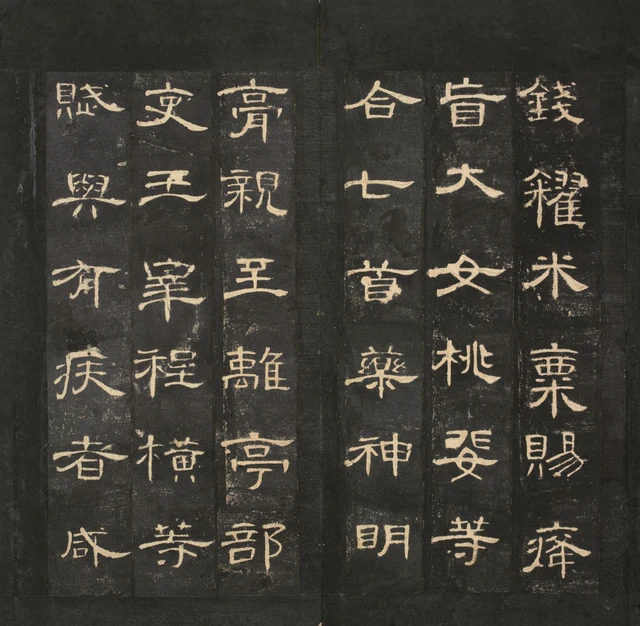
Reading boundaries / 释读边界
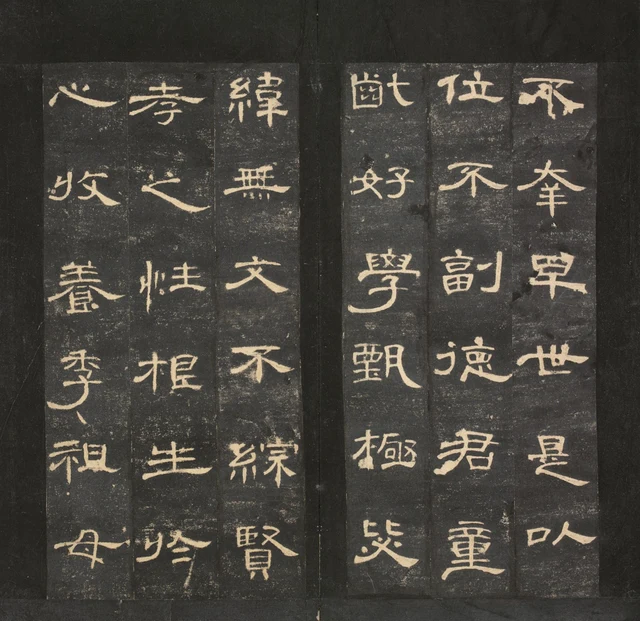
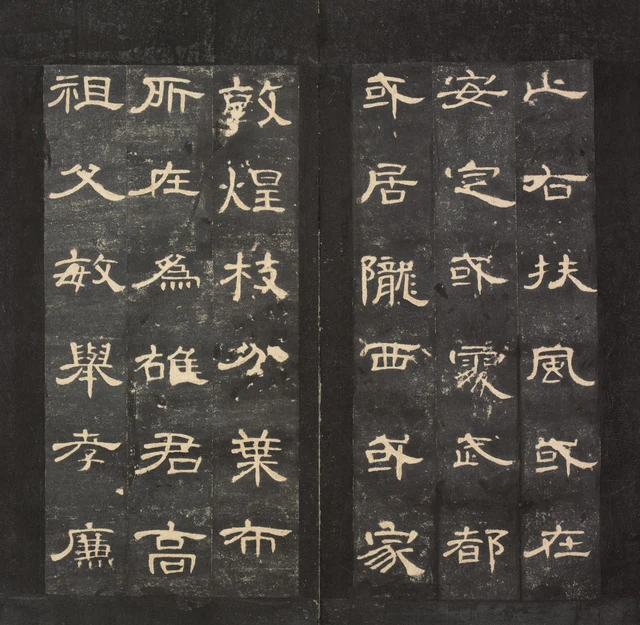
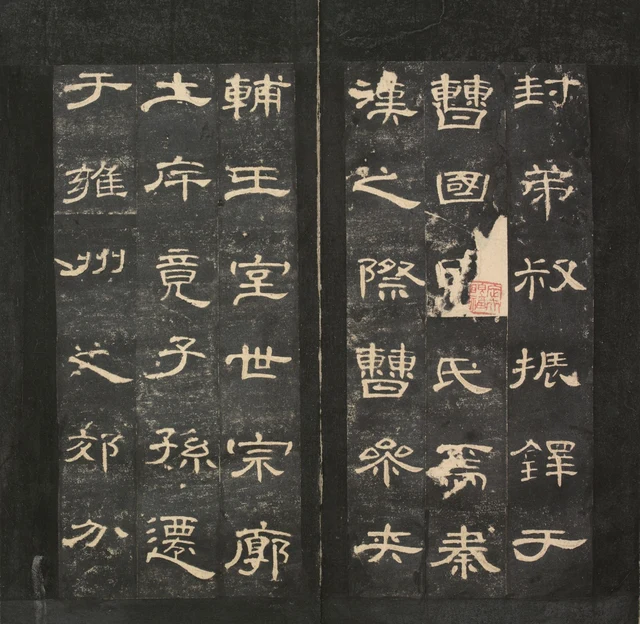
孝 and 季 share lower component 子 but have distinct upper components and meanings. Figure 1 explicitly locates both. Four 或 and two 于 are read within neighboring columns. In figure 4, the visible column 合七首藥神明 continues with 膏 at the top of the left half's right column, forming the medicinal name 神明膏. The phrase 七首 is preserved without asserting an unverified meaning such as seven prescriptions. 親 is followed by 至; 王 is second in the adjacent middle column, not directly beneath 親. The red seal, damage and repair below 國 in figure 3 are not regular character strokes, and color alone does not date their sequence. Album adjacency does not prove original stone-column adjacency.
Image rights
No republication permission has been obtained. No open license is claimed. Public research access to the official site is not a grant of republication rights. Copyright remains with the Palace Museum and any other relevant rights holders; public or commercial redistribution requires separate clearance.
All four figures show the same Palace Museum album, 新00045355, an early post-excavation Ming rubbing of the Cao Quan Stele, taken before the stone broke. Original stone: 185 CE; paper: Ming. All are whole photographed album openings, preserving three short columns per half. The cut-mounted short columns are not claimed to reproduce original stone-column adjacency.
Acquisition and processing, 2026-10-19 UTC
The public museum collection page links directly to the four official viewers. Each viewer's public Deep Zoom metadata specifies its image bundle, full dimensions, 510-pixel tiles and one-pixel overlap. The acquisition script fetches the highest pyramid level (12), places each tile at its published coordinates and removes only prescribed tile overlap. It saves the assembled master as JPEG quality 96, then makes a proportional reading-size reduction fitting 1400 × 1400 pixels at JPEG quality 92. No image content was cut out of these four openings.
`IMAGE_MANIFEST.json` records exact public tile roots and operations. The reading release does not include the assembled masters or source-page downloads. The first and sixth thumbnails of the museum's older gallery link to the same image; the essay does not label figure 1 as the original beginning of the inscription.
No AI generation, inpainting, handwriting reconstruction, restoration, recoloring, watermark removal or seal removal was performed. Tears, joins, paper edges, dark areas and collection marks remain. The embedded figures are smaller reading copies, not a basis for precise measurement of the stone.
What was actually inspected
The writer viewed all four assembled/reduced images and checked the individual characters against neighboring columns. The source reviewer and the series editor independently viewed the four 1400-pixel images. Verified positions: - Figure 1: 孝 at top of left half's middle column; 季 fourth in its far-left column, with 禾 above 子. Neighbors 之, 性, 養, 祖 remain. - Figure 2: four 或 in the right half, far-right column fifth; middle column third; left column first and fifth. Left half's right column reads 敦煌枝分葉布. - Figure 3: two 于, right half far-right column bottom and left half far-left column top. 曹 and 國 in right half middle column; damage/repair/red seal below 國 are separated from normal writing. - Figure 4: right half left column 合七首藥神明, 七 second. The next displayed column, at the right of the left half, begins 膏親至離亭部. 神明 continues across the mounted columns to 膏 as the medicinal name 神明膏. 王 is the second character in the left half’s middle column; the character directly below 親 is 至.
These are actual local image inspections, not claims of final HTML browser inspection. Final article browser checks, if performed, are documented separately in README.
Rights
图像版权归故宫博物院及其他相关权利人。未取得再发布许可,不宣称开放授权。 用户允许在研究包中使用并注明未获许可;这不授予对外传播权。 / Copyright remains with the Palace Museum and any other rights holders. No republication license has been obtained and no open license is claimed. Further public or commercial redistribution requires separate rights clearance.