Below this white plaster relief is a person easily overlooked.
He has not joined the mounted officer and crowded infantry. Instead, he sits on a seat projecting beneath the relief, toward the right of the image, his legs hanging over its front edge. Compared with the densely packed, roughly modeled army above, he is particularly small. Yet his position projects toward us farther than that of many soldiers.
Look first at this little figure away from the protagonists, then at the whole model, and another question emerges: whom does a memorial intend to make visible, and where does it intend to place the people who come afterward?
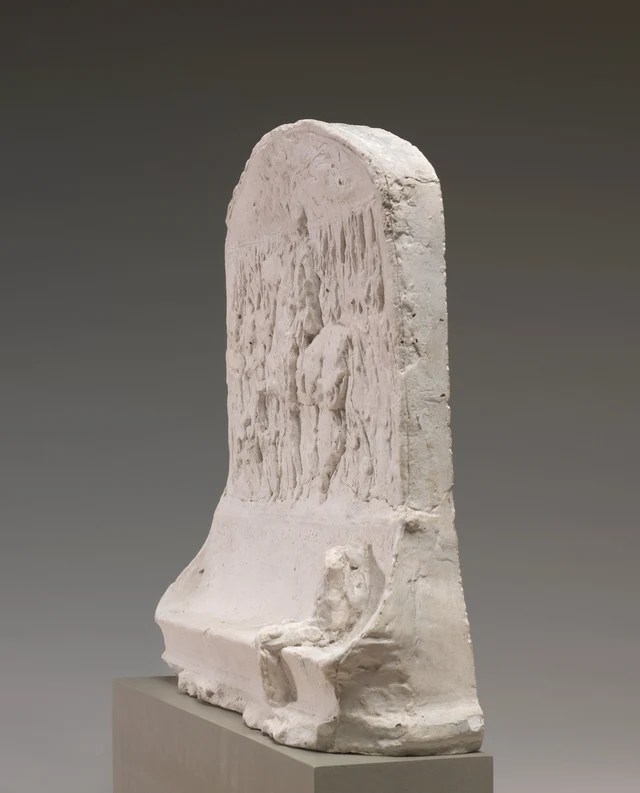
What I find most worth looking at here is not how many heroic stories the study already renders clearly, but how it arranges two kinds of body at once: bodies advancing in the relief and a body staying before it. The narrative above and bench below belong to one design. How a commemorative image becomes a place people can approach and remain is already a sculptural question here.
Robert Gould Shaw was the white commander of the 54th Massachusetts Volunteer Infantry Regiment, composed of Black soldiers during the American Civil War. On July 18, 1863, the regiment attacked Fort Wagner in South Carolina, where Shaw was killed. Its service took place amid racial inequality; Black soldiers protested unequal pay and restrictions on promotion. The commemorative project developed over many years. Saint-Gaudens began designing in the early 1880s, and the bronze memorial in Boston was unveiled in 1897. This plaster of 1883 belongs to a stage when the conception was still developing. National Park Service: memorial history; Related historical research
1. Before Faces Become Clear, Organization Appears
The oblique photograph reveals the white panel’s thick edge. The mounted figure and infantry do not stand like separate statuettes on a row of steps. They rise and fall from a shared background, remaining connected to the panel behind them.
The horse at the center is easiest to recognize. Its belly occupies a broad convex area, the neck rises to the head, and the legs divide below into narrow shapes. The rider’s upright torso rises above this broad form. Even without clear facial features, horse and man retain a complete framework: a horizontal equine body supports an upright human torso, while descending legs connect it to the marching group’s lower edge.
The soldiers around them are less readily distinguished. Heads, torsos, and limbs crowd together, and some contours run into those of neighbors. Dense long lines above mark upright weapons; angled legs below make walking legible. We need not count everyone before recognizing a military unit.
This is a specific visual sequence. The central horse and rider first emerge as a complete unit; soldiers first appear as repeated, crowded shapes. Attention is therefore not evenly distributed. The rider receives a higher position and the horse a larger continuous surface. Infantry occupy the surrounding area through numbers, density, and recurring directions.
We cannot reduce this difference to one person being “more important,” nor smooth it away by declaring everyone equally prominent. The model places a commander and a regiment in one image while retaining tension between an individual center and a collective background. We can keep seeking people along weapon lines and legs, but cannot read each soldier’s individual character from this rough study, much less attach historical names to its indistinct faces.
The exposed edge in Figure 1 shows how little depth these laterally spread bodies occupy. For another angle, the frontal photograph on the collection page shows horse and rider moving to the left, with the regiment around them. The frontal view makes their direction easier to follow; the oblique view reveals the thickness of the relief.
2. How Low Relief Accommodates a Regiment
Notice the relationship between the horse’s belly and the panel’s right edge. The figures on the panel’s front suggest bodily thickness, while the edge reminds us that many figures seemingly occupying different depths have been gathered into a compact surface. Much of the “near and far” is organized by overlap and degree of projection, rather than by simply shrinking real-life distances between people.
Relief allows us to accept two things simultaneously: this is a physical plaster panel, and this is a group passing by. A slight swelling of the horse’s belly suffices to establish a foreground. Intermittent forms behind need not each possess complete space to read as a continuation of the regiment. A weapon beside a head or legs beneath part of a torso prompt our eyes to connect the hidden portions.
Not every surface is equally clear. Larger protrusions mingle with brief incised lines, some junctions are abrupt, and edges are irregular. White plaster does not separate uniforms, skin, weapons, and horse through different colors. Recognition depends on shape and the photograph’s light and shadow. Structure reaches the eye before detail: broad plane, thin line, sparse area, dense area.
Do not rush to call this condition “lively brushwork.” We see the relief of a physical plaster surface. We cannot infer that every indentation came from the artist’s hand, much less treat every chipped edge as intentional expression. The work’s status as a study lets us attend to forms not yet fully developed, but its condition should not be romanticized as artistic intention.
Above, beneath the arched top, another human form and drapery extend horizontally. This figure lies closer to the background than the rider below and is constrained by the curved edge. The army occupies the more regular lower zone; the upper figure occupies a different spatial area. The model thus distributes not only front and back but above and below. Repetition below belongs to collective action; the more isolated horizontal form above reserves a place for commemorative allegory. We need not supply all the later version’s symbolic attributes to see this division.
What the small model economizes is space, not relationships. A little depth arranges center, ranks, and upper figure; the remaining physical depth is given to an entirely different element below.
3. What Projects Below Is a Bench
Follow the thick right edge downward. The panel no longer stays straight. At the bottom it curves forward into a broad seat; the front edge turns down, joining a lower base. Compared with the soldiers held close to the background above, this area occupies substantially more depth.
The little figure sits precisely on this projecting edge. His torso is upright, his legs turn downward from the seat. The pose is rough, but contact with the bench is clear: hips remain at seat height, knees advance, and the lower legs leave the seat. This turn transforms a broad shape from a “base” into something a body can use.
Discussing this 1883 model, art historian Kathryn Greenthal explicitly identifies the figure as a viewer sitting on an attached bench. She compares it with a drawing from architect H. H. Richardson’s office that places viewers at a distance, pointing out that the model seats a person on the memorial itself. “Engaging the Viewer”, pp. 2, 4.
That identification makes the photograph’s two kinds of depth especially interesting. The upper space represents a story that has already happened; the lower reserves room for someone who will approach in the future. Infantry can be compressed into shallow overlaps, but the seat must project to allow a seated pose. Represented space and space for bodily use obey different demands within the same model.
There is also a difference of scale. Using the seated figure as a reference makes the people and horse in the relief seem large. Looking only at the central rider could easily lead us to mistake the whole for a collection of ordinary small figures. The seated person changes our reading: this is a model of a larger monument, containing a separate indication of human scale.
The actual plaster is only forty-one centimeters tall. Of course we cannot sit in it. But the figure lets us imagine where the seat edge would meet a person’s body if the design entered public space, and how high the relief would rise behind them. Size here is more than a label’s number. It participates in how the work is imagined.
Nor is this person modeled as a standard spectator gazing upward at heroes. The photograph supports an account of posture and position, not certainty about his gaze or feelings. A seat makes remaining possible; it does not guarantee admiration, contemplation, or historical learning. That limit matters. A design can arrange where bodies go without doing the work of remembrance for every future visitor.
4. More Than a Memorial in Miniature
Treating this study merely as a “small preview” of a later masterpiece makes the bench and little figure seem dispensable accessories. We might ask whether the horse is convincing or the soldiers sufficiently detailed and miss the whole the model is testing.
It makes three things available for examination together. How rider and infantry coexist within a relief is a question of image organization. How arch, upright panel, and seat connect concerns the monument’s construction. How a person sits beside it concerns its entry into everyday space. They have not yet been separated into “the artwork itself” and “the setting for the artwork.”
The work’s roughness therefore also has value for understanding. Faces cannot yet sustain a full portrait reading, but the composition already chooses heights, densities, and sizes. Surfaces are not refined, yet the seat’s projection already suggests use. A model lets the designer bring these relationships together and test whether they work. We need not beautify every rough patch to see what it is doing.
History makes this arrangement more than a formal game. The 54th’s Black soldiers fought for the Union while continuing to seek equal treatment within the army. Commemorating them meant finding how to bring them and their white commander together into public memory. This study already incorporates the regiment around the mounted figure, without eliminating differences of prominence and recession. Acknowledging that stays closer to its actual forms than declaring it an image of equality already achieved. Related National Park Service research
Likewise, giving a viewer a seat does not automatically establish equal access to public commemoration for everyone. It first offers a visible, debatable design choice: the space before a memorial need not be only a distance from which to stand back and look up. It can also become somewhere a body pauses.
This study deserves to be viewed independently because it preserves that choice while still adjustable. The army above keeps marching; the person below has sat down. One faces history, the other the ordinary moment in which commemoration happens. A small plaster joins them, showing that designing a memorial also means designing ways for people to live alongside it.
Optional Reading through SAE: What Would One Missing Figure Take Away?
Begin with a small thought experiment: keep the relief, arched top, and bench unchanged, but remove the seated figure at the lower right.
The story of horse and soldiers remains recognizable. The seat still projects forward. But would someone unfamiliar with this design identify it as a bench just as quickly? Might they first see a broad, unusually shaped base?
More than a decorative element would be missing. The seated pose links surface, front edge, and lower space into a set of relationships a body can use, while establishing scale for the whole monument. Remove him and the plaster’s own dimensions do not change, but our sense of the architectural scale it represents may become less certain.
Try a second comparison. Keep the figure, but move him beside the model, standing on the ground. He can still indicate size, but his relationship to the memorial changes. He becomes an external scale reference. The original seated figure is a reference actively using one of the model’s components. Both arrangements can say “how large,” but only the seated one also demonstrates “how a body might stay here.”
The comparison moves judgment from whether the story is moving to what a specific formal choice does. We can examine its contributions to recognition, scale, and spatial use separately rather than merely saying the figure adds “a human touch.” This gives a concrete route into SAE aesthetics: when judging a work, attend to how form creates conditions for human experience, without mistaking the possibilities it offers for psychological facts already true of every viewer. General account of SAE aesthetics
Images and Sources
This essay concerns the same 1883 plaster study presented by the National Gallery of Art. It includes one officially downloaded oblique photograph, 3,306 × 4,096 pixels, unchanged. A frontal photograph is also available on the collection page, where observations about frontal direction can be checked; that photograph is not included among this essay’s image files. The essay is based on photographs, not in-person observation.
This study, the 1897 Boston bronze memorial, and the large patinated plaster dated 1900 are separate objects. No images of the latter two are mixed in here, nor have faces, symbols, or inscriptions from the completed versions been transferred to this early model. For image sources, see Image Credits; for research sources, see References.
