Start with her feet.
One reaches forward; the other stays beneath her body. Both turn outward. They rest on a square wooden platform, and her knees are not bent deep in preparation for a jump. Her skirt spreads around her, but her legs are firmly grounded. Look higher: her chin is raised, her shoulders open back, and both arms withdraw behind her body. Her hands are hidden. Nothing in front of her chest reaches out to greet the viewer.
She is not dancing, yet dance has already shaped the way she stands.
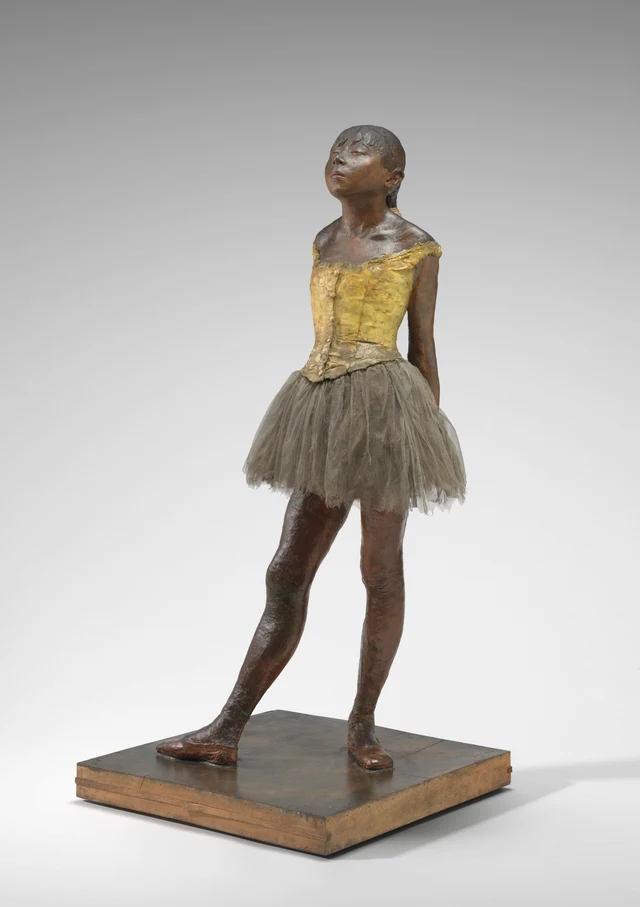
In a pause, Degas lets us see how dance remains in the body. The outward turn and staggered placement of the feet, the lifted chin, and the arms reaching back all sustain this position. Lightness here has a ground beneath it, something to support it, and a body that has to stand there.
The sculpture belongs to late nineteenth-century Paris. Ballet was part of the city’s theatrical culture; behind the stage lay years of practice and the pressure to earn a living. In 1881, Degas showed the wax at the sixth Impressionist exhibition. It was the only sculpture he exhibited publicly during his lifetime. His model, Marie van Goethem, was a ballet student at the Paris Opéra and came from a working-class family. This background connects the stance before us to a particular world. She was learning to become a dancer while growing up within the demands of a profession. Museum account
1. Two Feet Keep Lightness on the Ground
Without its wooden base, the figure is about thirty-nine inches tall. When a photograph fills the screen, she can easily seem life-size. Keeping her actual dimensions in mind, then looking again at the platform and her feet, gives our viewing distance a more definite scale.
In Figure 1, the girl’s right leg extends diagonally toward our lower left; the other is closer to vertical. These are not two pillars side by side. One leg opens out the pose; the other gathers the body over it. The opening beneath the skirt is tilted accordingly, wider on one side and narrower on the other. Our eyes follow the outstretched leg to the tip of the shoe, then return along the straighter leg toward the torso. Through this back-and-forth, we begin to feel where the body settles.
She is not lifting her whole body high onto the tips of her toes. The outlines of her slippers let us follow the feet as they extend forward and meet the wooden platform. We see an outward reach and contact with the ground at once. After the airborne leaps and turns familiar from stage photographs, these feet placed on a wooden platform reveal how much shape there can be in simply standing.
When the museum invited professional dancer Tara Hutton to discuss the sculpture, she identified a relaxed fourth position and read in it something like the fatigue at the end of a long rehearsal. That is an interpretation informed by a dancer’s experience. Museum audio transcript A first-time viewer need not learn the names of ballet positions before looking. The distance between the feet, the direction in which they turn, and the upper body’s refusal to slump are enough to show how rest and training can inhabit a single pose.
The right leg reaches out without carrying the whole figure forward. Her arms move back while her upper body stays lifted. Different parts point in different directions, yet she holds her ground. Her stillness emerges from the way those directions check one another.
2. Move to the Side, and Her Hands Appear
From the front, her face readily catches our attention. The raised chin may suggest pride, the lowered eyelids weariness. Before we have had time to take in her whole body, we have already begun choosing a mood for her.
The side view slows that choice.
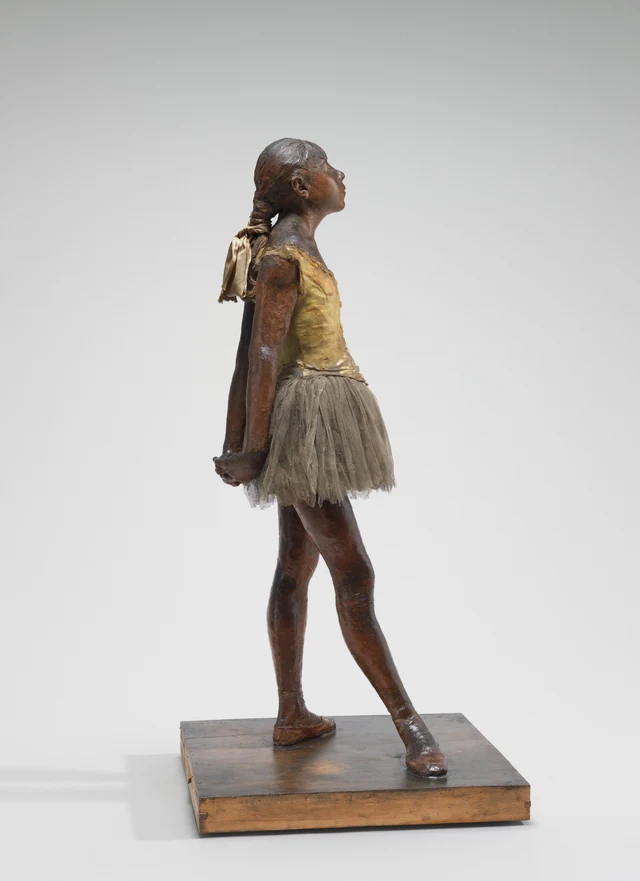
Her chin reaches forward and upward, lengthening the front of her neck. The outline of her chest and abdomen swells forward. On the other side, her almost straight arms descend backward from the shoulders, and her hands meet behind the skirt. A curve in front and a long diagonal behind come into view together.
From this angle, “holding her head high” is no longer just a matter of her head. The lift of the head, the opening of the shoulders, and the backward reach of the arms make up one whole pose. Crop the image down to the face, and you may find an expression. Look at the entire body, and you see the way of standing to which that expression belongs.
Move around to the back, and the previously hidden hands become the clearest nearby action.
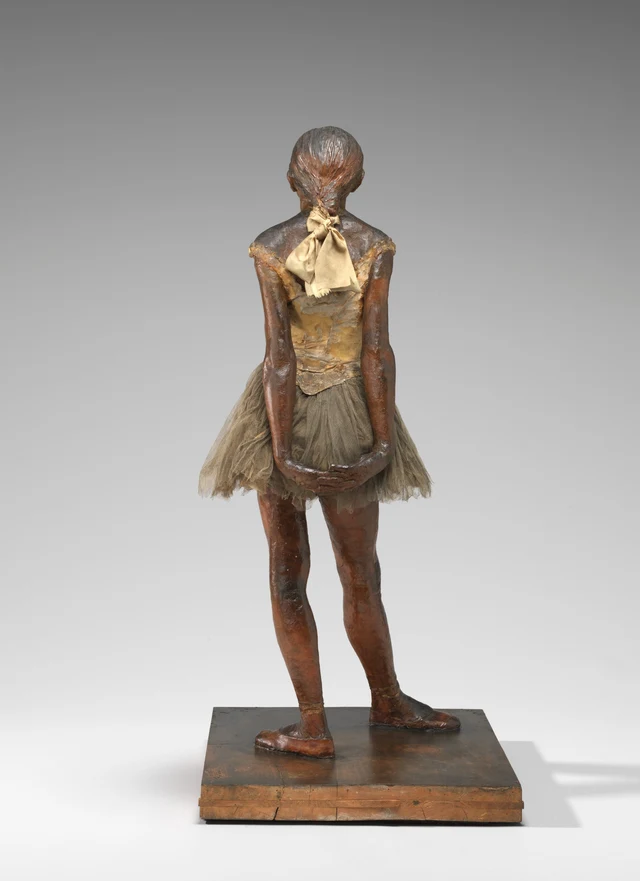
Both arms extend downward, turn at the wrists, and bring the hands together across the body. Their outline forms a long arc that closes in at the bottom, enclosing the back and part of the skirt. A pale ribbon hangs from the back of her head. Below it comes the narrowing waist of the bodice, and below that, the hands. Forms of different widths and textures are arranged one above another along her back.
This is more than a supplementary view supplying something the frontal photograph left out. The rear view redistributes our attention. With no face to read, we begin to notice how the hands rest together, how much space remains between the upper arms and torso, and how the fabric of the skirt is enclosed by the body and hands. The figure’s expressive force shifts from the face to the relationships within the body.
3. The Skirt Is Not a Sculpted Skirt
From a distance, we readily bring the yellow bodice, dark body, and gray skirt together into a whole person. Move closer to the head and shoulders, and the boundaries between materials begin to show.
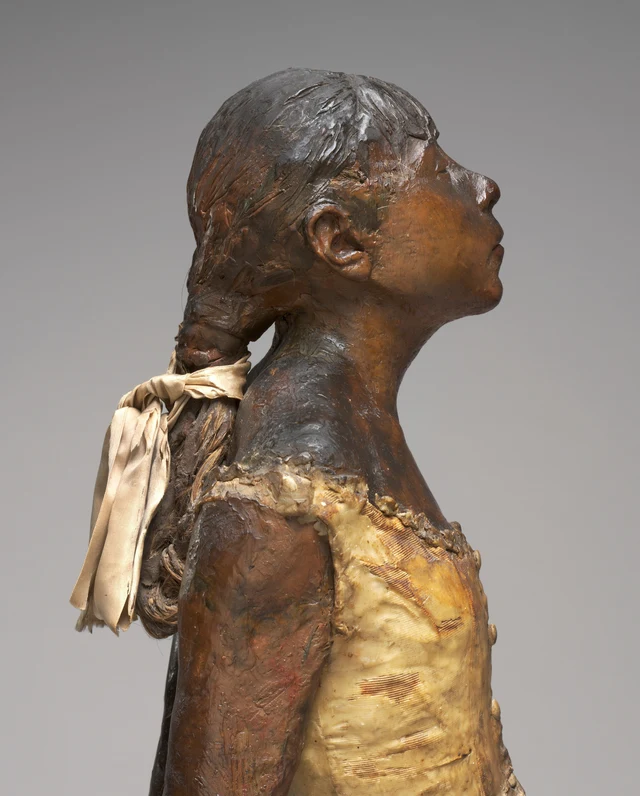
The bodice has an uneven layer of yellow wax as well as exposed areas of fine horizontal texture. Its irregular edges meet the broader contours of the shoulders. In places, the braid resembles a dark mass of modeling material; elsewhere, individual strands of hair can be made out. The pale ribbon tied around it retains the angles of folded cloth and its downward drape, its bright areas forming soft planes.
These differences were not all produced through imitation. Degas used human hair and actual clothing, then covered parts of both with wax. The bodice lies close to the body: it is something being worn, and it also helps shape the body’s surface. The gauze skirt spreads outward, its mesh and overlapping layers holding light in their narrow spaces. Technical study of the materials
In a single work, we encounter two kinds of recognition. Looking at the lower leg, we know we are seeing material modeled into a body. Looking at the hem, we are looking at actual fabric. Our eyes join them into a girl, even as differences in material keep reminding us how she was made. She is strikingly lifelike, and that likeness also leaves the work of making exposed.
This changes how the sculpture occupies space. The legs and torso form relatively compact volumes, while the skirt pushes the outline outward, with a loose edge and numerous tiny openings for light. Some of the width surrounding her body comes from the spread of cloth rather than from the body itself. Close-fitting and free-hanging, solid and open, alternate within a very small area.
The surviving skirt may retain original fabric, but its full appearance in 1881 remains uncertain. Nor can the brown wax and aged textiles we see today simply be equated with their colors at the first exhibition. The differences between the materials remain clear, however. This work stands before us through their combined presence. Technical study; Study of the original appearance
4. Who Gets to Judge Her Looks?
Not everyone welcomed this girl in 1881. Wax, real hair, and actual clothes in an art exhibition challenged expectations about the materials appropriate to formal sculpture. Nor had the ballet student’s body been remade as an ideal figure removed from everyday life. The work was displayed in a glass case, which also led some viewers to think of wax figures or specimens. Study of the original display and glass case; Contemporary criticism and later interpretations
Some critics went further than judgments of beauty or ugliness. Paul Mantz read moral corruption into the thin arms and projecting face, even treating that face as a portent of various vices. The museum’s research cites such judgments while also questioning the claim that the sculpture straightforwardly demonstrates Degas’s own belief in a “criminal physiognomy.” What a critic saw in the girl is not necessarily what the artist intended us to see. NGA study of iconographic interpretations
This brings the question into sharper focus. Of course we may find the sculpture beautiful, or dislike its shapes and surfaces. But does seeing a girl’s face mean that we already know what kind of person she is? The move from “I don’t like the way she looks” to “She will become a bad person” turns an aesthetic judgment into a verdict on character. Calling her “cute” today does not automatically amount to understanding her, either.
Wax and actual clothing make the question more pointed. She bears the marks of sculptural modeling while wearing things we recognize from ordinary life. For someone accustomed to marble statues, real hair and a fabric skirt may unsettle a once-comfortable distance of appreciation. Viewers may feel more inclined to approach her, or more eager to scrutinize her. The materials bring the figure close. How to look at her once she is close becomes the viewer’s own responsibility.
The social setting of the Paris Opéra makes such looking all the more consequential. Unequal relationships linked young dancers’ training, their families’ income, and powerful male spectators. These are part of the background needed to understand the profession; they cannot stand in for the whole experience of any one girl. Marie is a named model, not an anonymous example provided to prove a social conclusion. Young dancers in the nineteenth century
5. Return to the Front: Her Hands Are Still Behind Her
Now come back to the front.
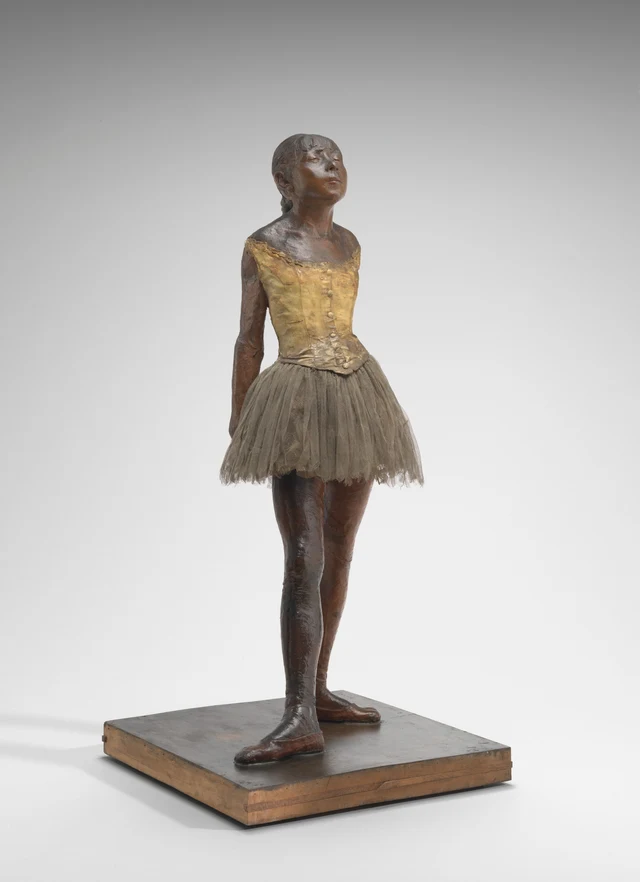
Compared with Figure 1, the legs appear closer together in Figure 5, overlapping in places. But on this return, the change in outline is not the only thing worth noticing. The hands are hidden behind the body again, and now we know how they meet.
That knowledge remains part of our looking. Only parts of her arms are visible, yet we can connect them to the hands behind her. Seeing the shoulders open back, we remember the two long lines descending behind them. The back does not appear in this photograph, but it is no longer a blank.
At first, looking from the front, we may have asked only what her face expressed. Now the space in front of her face, the depth of her torso, and the hands behind her belong to the same body. What we saw earlier helps us understand what is currently out of sight. On this return, the sculpture’s depth enters our way of seeing.
Degas has not given us a dance in the course of being performed. He pauses our looking at a point where dance has yet to unfold, although the body has already been shaped by it. Standing itself becomes something worth looking at. A person is momentarily still, yet the movements she has learned and practiced remain in the way she meets the ground.
Optional Reading: Another Look through SAE
If this skirt were a single mass of opaque wax instead of gauze, would she still seem so light?
First, find the skirt’s lower edge in Figures 2 and 3. Its main layers are fairly dense, but near the edge you can see small openings in the mesh and loose threads. Her legs emerge beneath this irregular, thin border. Keep that difference in mind, then try a thought experiment with the material. Preserve the skirt’s current length and outer contour, but imagine filling every opening in the mesh and every gap between its layers to make one opaque mass of wax. For now, change only that in your mind. Leave the face, the position of the feet, and the rest of the pose as they are.
We could still recognize the outline as a ballet skirt, but its relationship to the legs would change. Light can pass through the present gauze edge, the layers overlap inward, and the legs appear beneath a loose border. With a solid skirt, the junction between the outer shell and the legs would become a harder meeting of volumes. Even without calculating its actual weight, our sense of how that mass above bears down on the legs might change.
Return to Figures 2 and 3 and see which parts of the hem lead you to that judgment. This is an imagined comparison, not a measurement made on an altered sculpture. It asks why roughly the same outline need not give us the same viewing experience. If you find the pose more important than the material throughout, you can make that case through the spread of the legs and the direction of the torso. You need not accept this essay’s emphasis on the skirt’s visual weight.
The comparison also brings us back to the feet. Her stance rewards attention not only because the pose is unusual, but because forms of differing density finally come to rest where the two shoes meet the wooden platform. The lightness we feel in this sculpture has material conditions of its own. Seeing them does not diminish that lightness; it makes it specific.
This can offer a small point of entry into SAE (Self-as-an-End) aesthetics: beginning with identifiable relationships such as light passing through a hem and layers overlapping, we can go on to ask how a particular experience of beauty comes about. General account of SAE aesthetics; Perceptual beauty
Images and Sources
This close reading draws on five photographs supplied by the National Gallery of Art of the same original wax sculpture. Each measures 4,000 pixels on its longest side. They include full-length views from several angles and a museum photograph detailing the head and shoulders. The files remain as officially downloaded, without color adjustments, recompression, retouching, or generation. Lighting, lenses, and framing affect what photographs show; these images should not be treated as records of direct, in-person observation.
No photographs of the bronze casts made after Degas’s death are used here. Those casts have their own production and collection histories, and their surfaces cannot be substituted for the wax, real hair, and clothing seen here. For image sources and licensing, see Image Credits; for historical and scholarly sources, see References. The interpretations offered are this essay’s own and do not imply endorsement by the museum.


