Gold fills the space behind the two figures, but the picture does not shine with one uniform brightness. Mary’s face turns out from her blue hood; a faint gray-green gathers beside her nose and beneath her chin. The child’s chest and belly have their own light and shade, and his arm reaches toward a flower. Look behind their heads, though: the halos do not turn with their faces. Their circles and rows of tiny dots remain open to us.
Two orientations coexist. The bodies turn; the gold ground and halos address the viewer frontally.
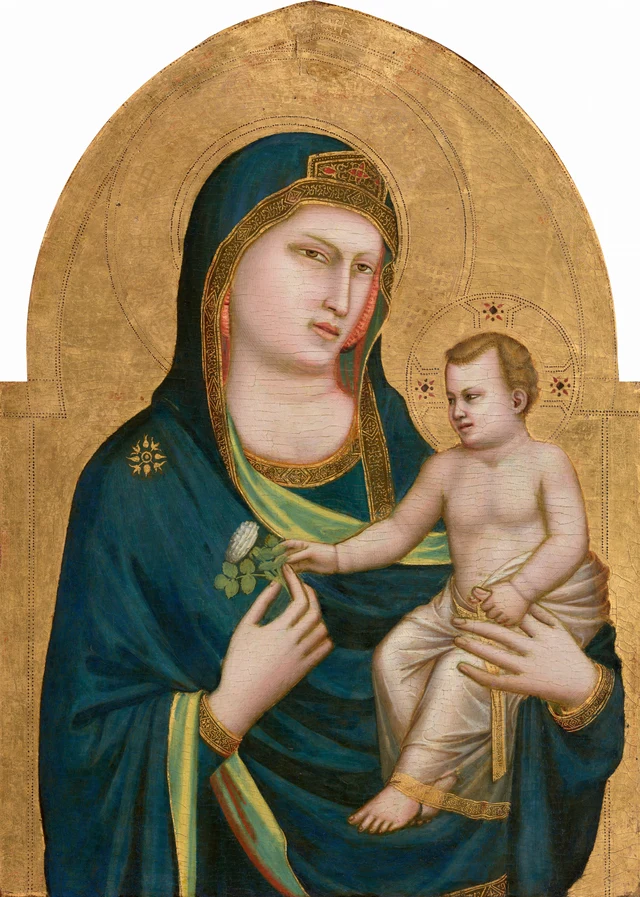
The reading proposed here is that Giotto places a tangible intimacy within a solemn act of presentation. The modeling of faces and the contact between fingers make Mary and the child feel approachable. Gold, halos, and richly patterned borders keep that intimacy before us as a sacred image. The painting draws its strength from their cooperation.
This panel belongs to early fourteenth-century Italian painting, when images on wood could form part of larger altarpieces, together with other panels and architectural framing, and participate in prayer and worship. It probably occupied the center of a multi-panel altarpiece, although the original arrangement and location remain disputed. Looking at it alone today calls for some awareness of its former function, without filling the gaps in our knowledge with an invented setting. NGA scholarly catalogue; the functions of altarpieces
1. How gold makes a place
Begin with the outer edge of Mary’s blue mantle. It rises over her head, spreads across her shoulders, and almost fills the lower part of the panel. Gold remains around it in areas of differing width: expansive above her, narrowing beside her shoulders, then opening conspicuously around the child’s head. This meeting of blue and gold establishes the figures’ extent and proximity before we have inspected their features.
There is no horizon and no wall receding into depth. Our eyes cannot follow a route into the distance. Yet the absence of a landscape leaves a thoroughly ordered picture. The large circle behind Mary, the smaller circle behind the child, and the ornamental band following the upper part of the panel form overlapping, enclosing shapes. They locate the two heads. The cross-shaped ornament in the child’s halo further distinguishes his identity within the shared gold field.
The circles do not follow the angles of the faces. Mary inclines her head toward the child; the bridge of her nose and the shapes of her eye sockets establish a turning surface. Her halo remains a broad circular field. The child also looks toward the left of the picture, while the ornament of his halo is displayed toward us. The heads can turn while the signs identifying the sacred figures remain clearly presented. Giotto is organizing bodily space and the legibility of the image at once.
Gold has details of its own. The two rows of dots around a halo merge into fine lines at a distance; closer inspection reveals the intervals between them. Within the circles and along the outer border, delicate engraved patterns interlace. The NGA’s technical research distinguishes the freely incised motifs from the impressed dots at the edges. One makes lines travel across the surface; the other gives a boundary a finely measured rhythm. Technical summary and note 9
These details provide two tempos of looking. The large circle is quickly recognized; the small patterns reward a slower attention. A single gold surface offers both an outline readable from farther away and workmanship that emerges at closer range.
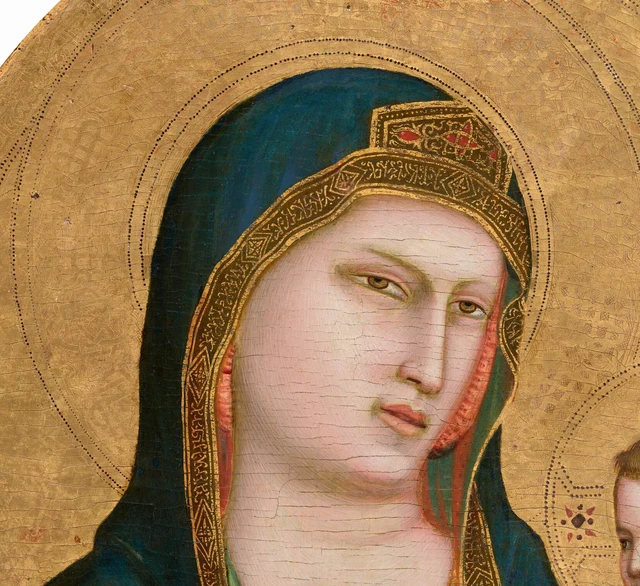
On the actual panel, gold leaf also catches the light falling onto the object. Burnishing, incision, and impressed decoration affect the way a gilded surface reflects light. These are material properties of gold-ground painting. Making a panel painting The lights and shadows on the face, by contrast, have been arranged in paint to show the raised bridge of a nose and the turning of a cheek. One surface responds to light outside the picture; another represents light describing a body.
A photograph fixes the gold’s appearance under one particular illumination. We can study its patterns, but tilting a screen will not reproduce the changing reflection of the original. That limitation helps clarify what the gold does. It is no vacant area waiting for a painter to acquire the skills to insert a landscape. It presents the panel as a luminous object, while giving the figures a place unlike an ordinary interior.
2. A face emerges from ornament
A densely ornamented gold border surrounds Mary’s forehead. It curves with the hood and drops down beside her face, making a narrow frame. Immediately against her cheeks, a red head covering appears as a slender strip. Blue, gold, and red meet at clear boundaries. The colors of the face join more gradually.
Look at the cheek on our left. Pale pink near the cheekbone gives way to gray-green beneath the jaw, without a division as hard as the edge of the hood. The bridge of the nose is light; darker color collects below the nostril. Red touches the upper eyelids, while greenish shade lies beneath the brows and at the inner corners of the eyes. Each passage articulates a different turn of the face. The lips are especially precise: a darker upper lip, a lighter lower one, and a very thin dark interval between them suggest a mouth slightly open.
The two pairs of eyes deserve separate attention too. Although Mary inclines her head toward the child, her eyes remain directed outward, preserving the face’s frontal address to a viewer. The child’s eyes turn toward the left of the picture, a movement sharpened by the short lines of brow and lid. His face does not repeat Mary’s long oval. The chin is shorter, the cheek rounder, and an ear emerges at the side of his head. Repeated halos link the pair; facial proportion and gaze distinguish them.
Our attention consequently moves at different speeds. At the hood, it follows a clear line. Within the face, it has to register small differences of color. Mary appears composed, while remaining far from an unmodeled mask.
Technical examination helps explain how this distinction was made. The panel has a white gesso ground. In the flesh, a green underpainting was followed by shading constructed with fine hatching and broader strokes, and paint was applied in thin layers. Tempera could thus produce subtle transitions in flesh color. NGA technical summary Greenish passages are worth examining, though the photograph alone cannot tell us exactly where an underlayer is showing or later wear has affected the surface.
The modeling of the face works with the arrangement of the whole garment. Across Mary’s chest, the blue mantle turns back to reveal yellow-green lining, which runs diagonally beneath the child’s outstretched arm. A bright turn within a broad dark blue area connects head, chest, flower, and arm. Lower down, the folds grow wider and darker, gathering into larger planes. Gold edging travels through them, joining the fabric’s modeled surface to the intricacy of its ornament.
“Realism” here is richer than simple resemblance to everyday appearances. Shading does not cancel the gold border around the face; folded cloth retains its pattern. We can register a turning head and recognize an image offered for devotional contemplation in the same act of looking.
3. The flower, the fingers, and a thin cloth
The most active route through the lower half begins with the white flower.
It does not open into a great rounded bloom. Its petals gather upward, white strokes standing against the blue mantle, with green leaves spreading beside them. Mary holds the stem in her right hand. Her fingers are long, their tips lifted. The child’s reaching right hand extends across the picture toward the leaves. Both gestures converge on a short length of the branch: one hand offers, the other explores. The flower becomes something that can pass between them.
Meanwhile, the child’s other hand is occupied too. At his waist, it grasps the index finger of Mary’s supporting left hand. Follow her long, extended fingers to find his smaller, curled hand. The larger hand opens; the smaller closes around a finger. Scale, direction, and the degree of opening differ. This contact is more specific than the outline of an embrace: the painting shows how one hand meets another.
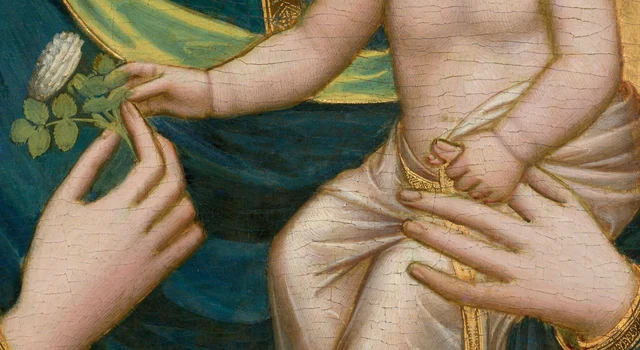
Those contacts also shape the intervals within the picture. A narrow strip of dark blue remains below the child’s reaching arm. A broader expanse of blue separates Mary’s flower-holding hand from the hand supporting him. Pale skin is sharply legible against the mantle. The gestures need no surrounding household objects to explain them. In these short lengths of arm and finger, a gold-ground sacred image acquires an intimacy that ordinary bodily experience can understand.
The white rose has a religious history as well. The museum’s account connects it with Mary’s purity. The scholarly catalogue also relates the rose to the Song of Songs and to the Church understood as the bride of Christ. Collection account; iconographic discussion Here, symbolism does not remove the flower’s availability to touch. The child’s reaching hand brings the symbolic object into an exchange between two figures.
Continue down his body. Most of the chest and belly are bare; a thin white cloth wraps his waist and legs. Close to Mary’s fingers, its folds gather in narrow, abrupt lines of shade. Across the knee, light areas broaden and the transitions become gentler. The cloth covers the body without concealing every change of its surface. We can follow the rise of the knee, the descent of the lower leg, and finally the exposed foot.
The toes appear one by one, divided by small dark lines. The top of the foot is lighter than the tips. It projects precisely over deep blue, making this small area of exposed flesh distinct. Above are the large areas of face and torso; below, only a small foot remains visible. The cloth separates them and, through the direction of the leg, connects them.
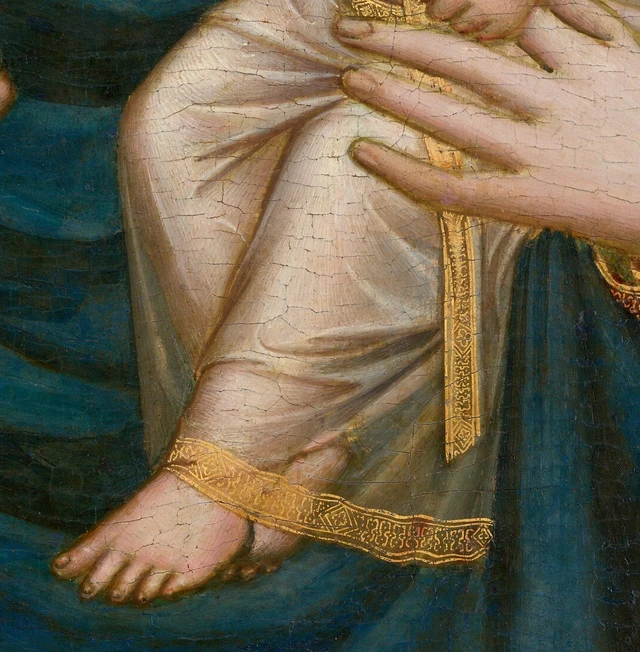
Yet this thin cloth carries emphatic gold ornament. Its edging travels across the lower part, bends, and descends along another edge. Flesh, folds, and gold patterns sit close together. Their proximity shows why dividing the painting into “lifelike” and “old-fashioned” portions would impoverish it. The child’s foot makes the body palpable; the gold border gives the fabric a precious and ceremonial character. Both effects meet at the edge of a single cloth.
Mary and the child do not press their faces together in an emphatic embrace. Intimacy unfolds chiefly through small gestures. The more expansive arrangement of faces and halos above continues to present the pair to a viewer. This distribution matters: a forceful movement involving the whole body would make the flower and fingertips harder to attend to; complete immobility would remove the two small exchanges now taking place.
4. What kind of object survives?
The painted surface is a little over eighty-five centimeters high. This is neither a miniature sacred image that could be held in a hand nor an enormous mural surrounding its viewers. Mary’s half-length figure occupies most of the area, with the child in front of her toward our right. Hands and feet gather in the lower half. Recognizable faces, halos, and small actions are concentrated within an object made to be presented frontally.
Its probable former role as a central panel helps explain that concentration. Before an altarpiece, viewers needed to recognize its principal figures. The gold field, the large blue form, and the halos provide a clear organization. Someone who stayed longer could then follow faces and hands into the exchange between mother and child. This does not require every historical viewer to have looked at the same pace. Nor do we know exactly how far away they stood or where the illumination came from.
The panel’s present outline cannot simply be used as a plan of the original altarpiece. The support was thinned, its upper edges trimmed, and evidence formerly preserved on the back was lost. NGA scholarship connects it with surviving lateral panels, but the arrangement remains unsettled. Santa Croce and Ognissanti are among the proposed original Florentine locations. Object history and reconstruction
This history changes a particular judgment we might make. We can describe the relation between the upper ornament and the surviving edge as it appears today, but cannot attribute every part of that relation to Giotto’s complete original design. At the same time, missing side panels do not prevent us from attending to the image that remains. Its internal relationships are clear: a larger and a smaller gold circle; deep blue and pale flesh; a hand extending toward a flower and another curling around a finger; modeled fabric and intricate gold edging.
For this reading, the achievement lies in the coordination of different demands. Giotto gives his figures actions intelligible through bodily experience, while preserving the clear, solemn presentation of a sacred image. Gold turns us toward that image; fingers and a flower invite us to stay. Intimacy sustains its solemnity by giving it visible, tangible content.
Optional reading: SAE and an object’s history
The following exercise uses SAE as a contemporary approach to looking; it does not establish Giotto’s intentions or the figures’ inner lives.
This time, the useful direction is the “beauty of causation.” That essay asks how something that has happened remains in what comes after, giving history a legible form. A fondness for the appearance of age is different from seeing how a particular trace was left. SAE general outline; The Beauty of Causation
Find two different lines in Figure 2. One consists of orderly dots following the curve of the halo. Another passes thinly across the cheek, without respecting the boundaries of face and garment. The first belongs to the ornament made during production; the second belongs to the network of cracks visible on the present surface. Calling both “the texture of age” erases two different histories.
Now ask two questions that can be checked. Why do the dots follow a circular arc? Does a crack continue as it crosses different colors? The first can be pursued through the technical record of a process that established a boundary in the gold. The second draws attention to a face made of paint that is also a material layer with a history. A photograph cannot date every crack or assign a particular loss to a particular restoration.
The gain should be concrete. What initially appeared as one splendid gold surface becomes differentiated into making, survival, and change. If we go on to call these traces beautiful, we still need to identify the visible relation between earlier and later that supports the judgment. Worn gilding does not automatically add beauty; nor can a taste for distressed surfaces decide the value of conservation. SAE helps turn a general exclamation into a more accountable attention to this object’s history.
Images and sources
This essay is based on direct inspection of the National Gallery of Art’s 2924 × 4096-pixel image and three details. The full image preserves the downloaded file unchanged. Details are rectangular crops retaining the corresponding pixels and original ICC color profile, without color adjustment, sharpening, restoration, retouching, or generated content. A digital image cannot fully reproduce the original gold surface’s reflection.
Images are used under the NGA’s CC0 Open Access policy, which does not grant unrestricted reuse of the museum’s article text. The visual analysis and wording are independent; links identify sources for historical and technical information. No museum endorsement is implied. See References and Image Credits.