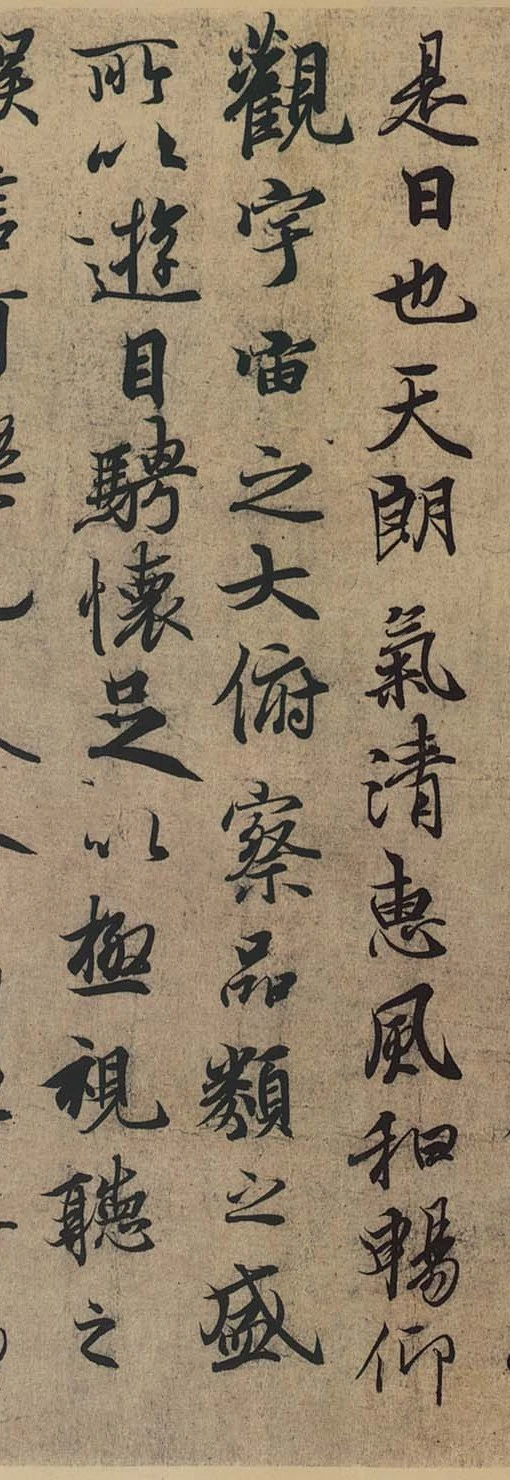
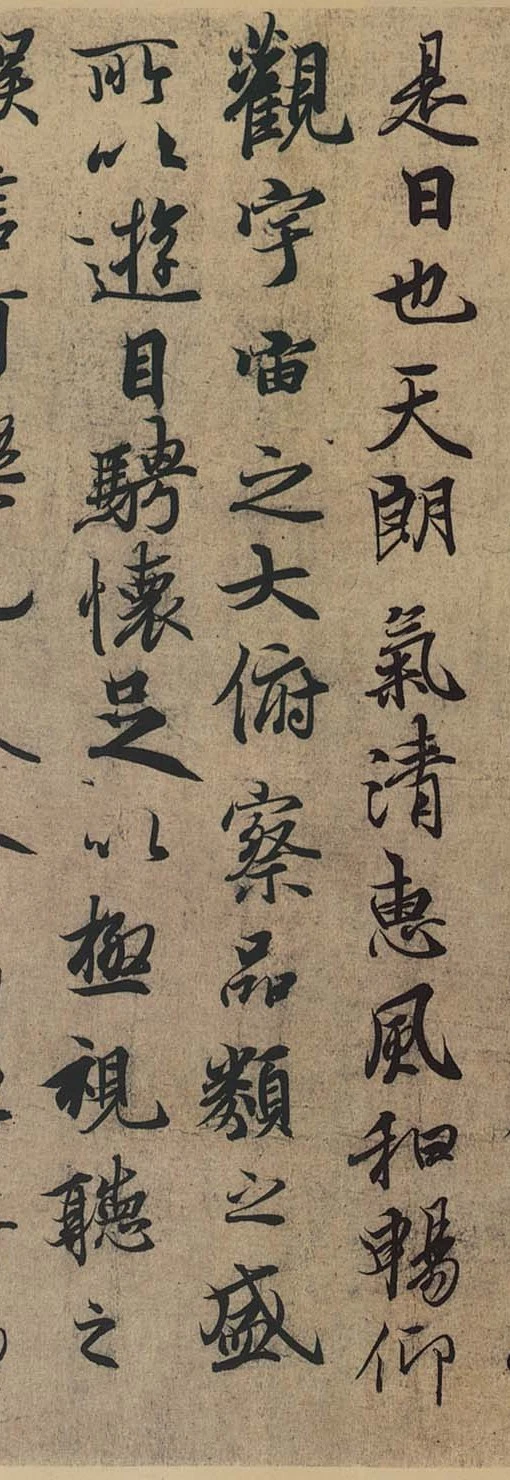
“The vastness of the universe” and “the abundance of things” follow one another down a single column. Both phrases contain 之, pronounced zhi, a connecting word translated here as “of.” Yet the two instances occupy different amounts of space. The upper 之 spreads relatively wide, its final stroke extending to the right before the open form of 大, “great” or “vast.” Farther down, after 俯察品類, “look down and examine the kinds of things,” a much smaller 之 sits between the densely worked 類, “kinds,” and the broad 盛, “abundant.”
Keep the surrounding characters in view, and the differences become easier to see. A wider character carries the eye from the form above to the one below; a smaller one gives both its larger neighbours room to stand out. The same character returns, but the eye does not move through each occurrence in the same way.
Our subject is the Tang-dynasty Shenlong copy of Wang Xizhi’s 蘭亭序, the Orchid Pavilion Preface, in the Palace Museum, Beijing. Traditionally attributed to Feng Chengsu, its copyist is not securely identified. It is not Wang Xizhi’s autograph. References below to strokes, columns and corrections concern, first of all, the forms visible in this surviving copy. Palace Museum collection record, in Chinese
The preface is traditionally dated to late spring in 353, the ninth year of the Yonghe reign. It describes a gathering for spring purification rites at the Orchid Pavilion in Shanyin, Kuaiji, and introduces the participants’ poems. From landscape, wine and poetry it turns to human life in time, finally addressing those who will read it later. This passage from gathering to recollection gives the writing a particular field of meaning.
The variation is more than a demonstration that one character can be written differently. What matters is how that character, arriving in another place, becomes part of another relationship. Individual forms retain their character without breaking the column into separate, self-sufficient specimens.
Read the whole preface first
The complete Chinese text below uses common simplified forms. Punctuation and paragraphs are editorial; they do not reproduce the manuscript’s columns. 悟言 is retained from the transmitted text and means speaking together face to face; 趣舍 concerns different choices and inclinations. Historical forms such as 脩, “cultivate” or “long,” 領, here “mountain ridge,” and 係, “follow” or “be attached,” are identified where relevant. A complete English translation follows the Chinese.
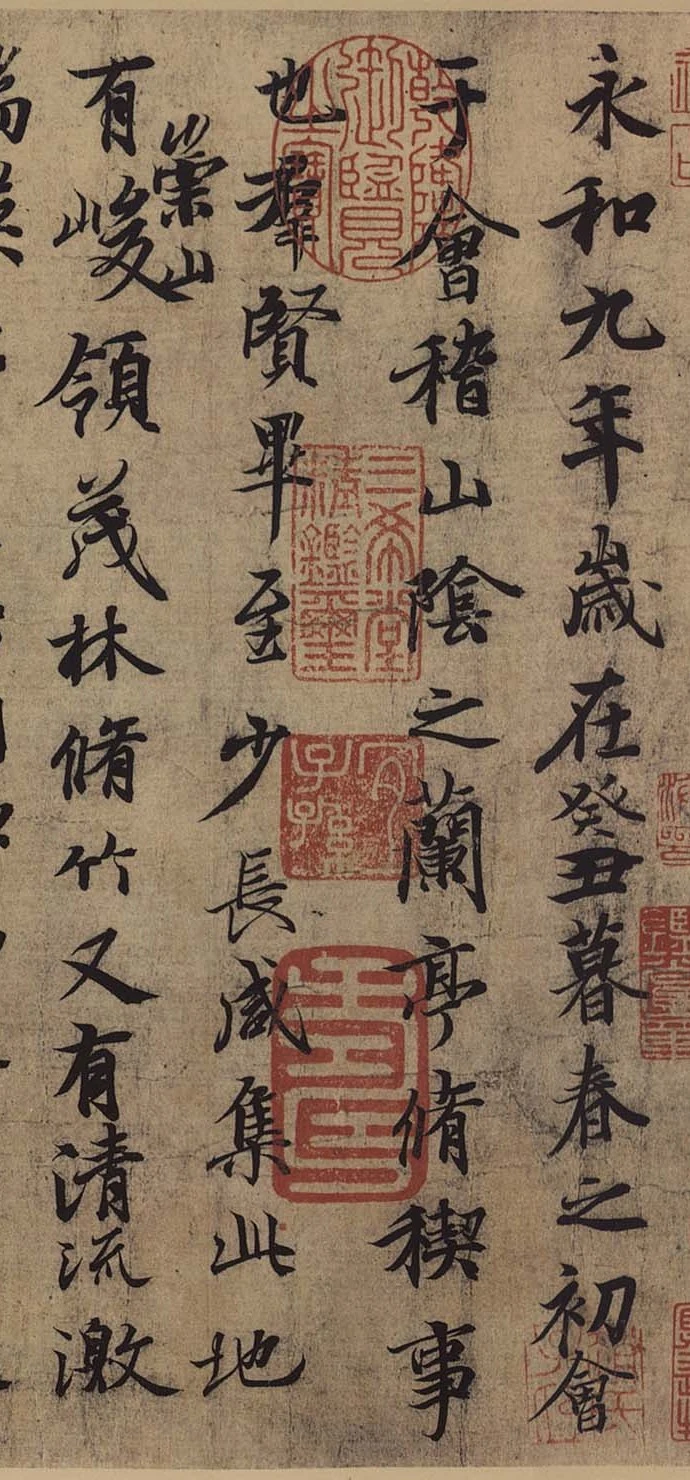
永和九年,岁在癸丑,暮春之初,会于会稽山阴之兰亭,修禊事也。群贤毕至,少长咸集。此地有崇山峻岭,茂林修竹,又有清流激湍,映带左右,引以为流觞曲水,列坐其次。虽无丝竹管弦之盛,一觞一咏,亦足以畅叙幽情。
是日也,天朗气清,惠风和畅。仰观宇宙之大,俯察品类之盛,所以游目骋怀,足以极视听之娱,信可乐也。
夫人之相与,俯仰一世,或取诸怀抱,悟言一室之内;或因寄所托,放浪形骸之外。虽趣舍万殊,静躁不同,当其欣于所遇,暂得于己,快然自足,不知老之将至。及其所之既倦,情随事迁,感慨系之矣。向之所欣,俯仰之间,已为陈迹,犹不能不以之兴怀;况修短随化,终期于尽!古人云:“死生亦大矣。”岂不痛哉!
每览昔人兴感之由,若合一契,未尝不临文嗟悼,不能喻之于怀。固知一死生为虚诞,齐彭殇为妄作。后之视今,亦犹今之视昔,悲夫!故列叙时人,录其所述。虽世殊事异,所以兴怀,其致一也。后之览者,亦将有感于斯文。
In the ninth year of Yonghe, the year guichou, at the beginning of late spring, we met at the Orchid Pavilion in Shanyin, Kuaiji, to perform the purification rites. All the worthy men arrived, young and old together. Here were towering mountains and steep ridges, luxuriant woods and tall bamboo, with clear rushing streams shining and winding to either side. We channelled the water into a winding course for floating wine cups and sat along its banks. Though there was no grand ensemble of strings and pipes, a cup of wine and a poem were enough to give free expression to feelings held within.
That day the sky was bright and the air clear; a gentle breeze flowed pleasantly. Looking up, we contemplated the immensity of the universe; looking down, the abundance of things. Letting the eyes roam and the heart range freely, we could delight our sight and hearing to the full. It was truly joyful.
People live in one another’s company, and a lifetime passes between looking up and looking down. Some bring out what they hold in their hearts, conversing face to face within a room; others give themselves to the things they love, roaming beyond bodily restraint. Although choices differ in countless ways, and some are quiet while others are restless, when people delight in what they encounter and briefly find satisfaction, they feel happy and sufficient to themselves, unaware that old age is approaching. When what they pursue has wearied them, feelings shift with events, and reflection follows. What once delighted them becomes, in an instant, a trace of the past, and even that cannot fail to move them. How much more so when a long or short life follows the course of change and ultimately comes to an end! An ancient saying has it: “Death and life are also matters of great moment.” How could this not be painful?
Whenever I read what stirred people of the past, it is as though the two halves of a tally fit together. I cannot face their words without sighing in sorrow, yet cannot fully resolve it in my heart. I therefore know that treating life and death as one is an empty claim, and equating the long-lived Pengzu with those who die young is mistaken. Those to come will look at us as we now look at the past. How sad! So I have set down the names of those gathered here and recorded what they composed. Though times and circumstances differ, the impulse that moves us is alike. Those who read these words in the future will also be stirred by them.
仰觀, “look up,” and 俯察, “look down and examine,” extend the gaze outwards. In 俯仰一世, “a lifetime between looking down and looking up,” nearly the same bodily movements become a measure of how short life is. The turn is close at hand: satisfaction of the senses gives way to the question of how satisfaction becomes the past. The essay leaves human attachment and limitation in place. By recording people and poems, it provides words through which later readers can meet them.
The preface stands as literature in its own right. Its movement from joy through pain to later readers is clear. On returning to the paper, we find finer changes in the forms and columns of the writing.
Two instances of 之: begin with what stands around them
Return to the middle column of Figure 1. 觀, “observe,” occupies a broad space at the top. Below it, 宇 and 宙, together meaning “universe,” enclose small areas of paper. Then comes the wider 之, followed by the spreading arms of 大, “vast.” The lower part of this 之 has not contracted to a dot. Its horizontal reach separates the neighbouring forms while continuing to lead the eye downwards.
Farther down are 俯, “bow or look down,” 察, “examine,” 品, “kinds,” and 類, “categories.” In 類 especially, the two components and their internal turns make a dense arrangement of black and white. The following 之 is noticeably smaller, with a short, level base. 盛, “abundance,” then opens out to either side. Counting strokes would tell us that both instances of 之 are simple. Comparing the areas of paper they occupy reveals two different arrangements.
This is not a rule that simple characters must be small and complex ones large: the upper 之 already offers a counterexample. The traditional term 揖讓, yirang, “mutual yielding,” can here describe something we can point to. One form contracts, allowing the larger characters before and after it to remain visible together.
Traditional calligraphy criticism speaks of 結體, jieti, the construction of a character: how its strokes relate, where its centre of balance lies, and how its sides open or close. 行氣, xingqi, the continuity of a column, restores those characters to their sequence and asks how one ending leads into the next beginning. The two instances of 之 bring the scales together. A character’s width also participates in the column’s changing density.
Now look to the neighbouring columns. At the right, 清惠風和暢, “clear [air], gentle breeze, pleasant and free-flowing,” contains its own contractions and openings. On the left, after 騁懷, “let the heart range,” the lower strokes of 足, “enough,” spread broadly, followed by the smaller 以. The two central instances of 之 do not carry the rhythm alone. They belong to a group of characters constantly changing in width, weight and spacing. A grid of isolated examples would help us compare their forms, but would remove the central question here: beside whom is this character standing?
The opening does not occupy equal squares either
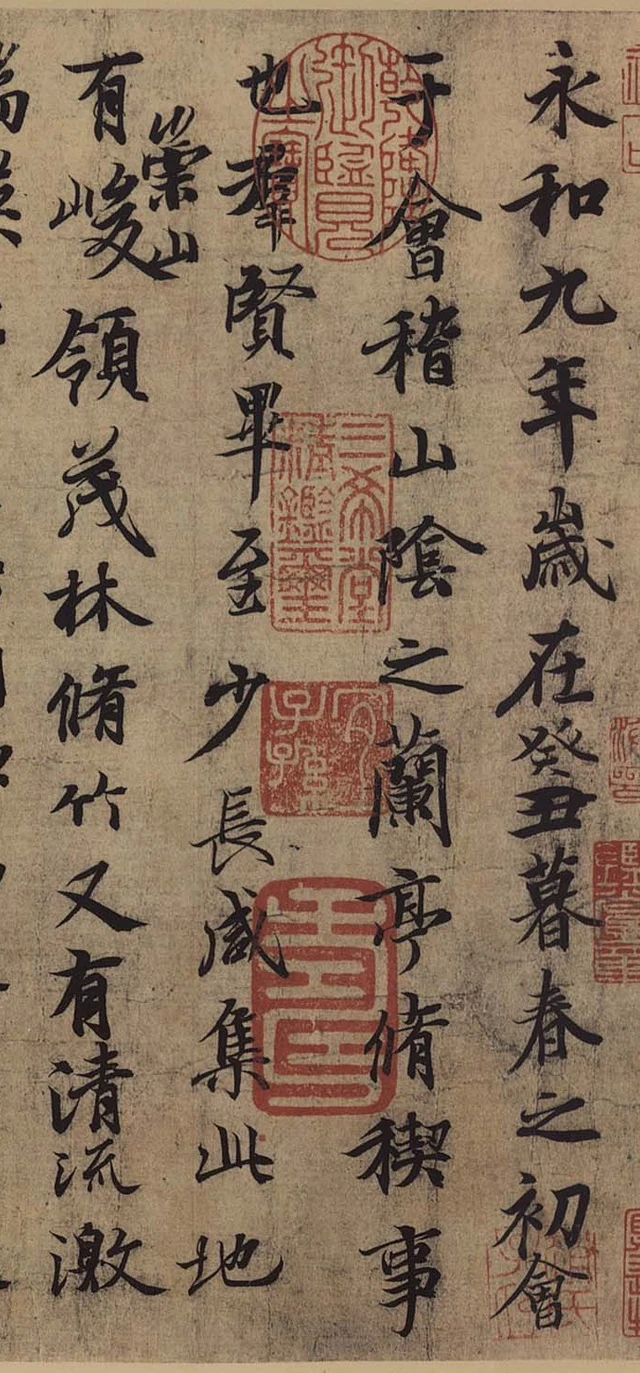
永和九年 can pass quickly as a familiar opening date. Pause, and 九, “nine,” sends a curve to the right, while 年, “year,” drops a long vertical stroke. Below them, 歲在癸丑, “the year being guichou,” does not hold size and alignment constant either. The column has a general downward direction, but no actual straight line pins every character’s centre to one position.
Lower down, 暮春之初 gives another sequence. 暮, “late,” and 春, “spring,” contain stacked horizontal elements; 之 flattens the form; then the two components of 初, “beginning,” restore differing vertical lengths. In the neighbouring 山陰之蘭亭, 之 stands between the dense 陰 and the vertically extended 蘭. The latter phrase names the Orchid Pavilion in Shanyin. Following the two passages takes us through different sequences of heights and widths.
Here 之 also connects language: 暮春之初 specifies the beginning of late spring; 山陰之蘭亭 links the place to the pavilion. Recognising that connection lets us keep reading, while the changing shape and position of the ink give the connection a visible duration.
At the left of Figure 2, the smaller 崇山, “towering mountains,” enters beside 有, “there are,” and 峻, “steep.” The transmitted sheet retains differences of scale, additions at the side and adjustments. The smaller inserted characters have not been tidied away; they take part in the local spacing.
This offers a tangible approach to what is often called naturalness. The text escapes the rigidity of equal squares, while leaving us able to follow its direction. Leaning forms and uneven spacing sustain a legible continuity. Each character brings a difference into a route we can still travel.
Connection can also pass through blank paper
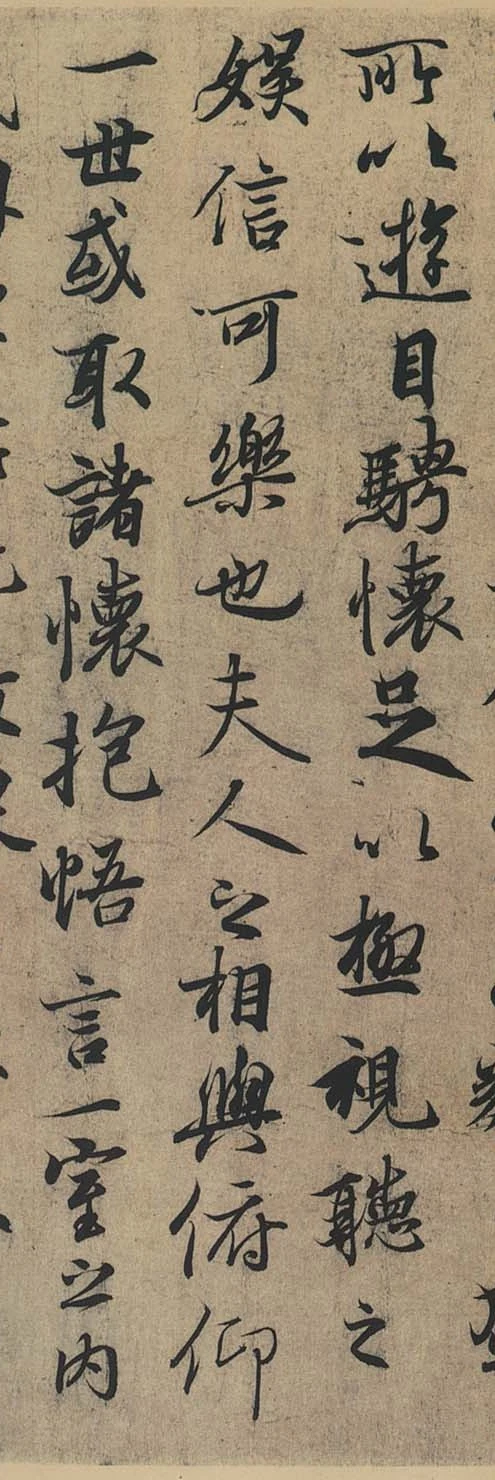
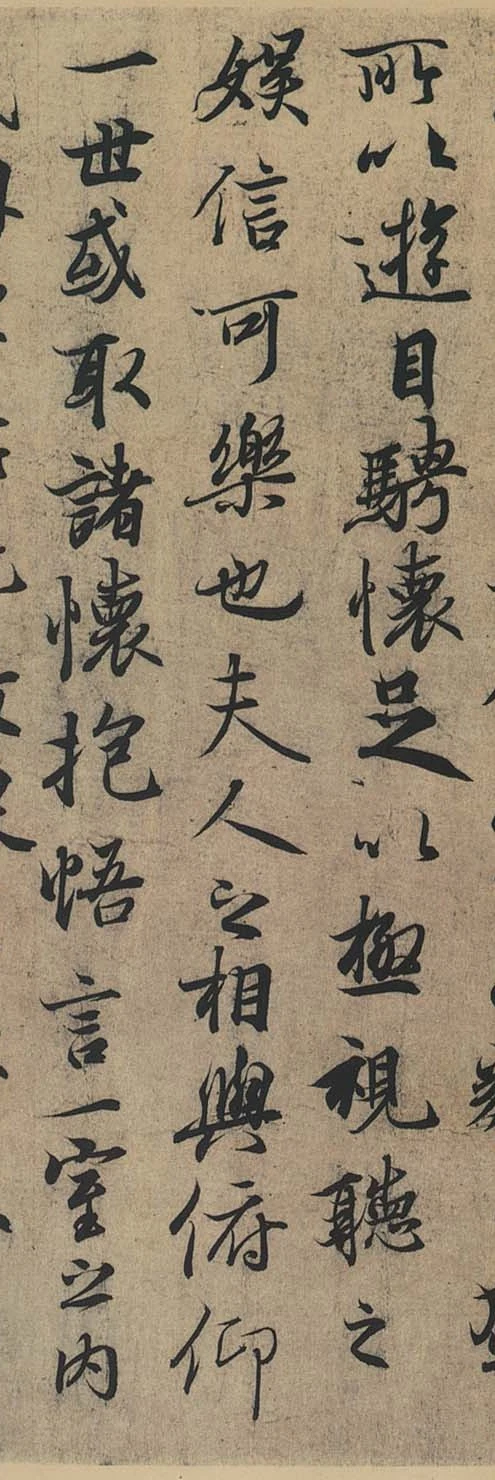
The 之 in 視聽之娛 stops at the bottom of a column; 娛 is already at the top of the next one to the left. Meaning makes a single phrase of them, while the eye travels across unwritten space. The change of column does not sever the phrase. It entrusts the connection to reading.
Continue down through 娛信可樂也, “delight; truly joyful,” and 夫, an introductory particle, and 人, “people,” both spread relatively widely. Then 之 contracts before 相與, “associate with one another,” occupies more space again. This 之 lies within a column. Unlike the previous one, it need not hand the eye to another column. A related linguistic function produces a different visual continuation.
In the adjacent 一室之內, “within one room,” 之 is also near the column’s end, but 內, “inside,” remains beneath it. Both this 之 and the one after 視聽 are low on the page, yet the pauses differ. One has another character immediately below; the other requires a change of column. What remains to be read contributes to the meaning of a position.
Most of these characters have no continuous ink line joining them. The traditional idea of 意連, yilian, “connection in intention,” has a concrete application here. The slant of one form, the placement of the next, the paper between them and a phrase already partly read all help sustain continuity.
With this in view, the passage about looking up at the universe and down at the abundance of things offers more than a general impression of grace. Fine strokes, wide forms, small characters and openings each occupy particular places. They guide the eye while repeatedly allowing its movement to adjust. The lightness has a structure we can identify.
Reflection arrives, but variation keeps more than one direction
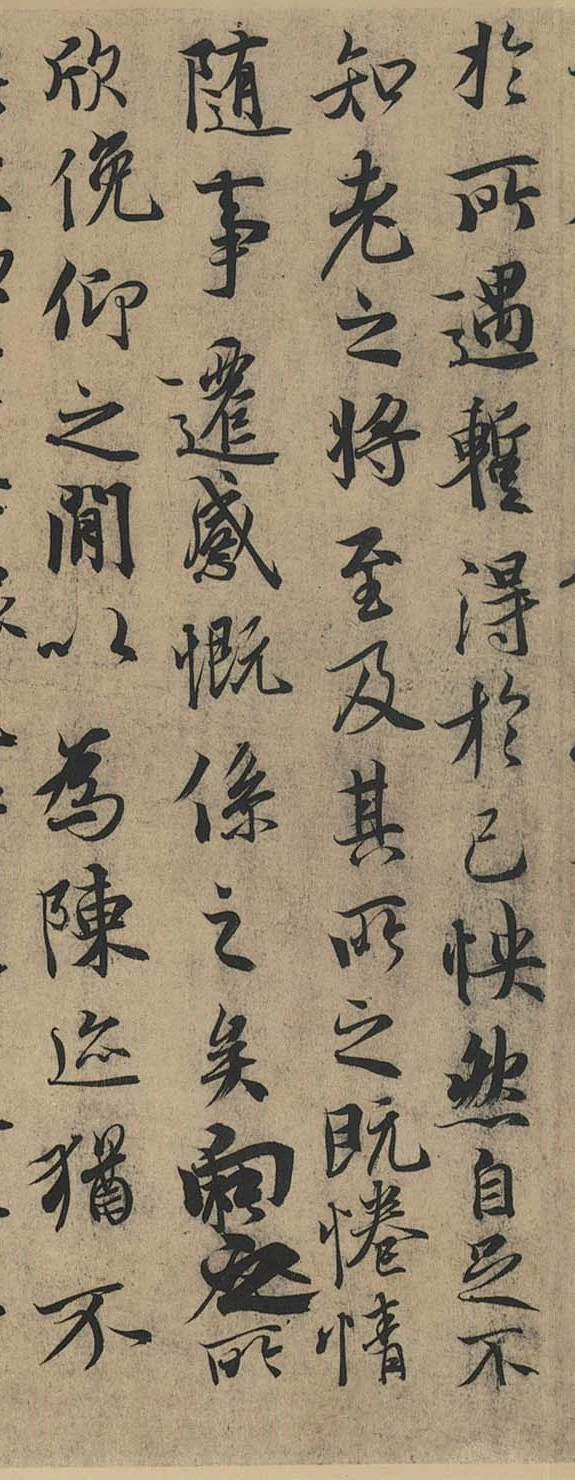
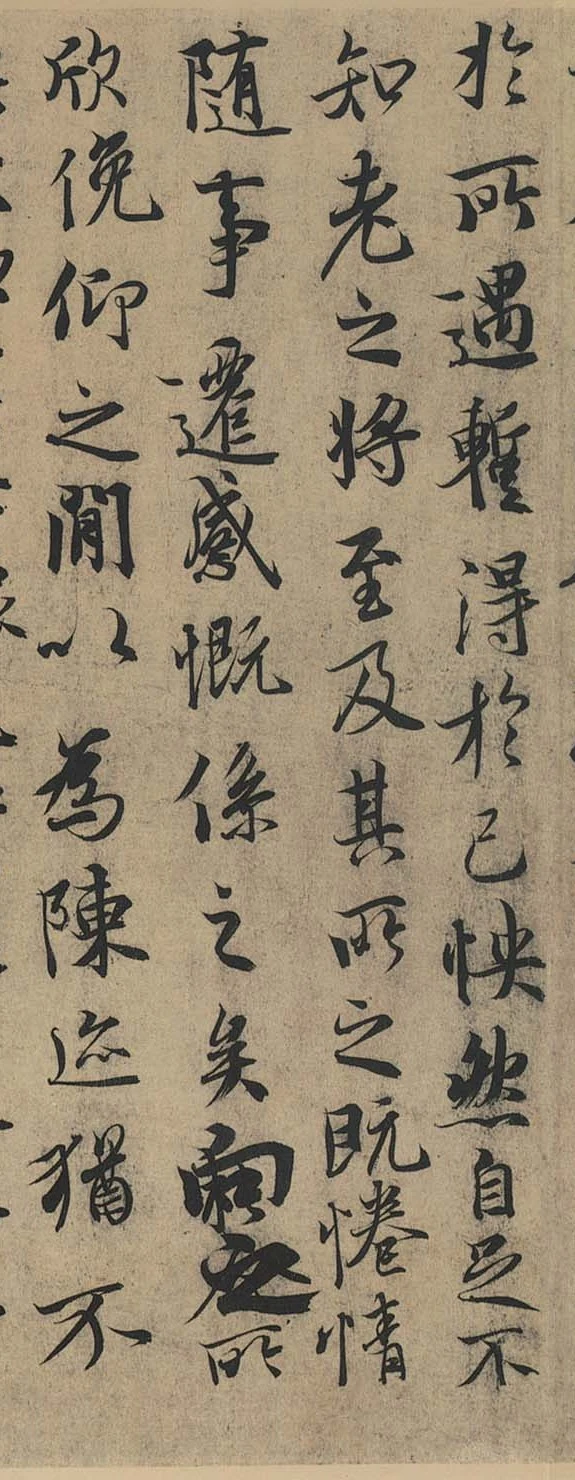
In the second column from the right, 知老之將至, “know that old age is approaching,” lies above 及其所之既倦, “when what one pursues has become wearisome.” There are two more instances of 之 within one column. The upper one sits between 老, “old,” and the longer 將, “about to.” The lower stands between 所 and 既. Between them, 將至及其所 has already formed another sequence of changing heights.
The language is changing too. 老之將至 concerns the approach of old age; 所之 may be understood as what one goes towards or pursues. These instances of 之 do not always perform exactly the same grammatical task. Reading that difference while comparing the characters’ placement gives both meaning and form a further dimension.
The next column to the left, 隨事遷感慨係之矣, “feelings change with events, and reflection follows,” changes markedly in density. 遷, “change or move,” spreads sideways. 感 and 慨, together “reflection” or “deep feeling,” contain many strokes. After 係, “follow,” come the simpler 之 and 矣. Below them lies a dense patch of overlapping ink with smaller writing beside it. The eye meets an open turn, then a crowded interior, then passes through simpler forms.
Some passages are indeed more crowded than the opening. Yet reflection has not made the writing grow uniformly larger and darker. In the left column, the 之 in 俯仰之間, “in the moment of looking down and up,” still extends horizontally with visible paper around it. The characters below 陳迹, “traces of the past,” continue changing their opening and closure. Relations between the columns remain active.
The museum notes that this copy consists of two joined sheets: thirteen columns on the first are more widely spaced, while fifteen on the second draw closer together. That overall observation helps, but the closer spacing still contains simple and complex strokes, expansion and contraction. “The second half is tighter” gives us a starting point for looking, rather than replacing the looking. Palace Museum record
Reading the feelings and reading the forms can illuminate one another. The text places joy within passing time; the writing carries that recognition through columns that retain variation and proportion. Complex reflection reaches us through more than one expression of the ink.
Later readers have already entered the words
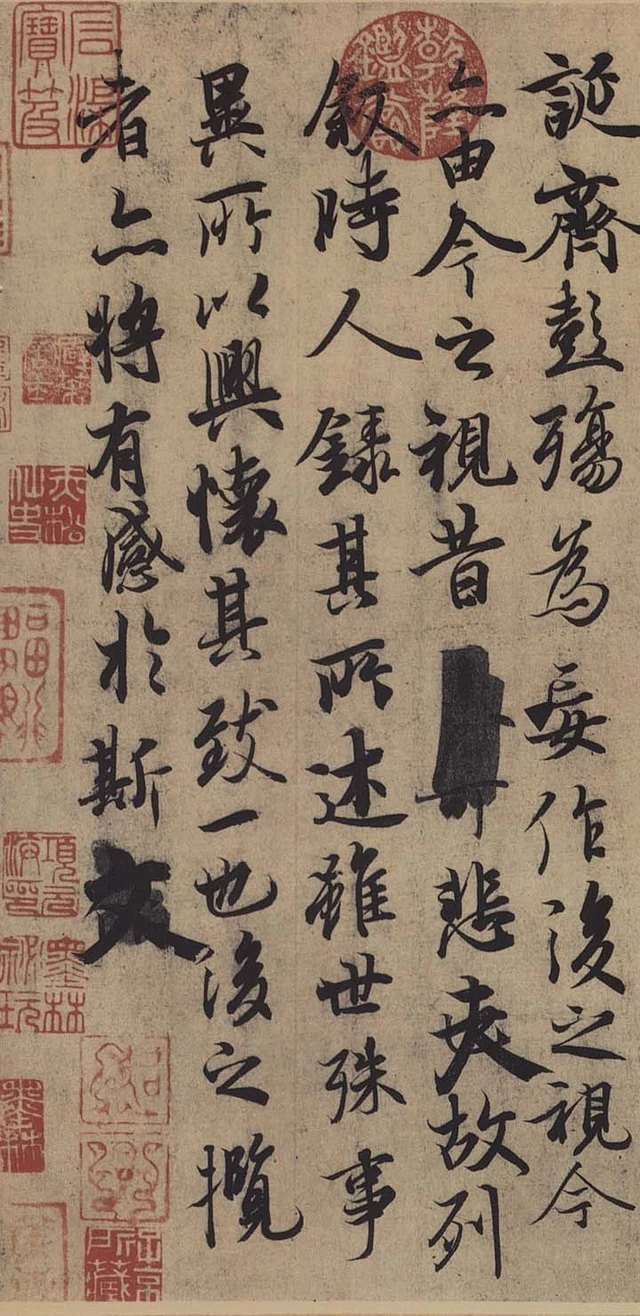
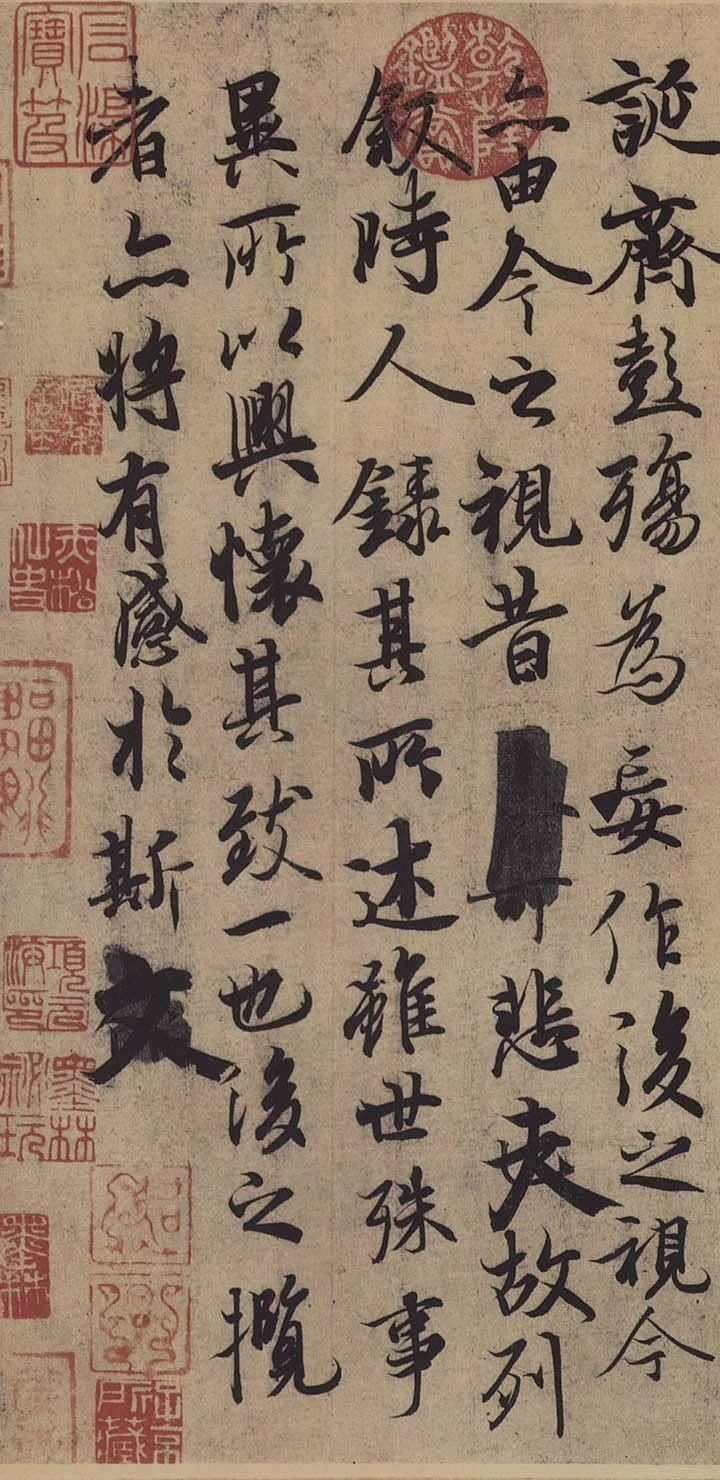
後之視今,亦猶今之視昔 places future and present readers in a relationship: later people will look at us as we look at the past. It does not promise them every detail of the gathering. It recognises that today, too, will have become past.
The two instances of 之 in Figure 5 have not become identical signs merely because the syntax forms a parallel. 後之視今 lies low in the right column, after which we change columns. 今之視昔 resumes the relationship higher in the next column. Meaning makes a comparison; the paper makes us encounter it successively. A printed layout might align the phrases, but here each has its own place.
The final 後之覽者, “those who read later,” also crosses a column boundary. 後之覽 lies near the foot of the penultimate column; 者 moves to the top of the leftmost one. From there we continue down to 斯文, “these words.” After the crossing, a whole closing statement remains. Entering the final column, the eye reads a place being left for future reading.
We are indeed later readers, looking through a Tang copy, later collecting and modern photography. That distance can remain present in the work’s appeal. The copy preserves specific relations between forms and columns for people to come; subsequent seals and mounting give the transmission further layers. Those layers are also conditions of how we see it today.
The Orchid Pavilion Preface is often praised for the variety of its repeated characters. Returning them to their columns reveals that variation need not mean every form competing to be different. A 之 may be broad, small, or a connection to the next column. Large neighbours, small neighbours, dense strokes and blank paper participate in each arrangement. We recognise the same character and discover the relationship it makes in this particular place.
Optional further reading: after recognition, what can still become visible?
Try using two small slips of paper to cover 宙 and 大, and 類 and 盛, in Figure 1, leaving only the two instances of 之. Their widths, sizes and stroke lengths are easy to compare. Then remove the slips. Read from 宇宙 to 大, and from 品類 to 盛.
The characters have not changed. The restored context changes the object of comparison. First we compared two outlines; now we see two sequences of relations. The smaller 之 sits between a dense character above and a broad one below. The wider one makes a different sequence with 宙 and 大. The exercise shows how restoring what a crop removes can change our judgment.
In “Both Answers Are Right. Why Is This One Beautiful?”, I discussed the distinction between obtaining a result and seeing how it holds together. Beginning with two ways of adding a sequence of numbers, the essay turns towards relations that can be examined again. The reminder is useful here; a mathematical proof is not being transferred to calligraphy.
This optional reading through SAE, or Self-as-an-End, makes a second look after recognition more specific. We can say not only “another 之,” but also what stands above it and below it, where its final stroke extends, and where paper remains visible. Another person can return to those places in the same image and may experience them differently.
Such relations give appreciation an object to return to. Beyond the work’s reputation as “the finest running script under heaven,” there is writing that can be examined place by place. Remove the slips, and the character is still the same character. The column has come back into view.
Version, image guide and image permissions
- The object is catalogued as 馮承素行書摹蘭亭序卷, Palace Museum accession 故00002597, ink on paper, running script, 24.5 × 69.9 cm. Following the museum, this essay treats it as a Tang copy. Feng Chengsu is a traditional attribution, not a secure identification; the object is not Wang Xizhi’s autograph. The museum also describes the half Shenlong seal as a later addition. Catalogue title, traditional attribution and research judgment should be distinguished.
- This reading uses published photographs, not an examination of the original. Screen images do not directly yield pressure, speed, exact stroke sequence or a writer’s mental state. A copy particularly requires us to distinguish visible forms from supposed movements in the lost original.
- The full Chinese transcription uses common printed forms and retains 悟言 and 趣舍. 岭/領, “ridge,” 修/脩 and 系/係 distinguish modern transcription from historical forms; modern fonts are not facsimiles. Punctuation and paragraphing are editorial. Column numbers count the main text from right to left; small side additions do not count as separate columns.
- All six shared images come from Wikimedia Commons, File:LantingXu.jpg, 4513 × 1480 pixels, checked against the museum collection image and official illustrations on printed pages 16–18 of Forbidden City, 2022, no. 12. Processing consists only of rectangular cropping, proportional reduction and JPEG encoding. No strokes were added, seals removed, colours adjusted, or writing generated or redrawn.
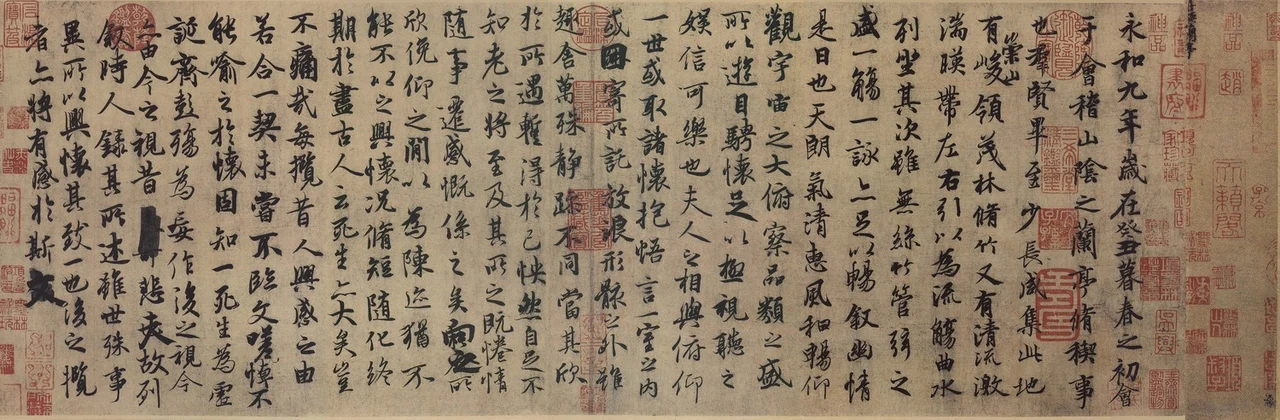
- 00: complete main-text overview contains all twenty-eight columns, but excludes the title section and later colophons. Read from the upper right, down each column, then move left. Image 01 compares the two 之 in column 9; 02 locates the opening; 03 keeps the connection between 視聽之 and 娛; 04 shows columns 15–18; 05 shows the final five columns. The five details appear above as Figures 1–5. The overview is one reduced photograph, not a reconstructed full mounted scroll.
- Commons labels its file PD-Art/Public Domain Mark and lists an earlier source. That statement is not an image licence granted to this package by the Palace Museum. No individual permission has been obtained from the museum or other relevant rights holders. Attribution does not establish permission or guarantee reuse for every purpose and jurisdiction. Check applicable requirements before further publication. See the accompanying image notes and permissions document.
- Red seals belong to later collecting; they are not assigned to the paper originally facing Wang Xizhi or the Tang copyist. Later mounted colophons are not treated as a continuation of the preface’s handwriting.
Further images and reading
- Palace Museum collection record: medium, dimensions, the Tang-copy identification, the Feng attribution and the half Shenlong seal. The page image is a partial preview, not a complete high-resolution photograph.
- Official PDF: “The Historical Transmission of Copying Ancient Painting and Calligraphy,” Forbidden City, 2022, no. 12: PDF pages 3–4 reproduce the main text across a spread; page 5 gives the detail around 宇宙之大 and 品類之盛. Printed pages 16–18.
- Wikimedia Commons: File:LantingXu.jpg: the direct source of all six images and its rights statement. Public original, 4513 × 1480.
- Han Qin, “Both Answers Are Right. Why Is This One Beautiful?”: the complete Ray 03 essay used in the optional further reading.