By the time the middle column reaches 金戈, “weapons of war,” it is almost at the bottom of the silk. The upper part of 金 opens out: two substantial diagonal strokes form something like a roof, while the lower part draws out a long, fine oblique line. The following 戈 brings a broad diagonal down across it. To the right, 山猿与, “mountain, gibbons, with,” combines a small character with long, slender curves. To the left, 青青, “green upon green,” is represented by one 青 followed by a repetition mark. These three column endings do not finish in the same way.
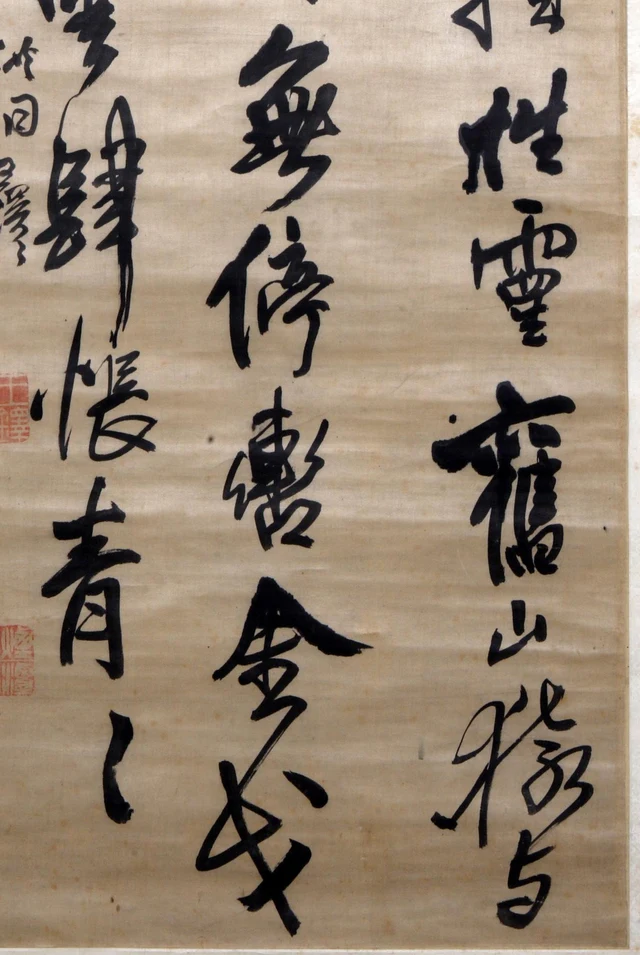
Isolate 戈, the last large character in the middle column, and it can look like a single forcefully leaning form. Restore its neighbors, and its weight acquires other causes. The slender 猿, “gibbon,” on the right leaves open ground; on the left there is also an interval between 青 and its repetition mark. The heavy diagonal occupies the lower area, made more conspicuous by these nearby openings. The vertical force of this work is built from supports that do not stand at the same height.
The Palace Museum catalogues this silk hanging scroll as Wang Duo’s Poem in Running Script. It dates to 1646 and is signed 丙戌十二月。洪洞王铎: “Twelfth month of the bingxu year. Wang Duo of Hongdong.” The large characters give one of his own five-character regulated poems. Citing volume 17 of the Nishanyuan Selected Works, the museum calls it 念濯秀漱六, “Thinking of Zhuoxiu and Shuliu.” The inscription itself writes the first name as 擢秀, rather than 濯秀. Our object is this particular scroll, with its dedication, correction and supplementary note. Museum record
How the three large columns join
Begin with the whole-work orientation image. Read down each column, starting on the right and moving left. The right column begins 乱后, “after the upheaval,” and ends 与, “with.” The middle picks up with 狎, “to be familiar with,” and ends 戈. The left begins 各, “each,” and finishes 青青. The smaller writing at the far left supplies the dedication, address, correction and date; it is not a fourth equally sized column of the poem.
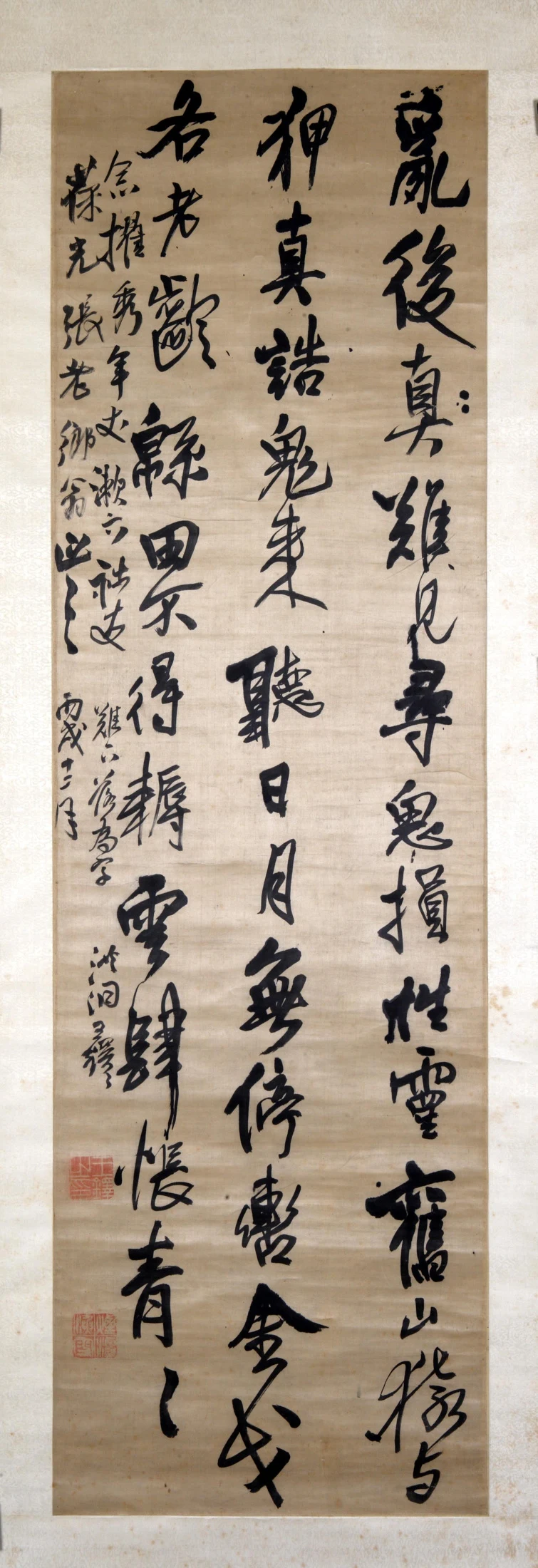
Here is the complete poem in its corrected reading. 为 has been supplied from Wang’s own note, 难下落为字, “the character 为 was omitted below 难.” The 真 beside the opening has deletion dots. The final repetition mark is expanded into a second 青. Punctuation and five-character lines are editorial, rather than the divisions on the silk.
乱后难为见,寻思损性灵。
旧山猿与狎,真诰鬼来听。
日月无停辔,金戈各老龄。
緜田不得耨,云肆怅青青。
After the upheaval, it is hard to meet; thinking of you wears away the spirit.
In the old mountains I would be familiar with gibbons; even spirits would come to hear the Daoist revelations.
Sun and moon never halt their reins; amid weapons of war, each of us grows old.
The fields cannot be hoed; before the green mountain country, I grieve.
This is a reading of the poem’s general sense. 狎 means intimacy or familiarity; 辔 is a horse’s reins; 耨 means to hoe or cultivate. I have not independently located an annotated edition that settles the precise references of 緜田 and 云肆 in the last couplet. The translation therefore retains the limited sense of fields and mountain country without naming a particular place.
The complete inscription, following the museum, reads: 念擢秀年丈、漱六社友。葆光张老乡翁正之。难下落为字。丙戌十二月。洪洞王铎。 It means: “Thinking of the elder friend Zhuoxiu and my poetry-society friend Shuliu. Presented to the venerable fellow townsman Zhang Baoguang for correction. The character 为 was omitted below 难. Twelfth month of the bingxu year. Wang Duo of Hongdong.” Hongdong is the place named in this signature; the inscription alone is not grounds for changing the account of Wang’s birthplace.
The poem’s immediate circumstances are separation, longing and the passage of years. 乱后 at the opening and 金戈 later place its imagined mountain life amid war. The “old mountains” are something looked back toward, rather than an excursion easily undertaken. The year 1646 falls after the transition from Ming to Qing. That setting helps explain why old friends, the hills and aging appear together. The particular forms of the brushwork still deserve observation in their own right.
A large 聽, then a suddenly small 日
Read down from the top of the middle column. 狎, 真 and 诰 each occupy their place. At 鬼来, “spirits come,” the line becomes finer, and the lower part of 来 stretches to both sides. 聽, “to hear,” then abruptly enlarges. In this traditional form of 听, the 耳 component on the left is heavy, with closely stacked horizontals. The right side is lighter, its curving lines turning outward. Density and openness already coexist inside one character.
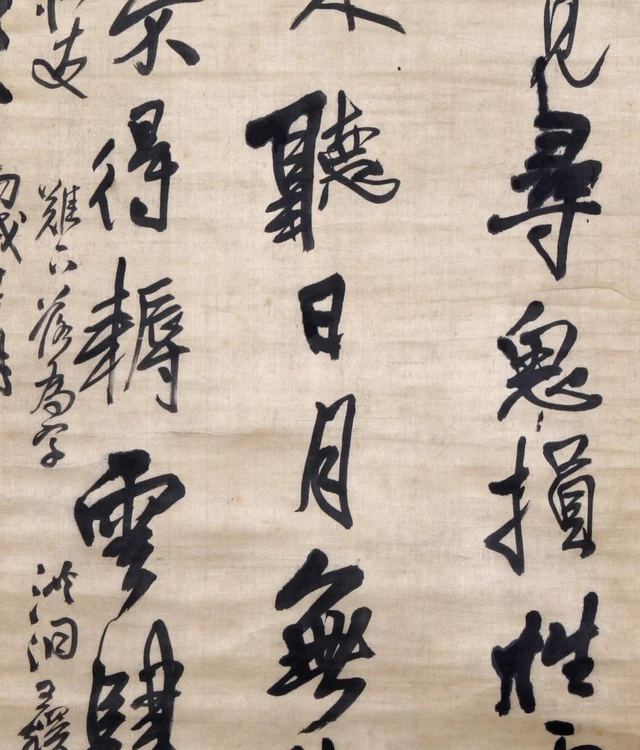
Below 聽, 日, “sun,” contracts into a short, narrow form. 月, “moon,” then lengthens the space: its outline is lean, with a narrow opening inside. 無, “without,” gathers into a heavier mass again. The phrase 日月无停辔, “sun and moon never halt their reins,” moves forward readily in meaning. Visually, however, it asks us to pass through contraction, elongation and concentration. One evenly paced descent cannot account for it.
A comparable change takes place in the right column, without lining up neatly with the middle. 寻 is dark and heavy; 思 and 损 beneath it turn in finer strokes; 性 becomes heavier again. The dense places in the two columns do not form one horizontal belt. When the eye encounters a large character in one column, it may find a fine character and a larger gap beside it. A crowded form therefore has neighboring openness to answer it.
The traditional term 行气, the continuity or vital flow of a column, becomes concrete here. Reading downward, we follow relations between the end of one character and the placement of the next. At the same time, a column’s expansion continually changes its distance from its neighbors. Continuity involves both turns within characters and responses between columns. Cutting every character into an identically sized square would immediately lose these staggered relations.
The dense horizontals on the left of 聽, and the tiny white interior of 日 below it, also make the weight of ink specific. Darkness is not one undifferentiated surface: it has gaps, edges and changes of direction. Wang allows differences of weight into each character and into the scale of several characters together. The closer the inspection, the less sufficient a single adjective such as “powerful” becomes.
How leaning continues without dispersing
Return to the upper part of the scroll. At the upper right, 乱, “upheaval,” contains densely turning strokes and a terminal portion extended to the right. The long diagonal of 后 below it also opens toward the lower right. In the middle column, 狎 has a long vertical portion and leads to a substantial, relatively upright 真. The left column’s first character, 各, opens on a more lateral, oblique axis. The three beginnings do not share one orientation.
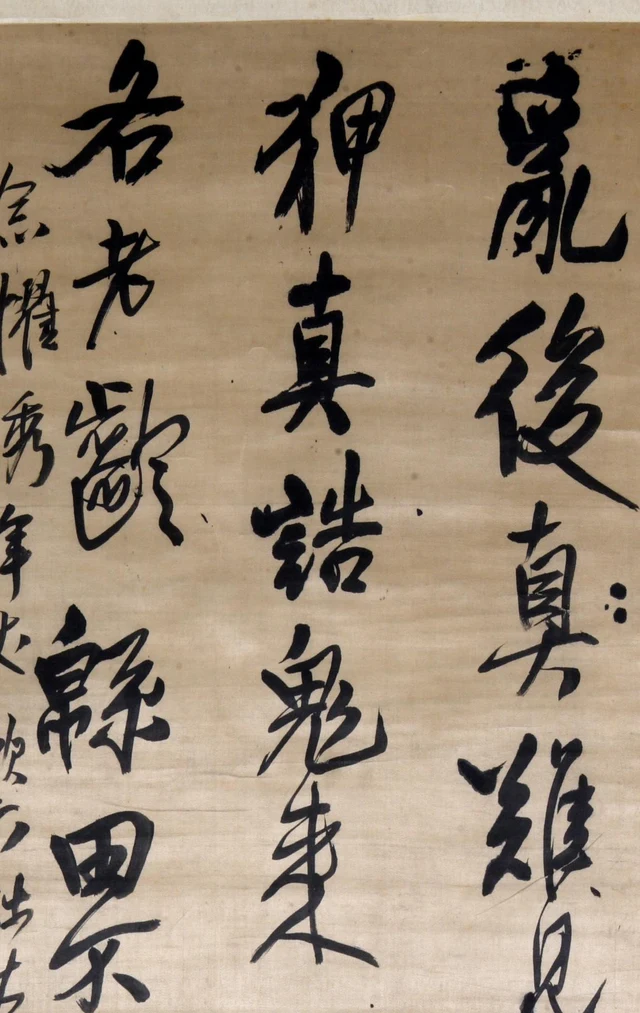
The succession of 鬼 and 来 in the middle is particularly clear. After the lower turn of 鬼, a slender central movement in 来 takes up the downward route before spreading outward at the end. This passage lacks the weight of 难 and 寻 beside it, but its fineness does not make it vanish. Darker masses on either side make the direction of the finer line easier to see.
Here the traditional phrase 欹正相生, the mutual generation of leaning and uprightness, has practical value. 欹 means inclination. 正 need not mean an absolutely vertical position: it may be a comparatively stable horizontal support within a character, or a clear downward movement nearby. A leaning large character does not have the same effect beside every other leaning form. In this scroll, the opening of 金 and the diagonal passage of 戈 work with the slim 猿 and small 与 to their right. Together they establish an order that can continue through displacement.
In the whole-work image, the three vertical frameworks are clear. Enlarged details reveal how each sways from side to side. Broad uprightness and local inclination do not cancel one another. This is also a feature of the hanging-scroll format: the whole can be available at once. We may follow the textual order, but we can also compare a character laterally with those beside it. The poem requires a sequence; the composition lets one glance connect several different positions.
Small writing keeps the work’s history beside it
The small note at the left, 难下落为字, resolves a problem near the upper right that meaning alone might not settle. 真 carries deletion dots, the large text reads 难见, and the note says that 为 was omitted after 难. The corrected line is thus 乱后难为见. The explanation is on the left, but its target is at the far right. The reader must bring the already-read opening back into view.

This small writing also changes the space on the left. 龄, 緜 and 田 in the third large column are already substantial; the continuous smaller inscription beside them thickens the upper-left area. Lower down, the supplementary note and signature enter in separate groups. Beside the final 青 and repetition mark, the space opens again. The inscription cannot simply be removed from the picture once the large characters have been read. It identifies the recipient while participating in the pattern of density before us.
Nor do the deletion dots turn 真 into blank ground. The character remains in the right column, retaining its height and width while leaving the corrected poem. A complete transcription lets us read correctly. A complete image shows that correction did not cancel the form already written.
Return once more to 金戈 at the bottom of the middle column. It is now more than an attractive detail to copy. It belongs with the changing sizes of 聽日月無 above it, the finer ending of the right column, and the dedication, correction and signature on the left. Wang has made a forty-character poem into a vertical space that can be surveyed, enlarged and compared repeatedly. Its strength lies in these relations of displacement and mutual support.
Optional reading: What remains after deletion?
Read only the corrected text above, then return to Figure 3. That deleted 真 is no longer in the corrected poem, yet it remains in the image. 为 has entered the corrected text without being inserted at the same size in the right column. Written space and the corrected sentence preserve different kinds of information.
In The Wood Still Holds That Dry Year, I considered verifiable histories through tree rings, stone steps and repairs. SAE’s “beauty of causation” offers a limited, useful direction here: recognize a sequence through what remains, without supplying an unverifiable inner monologue for it.
This scroll provides more substantial evidence than speculation: the dots beside 真 and the small note 难下落为字 really do require us to connect the main text, correction and supplement. Looking closely need not praise error or translate the dots into remorse. It simply lets us see more specifically how a finished work retains differences left by its making.
Return that observation to the three large columns. It extends the study of brushwork and composition. A position easily passed over gains weight again: the 真 that is no longer pronounced still occupies part of the right column’s height.
Image and transcription notes
- This reading uses the Palace Museum’s public photographs, not an encounter with the original. The museum classifies the work as running script; frequent cursive forms do not justify changing its catalogue title. Recorded dimensions: 172.8 × 52 cm.
- The source is the museum viewer’s public Deep Zoom photographic data, assembled by the documented coordinates and overlaps, then cropped and proportionally reduced. No characters were generated or repaired; no seals were removed; colors and aspect ratio were not changed. The orientation image shows the main text and inscriptions, not necessarily every part of the mounting.
- The ancient poem is public-domain material. The museum’s transcription supports the reading. 濯秀 belongs to its cited poem title, 擢秀 to its transcription of the inscription; the difference is retained. 緜 follows the catalogue. The final couplet is translated conservatively.
- A photograph does not establish exact stroke-by-stroke timing, speed or mental state. The correction note demonstrates an omission, but cannot reconstruct the moment of every stroke.
- Museum permission to republish the photographs has not been obtained. These details are supplied for this reading. Before public publication, consult the museum’s image authorization and copyright statement.