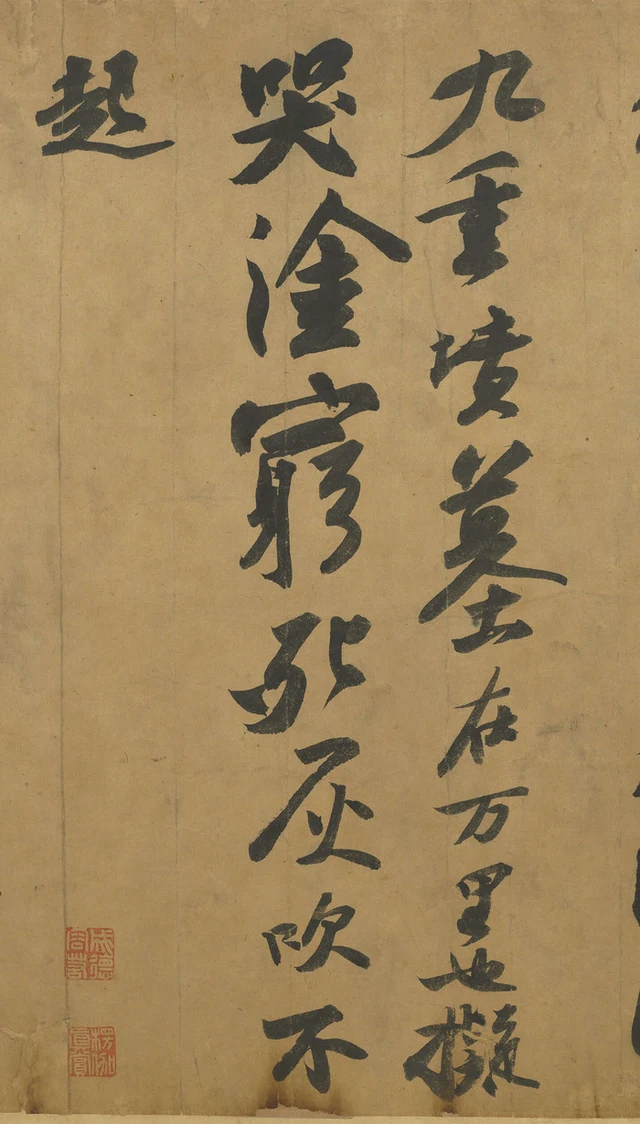
When we reach “dead ashes cannot be blown alight,” the eye still has somewhere to go. The character 不, “not” or “cannot,” has reached the bottom of a column. The final character 起, “rise,” and here “rekindle,” stands at the top of the next column to the left. To finish these five Chinese characters, we have to move from the lower edge of the paper back up to the left. Below 起 lies a long stretch of paper with no further poem text.
The character itself is far from faint. Its lower strokes extend to the right, and the ink remains clearly present. The poem speaks of ashes that cannot be brought back to life; the writing leaves its last character conspicuously high on the page. Our first encounter is with two different kinds of ending: the meaning approaches stillness, while the eye must make one more move.
Much of the force of the Cold Food Scroll, or Hanshi tie (寒食帖), lies in this uneven distribution of writing. Every verse line contains five Chinese characters. On the paper, some gather into substantial masses; others contract into fine strokes. A column may accommodate many characters, or it may end after just one. The words remain readable, but the eye is repeatedly asked to change its stride.
The handscroll now held by the National Palace Museum in Taipei, catalogued in English as The Cold Food Observance, includes Su Shi’s poem manuscript, a colophon by Huang Tingjian, and inscriptions and collectors’ seals added later. A colophon is a written comment appended to a work. The scroll opens from right to left; each vertical column is read from top to bottom. For now, we will look at Su Shi’s two poems and his closing note, keeping later writers’ large and small characters, and the red seals, distinct from his writing.
The poems were composed in 1082, the fifth year of the Yuanfeng reign, during Su Shi’s banishment to Huangzhou. The surviving calligraphy bears no year of execution. The museum’s account places the writing after the poems’ composition but leaves its exact date uncertain. National Palace Museum, work description, in Chinese
First read both poems
The Chinese texts below give the poems as corrected in the manuscript, using commonly printed simplified characters. Punctuation and five-character verse lines have been added for reading; they do not reproduce the manuscript’s columns. Each complete Chinese poem is followed by a complete English verse translation and an explanation. “Cold Food” names a spring festival; the second poem associates it with offerings at the graves of the dead.
The images retain the historical character forms. Where a form differs from the simplified transcription, the discussion identifies both: 灶 corresponds to 竈, “stove”; 湿 to 濕, “wet”; 苇 to 葦, “reeds”; 见 to 見, “see”; 乌 to 烏, “crow”; and 头 to 頭, “head.” You do not need to know Chinese to follow the locations described below.
The first poem
自我来黄州,已过三寒食。
年年欲惜春,春去不容惜。
今年又苦雨,两月秋萧瑟。
卧闻海棠花,泥污燕支雪。
暗中偷负去,夜半真有力。
何殊病少年,病起头已白。
Since I came to Huangzhou,
three Cold Food festivals have passed.
Each year I long to hold the spring;
spring leaves and will not let me keep it.
This year, again, the bitter rain:
two months as desolate as autumn.
Lying here, I hear the crabapple blooms have fallen,
their rouge and snow now stained with mud.
Someone has stolen them away in darkness:
what strength there is at midnight.
Like a young man stricken by illness,
who rises to find his hair already white.
Three Cold Food festivals have passed since Su Shi arrived in Huangzhou. Every year he wants to hold on to spring, and every year it eludes him. Now prolonged rain has made two spring months feel as bleak as autumn. Lying down, he hears that the crabapple blossoms have fallen, their pink and white petals muddied. It is as if something beautiful has been carried away under cover of darkness. The flowers then become a young person who has been ill: by the time he gets up, his hair has turned white.
燕支 means rouge, the pigment evoked by the flowers’ colour. The phrase 偷负去, “steal away, carrying on one’s back,” recalls the Zhuangzi, in the chapter “The Great and Venerable Teacher”: however securely something is hidden, someone strong may carry it off at midnight. Here the fallen blossoms give the loss of spring a visible form. The last line suddenly exchanges the passing of a season for a human being’s ageing. Zhuangzi, chapter 大宗师, Chinese text
The second poem
春江欲入户,雨势来不已。
小屋如渔舟,濛濛水云里。
空庖煮寒菜,破灶烧湿苇。
那知是寒食,但见乌衔纸。
君门深九重,坟墓在万里。
也拟哭涂穷,死灰吹不起。
The spring river threatens the door;
the rain keeps coming without end.
My little house is a fishing boat
in a haze of water and cloud.
In the empty kitchen, cold greens simmer;
in the broken stove, wet reeds burn.
How would I know it is Cold Food?
I only see a crow carrying paper.
The ruler’s gates lie ninefold deep;
the graves are ten thousand li away.
I too would weep where the road runs out,
but dead ashes cannot be blown alight.
The river is close to entering the house, and the rain will not stop. The small dwelling resembles a fishing boat lost in mist and cloud. The kitchen is empty; there are greens to cook, and damp reeds to burn in a broken stove. What tells him that the festival has come? A crow carrying paper used in offerings to the dead. The court is shut away behind successive gates; the ancestral graves lie far off in his home region. He thinks of weeping like Ruan Ji at the end of a road, yet feels as spent as ashes that cannot be revived.
“The ruler’s gates lie ninefold deep” describes a court that cannot be approached. “Ten thousand li,” using a Chinese unit of distance, expresses the remoteness of the graves rather than a distance to be measured. 哭涂穷, “weep where the road runs out,” invokes Ruan Ji, who would weep and turn back when his journey brought him to a dead end. 死灰, “dead ashes,” also recalls Han Anguo’s words in a time of disgrace: even dead ashes may burn again. The poem closes down that possibility with 吹不起, “cannot be blown alight.” Book of Jin, biography of Ruan Ji, in Chinese; Taiwan Ministry of Education, source of the expression “dead ashes rekindle,” in Chinese
The desolation of the two poems develops through very concrete things. In the first, spring, flowers and youth are taken away; the strength belongs to whatever takes them. The second moves indoors, to a cooking pot, a stove and reeds that are difficult to burn, then looks towards the inaccessible court and home. Its final ashes still belong to the stove before us. Desolation has not dissolved into an abstract word for a feeling.
We have read the poems, but we have not finished looking at the writing. Why do these same sentences, on this particular paper, still send the eye on a journey?
The poem has verse lines and the ink has another route
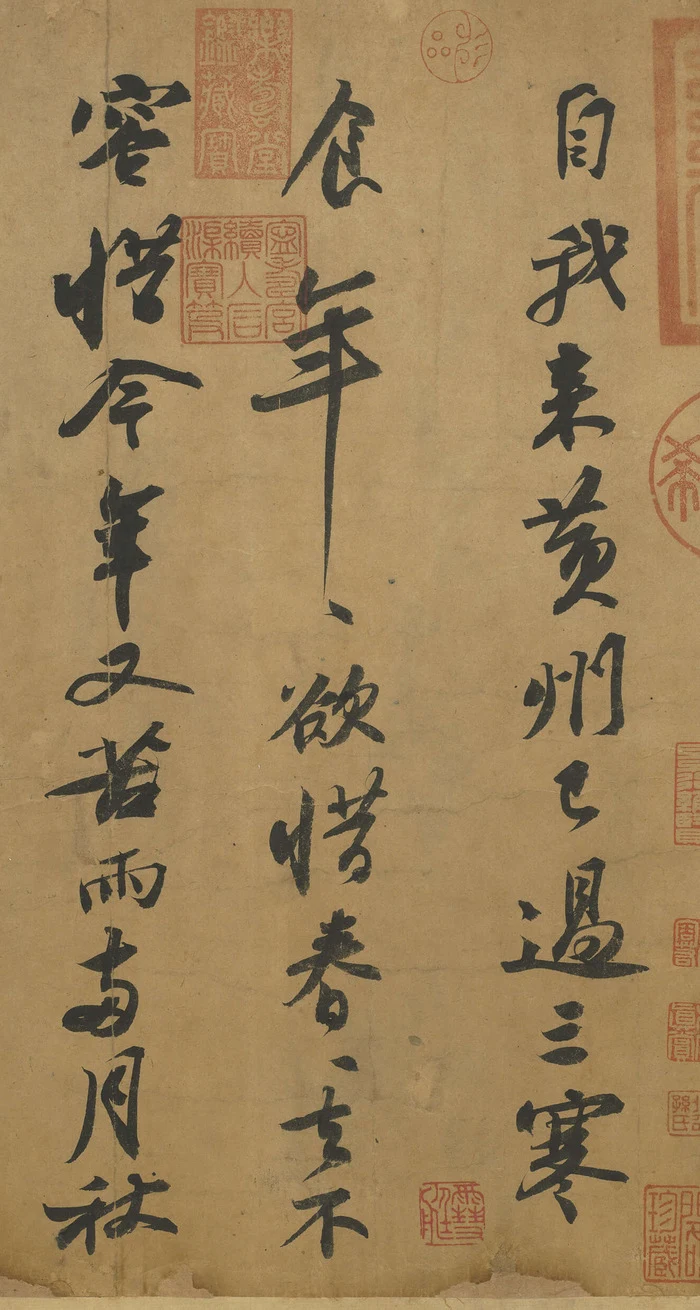
At the beginning of the scroll, 自我来黄州, “Since I came to Huangzhou,” does not occupy a column by itself. The next phrase, 已过三寒, “already three Cold…,” continues beneath it. Only 食, “food,” moves to the top of the next column to the left. We know that 寒食, “Cold Food,” is a single festival name, but the eye has to cross between columns to bring the two characters together.
Farther left, 春去不容惜, “spring leaves and will not let me keep it,” is split again. The last two characters, 容惜, “allow [me] to cherish,” begin a new column, followed by 今年又苦雨,两月秋, “this year again bitter rain, two months [like] autumn.” The end of one verse line and the start of the next pass through the same column. The manuscript’s column breaks do not enclose each unit of verse. Meaning remains continuous, while the changing lengths on the paper help organise that continuity.
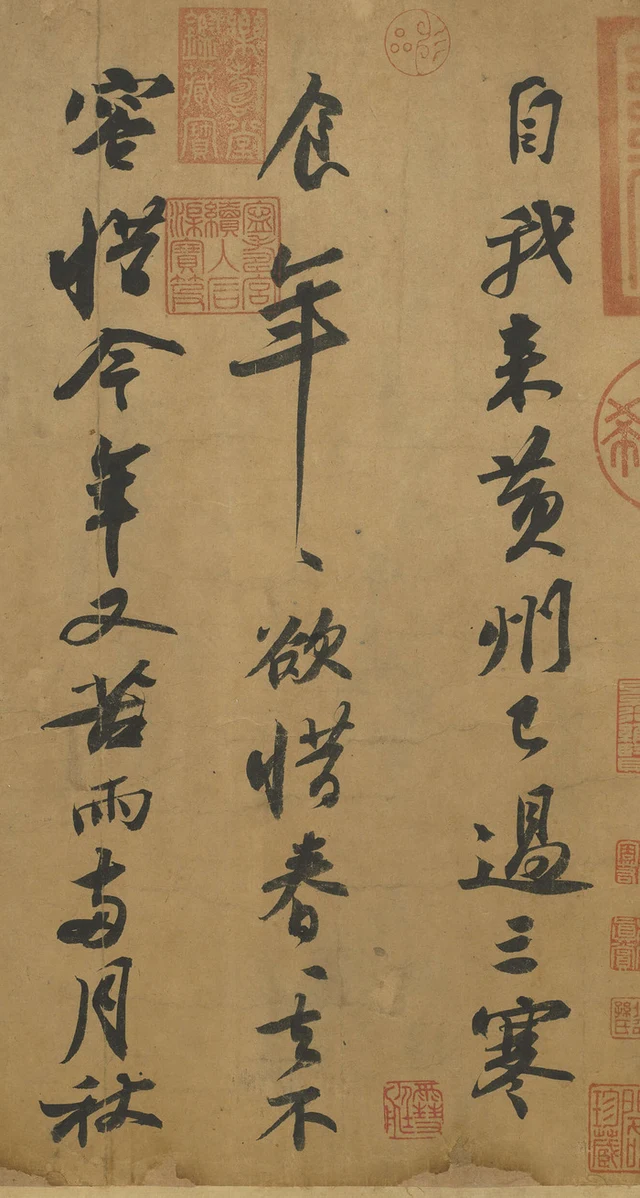
The repetition of 春, “spring,” crosses a verse boundary: the first instance ends “long to hold the spring”; the second begins “spring leaves.”
Pause over 年年, “year after year.” In the upper half of the middle column, 年 has substantial horizontal strokes across its upper body, while its last stroke extends a long way down. This separates the main body of the character from the following 欲, “wish” or “long to.” In the column immediately to its right, one character follows another down the paper. The left column, beginning with 容惜 and continuing through “this year again bitter rain, two months [like] autumn,” contains more characters. Together these three columns already offer routes of different densities. Calling the opening “regular” makes sense only in relation to what follows; it does not mean that every early character stays inside an equally sized square.
Most of these characters are not joined by a continuous ink line. Their connection depends on the direction a preceding stroke suggests, the position where the next character begins, and the width of the surrounding blank spaces. Traditional calligraphy criticism calls this 行气, xingqi, the continuity or flow within a column. We can locate that “flow” in quite tangible things: the eye follows a long stroke down, meets a smaller character, pauses, then turns towards the neighbouring column from a character that spreads sideways. Characters can connect even where their strokes do not touch.
Seen across the whole of Su Shi’s text, the route is not a simple slope of increasing speed. In the second poem the writing does grow markedly larger and heavier, but it also narrows, lightens and gathers itself again. Each passage needs to be seen beside its neighbours.
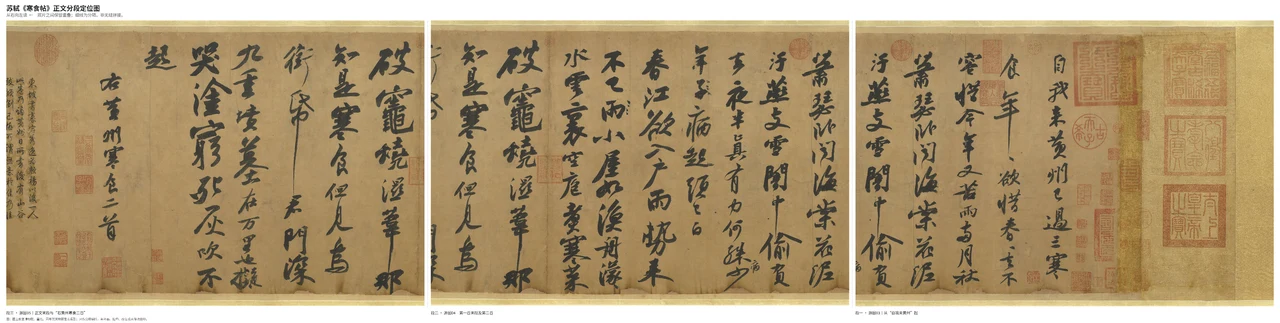
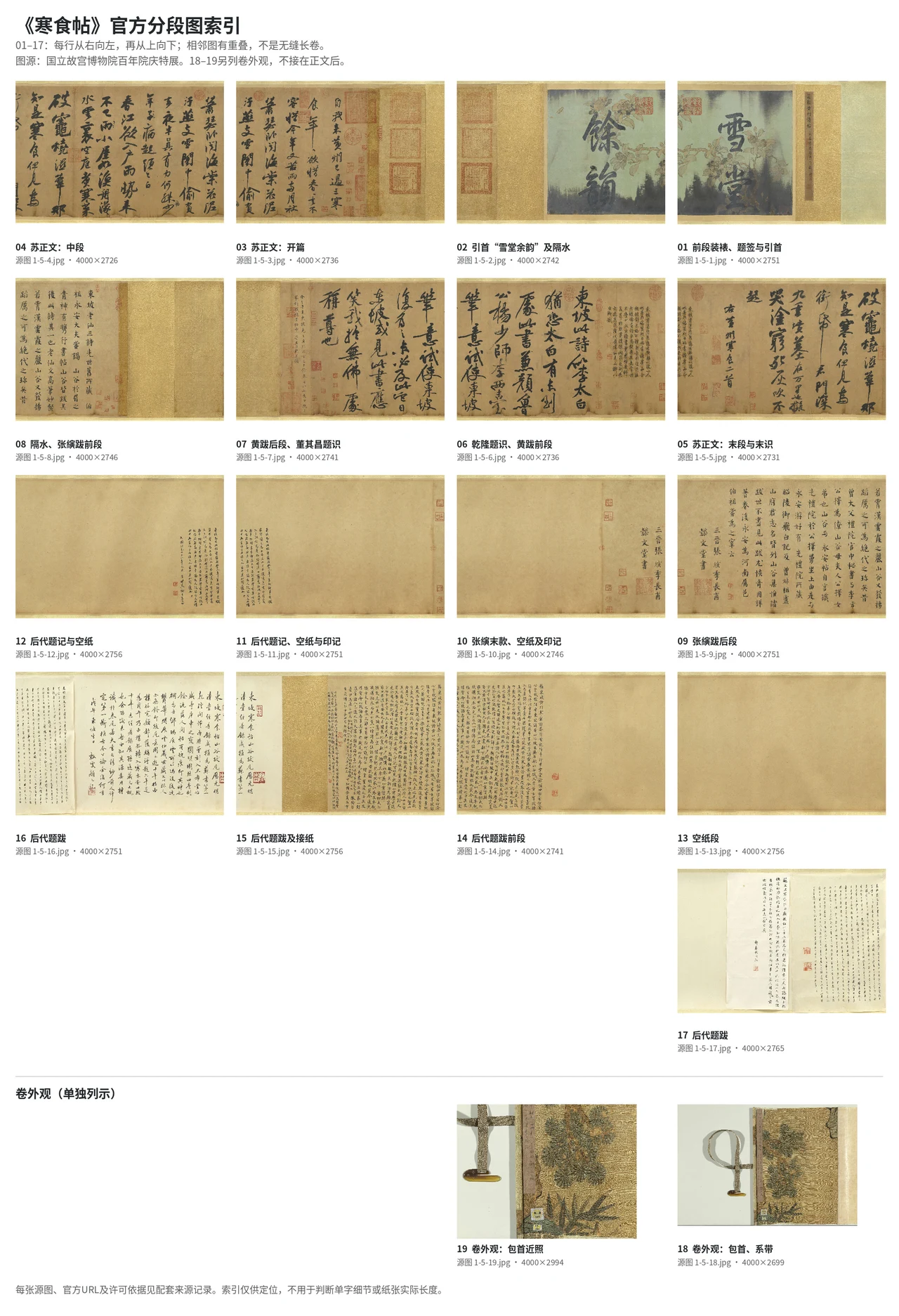
Open the overview of Su Shi’s text; browse the museum’s high-resolution images from its 2025 exhibition. The overview has Chinese labels: its right panel shows the opening, its centre the middle, and its left panel the ending. Read the panels in that order. They overlap and do not form a seamless photograph.
Fine strokes and open spaces within heavy ink
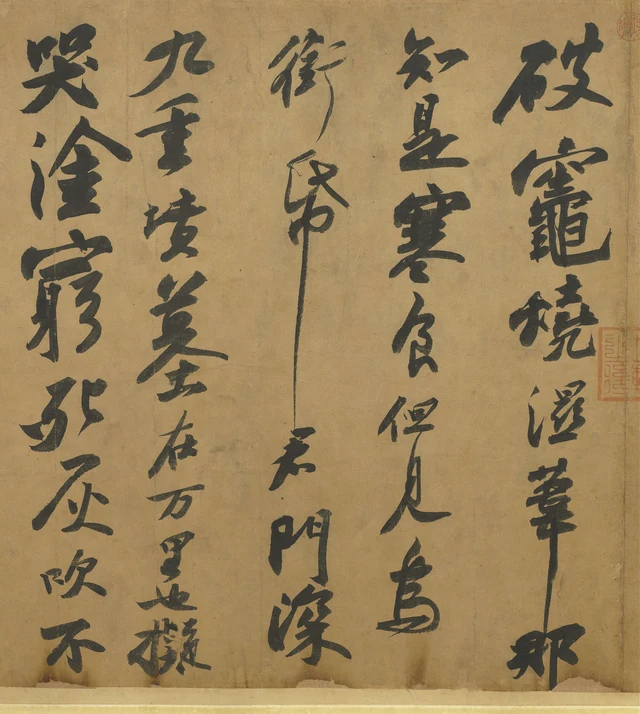
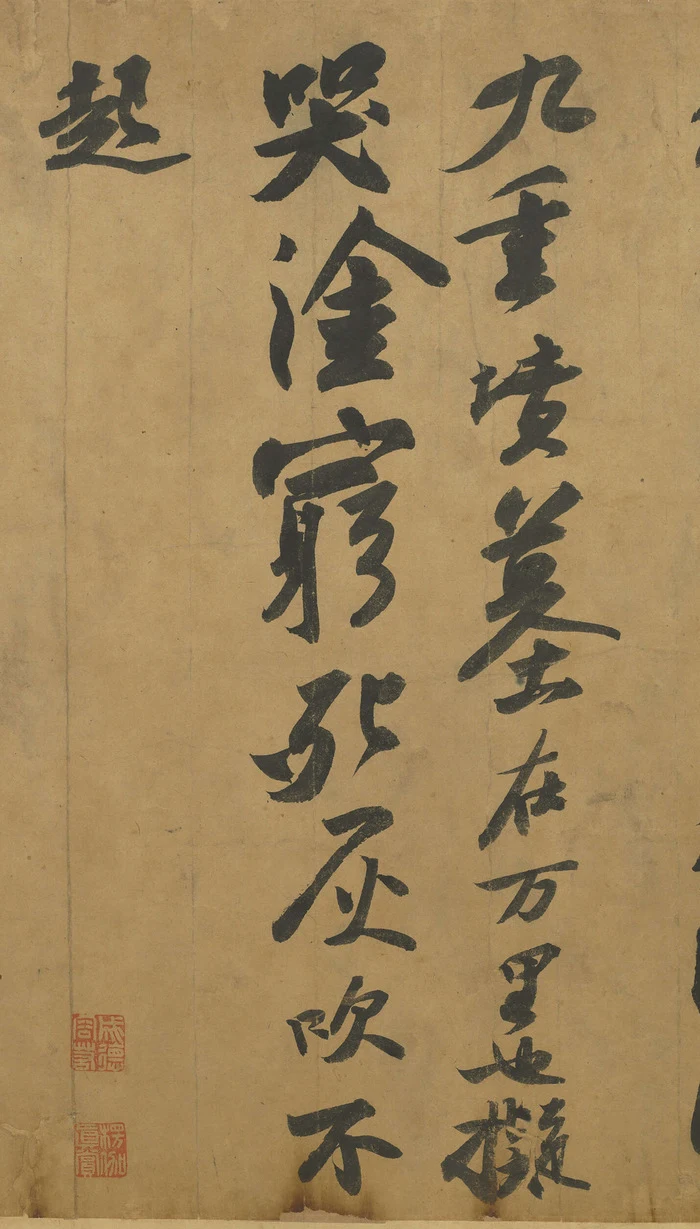
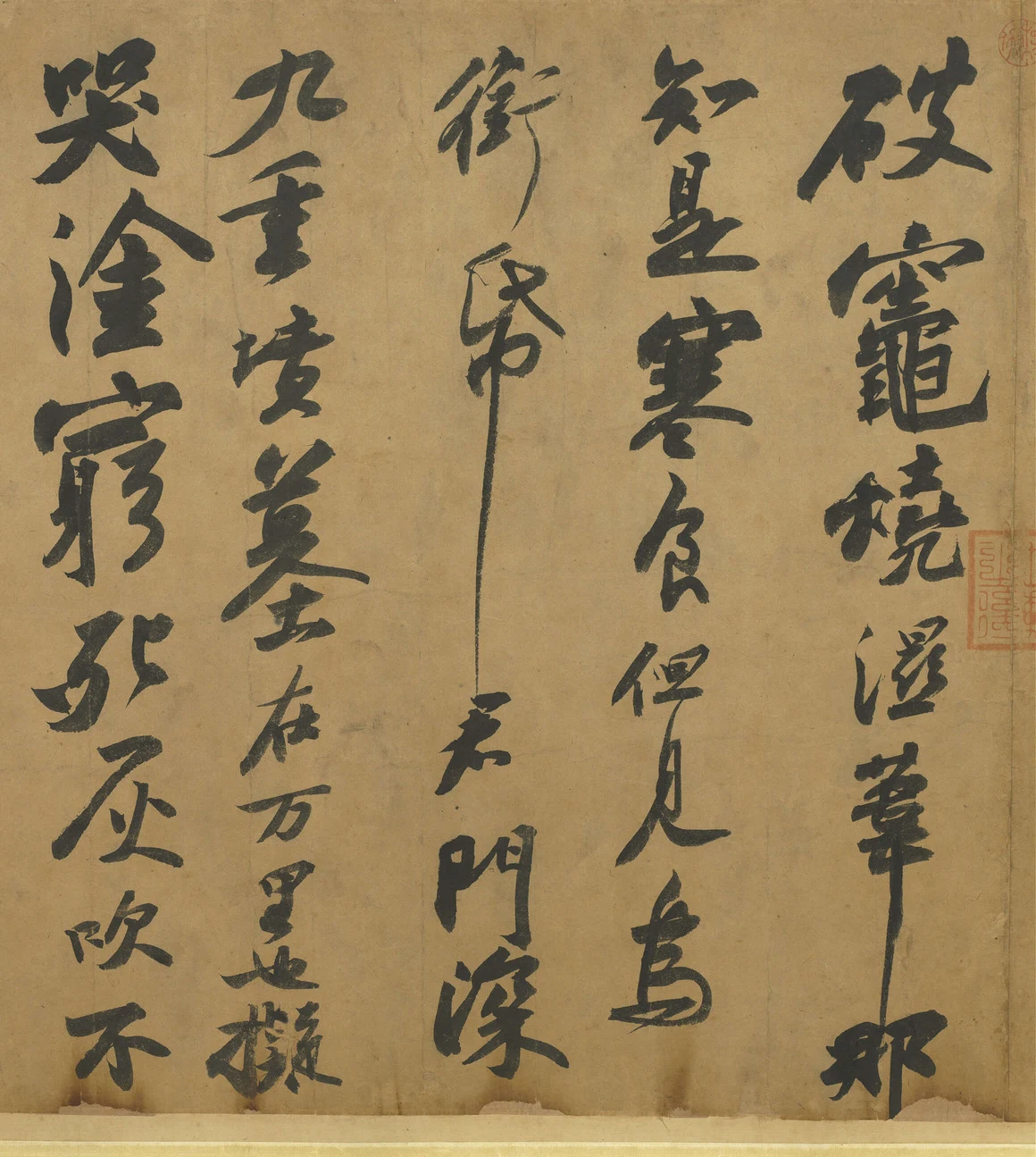
破灶, “broken stove,” is especially arresting. Find the top two characters in the rightmost column of Figure 3. The left and right parts of 破, “broken,” open apart. The stove character 灶 appears in the manuscript as 竈: its covering strokes at the top and tightly folded forms beneath occupy a considerable area. The eye cannot easily slip past these two characters.
Continue down that column, however, and the strokes do not simply become thicker. Below 燒, “burn,” comes 濕, “wet,” printed as 湿 in the poem transcription; parts of it are fine and pointed. 葦, “reeds,” printed as 苇, ends in a very long vertical stroke, reaching down towards 那, “how,” near the foot of the column. After the heavy cluster of forms comes a fine line, with stretches of paper opening on either side. The weight of the writing changes within a single column.
The adjacent column, 知是寒食但見烏, “know it is Cold Food, only see a crow,” behaves similarly. Below 知, “know,” and 是, “is,” the character 寒, “cold,” is relatively heavy, its horizontal strokes gathered together. 食, “food,” takes a narrower form; 但, “only,” and 見, “see,” become noticeably finer. The lower curve of 見, printed as 见 in the transcription, reaches sideways before the eye arrives at the more spread-out 烏, “crow,” printed as 乌. A description of the second poem as simply “ever larger and darker” would lose these details.
The variation also happens inside individual characters. Heavy ink does not mean an absence of open space. Compare the small patches of paper enclosed within 竈, “stove,” with the wider opening inside 見, “see.” They make the black appear, respectively, tightly gathered and lightly enclosing. A photograph lets us compare dark and light, thick and thin, and exposed paper within the same image. Darkness alone cannot tell us how hard the brush was pressed or how fast it moved.
Farther left, a different compression appears in 九重坟墓在万里也拟, “ninefold [gates]; the graves are ten thousand li away; I too would….” This is the second column from the left in Figure 3; the manuscript uses 墳 for simplified 坟 and 擬 for 拟. Its 万, “ten thousand,” is itself a historical form, not a modern simplification to be replaced automatically with 萬. At the top, 九, “nine,” and 重, “layers,” spread out. Lower down, the characters sit increasingly close together, until 里也擬, “li / too / would,” cluster near the lower edge. In the leftmost column, 哭, “weep,” 涂/塗, “road,” and 穷, “end” or “exhaustion” (written 窮), open out again. Especially in 窮, the internal turns create a large structure of black and white. The compressed route has widened once more.
For me, the tension comes from these repeated contractions and releases. Substantial forms hold the eye; fine strokes let it pass again; crowding at the foot of a column brings the next change of column into view. The poem continually encounters barriers, and the writing gives the reader a route that cannot be travelled at an even pace. The two reinforce one another as we look, without requiring us to assign every turn of the brush to a particular second of Su Shi’s grief or anger.
Corrected characters still occupy the paper
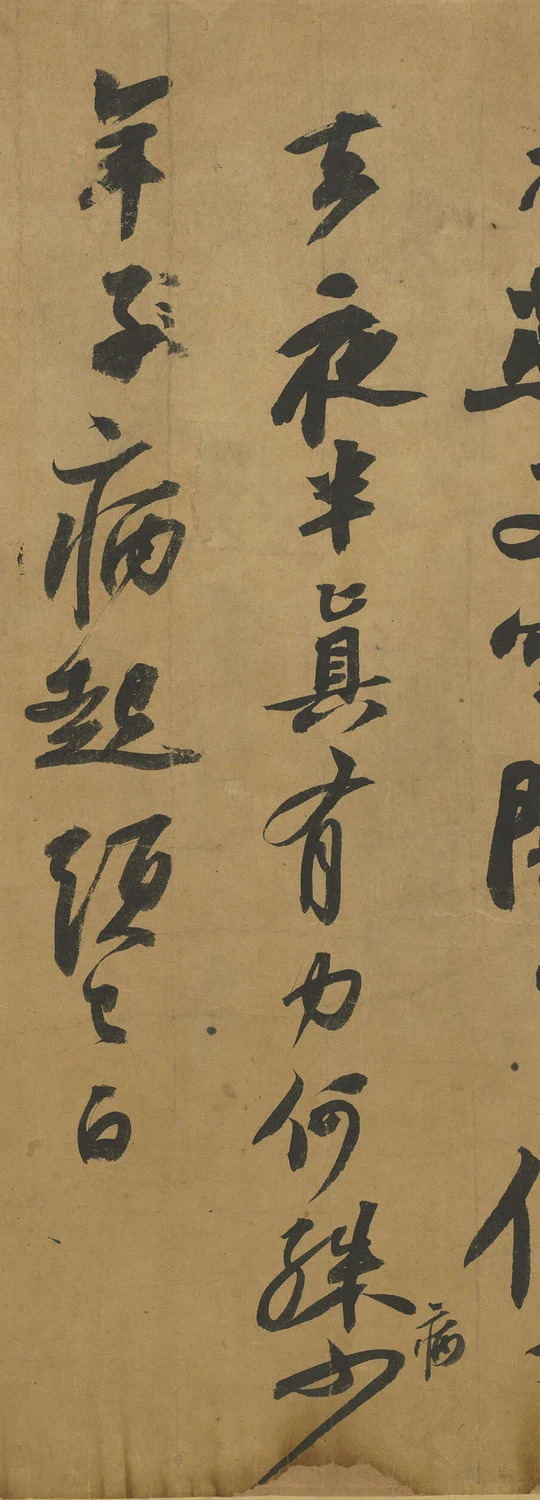
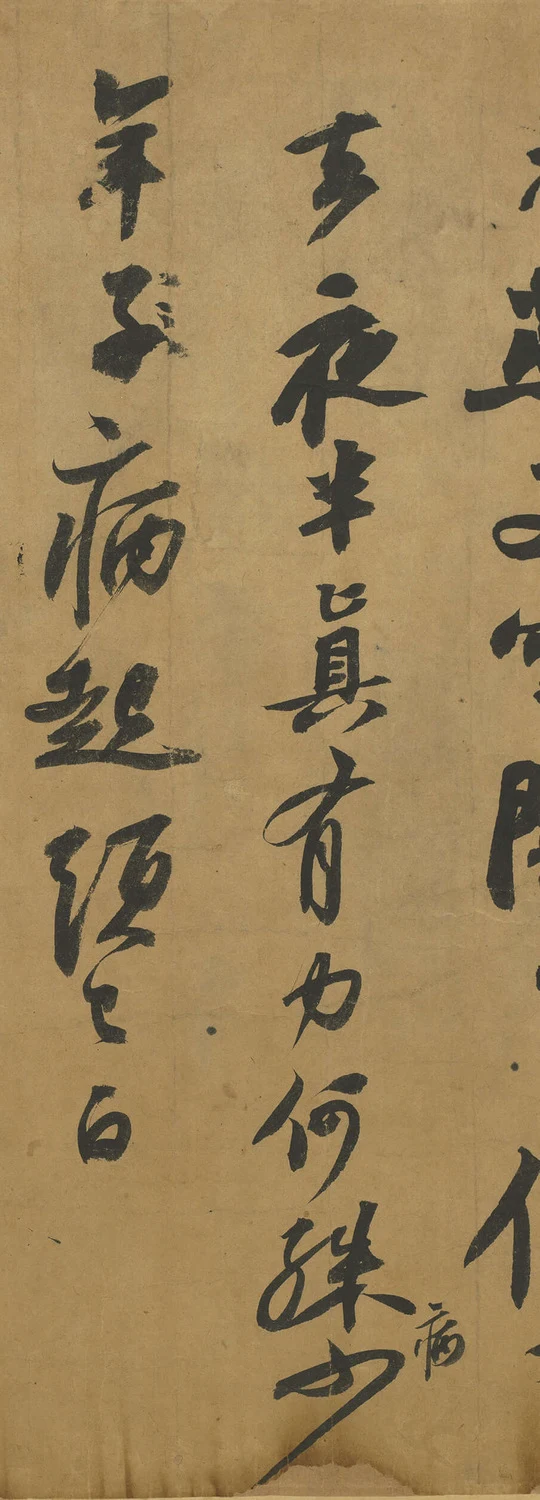
Near the end of the first poem, the large characters read 何殊少, “how different [from] a young….” A much smaller 病, “ill” or “illness,” has been squeezed in to the right of 少, “young.” In the next column to the left, 年 completes 少年, “young person.” Beneath 年, an extra 子, “child,” has been cancelled with dots, before the writing continues with 病起头已白, “rising from illness, his hair already white.” The corrected phrase is 何殊病少年, “like a young man stricken by illness.”
This is more than a detail for a textual editor. The large characters are already approaching the lower edge when a small character enters from the side. In the next column, the deleted character still leaves ink behind. Our eyes have to negotiate differences of scale, an insertion and a deletion to distinguish the words to be read from the traces of the writing process.
There is a similar trace at the start of the second poem: an extra 雨, “rain,” after 雨势来不已, “the rain keeps coming without end,” has also been cancelled with dots. Its departure from the poem has not made it disappear from the paper. A printed edition can set the corrected words neatly afresh. This sheet keeps the corrected wording together with what the correction did not erase.
The insertions and deletions turn the writing back upon itself. Larger forms already written, smaller writing added beside them, and ink excluded from the final poem all occupy the same small area. Correction has not restored the paper to an untouched state. It has become part of the local pattern of density and space.
At the end, 起, “rise” or “rekindle,” standing in a column of its own, completes the sentence and brings these successive turns to a halt. The 不, “not,” at the bottom of the preceding column still draws us towards it, but beneath 起 no poem text follows. The suddenly shortened column gives the blank paper a weight different from the spaces between earlier characters.
Farther left another hand takes over
Su Shi identifies what he has written with 右黄州寒食二首, “To the right: two Cold Food poems from Huangzhou.” The word 右, “right,” accords with the direction of reading a handscroll: the poems just read lie to the right of this closing note.
The large characters that appear farther left belong to Huang Tingjian’s colophon. The museum dates it to before the ninth lunar month of 1100. Today smaller writing added much later by the Qianlong emperor is also visible between Su Shi’s text and Huang’s. Other inscriptions farther along the scroll belong to still other moments. The joined papers place these acts of reading and collecting beside one another without turning them into a single occasion. Museum description and images, in Chinese
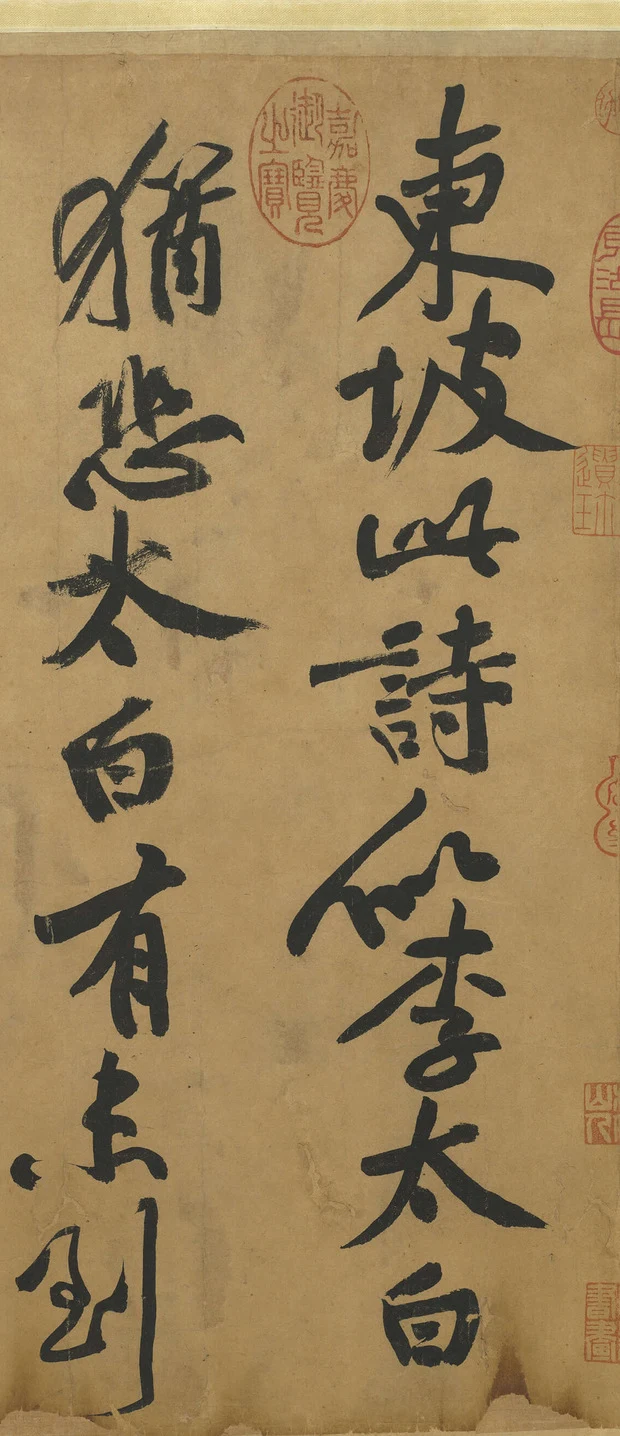
Huang first discusses the poetry. He hears something of Li Bai in it and even thinks it reaches places Li Bai did not. He then turns to the writing, recognising qualities associated with Yan Zhenqing, Yang Ningshi and Li Jianzhong, before concluding:
> 试使东坡复为之,未必及此。它日东坡或见此书,应笑我于无佛处称尊也。 > > Ask Dongpo to write it again, and he might not equal this. If one day Dongpo sees these words of mine, he will surely laugh at me for proclaiming myself the honoured one where there is no Buddha.
Dongpo is Su Shi’s literary name. This is the judgment of a calligrapher who knew him, directed at the particular work before him. Huang insists that a second attempt might not achieve the same result, while allowing himself a friend’s mixture of modesty and teasing. His appreciation rests on this specific ink trace: even the same writer, writing the same poems again, might not produce the relations we see here.
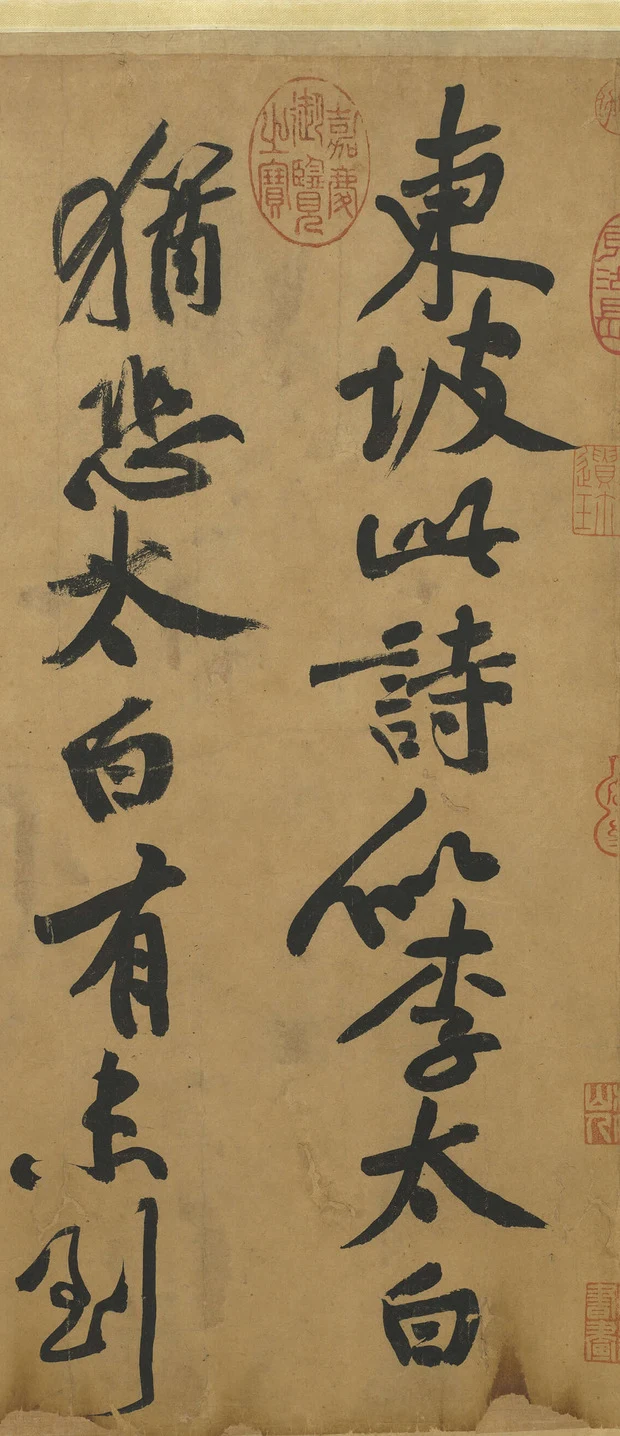
Huang’s characters are generally larger than those of Su Shi’s main text, and the strokes expand in different ways. Look at 東坡, “Dongpo” or “Eastern Slope,” the top two characters in the right column. Oblique strokes sweep out from the interior, and the longer lines give the spaces between them a more open feeling. The mass of gathered dark ink around Su Shi’s 破竈, “broken stove,” gives way here to a more outward-reaching configuration. We can compare the two passages. We cannot arrange them into a story in which Su Shi writes with mounting agitation until he reaches these enormous characters: by then Huang Tingjian is holding the brush.
The red seals introduce another layer. Square and round, they are scattered among the characters and along the paper’s edges; some extend close to the written strokes. We cannot look at the work today without encountering this red. It records later acts of collecting, appreciation and ownership. When considering how Su Shi arranged his columns, however, we need to remember that many of these seals were absent from the paper as he wrote.
Return to the 起, “rekindle,” with which we began, and the extent of its ending becomes clearer. Su Shi’s poems finish here. To the left remain his closing note, someone else’s comments, and the writing and seals of successive later owners and readers. The work’s history continues, while this act of writing the poem text has stopped.
The Cold Food Scroll leaves a distance to be travelled even after a poem has become intelligible, a distance that no transcription can cover for us. Long vertical strokes, fine lines, crowded passages, deleted characters and changes of column give language specific distances on the paper. Look once more after reading: those distances are only beginning to become clear.
Optional further reading on what the eye waits for
First say the last line to yourself: 死灰吹不起, “dead ashes cannot be blown alight.” Then look at Figure 1. On a first pass, you may follow the meaning, quickly find 起 and finish the sentence. On a second pass, try following the actual ink: from 死, “dead,” down through 灰, “ashes,” 吹, “blow,” and 不, “not,” then up to 起 at the left.
Both times you face the same image. Yet knowing the sentence may lead you to skip over that jump the first time. Once we know what the last character is, it is easy to suppose that we have also seen where it is.
Now compare 已过三寒食, “three Cold Food festivals have passed.” At the scroll’s beginning, the rightmost column reaches 寒, “cold,” and 食, “food,” appears only in the next column. This crossing does not lead to a large empty space: after 食 come 年年欲惜春, “each year I long to hold the spring.” Both crossings complete a unit of language. One immediately leads into more writing; the other ends the poem text. The two movements carry different weight.
In “The Note Has Not Sounded. You Are Already Waiting.”, I wrote about how a familiar melody makes us anticipate the next note. I also wrote: “Familiar does not mean used up.” That line of thought directs attention to something quite specific: what we remember helps arrange how the next moment comes into view.
SAE, or Self-as-an-End, brings the “beauty of cognition” to bear here on the way we ourselves read. Knowing the five-character verse form makes us anticipate where a line will finish. Knowing 寒食, “Cold Food,” makes us actively join characters placed in different columns. Understanding helps us look; at times it also runs ahead of looking.
There is no need to deliberately forget what the poem means. Bring the lines you have read back to the paper, and point out where they connect and where they stop. Then the expectations formed by meaning and the positions of the ink can be seen working together. The rhythm of calligraphy belongs both to the writer’s past movements and to the way we now read through characters that remain still.
Image guide and textual notes including dimensions and image processing
This essay is based on the National Palace Museum’s published high-resolution photographs, rather than an encounter with the original scroll. Photography and screens affect paper colour, ink colour and the sense of scale. Comparisons here mainly concern strokes, character forms and intervals within the same image.
A guide to all seven shared images
The filenames run from 00 to 06. The five details appear in the essay as Figures 1–5; the other two are linked here. All use the same shared image files.
- 00 — Overview of Su Shi’s text: the labels already printed on the image are Chinese. Read the panels from right to left: opening at right, middle in the centre, ending at left. Within every panel, read columns right to left and characters top to bottom. The three museum photographs retain overlapping areas and separators. They are a locating aid, not a seamless full-scroll image; image width cannot be converted into the physical length of Su Shi’s section. A narrow edge of Qianlong’s later small writing remains at the far left and is not part of Su Shi’s text.
- 01 — The ending: Figure 1. Find 不, “not,” at the bottom of the middle column, then move up and left to 起, “rekindle.” The paper below 起 has no further poem text.
- 02 — The opening: Figure 2. Begin at the upper right. 寒, “cold,” ends the right column; 食, “food,” begins the middle one. The marks beneath 年, “year,” and 春, “spring,” in the middle column repeat those characters.
- 03 — Ink and spacing: Figure 3. Five columns run, from right to left: 破竈燒濕葦那 (“broken stove / burn / wet reeds / how”); 知是寒食但見烏 (“know / is / Cold Food / only see / crow”); 銜紙君門深 (“carry paper / ruler’s gates / deep”); 九重墳墓在万里也擬 (“ninefold / graves / ten thousand li away / I too would”); 哭塗窮死灰吹不 (“weep / road’s end / dead ashes / blow / not”). These sequences identify the manuscript’s columns, not the poem’s verse lines. Standard printed forms are used as reading aids rather than exact facsimiles of each written form; for example, 紙, “paper,” identifies the manuscript’s 帋. The final 起 lies outside this crop to the left.
- 04 — Corrections: Figure 4. The small 病, “ill,” is beside 少, “young,” near the bottom of the right-hand main column. In the left column, the cancelled 子 follows 年; farther down comes 頭, “head.”
- 05 — Huang Tingjian’s colophon: Figure 5. At the upper right, 東坡, “Dongpo,” begins Huang’s comment on Su Shi. These larger characters are Huang’s, not a continuation in Su Shi’s hand.
- 06 — Full-scroll photograph index: the existing headings and labels are Chinese. It indexes all 19 museum photographs. Images 01–17 show the opened scroll, arranged within each row from right to left and then from the upper row down. Images 18–19 are separate views of the outer wrapping and ties. The sequence distinguishes the opening title section, Su Shi’s text, Huang’s colophon and later inscriptions. Adjacent photographs may overlap. This is an index to separate photographs, not a seamless or measurable reconstruction of the whole scroll. Use the museum’s gallery for the high-resolution originals.
Text and material evidence
- The five details use rectangular crops and proportional reductions of the museum’s images. No strokes have been added, seals removed, colours altered or writing generated. The overview and index arrange separate photographs while retaining overlaps. Image credit: National Palace Museum, Taipei, Northern Song Su Dongpo’s Poems on the Cold Food Festival at Huangzhou, handscroll; museum photography, cropped details or arranged photographic views as indicated.
- The corrected text reads 何殊病少年, “like a young man stricken by illness,” and 病起头已白, “who rises to find his hair already white.” The museum’s appreciation page prints 鬚, “beard,” where its detailed collection transcription gives 頭, “head.” This essay follows the visible manuscript and the latter transcription, using 頭, simplified 头. The cancelled 子 and extra 雨 are not included in the corrected poems; repetition marks are expanded into repeated characters.
- The museum records the catalogued unit 本幅 as 34.2 × 199.5 centimetres. That catalogue unit is not identified here as the independent dimensions of Su Shi’s poem manuscript alone.
- Huang Tingjian’s colophon, Qianlong’s and other later inscriptions, and collectors’ seals are distinguished from Su Shi’s text. The poems’ composition date is not the exact date of the surviving ink. Corrections do not by themselves prove that this sheet records the poems’ first composition. Handwriting is not treated as direct evidence of personality or of a precisely identifiable mental state.
- The images used here come from the museum’s exhibition website. The download terms on the separate Open Data record should be checked independently; this essay does not transfer that record’s image licences to the exhibition photographs. Museum website open-data statement. Source attribution does not imply museum endorsement of this essay.
Further images and reading
- National Palace Museum centennial exhibition, 2025, section two: the recent high-resolution photographs used here; the work is listed as 宋 苏轼 书黄州寒食诗.
- National Palace Museum appreciation page, in Chinese: the work description and another set of photographic sections.
- Museum Open Data collection record: inscriptions, seals, catalogue details and character-by-character transcription; its image download licences are distinct from the exhibition source used here.
- Han Qin, “The Note Has Not Sounded. You Are Already Waiting.”: the full English essay cited in the optional further reading.


