The added thumbnails are supplementary photographs of the same original sculpture. Close readings of a particular background or viewpoint still refer to the official images linked in the essay. Click a thumbnail to open the museum’s work page.
Follow the chest and abdomen downward. Cloth gathers at the waist, then suddenly crosses diagonally over the thighs, clinging on one side while already swelling behind the body on the other. Above, two wings push the outline outward. She has not been scattered by the wind. Her chest faces forward, and forces moving in several directions meet in the same body.
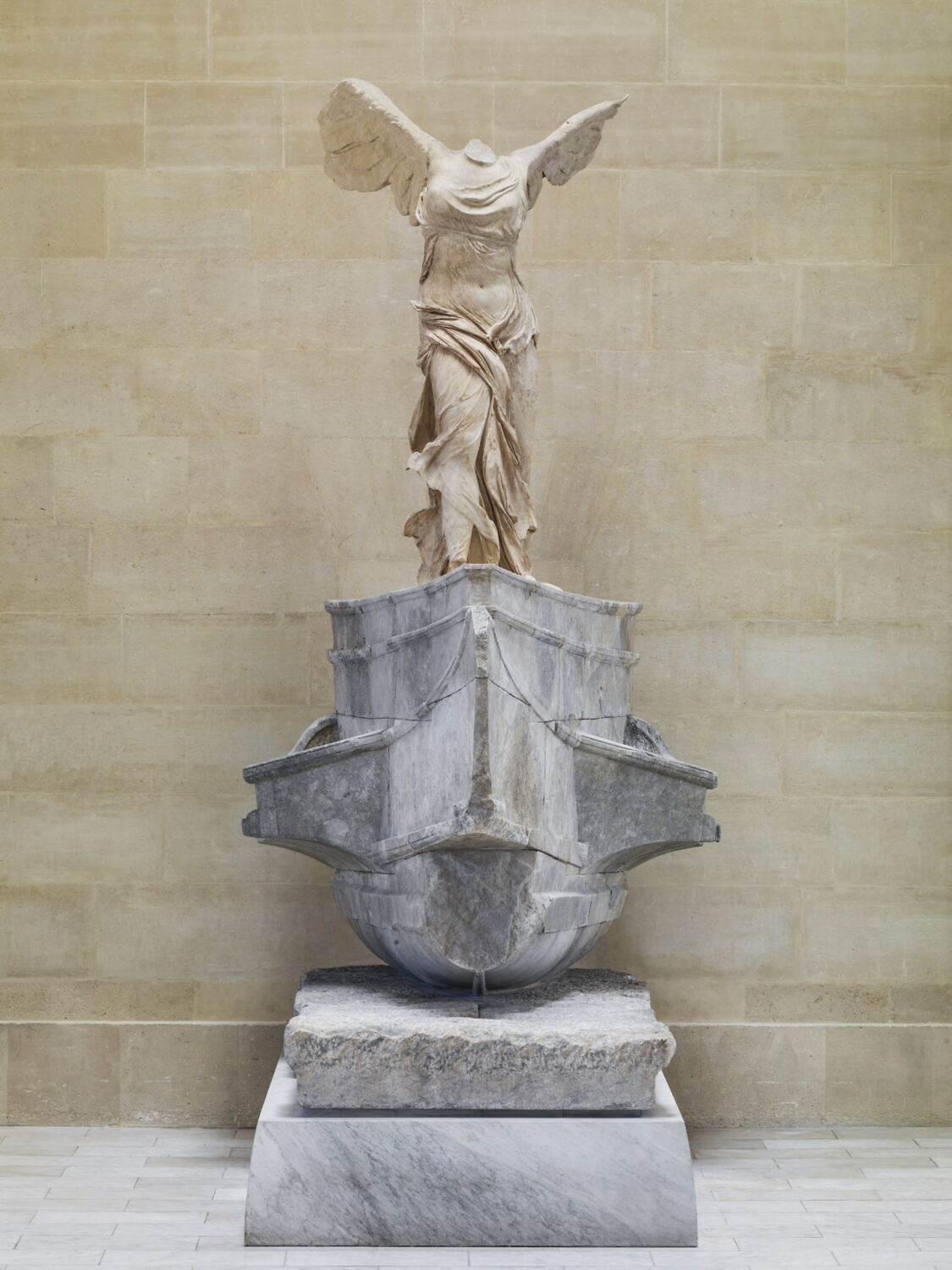
Look farther down and we discover that she stands on a ship’s prow. The prow is dark gray, with broad, substantial elements extending sideways and a ridge facing us at the front. Above, the goddess opens her wings; below, the ship also spreads to either side. This is more than a delicate figure placed on a heavy pedestal. Both upper and lower parts expand and claim space outward, one dividing into layers of feathers, the other fixing its direction through a sharply defined hull.
View the Louvre’s official frontal overall photograph. Image description: A pale goddess stands on a gray prow, her wings extending diagonally upward. Prow, rectangular stone base, and present-day display platform appear together. Photograph from the Louvre collection page, Philippe Fuzeau, 2014.
The sculptor’s name is unknown. The Louvre’s current record dates the work to 200–175 BCE, in the Hellenistic period. She is Nike, the goddess announcing victory. The monument originally stood in the Sanctuary of the Great Gods on Samothrace in the Aegean, dedicated to a naval victory. Which battle and which patron remain debated; a proposed victor cannot be treated as her established owner. We face a dedication that made victory appear in a religious space. Ship, wings, and human body give an abstract noun the posture of arrival. Collection record; Louvre introduction to the work and original site
1. The Wind Does Not Blow Every Fold the Same Way
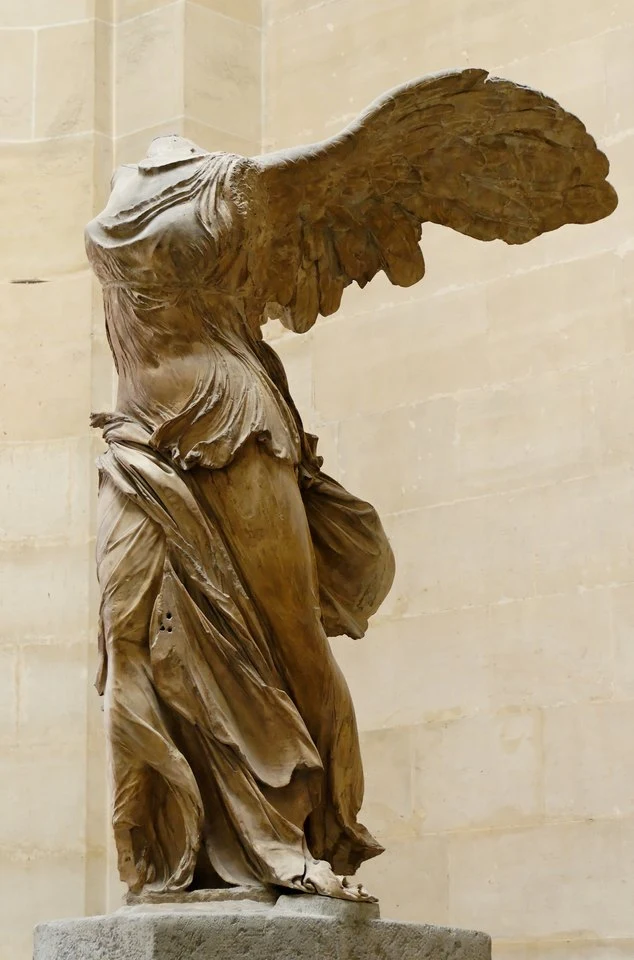
From an oblique frontal position on the goddess’s own left, we can see her abdomen and the cloth billowing behind her together. The close-fitting long garment and the mantle wrapped around the lower body offer different impressions of thickness.
Across the abdomen lies a broad, pale surface, with fine folds gathering along its sides. Near the thighs, cloth rolls into a thick diagonal band pressing across another layer of finer lines. Farther down, long folds descend in deep valleys with turned-up edges. The billowing fabric behind her is especially important. It has breadth that pushes outward before being drawn back to the body. It is not a ribbon pasted onto the outer contour; it seems to contain a volume of passing air.
View the official oblique frontal photograph from the left. Image description: The nearer wing’s feathers, folds over chest and abdomen, thighs covered by the long garment, and mantle billowing behind are visible together; only the hull’s upper edge appears. Photograph by Michel Urtado, Tony Querrec, and Benoît Touchard, 2015.
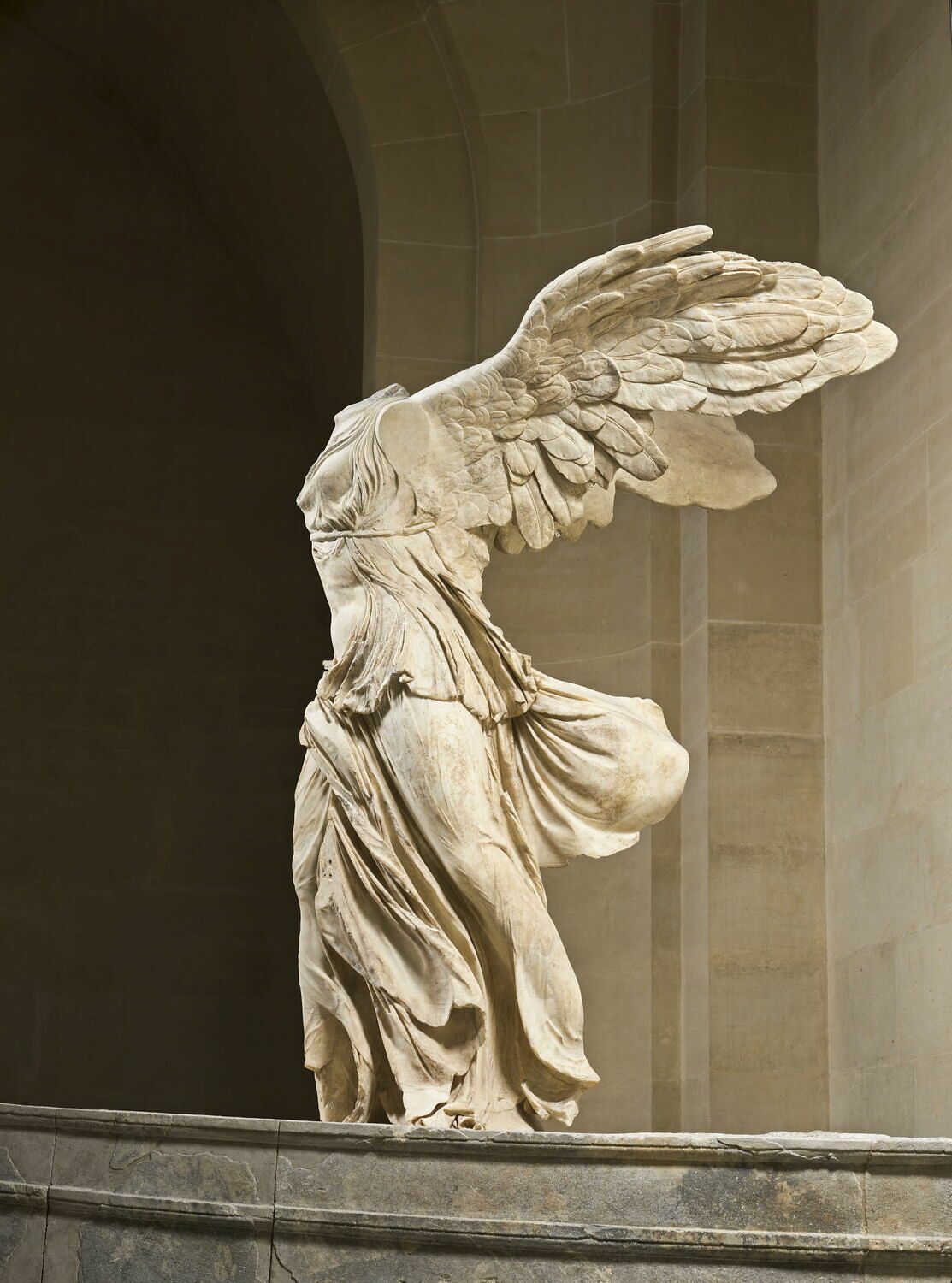
The familiar term “wet drapery” helps identify the effect of cloth clinging and revealing the body’s contours, but it cannot fully describe this wind. If all the fabric clung, the figure would seem wrapped in a membrane. If it all flew loose, a broad outer outline would swallow the body’s firmness. Here are attachment and separation, fine small folds and large billowing pockets. The force of air appears precisely through their differences.
Look also at what points downward. Not every fold flies back; many still descend along the legs. Diagonal folds cross the body and are received by long vertical ones. Wind and gravity have not been tidied into one arrow. Cloth is fastened in places, blocked by the body in others, and elsewhere has room to open. These conditions give the same gust different effects.
This gives the goddess’s advance weight. Chest and abdomen do not retreat with the hem, nor do the wings turn the legs into a loose bundle of lines. The body holds its direction, allowing the clothing to seem responsive to something outside it. Facing into wind means more than furnishing a figure with wavy decoration. We can see that she moves forward while some things still attached to her lag behind.
For me, the wind feels most substantial because the body retains its volume. The chest has already arrived in front, the mantle remains behind, the wings open space sideways, and descending folds draw everything back to the ship. The eye cannot collect all these directions in one smooth movement. Still stone consequently makes us feel an action not yet finished.
2. The Wings Bring Space Beyond the Body Into Play
The nearer wing in the oblique view looks much broader than in the frontal photograph. Feathers are short and dense at the root, lengthening outward. Layer presses over layer before the tips can extend individually. This is not a flat panel with a pleasing outline. Overlap gives the wing thickness and the broad spread an ordered progression from inside to outside.
Try following the upper edge outward, then returning along the lower. The upper edge is long and slightly undulating. The lower consists of individual feather tips of unequal lengths, with intermittently changing shadows. One maintains an overall direction while the other lets many small parts emerge. The same wing combines continuity and articulation: from afar, an expansive momentum; closer, the means by which many feathers carry that momentum outward.
The space below the wing also matters. No solid object draws a connecting line for us, yet the wing’s lower edge faces the billowing mantle across a gap. Above, it reaches outward; below, the cloth pushes backward. Together they seem to open a stretch of space beside the body. To see the work only as chest plus legs plus wings misses a distance belonging to no single component but determined by them together.
In the frontal view, one wing looks broad, the other narrow. The oblique view partly explains why: wings extend into depth, and photography compresses certain surfaces. They are not two flat symbols pasted behind the figure solely for frontal recognition. Yet the wings we see today also contain a fact we must know. The goddess’s own right wing is a plaster reconstruction; the left retains ancient marble assembled and restored from fragments. Areas of chest and back also include additions. The spread we admire combines evidence surviving from antiquity with later reconstruction. Louvre condition record
The nearer ancient wing preserves carved relationships of feathers spreading layer by layer; the reconstructed right wing helps restore the overall expansion visible today. Looking closely, we distinguish tips and overlaps one by one. Returning to the overall view, both wings jointly determine the breadth above the body. The whole presented by a sculpture and the experiences of every piece of its material cannot always be described by a single date.
3. The Prow Makes Her Arrival an Event
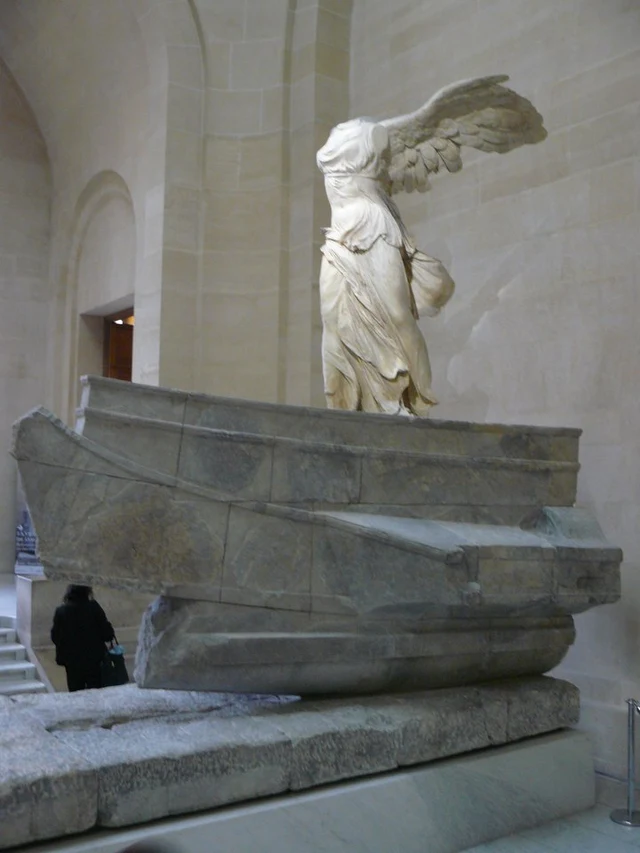
Crop the photograph beneath her feet and we have a winged goddess surrounded by wind. Restore the ship, and her arrival gains an object and a place.
The lateral overall view best corrects the idea that a base merely raises something up. The gray hull extends horizontally, with its truncated front and long upper edge visible together. The goddess’s height stands upon this length. The prow is not a vertical column: it carries the work’s space from high above toward the front. Though only part of a ship is visible, our eyes still imagine its continuation along the gunwale.
View the official oblique side photograph including the prow. Image description: The gray prow extends horizontally beneath the goddess. Rectangular stone base and modern display platform form distinguishable layers; part of the staircase and a doorway appear at left. Photograph by Stéphane Maréchalle, Tony Querrec, and Benoît Touchard, 2014.
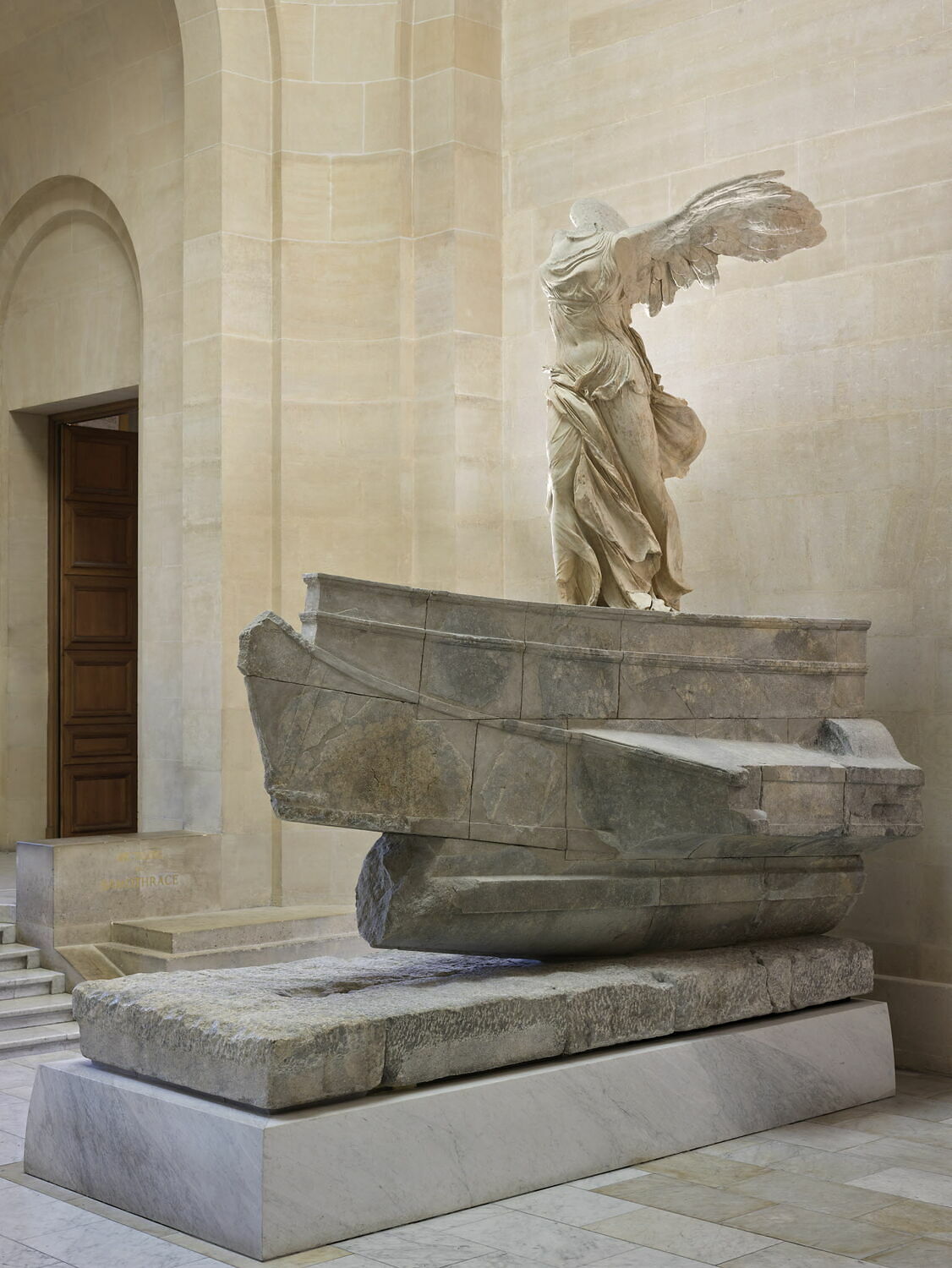
The hull’s planes meet the clothing’s curves without becoming confused. Light and dark within the folds continually gather and curl. Broad planes along the ship let the eye travel farther, pausing only at joints and edges. The former suggest local change; the latter establish a longer scale on which direction can be measured. The goddess both occupies this place and seems just to have arrived from elsewhere.
Two stones clarify the distinction. The statue is Parian marble; the ship and rectangular stone base are Lartos marble. The pale figure and darker hull in today’s photographs are not merely one surface divided by illumination. Material record Their tones do something simple before our eyes: they let body and ship retain separate wholeness while making their encounter clear.
The prow also changes the tone of “victory.” A freestanding Nike can become a general emblem. A Nike alighting on a warship connects divine acknowledgment to human action. No naval battle unfolds here, nor are we asked to identify individual sailors. The event is condensed into the relationship between the ship and the arriving figure. Human action recedes behind the image, yet the ship gives the question “Why is she here?” a sustained direction.
Weight, then, is not merely tolerated as a foil to lightness. The ship has its own forward drive; its projecting ridge answers the goddess’s forward-facing torso. One is low and long, the other tall and spreading. Advance is distributed between two volumes, then gathered into one arrival.
4. Having No Head Does Not Mean Needing No Head
We easily mistake a familiar present appearance for the way a work ought to look. This goddess is especially susceptible to a certain compliment: without a head, she is purer; without arms, nothing remains but force.
Yet she was not created as a headless, armless figure. She was already broken when discovered in 1863. Fragments of the right hand found later explicitly remind us that her body once possessed another degree of completeness. Account of discovery and the right-hand fragments
Loss certainly changes viewing today. Without a face, our attention moves readily from chest to wings. Without arms entering the surrounding space, the wings’ extension becomes especially conspicuous. The broken neck abruptly ends the body above, while the eye continues searching along the lifted chest. These effects of survival can be seriously described. The problem comes with the next step: liking them does not establish that the original head and hands could only have been burdens.
A head would specify direction further; gestures would redistribute space beside the wings. Exactly how requires evidence, but recognizing that they would participate in the whole is enough to keep us open. Her continuing power today does not mean that completeness could only have weakened her.
Restoration also prevents this from being a simple choice between whole and broken. The wingspan we praise already contains reconstruction, while the gaps we are accustomed to retaining have not all been filled. Today’s image results from selective restoration. Knowing this, we can appreciate the whole and acknowledge its historical layers without demanding that the work testify to a doctrine that brokenness must be more beautiful.
5. The Staircase Gives Our Bodies a Direction Too
The Louvre placed her at the top of the Daru staircase in 1883. The museum explains that this elevated display echoes her original sanctuary position, high enough to be seen from afar. Yet the Paris staircase does not reproduce the Aegean sanctuary unchanged. New architecture gives viewing another rhythm. Introduction to the Daru staircase
The overall photographs show how the accumulated height of goddess, ship, and platform prevents her from appearing as a figure at our eye level. According to the current collection record, the goddess is approximately 3.28 meters high and the full monument approximately 5.64 meters. At the staircase’s end, she asks viewers both to look upward and to approach. Our ascent crosses the wings’ outward spread and the prow’s forward reach.
Photographs can explain this arrangement but cannot replace actual steps underfoot. What matters most is not the claim that the original must be more overwhelming in person. It is how display organizes approach in advance: before small folds become clear, we face an expansion on high; as details emerge, the large outline continues to maintain its scale above us.
The Louvre’s visitor guide also identifies an important ancient viewing direction as obliquely from the goddess’s own left front. Original site and viewing direction This is also the direction from which this essay examines wing and billowing mantle. The frontal photograph gives the whole arriving toward us; the oblique view enriches the route of air around the body. They need not compete for a single correct position. We need only remember that today’s famous frontal silhouette does not contain all the sculpture’s spatial arrangements.
Having looked at the ship, return to the relatively smooth cloth across the abdomen. Its stillness now has surroundings: wings spreading above, twisting long folds below, the mantle swelling behind, and the ship reaching forward underfoot. What holds me is that this quiet surface does not eliminate the movement around it. She retains her own volume in the wind. Victory appears not as a lightness blowing everything away, but as a force able to bear what comes toward it while arriving here.
Optional Reading: Distinguishing Two Ways of Remaining with SAE
The main essay has read wind as relationships among parts. SAE’s “perceptual beauty” can ask further: once we recognize wind, have those relationships been used up?
Ray 08’s essay, “As the Light Fades, the Garden Appears Differently,” begins in a garden at twilight. It considers how conditions affect sensory appearances and how those appearances do more than alert us or identify something. Returning to the goddess, temporarily set aside “This is windblown.” Look only at how the abdomen’s flatter brightness enters dense folds beside the waist, how deep channels separate a bundle of drapery, how short shadows fall beneath individual feather tips. Even when we understand what they represent, these distinguishable appearances remain worth lingering over. Read the Ray 08 essay
This ray adds attention to what comes after recognition. It does not supply another cause for the wind. Instead, it pauses explanation, keeping folds from immediately being exchanged for an attractive word of movement. We are also looking at photographs: lighting, framing, and screens participate in the presentation of light and shade. Acknowledging this does not make the image arbitrary. Light and dark, widths, and overlaps can still be pointed out place by place within the same photograph. Perception does not reject knowledge, nor must it rely on endless new discoveries to continue.
Another way of remaining calls for the question raised by Ray 05, “The Wood Still Holds That Dry Year.” Beginning with tree rings, stone steps, and repairs, that essay asks how the past enters the present through actual effects, rather than through stories invented from an aged appearance. In this statue, the plaster right wing, reassembled ancient feathers, and still-open broken neck have different origins. They are not one uniform category of “traces of time.” Read the Ray 05 essay
Here we especially need to distinguish two levels of causation. Folds make us think of wind, but this stone was not blown into folds by that sea breeze. Carving represents a state of forces. Breakage and reconstruction, by contrast, really do result from the object’s later history. The former makes an absent natural force perceptible; the latter makes the object’s actual passage through time verifiable. Confusing them would turn restoration into ancient design or carved folds into a record of local weather.
Causal beauty thus goes a step beyond the main essay’s analysis of movement. It asks us to check which visible shape can establish which past. Its conclusion is not that older means more beautiful. We can like today’s outline while wanting to know how it came about; value fragments without treating destruction as beauty’s necessary price. Look again at the nearer wing. Broken sequences of shadow beneath feather tips invite slow discrimination, while joints between stones direct us toward restoration records. The same place lets us feel expansion and retains a provenance that must be verified part by part.
Notes on Images and Sources
This essay examines eight official Louvre photographs of the same object, Ma 2369, including frontal overall, left oblique frontal, and oblique side views with the prow. These photographs are not equivalent to walking around the work in person. Image rights belong to the museum and the named photographic rights holders; links do not imply permission for open reuse. Dimensions, materials, and reconstructed parts follow the current collection page. Movement and spatial analysis are this essay’s readings. See the references and official image viewing links.


