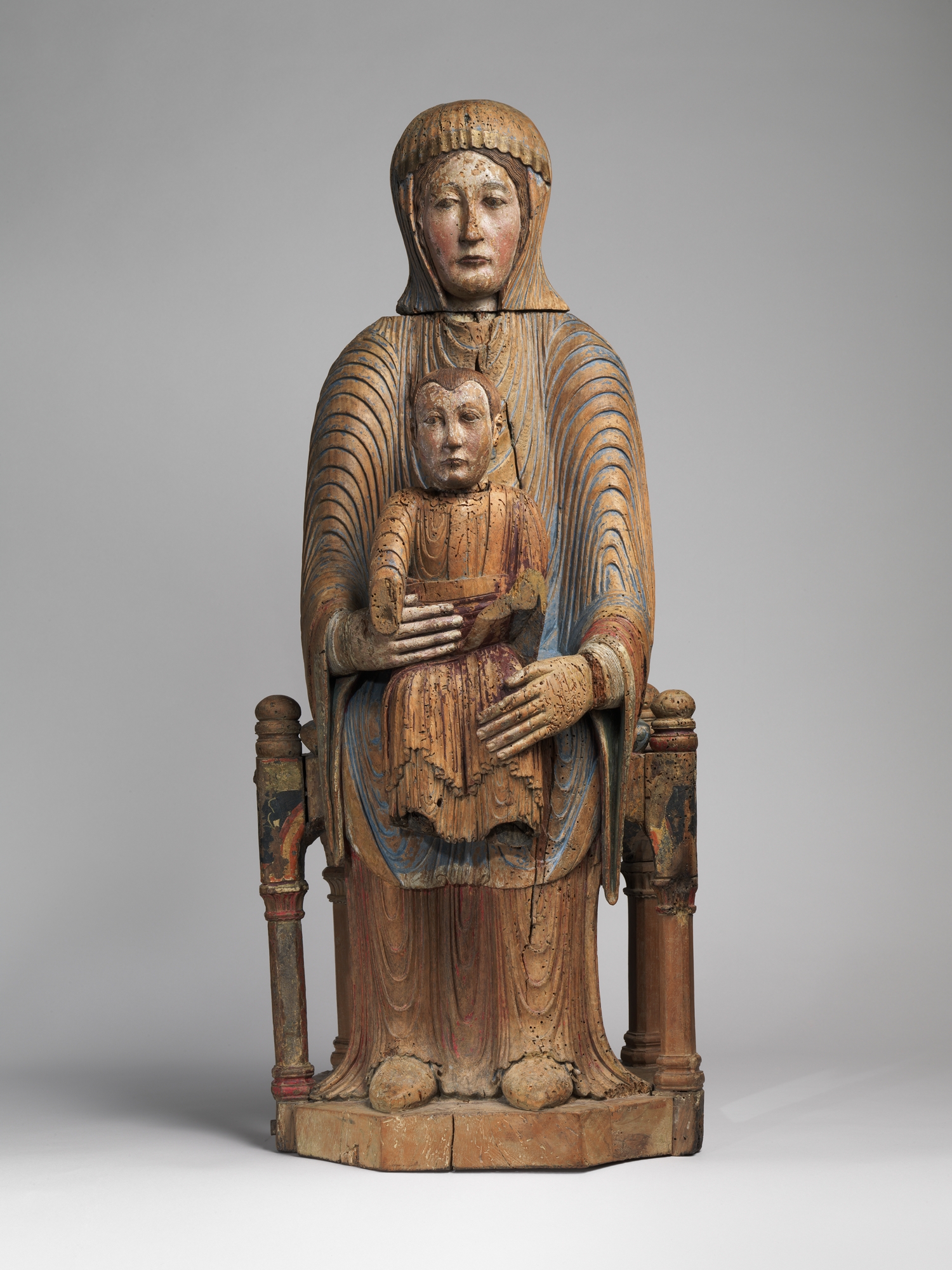
The child sits in front of his mother. Both faces turn toward us.
Her head rises well above his, her shoulders spread to either side, and her long clothing falls to her feet. The smaller child sits just as upright. His head does not lean toward her; his face does not turn in search of hers. One of her hands crosses his waist, while the other rests diagonally over his knees. These two very large hands keep him at the center of her body while leaving his head, chest, and upper body exposed.
Stay with this relationship for a moment. She holds him, but the embrace has an opening facing outward. We stand before that opening.
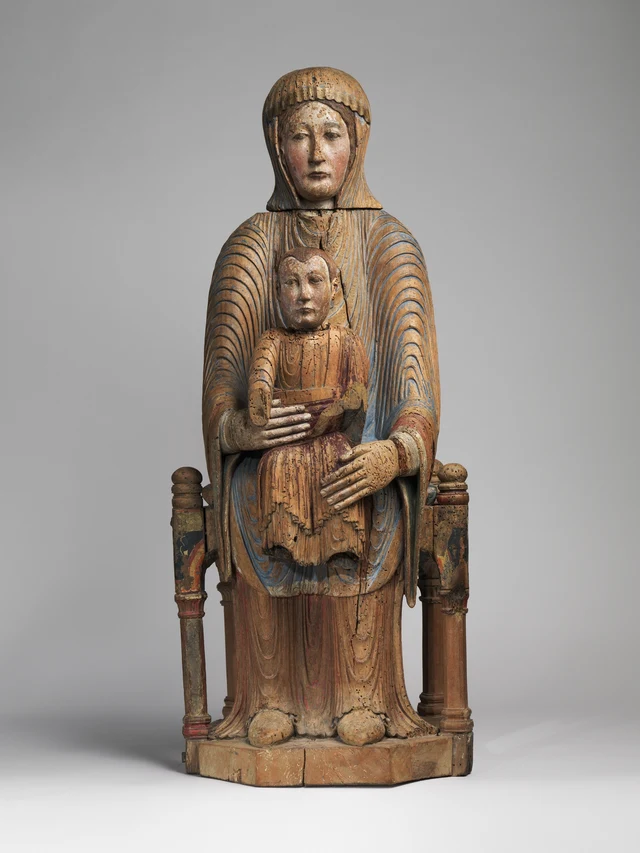
The majesty offered by this sculpture rests on a specific dependence: the child’s position facing the viewer is supported by his mother’s knees, hands, and torso. Relative size, the placement of her hold, and their forward orientation together turn a child on his mother’s lap into the center of reverent attention.
The work belongs to twelfth-century French Romanesque sculpture. This type of Virgin and Child is called the “Throne of Wisdom,” or Sedes Sapientiae. In Christian interpretation, Christ is divine wisdom made flesh, and the Virgin bears him. Once we know the name and look again at her body, “throne” becomes more than an abstract metaphor. She sits on a throne and also makes a seat for the child with her own body. Museum interpretation
1. A Small Body at the Center of a Larger Form
The frontal outline is steady. From the lower edge of the veil to the shoulders, the form broadens, then descends along the arms. Seat columns stand outside on either side, fixing the width below. The Virgin’s feet rest side by side at the bottom, while her long clothing conceals most of the interval between her legs. Very few abrupt projections interrupt this outer contour.
The child sits in front of this continuous form.
He does not fill her entire chest and abdomen. Layers of folds remain visible above his head, below her neck. Her sleeves show to either side, and her clothing continues beneath his robe. We can trace his outline all the way around and keep recognizing the larger body behind him. His mother is thus both a figure and the background that allows another figure to appear clearly.
This contrast of large and small does not simply rank the larger as more important. The child sits farther forward, his face among the dense folds before her chest, and both large hands converge on him. The larger form directs attention toward the smaller one. The broader and longer her hands appear, the more we notice that the person they surround merits close attention.
The hands also take different directions. On the left of the image, the fingers extend almost horizontally across the child’s waist, making a clear crosswise line. On the right, the hand descends diagonally over his knees, its fingers spread along the cloth. They neither meet at the center nor cover his chest. One gesture secures him at the waist; the other settles him below. His upper body remains open.
The touch is tangible, yet it is difficult to read this as a fleeting domestic moment. The child does not wriggle, and his mother does not bend toward him. Their faces do not complete a closed circuit of mutual gazing. The embrace joins them, while their orientation presents them together to the viewer before them.
The child’s face makes this distance clearer.
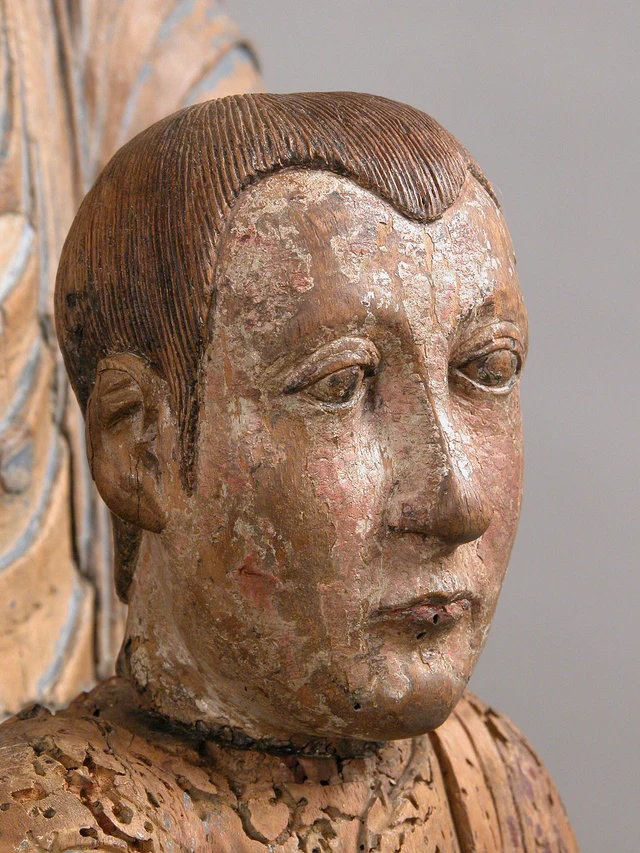
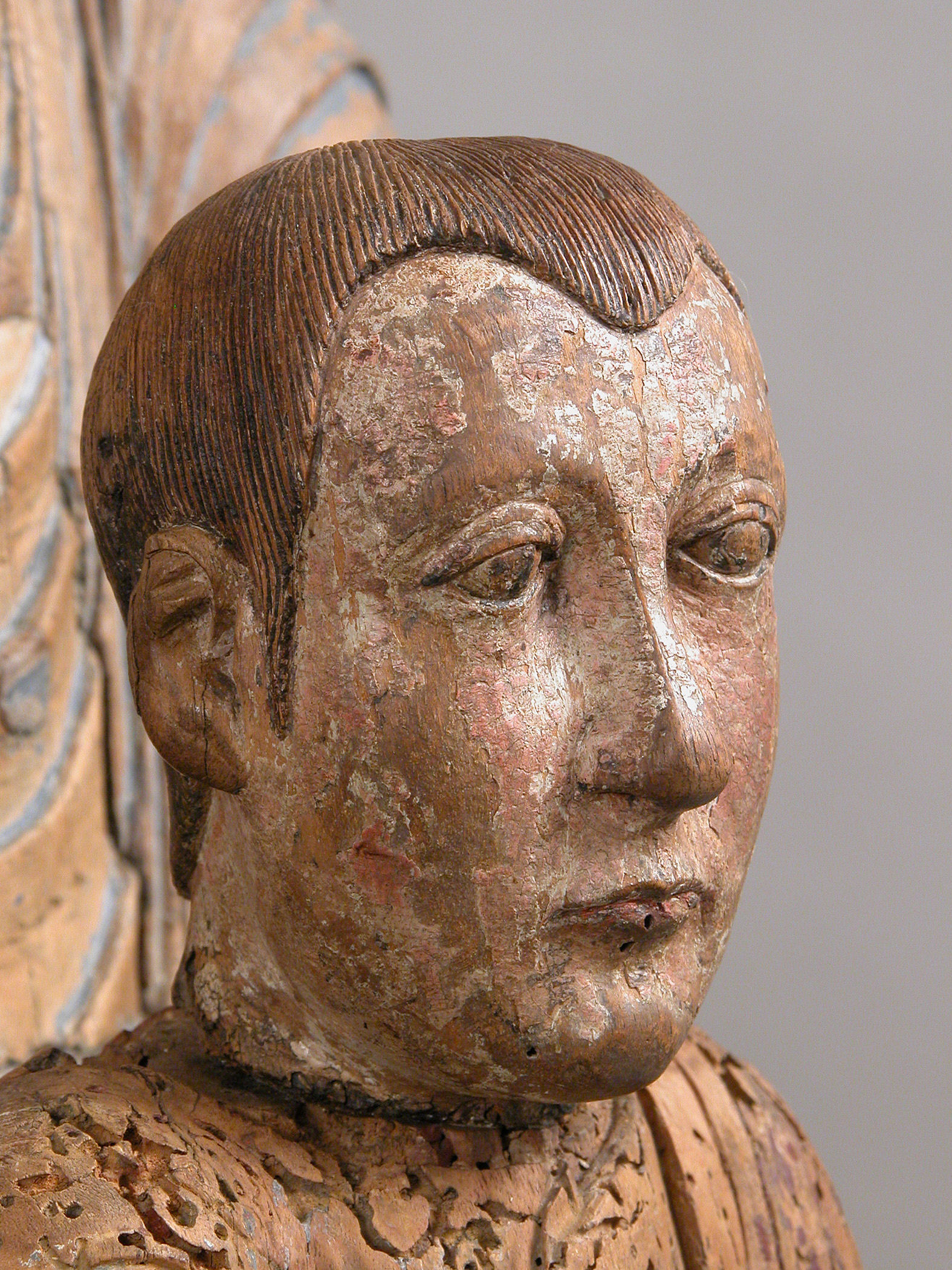
His head is small, but the face is firmly structured. The bridge of the nose is long, the lips are closed, and the chin has a definite turn. Closely arranged short hair falls downward, making an orderly edge across the forehead. These forms bring him close to a miniature adult. The museum likewise interprets his appearance in this way: a small body bears the identity of wisdom incarnate. Museum account
Judging whether this face “looks like a baby” therefore tells us only about one expectation we bring. The work establishes a different visible relationship: the body requires support, while face and posture have the strength to address others independently. Smallness and authority hold at once. The tension between them rests within the mother’s two hands.
2. Seated on Her, Seated Before Us
The frontal view places mother and child one over the other. The side view gives the seat depth.
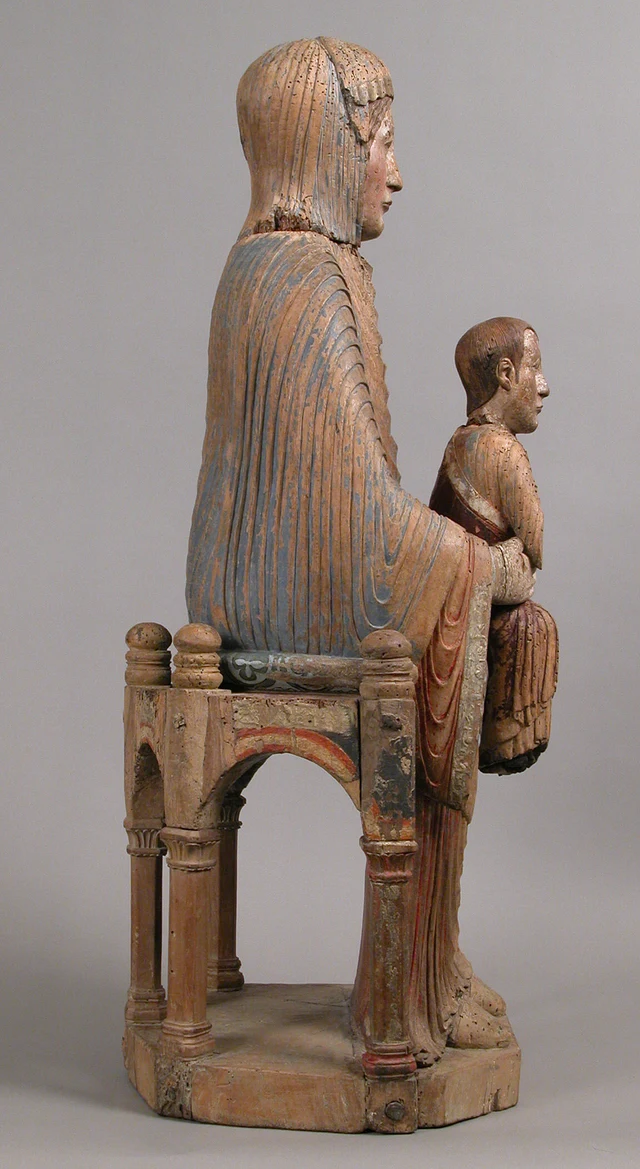
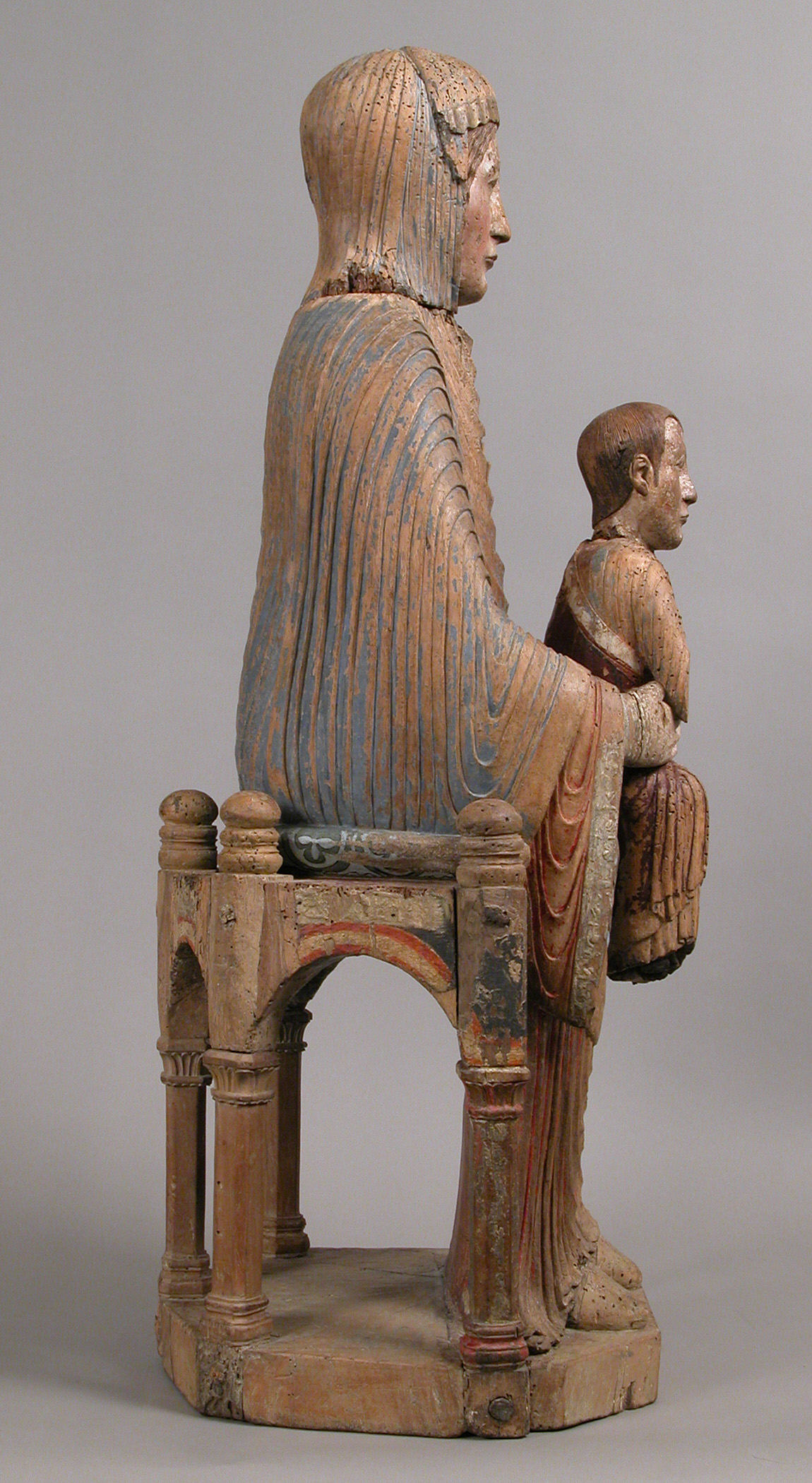
From the side, the Virgin resembles an upright backing wall. Her head sits above her torso, her neck does not incline markedly toward the child, and the clothing behind falls continuously from her shoulders. The child occupies a place in front of this vertical form. Between his nose and her back lie the thicknesses of two bodies. The figures that seem closely superimposed from the front now occupy separate positions, one ahead of the other.
Lower your eyes. Her forearm reaches forward from her body; the folds over her knees support the child’s seat. “The mother becomes a throne” now has two directions: her torso provides a backrest-like background behind him, her knees a seat beneath him, and her hands settle him from either side. Her body has not been wholly converted into furniture. Fingers and face remain clearly recognizable, while the support furniture provides has become a human hold.
The same view makes the child’s posture seem more independent. His torso does not recline along his mother’s chest but rises upright in its own place. He is supported and also brought forward. Were he merely pressed against her chest, two figures might still be visible from the front, but this projecting distance would shrink, diminishing his power to face viewers on his own.
The chair below makes support explicit again. An opening remains beneath the round arch, and columns connect downward to the base. The compact body formed by the clothing above meets the more open framework below. The stability we feel comes both from the seated pose and from a legible architectural order.
Here we need to distinguish slightly between visible support and the wooden sculpture’s actual construction. The museum’s technical study explains that the principal parts, including the mother’s and child’s torsos and legs and the seat, were originally carved from a single block, while the heads and other parts were joined separately. Four of the throne’s present five columns are replacements, as is the base except beneath the Virgin’s feet and robe. Study of materials and construction, p. 47 and p. 63, note 6
This makes the side view more rewarding. The image shows us “the chair supports the mother, and the mother supports the child,” while the making connects several bodies within one piece of wood. The complete framework we see now also includes later restoration. The sculpture communicates support through the front and back, above and below, and points of contact that its forms make legible. It does not require every visible column to bear the corresponding weight in actuality.
This distinction does nothing to weaken the embrace. Instead, it makes us notice how clearly the carver had to distinguish, within connected material, who is seated, who provides support, and who is presented forward. Two figures emerge from a tightly joined whole and still retain two fronts.
3. Folds Keep Stillness Unfolding
These figures hardly twist, yet their surfaces continually guide the moving eye.
Folds over the Virgin’s shoulders arch outward in layers, then gather into tighter loops near her elbows. Lines on her chest descend and form larger arcs beside the child over her knees. His clothing also falls and turns back in this way, but within a much smaller area. The larger and smaller bodies thus share a surface rhythm without losing their difference in scale.
Most interestingly, the folds do not everywhere explain the body by following its anatomy. The repeated lines across the frontal shoulders and sleeves, with their clear intervals, join into an order of their own. We need not first ask what force caused each crease. Our eyes can rise and fall along it, pass over a ridge, and enter a groove. A motionless body thereby gains a surface that sustains attention.
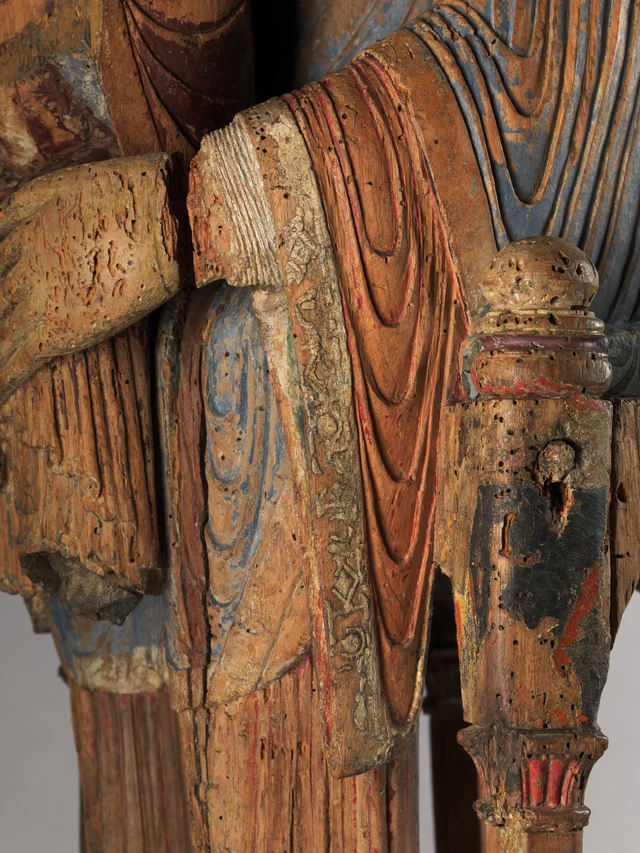
In close-up, this order divides again into three layers. Broad blue folds occupy the outside; the red sleeve surface within makes a long hanging curve; near the wrist lies a stretch of fine, close parallel lines. A narrow decorative strip edges the long sleeve, with circles and diamonds in sequence. Large curves contain smaller ones, and small edges contain smaller patterns still. They gather where the mother extends her hand without collapsing into a single texture.
Much of the wood is now exposed. Blue often survives in recesses, while red appears only intermittently on the sleeves and child. This surface can suggest that warm old wood was always the work’s dominant color, with paint merely tracing a few lines. Technical study offers a different, evidence-based picture: the Virgin’s outer garment originally used ultramarine blue, her robe a bright red, and the child’s mantle deeper layers of red. The geometric sleeve borders also included tin relief decoration. Museum introduction to the study of the polychromy
Color, then, originally helped articulate volumes. A larger blue outer garment enclosed the center; red cloth appeared within; pale faces and hands emerged from the clothing. We can still distinguish these areas, but we cannot treat every mottled boundary today as part of the original painted design. Surviving paint, wood, and loss together make the surface shown in the photographs.
Try placing the cuff in Figure 4 beside the face in Figure 2. The face is relatively smooth, its features allowing us to recognize a person. The sleeve concentrates repeated carving, fine borders, and distinctions of color. The work’s richness does not require the face to keep changing expression. It leaves a different activity to the clothes, making the holding pose stable while our looking can continue to deepen.
4. Showing Outward, Keeping Within
The back spreads out another whole field of folds.
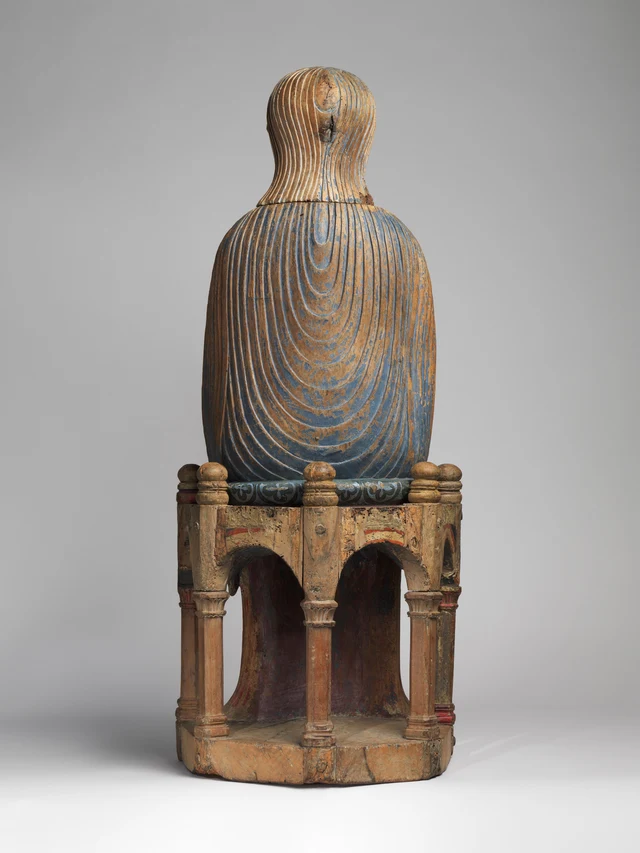
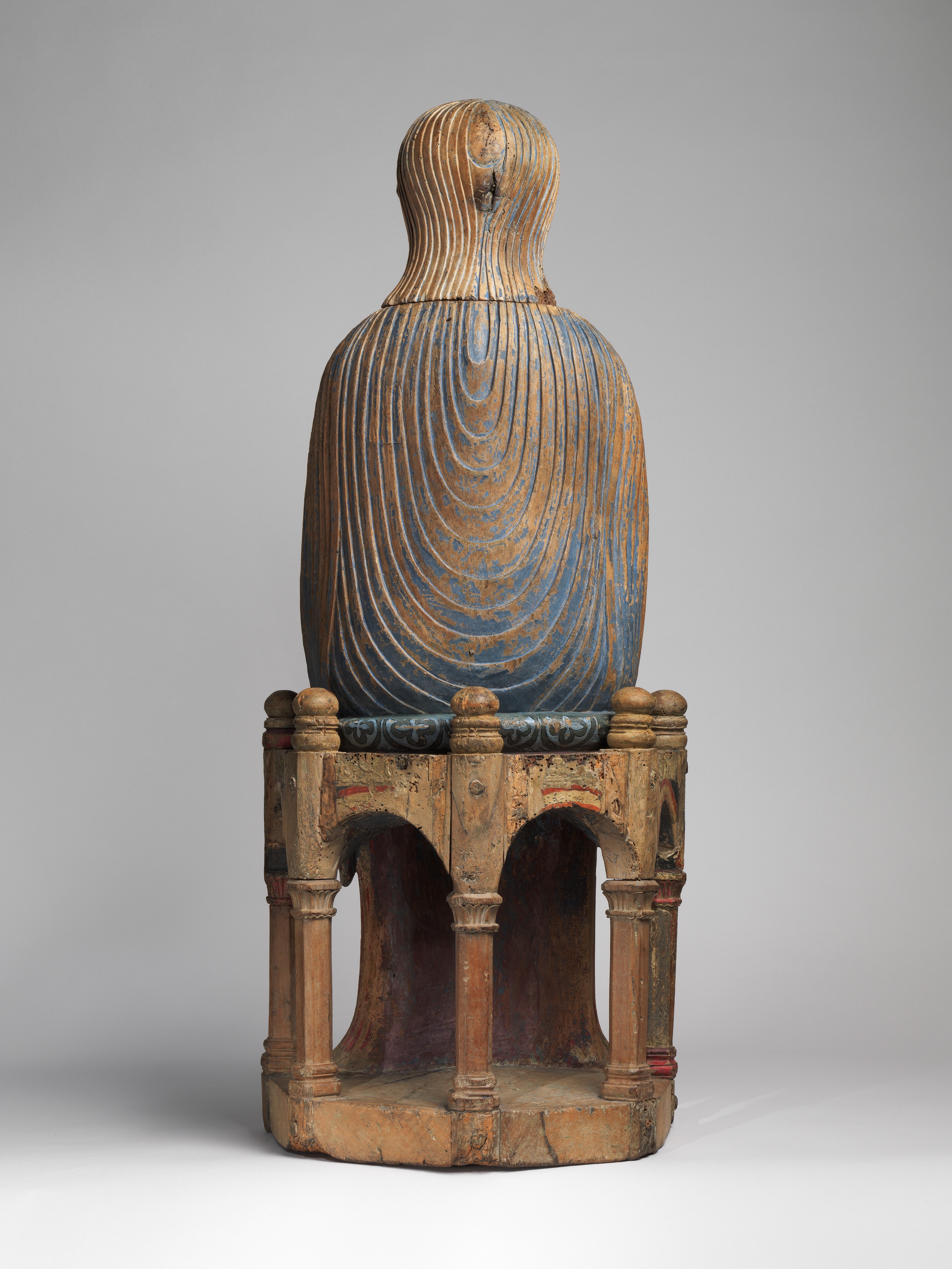
Neither face is visible, yet the back has not been treated as a flat plane to ignore. Folds descend from the shoulders; successive arcs open across the center, becoming broader farther down. The veil has its own fine vertical lines, the back broad encircling curves, and the cushion edge a horizontal band of ornament. Even away from the front, our looking can continue along the surface.
A small seam is also concealed in this surface.
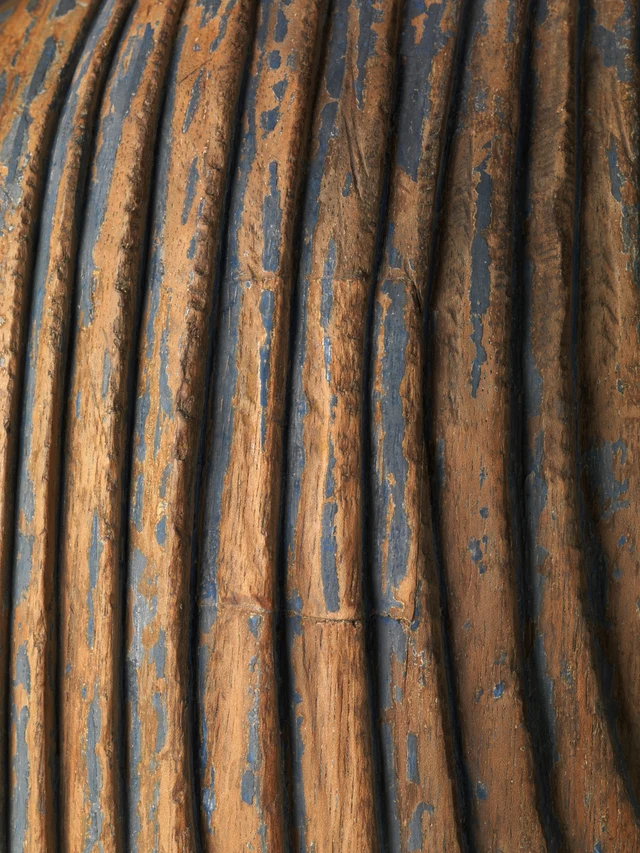
Do not rush to look for a large hole. Figure 6 shows a few unobtrusive horizontal seams between vertical folds. The piece closing the opening is itself raised and recessed, reconnecting with the surrounding clothing. Its task is precisely to make an entrance to the interior into a continuous surface again.
The museum interprets this cavity behind the shoulders as a possible space for relics. Technical examination did not establish that any relic was present. Collection account; Construction study, p. 48
This adds a layer to “bearing” that differs from the front. The front makes the child in the Virgin’s arms clearly visible; the small closed cavity in the back may have held sacred remains not intended for everyday viewing. One relationship opens through an image toward people, while another uses a container to preserve something. A visible body and an invisible interior coexist in the same wooden sculpture.
We need not claim that these relationships mean the same thing. Christ’s position belongs to the composition the work plainly presents. A relic container is a proposed function based on the cavity and comparable practices. They merit being considered together because the religious life this object entered was not limited to admiring its exterior form. It may have received veneration and may have contained relics; the museum also notes that images of this kind could be carried in church processions. The continuing folds across the finished back help us understand how it could sustain viewing from different directions. Museum account of function
Look again now at the mother’s hands. The embrace with which we began has gained substance. It places the child in front of her body, giving a small body that needs support a position facing everyone before it. Less than eighty centimeters tall, the sculpture still organizes this position with clarity and gravity: the outer contour steadies, the folds spread, the hands gather, the faces turn toward us.
Majesty arises within these relationships. The mother does not withdraw, and the child does not disappear into her arms. Through her own volume and her hold, she gives him a front that can be seen.
Optional Reading: Another Look through SAE
What would change if the child turned his head toward his mother?
Begin with a very small thought experiment. Keep the mother, both hands, the throne, and all the clothing as they are. Turn only the child’s face toward her. There is no need to imagine a new expression or replace missing hands. The comparison changes orientation.
In the original, both faces leave the same space in front open to the viewer. In the imagined version, the child would draw some attention back toward his mother. We could still see them and recognize the embrace, but we might begin to feel like bystanders looking at a relationship between two people. The front that the original opens toward us would acquire an inward-turning branch.
This gives “large hands,” “upright posture,” and “a miniature adult’s face” more precise roles. Merely listing these features does not explain how the work’s majesty takes shape. Only in concert with the shared forward orientation do they make the child both supported and available to view. Change one relationship and, even if the other shapes remain still, the whole can assign the viewer a different place.
The thought experiment is not meant to rank a more intimate version as lesser art. It distinguishes two ways of organizing attention and asks how fully the original realizes the relationship it adopts. From here we can approach SAE aesthetics and its question of how a construction unfolds: the grounds for an experience of beauty should be explicable through the arrangement of forms, rather than guaranteed by a sacred subject, great age, or solemn name. General account of SAE aesthetics
Images and Sources
This close reading uses six photographs supplied by The Metropolitan Museum of Art of the same sculpture, including frontal, side, rear, and detail views. It is an act of looking through a set of photographs, not in-person observation or a complete circuit. The official downloaded files are retained without color adjustment, retouching, or generation.
This essay follows the current collection record’s dating of about 1175–1200. The surviving surface has undergone paint loss and restoration; the throne and base also include replacement parts. These circumstances are explained where they affect interpretation, rather than allowing today’s wood color to stand for the original polychromy. The images and construction and paint studies all concern accession number 16.32.194a, b. For image sources and licensing, see Image Credits; for research sources, see References. The formal judgments offered here are this essay’s proposed readings.