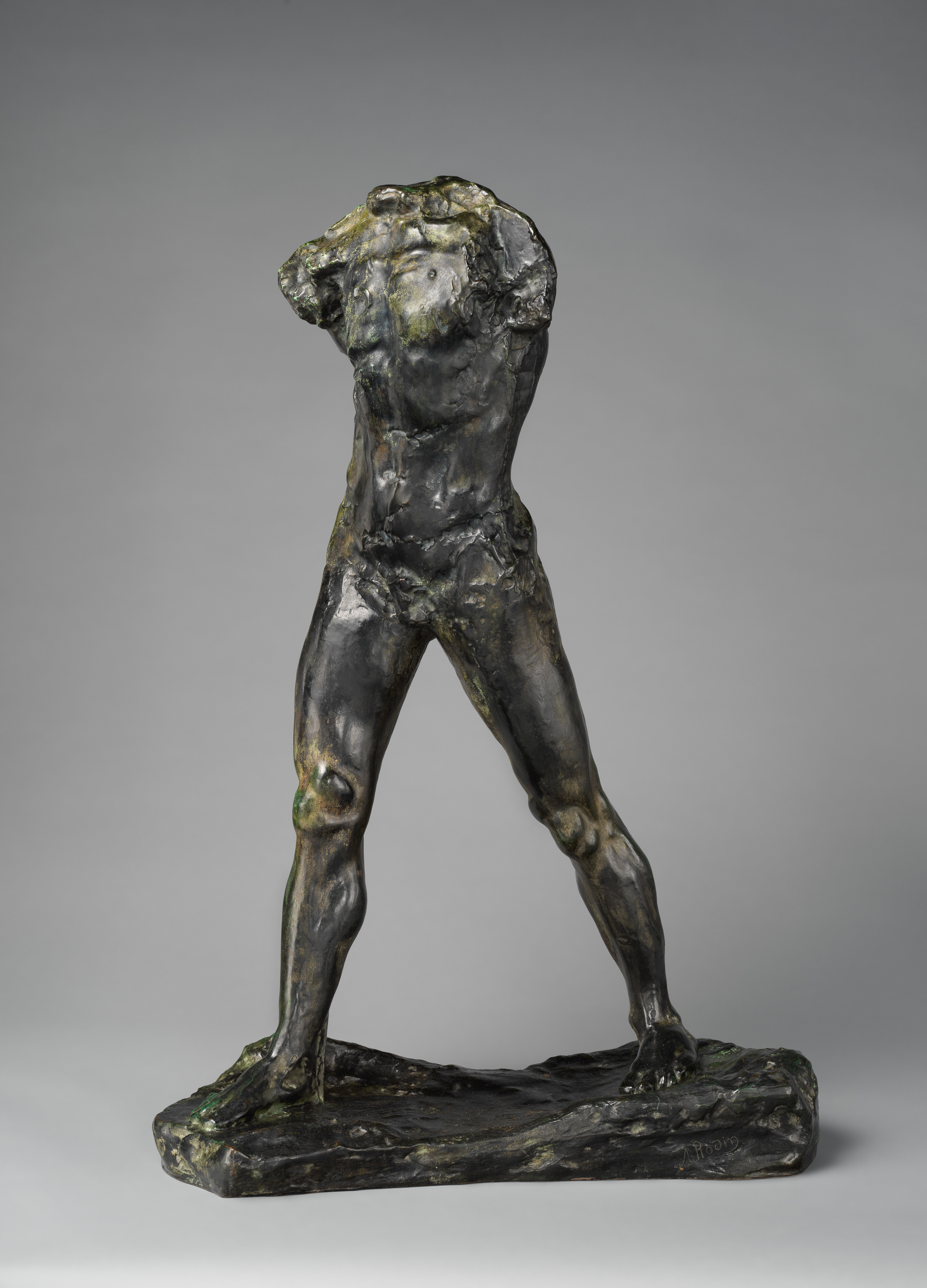
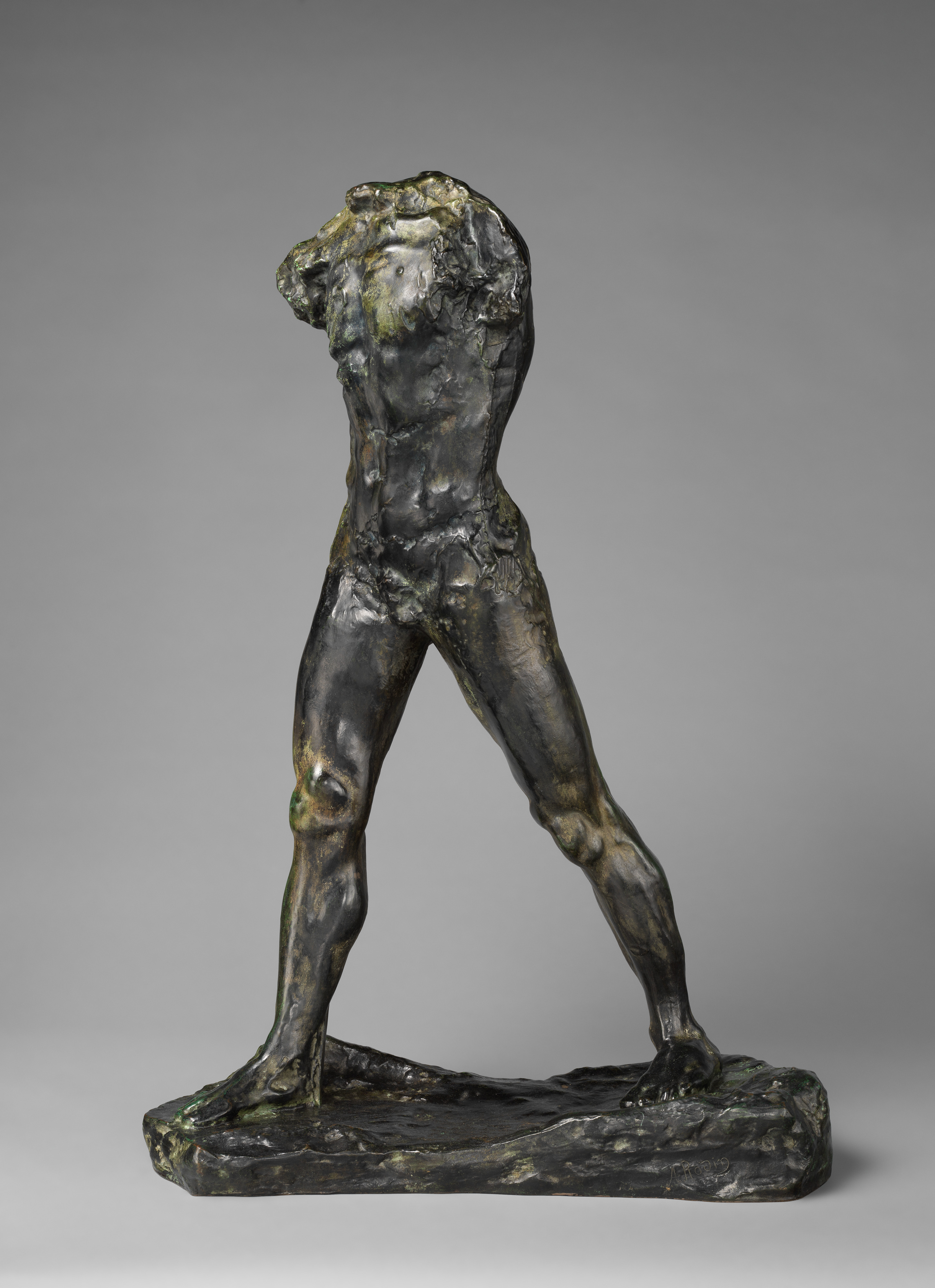
The legs are already spread apart, but the upper body does not settle squarely between them.
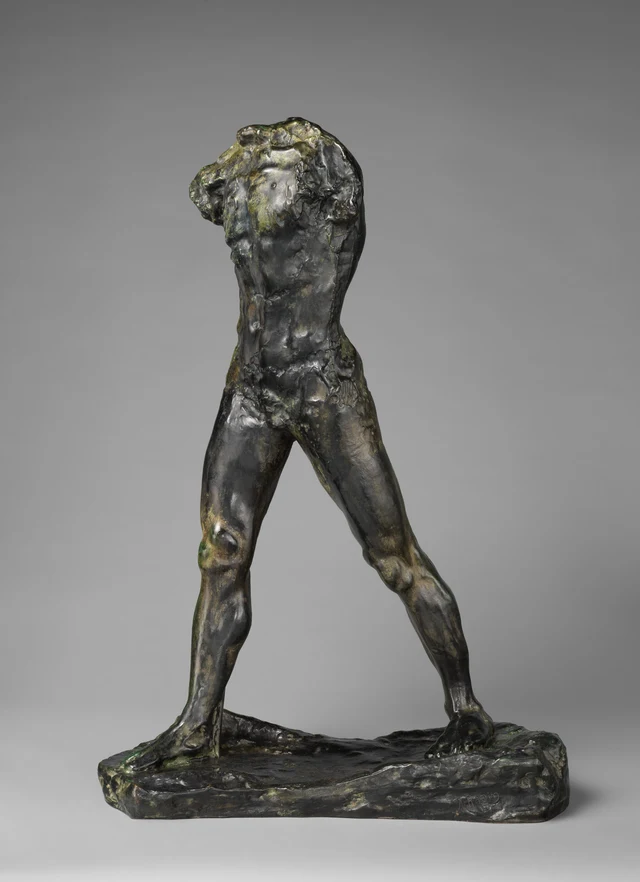
The lower leg on the left of the image is closer to vertical, its foot reaching forward to the left; the other leg stretches diagonally away, its toes near the opposite end of the base. Between the legs opens a tall, broad triangle. Follow its apex upward: the abdomen narrows, and the chest turns in another direction. There is no head to tell us where the eyes are looking, no arms to mark the rhythm of the stride. Still, this body has forward momentum.
Rodin builds walking through the connections between parts. The distance between the legs, the shift of the waist and abdomen, and the turn of the chest do not all repeat one direction, yet together they establish this stride.
In the late nineteenth century, Rodin returned to figure studies he had kept in his studio. He brought together a torso and legs originating in studies for Saint John the Baptist; a small plaster version was exhibited at the Pavillon de l’Alma in Paris in 1900. Earlier studies could become parts of a new work, and joining them could itself be an act of creation, rather than merely a manufacturing step to conceal. Musée Rodin: Multiples, Fragments, Assemblages
The bronze before us has neither head nor arms, yet Rodin accepted it as a finished work. It lets us see a human body and, at the same time, how that body has been assembled. Met collection account To understand this sense of completion, we can begin by adding nothing and asking how much the existing parts already do.
1. The Feet Stay on the Base. Where Does the Stride Come From?
First, look down the leg on the left of the image.
The thigh angles outward from the hip. At the knee, the contour changes direction slightly, and the lower leg tapers downward. The ankle is slender, but the foot stretches out at some length before meeting the base. The other leg extends from the hip toward the lower right of the image, its thigh, lower leg, and ankle forming a longer diagonal. Both legs begin at the same height but take different routes to the ground.
If we look only at the distance between the feet, we may simply see someone standing with legs apart. Bring the chest and abdomen into view, and the stance becomes less symmetrical. The torso does not sit directly over the midpoint between the feet, nor does the chest face precisely in line with the plane in which the legs spread. The lower body opens out; the upper body turns away. A difference of direction remains unresolved within the figure.
This difference makes it hard for the eye to settle at the center. We look from the extended foot to the knee, follow the thigh back to the hip, and are carried by the narrowing, displaced waist toward the chest. Here, “forward” is not drawn as an arrow. Several forms pass it along. The distance of the stride lies below, the force of the turn above; waist and abdomen connect them.
The base deserves attention too. It is very low, its surface uneven, its outer edge not finished as a neat architectural platform. Both feet meet this ground firmly, leaving a broad opening between them. The metal body stays solidly in place, while its visible action spans that distance.
Both things can be true: the cast has not moved, and we do recognize walking in its shape. Photographs cannot tell us how a real human body’s center of gravity shifts, much less make this pose a frame from a gait experiment. What we can follow here are visible relationships: where diagonals extend, where knees change direction, how the torso departs from symmetry, and how the space between the feet separates these directions.
Do not overlook that space. The legs frame the background with two unequal sides, narrow above and broad below, one side straighter and the other more oblique. How far the body opens out becomes especially clear precisely where there is no bronze. Walking resides not only in the muscles but also in the space the body leaves open.
2. The Join at the Waist Has Not Disappeared
Move your eyes to the lower edge of the abdomen, and the surface suddenly becomes crowded.
Although the abdomen above is uneven too, it still offers relatively continuous planes. Where it meets the hips below, an irregular horizontal ridge interrupts that continuity. Projections, grooves, and small bright facets gather together, as though several pieces of form were pressing against one another. Farther down, the thighs open again into longer, smoother volumes.
Knowing the history of the assembly draws further attention to this area. The Musée Rodin’s account of the creative process explains that an early version combined a cracked torso kept in the studio for years with a pair of legs, without attempting to hide the join. That assembly took place in the making of the model; what we see now is a bronze cast preserving those relationships. Musée Rodin on the creative process
We need not treat every groove as a precise record of a particular operation. The photographs let us recognize changes in the surface, but not determine individually which arose from modeling, the condition of an older model, or treatment during casting. The more immediate point is that the transition between upper body and legs has not been smoothed into uniformly even skin. We can see the connection.
This gives the waist two tasks. It is where the human body passes from chest and abdomen into legs, and where our looking passes from roughness into smoothness. The eye is briefly checked here, then travels down the thighs again. A continuous stride has not required a continuous surface everywhere. At precisely this uneven place, we can feel how the upper and lower forms take hold of one another.
The chest resembles a substantial mass that has been compressed and turned over, while the legs draw its force out lengthwise. If both were covered in equally fine wrinkles, that extension below might be less pronounced. If everything from chest to foot were equally polished, the upper body’s solidity, weight, and changes of direction would lose some of their tactile presence. Now the two treatments meet, and the body acquires different speeds: our eyes linger over chest and shoulders, slide down the legs, then stop again where feet meet base.
“Assembly” is therefore more than an interesting story behind the work. It enters the form before us. Parts in different states have not been polished into an undifferentiated whole. They sustain one pose while their differences remain visible.
3. A Rear Three-Quarter View Opens Out the Torso’s Turn
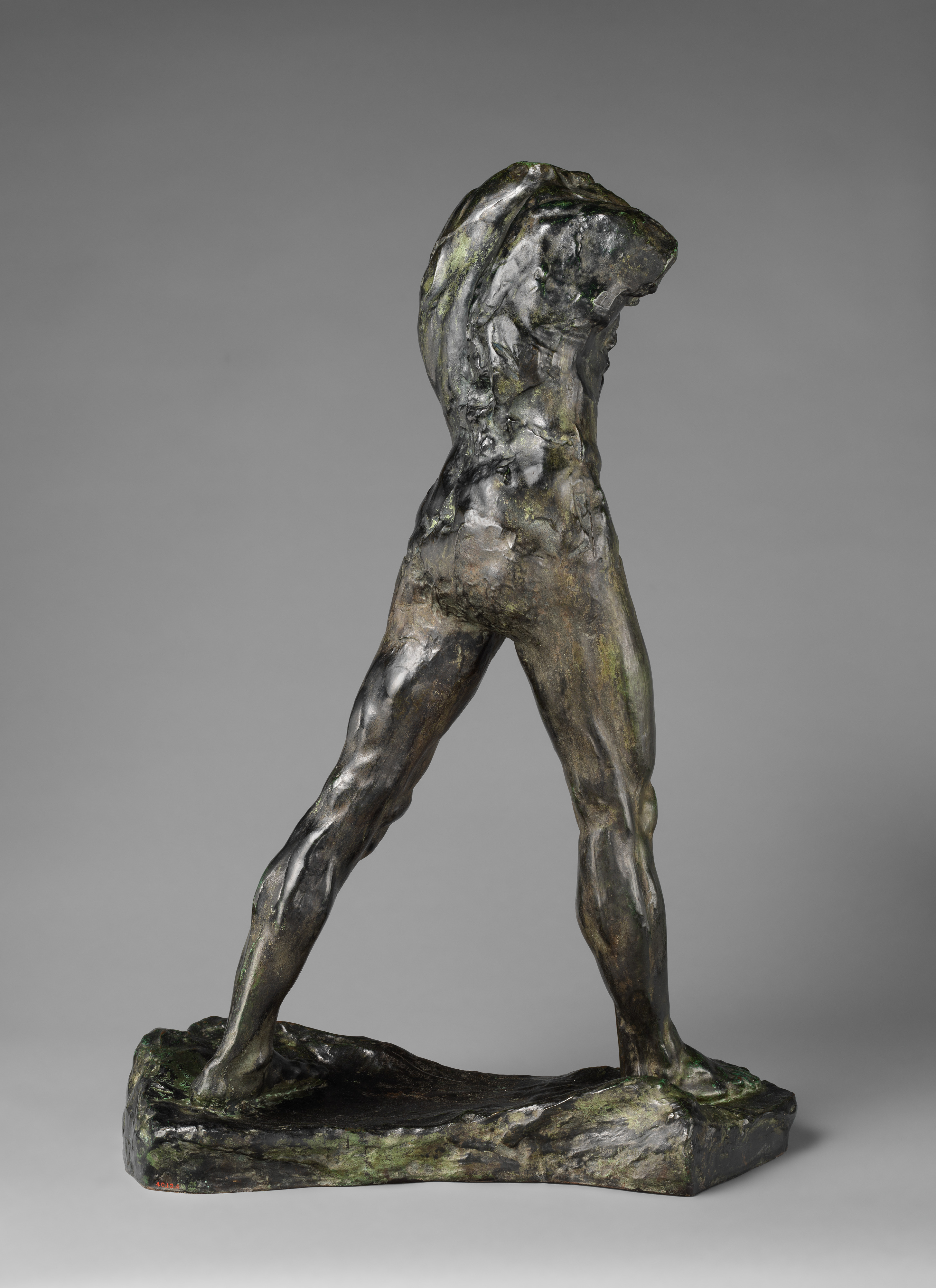
Move around toward the back, and the front of the chest and abdomen recedes; the back forms a broader arc.
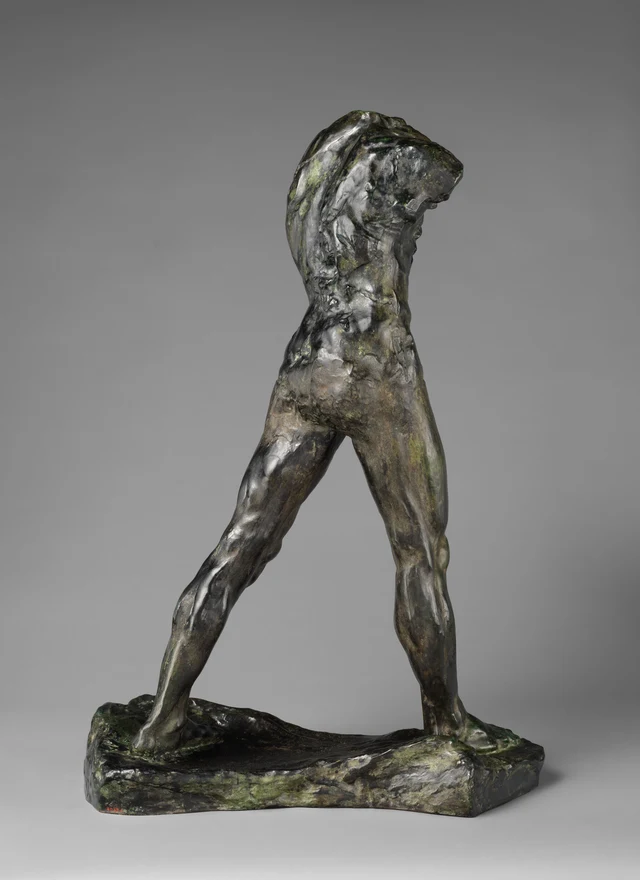
In Figure 1, the chest appears broad and the abdomen elongated. In Figure 3, the torso narrows but gains a conspicuous depth. The upper back swells outward, the waist draws inward, and the hips expand again. The contour is not one long line dropping from shoulder to foot, but a succession of contractions and expansions. Before the legs enter the lower part of our field of vision, the upper body has already undergone several changes.
The leg reaching toward the lower left of the image continues the back’s arc toward the ground; the other, closer to vertical, contains the form on the right. The opening between the legs is still large, but its shape and inclination differ from those in the front view. What first seemed a distance spread sideways now reveals more clearly the depth of a stride extending forward and back.
This is also where a photograph’s viewpoint can mislead us. From the front, depth is compressed into a flat image and can look like a sideways spread; from the rear three-quarter angle, some lateral distances are compressed instead. The two views help each other give the step depth beyond the page. We need not pretend to have walked all the way around. These available angles already remind us that the same contour can enclose quite different spaces.
Follow the uneven surface near the spine downward. At the waist and hips, it gathers into a dense cluster of ridges and hollows before the long surfaces of the legs open out again below. The rough and smooth, the abrupt and sustained, encountered at the front continue here in a different set of shapes. Front and back are not simply one image turned over. They reveal the same relationships from different places.
Most importantly, the torso does not sit vertically over the legs like a straight tube. It has curves and turns of its own. The legs open a stride, but the upper body continues to alter that stride’s direction and weight. Our sense of movement arises between parts that do not align completely.
4. Without Head or Arms, the Edges Still Do Their Work
Look again at the upper end. There is no smooth neck support waiting for a face to appear. Around neck and shoulders, the edges rise and fall unevenly. One side of the chest rolls outward into a thick projection; the other ends suddenly and steeply. The body stops extending at these points, but its volume does not disappear.
These terminating edges catch the light. Higher projections brighten and neighboring hollows recede, making the chest’s thickness more apparent. From the rear three-quarter view, the end of a shoulder becomes an inclined plane cutting off the back’s arc. These edges mark where the human body does not continue, while drawing a clear outer boundary for the forms that remain.
The absence of head and arms belongs to this sculpture’s construction. It cannot directly serve as evidence of something that has happened to the figure, or of its psychological state.
In Figure 1, the ends on either side of chest and shoulders are asymmetrical: one is more compact, the other exposes a broader sloping plane. They give the chest width while revealing its turn. In Figure 3, the bright plane at the shoulder’s end joins a longer reflection along the back. Our eyes enter the back’s arc from this shorter plane, then draw inward along the waist toward the hips. The truncation above gives this passage of looking a clear starting point.
The edges also keep the substantial chest and back from becoming a vague mass of undulations. At the shoulder’s end, where bronze stops and background begins becomes suddenly distinct; as the contour continues downward, the inward curve of the waist changes it again. Head and arms do not carry these outlines any farther. Our attention follows the existing volumes of chest and back toward the stride below.
The Musée Rodin connects the artist’s explorations of partial figures with his interest in fragments of ancient sculpture: the incompleteness of surviving works did not invalidate their proportions or expressive force. Musée Rodin: The Human Body, Nature, and Movement What matters here is not making a new work look like an “excavated antiquity.” It is recognizing that, when judging whether a sculpture is complete, we can ask whether its formal relationships hold together rather than simply check that all the anatomical parts are present.
5. The Body Remains Incomplete. The Step Is Already There.
Look again at Figure 1. The legs no longer seem merely two spread supports.
Each has its own bend at the knee, taper of the lower leg, and extension of the foot. The hips connect them without erasing their differences. Above, the rough torso opens in another direction, and the uppermost edges contain its volume. Long lines, short ripples, broad planes, and narrow joins act upon one another within a relatively small bronze body.
At an overall height of 85.1 cm, this cast also invites us to step back mentally from the screen’s enlargement. It is not a colossus towering above its viewers. The three photographs magnify small grooves and highlights with great clarity; in person, the whole body and base would first appear as a comparatively compact assembly. Surface detail helps us enter more deeply, but the overall stride still has to hold together first.
Walking has a particular persistence here. We need not find the exact pose one second later, nor wait for a foot actually to leave the ground. Simply follow torso, hips, legs, and feet once more, and their directions set the eye in motion again. A stride has been fixed, yet the relationships that constitute it remain active.
In this work, anatomical wholeness is not a condition of sculptural completion. The feet define the distance of the stride; waist and hips join legs to torso; the turn of chest and back gives the step direction; the truncations above contain the volume. Without head or arms, the pose is still fully articulated. Rodin stopped here because the forms already present were sufficient to make walking visible.
Optional Reading: Another Look with SAE
Is recognizing walking enough to say this is a good sculpture?
Seeing the legs stride apart, we may quickly understand what it represents. Once that recognition is complete, what else do the undulations of chest and abdomen, the joins at waist and hips, and the truncated shoulders let us see?
Try looking down from the chest in Figure 2. Its broad plane does not continue evenly into the legs: at the lower edge of the abdomen, dense irregularities slow the eye before the thighs draw it downward again. We receive more than the outline of “a step forward.” We also sense how the upper body’s weight passes through the narrow waist and hips into the legs. In Figure 3, a short inclined plane at the shoulder’s end cuts off the back; the back’s arc draws into the waist before the distance of the stride opens below. This step has undulations and weight that invite repeated looking.
You can also judge differently. Perhaps the spread of the legs is already the strongest element, while the small variations of chest and abdomen distract from it. Try naming a precise place, such as the dense irregularities at the lower abdomen in Figure 2, and explaining why it makes the movement clearer or prevents your eyes from continuing along the body. The disagreement can then center on the same form, without reducing likes and dislikes to “full of life” or “not complete enough.”
This question connects with a distinction in the general account of SAE (Self-as-an-End) aesthetics: beauty is not the same as understanding, nor as correctness or usefulness. Knowing what a work represents does not exhaust the ways its construction unfolds. We can recognize the stride before us; judging how chest and back, waist and hips, and truncated edges make it worth continuing to look requires something further. General account of SAE aesthetics
Returning to the work from here, “completion” asks something more specific than whether all the parts are present: have the existing forms sufficiently revealed this movement’s direction, depth, and rhythm? This remains a question we can examine, compare, and dispute.
Notes on Images and Sources
This essay uses three original official downloads of the same bronze cast, 40.12.4, from The Metropolitan Museum of Art. Each measures 4,000 pixels along its longest edge. The first two are front three-quarter views from very similar angles; the third is a rear three-quarter view. They do not provide a complete circuit of the work. The images have not been color-adjusted, recompressed, cropped, or generated. Lighting, lenses, and framing affect the appearance of surfaces; this close reading of photographs does not claim to be direct observation on site.
Musée Rodin sources explain the development of the work’s configuration and its creative methods. The large version discussed there is not the physical object illustrated here. This essay uses the Met’s dates and measurements for this cast, without transferring the enlargement, casting dates, or height of another example to it. Download addresses, pixel dimensions, licenses, and file checksums are listed in the Image Credits; sources and the scope of their use appear in the References.