The first things you notice may be two very long grooves.
They descend beside the nostrils, pass the tightly closed corners of the mouth, and curve upward again beside the chin. The mouth is caught between them, so short that it nearly becomes a single arc. Above, the eyes are closed too. But the lids do not rest peacefully: one layer presses against another, while fine creases at the outer corners spread sideways. Eyes and mouth have closed, yet the face is unusually full of rises and hollows.
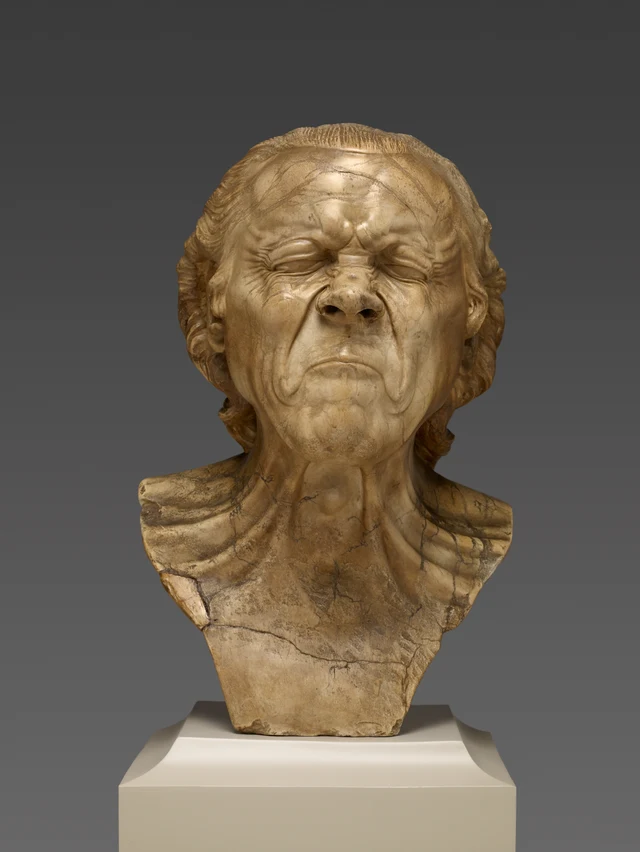
For me, the bust’s greatest strength lies in turning a tense expression into terrain we can examine at length. We immediately recognize a face exerting itself, but cannot finish looking in that first recognition. A swelling, a deep groove squeezed into being, a broad plane that remains open: each has its own weight. The sculpture retains a grimace that would ordinarily pass in an instant, making its construction more enduringly rewarding than its name.
The work dates from the late eighteenth century. Born in what is now southern Germany, Messerschmidt trained in Vienna and made portraits for the court and aristocracy. This head belongs to a group of expression studies from his later years, subsequently known as “Character Heads.” Contemporary investigations of expression and mental activity provide a context, but the title The Vexed Man was not the sculptor’s own. It was added after his death. Artist’s biography; Exhibition background; History of the heads and their titles
1. Where the Face Closes, Forms Multiply
Keep your eyes near his eyes for a moment.
The brow ridges draw toward the root of the nose, forming adjacent bulges between the eyebrows. Below, thick lids pile together, and the eyeballs almost entirely withdraw from view. Usually we follow someone’s gaze to discover what they are looking at. Here, no such guidance is available. Attention stays around the eyes, moving along the narrow ridges and channels squeezed into the surface.
The outer corners are especially clear. Fine creases do not form evenly spaced rings. They converge in a small area and spread toward the temples and upper cheeks, becoming shallower outward. They give “tightening” a direction we can trace. Short transverse folds cross the bridge of the nose, unlike the fine lines radiating outward beside the eyes. Between the brows, fine lines become two thicker swellings. Exertion does not take the same shape in every part.
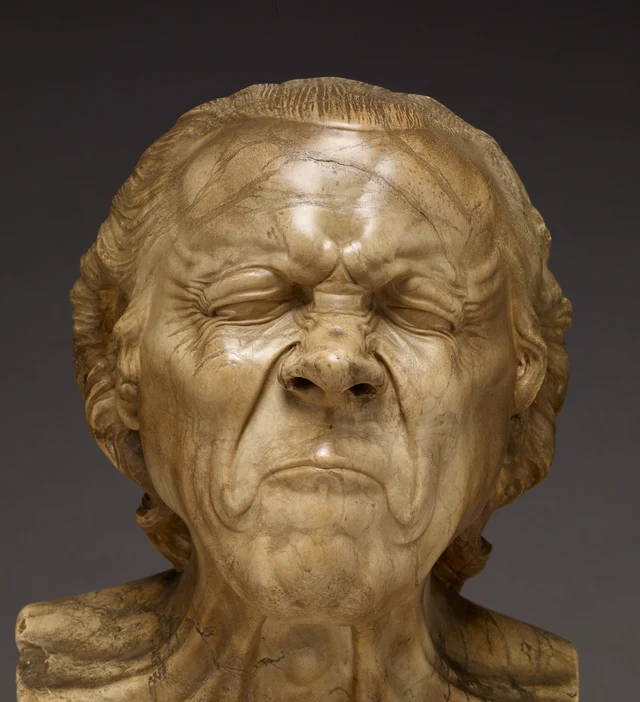
The mouth is treated at a slower pace. Unlike the quickly spreading eye creases, the deep grooves beside the nostrils lengthen, descend, and curve below the mouth corners. Together they enclose the area beneath the nose, the lips, and the upper chin in a concentrated zone. The upper lip does not open, nor does the lower lip turn outward. The mouth is compressed into a short length, while the curves enclosing it are long. This tiny closure gains force beyond its own dimensions.
Look next at the nostrils. Eyes and mouth leave only narrow seams, but the nostrils are definite dark holes, with the wings of the nose flaring sideways. Not everything draws inward. Closure and expansion crowd close together, and the tip of the nose projects forward. These opposing directions make the face seem tight, rather than merely full of wrinkles.
Nor has the whole head shrunk. The upper forehead remains a broad plane, the outer cheeks substantial volumes. Dense folds need these comparatively open parts beside them if we are to feel a contraction concentrated in particular places. Were every inch carved equally densely, the pressure around eyes and mouth would be less prominent.
2. How Much Neck Does a Tightened Face Need?
The frontal view places the deep grooves side by side, making it easy to treat the face as a flat diagram of expression. An oblique view reveals thickness on either side of each groove.
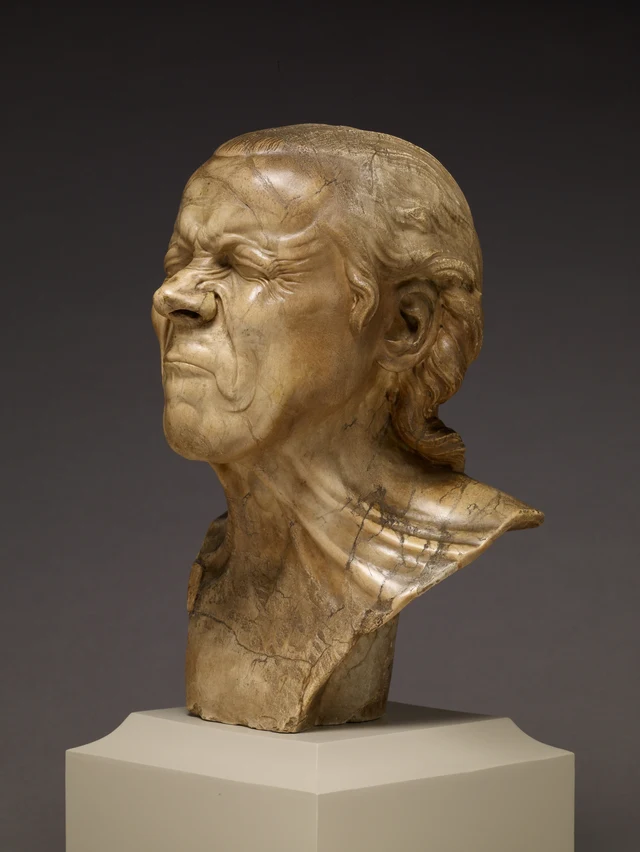
In Figure 3, the nearer cheek makes a large illuminated plane. The groove beside the mouth no longer resembles a line drawn on a face. It looks like a narrow valley where two volumes meet. On its inner side, the mouth projects farther forward; on its outer side, the cheek spreads toward the ear. Fine eye creases cross smaller changes of level, crowded along the cheek’s upper edge. We can distinguish places shaped by fine incision from those whose effect depends on the projection of an entire plane.
The nose is especially prominent here. It extends from the wrinkled root, with shadow beneath the nostrils; the lips withdraw, then the chin pushes forward again. A sequence of advances and retreats occupies the face’s depth, rather than a single mask projecting uniformly outward.
The neck takes up these shifts below. A long distance stretches between jaw and shoulders. Several raised bands descend diagonally along its sides, while almost vertical ridges mark the throat. Folds around eyes and mouth are short and dense; neck bands are long, broad, and straighter. Compression above and stretching below meet at the jaw.
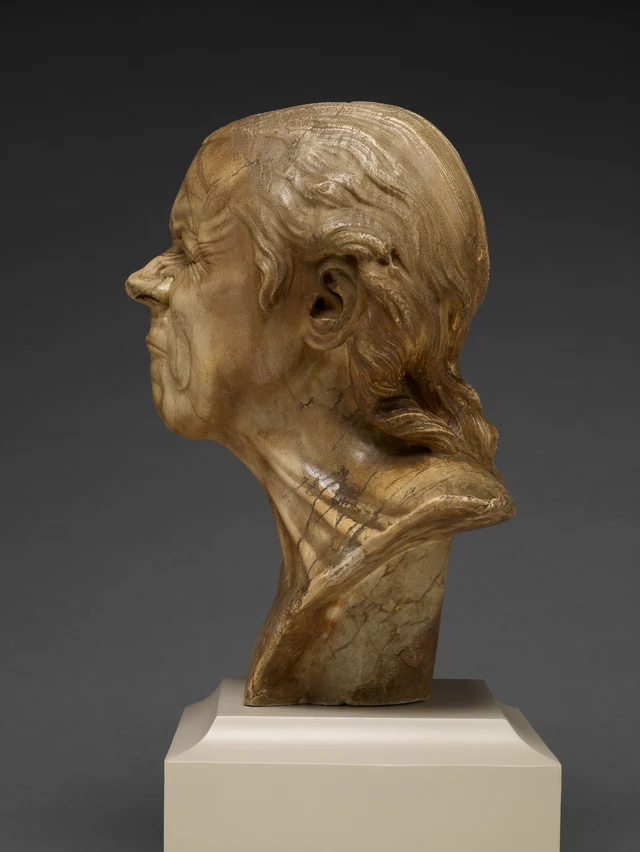
The profile makes the neck’s necessity clearer. The chin projects, the front of the neck immediately retreats, and the lower chest advances again. This longer curve places the face’s short advances and withdrawals within a larger outline. The head does not droop softly, and the neck does not disappear between raised shoulders. It is held clearly aloft, keeping the face’s contraction exposed.
The bust is cut short at the shoulders and gathers below into a narrower stone body. No gesture points toward something vexing; no costume or setting supplies a cause for the expression. Removing most of the body also cuts off an easily imagined story. Enough shoulder and chest remain to give the neck’s tension a starting point, but not enough to explain “what happened.” The expression can thus be highly specific while the event remains absent.
3. Not Every Line in the Stone Is a Wrinkle
At first, the yellow-brown color and dark markings can be read together as aging skin. Compare forehead, cheek, and lower shoulders closely, however, and at least two kinds of line emerge.
The fine eye creases have clear beginnings, endings, and depths, arranged around the closed lids. Some dark forehead markings cross smoother surfaces, branch diagonally, and do not entirely follow the features. Similar irregular markings appear on the neck and at the bottom of the bust. The first kind shapes folds through changes in surface height; the second first reaches the eye through color differences. The darkest line in the photograph need not be the deepest groove.
The Getty’s exhibition account explains that the sculpture is alabaster and that the stone’s natural markings participate in the face’s appearance. The polished face also contrasts with more roughly carved hair. Account of material and surface The face’s complexity therefore depends on more than how many wrinkles the sculptor cut. The stone’s own markings travel among the modeled rises and hollows.
In Figure 2, continuous bright areas run between the brows and across the forehead. Light is not interrupted at every dark marking. At the eye corners, actual grooves divide illuminated surfaces into narrow strips. The distinction matters: one lets us see the continuity of the stone’s surface; the other shows how that continuous surface is pressed into folds. With sustained looking, the illusion of skin and the presence of stone do not cancel one another. They become clear in turn on the same forehead.
The hair offers another comparison. In Figure 4, incised lines sweep backward over the crown, becoming larger curls behind the ear. Light spreads over the cheek but is divided by many narrow channels in the hair. The curls behind the ear project in successive sections along the contour. The material is of the same kind throughout, yet surface treatment makes it appear as skin, locks of hair, or the deep hollow of an ear.
The ear is especially interesting among these differences. Between the broad cheek and dense hair, its outer edge makes a thick arc, while the interior suddenly recedes into darkness. Closed eyes and mouth dominate the front; the side introduces a deep cavity that remains open. We need not interpret the ear as another emotion. Its clear recession establishes depth for the projecting cheek and hair around it.
These photographs cannot determine the cause of every dark mark or reconstruct the newly carved stone from color alone. They do show enough to establish that line, color, sheen, and volume do not all convey the same information. Calling every dark trace a “wrinkle” would miss how the material participates in making the image.
4. The Title Supplies an Emotion; the Sculpture Preserves Time
The Vexed Man is an easy title to use. Closed eyes and downturned mouth corners seem to supply immediate evidence for “vexation.” Yet the flared nostrils might also suggest a response to a smell, while the firmly shut mouth looks as if it is holding back an impending action. The work makes contraction very definite without giving its cause an equally definite answer.
The history of the title clarifies this. Messerschmidt called such works Kopfstücke, “head pieces.” After his death, forty-nine heads were exhibited in Vienna in 1793; descriptive names were subsequently printed in an anonymous publication in 1794. Names that now seem to have been born with the expressions actually belong to the works’ later history of interpretation. Getty account of the naming
We need not discard the title. It offers a way into the work, but not a key to every detail. Knowing the name should still leave us able to ask: Why are the two mouth grooves so long? Why does the neck stretch more broadly than the area around the mouth? Why do the cheeks retain such large smooth planes? “He is vexed” cannot answer these questions, any more than it can do our looking for us.
The title can also conceal another distinction. When a living person makes such a face, we ordinarily expect it to relax in the next moment. Eyes will open, the mouth will move, cheeks will change shape. This stone sculpture supplies no next moment. The folds have formed, the neck stays tense, and the material continues to sustain that state.
We can therefore look more slowly than we usually look at a grimace. Tiny eye creases can be compared with the broad curves beside the mouth. What looks like a line from the front can reveal thickness from the side. Fleeting differences within an expression gain time for repeated examination in stone.
That is why I consider this an outstanding sculpture: it turns expression from a quickly recognized signal into a form worth staying with. The figure keeps his eyes closed, giving the viewer’s eyes all the more to do.
Optional Reading: Another Look through SAE
Facing Figure 2, hold two possible readings in mind for a moment: a man is vexed; a man is holding back a sneeze. The latter is a hypothesis for looking, not a researched claim about the work’s subject or the figure’s physical condition.
Through “vexation,” the closed eyes and mouth readily become central. They make the face seem unwilling to open outward, while the two long mouth grooves enclose that closure firmly. Broader cheeks and forehead remain around the edges, setting off the tension near eyes and mouth. The taut neck in Figures 3 and 4 makes the state seem to continue.
Switch to “holding back a sneeze,” and the nostrils may stand out first. Flared nostrils, wrinkled nose root, closed eyes, and compressed mouth join into an action not yet released. The broad cheeks now do more than form a background for fine wrinkles: they make a sudden local contraction more evident. Long neck ridges seem to draw that brief change below the face. Our expectation of a “next moment” grows stronger than in the first reading.
Neither reading changes the stone, but each changes the order and weight of details. Such a change can genuinely enrich aesthetic experience. Nostrils previously treated as background now form a clearer relation of opening and closing with eyes and mouth. Interpretation must nevertheless withstand specific tests. “The entire face draws inward,” for instance, is inadequate in either reading: the nostrils flare, the nose tip projects, and the broad cheeks have not disappeared.
Identify the three details each reading depends on most. Then ask whether it neglects some part moving in the opposite direction. Which makes the connection between neck and face clearer to you? Without deciding what the figure is really thinking, we can compare which formal relationships an interpretation reveals and which it pushes into the background.
SAE aesthetics treats context as part of aesthetic experience while distinguishing understanding from beauty. This comparison brings those points together. An interpretation can change how a work unfolds before us, but must still explain its contribution through specific relationships among eyes, nose, mouth, and neck. Its value can therefore be discussed rather than judged solely by whether it sounds like a plausible story. General account of SAE aesthetics
Images and Sources
This close reading uses four Getty Museum photographs of the same alabaster bust: frontal, front-left oblique, left profile, and a museum facial detail. They support the comparisons of form and surface made here but do not provide a complete circuit or record in-person observation or touch. Photographic lighting, framing, and screen display affect color and light and dark.
The official original downloads are retained without retouching, color adjustments, or recompression. The essay uses the Getty’s current dating of 1771–1783. The “after 1770” used in earlier exhibition material is not presented as a more precise new date. For image sources and licensing, see Image Credits; for literature, see References. The judgments are proposed readings based on photographs and do not imply endorsement by the museum.


