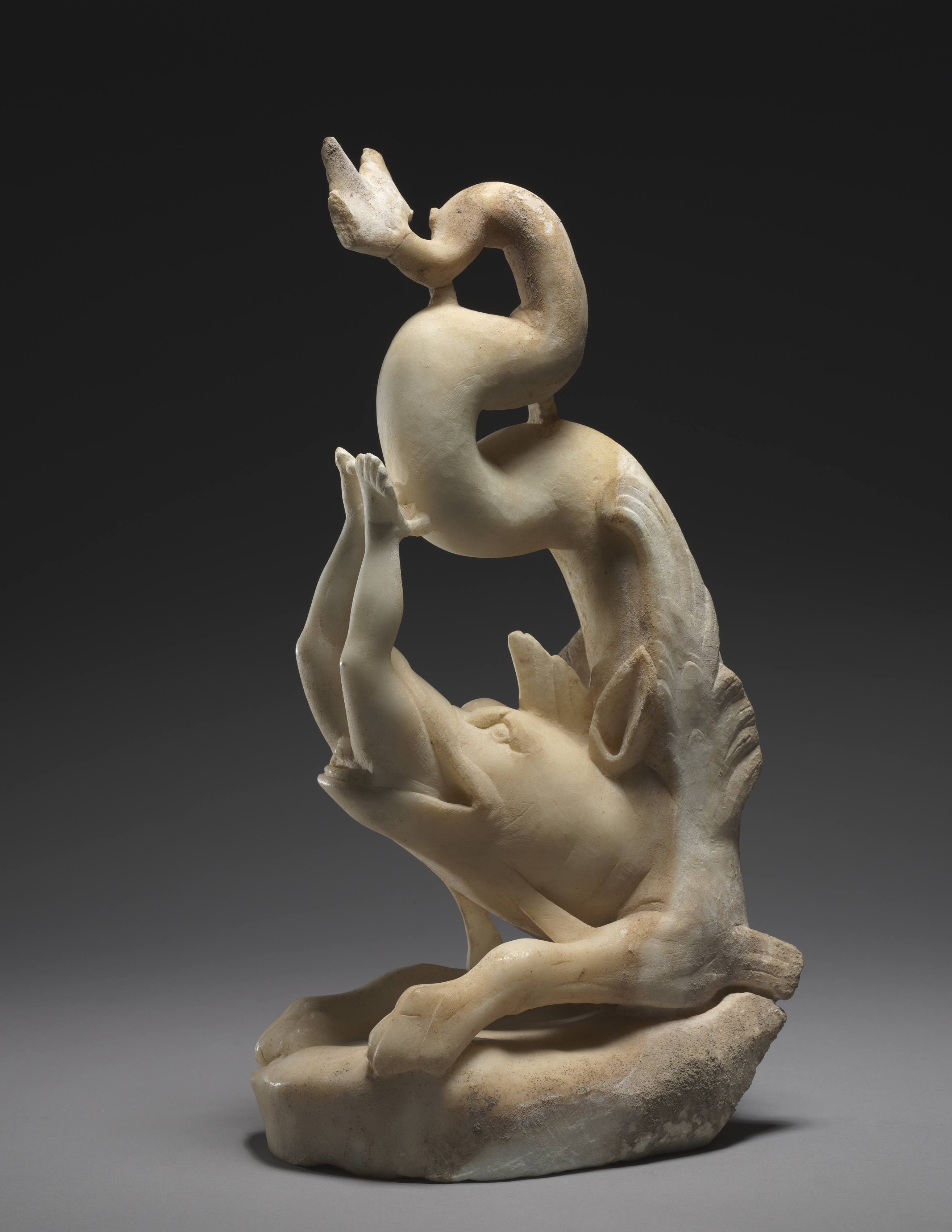
The highest thing here is not a human foot.
First find the two feet pointing upward together. Then look above them: a thick, curving form makes several turns before opening into a fan-shaped end. The human body hangs upside down below it, its head already out of sight. The sea monster opens its mouth and raises its snout, while its forepaws rest low on the base.
A person disappears downward. A tail opens upward.
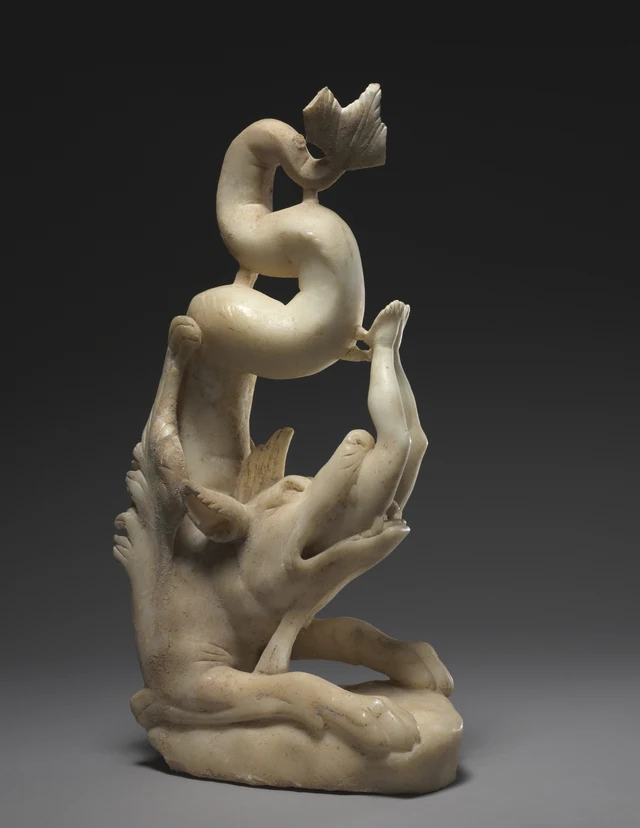
It is easy to sum this work up as “a sea monster swallowing a man.” Yet swallowing usually brings to mind a mouth and a belly capable of holding food. Here, the coiling tail occupies most of the height. It leads us away from the mouth, then brings our eyes back to it. The sculpture’s force lies in making an action that will end in disappearance into an upward-growing form that remains available to view. The alarming story and the shape that rewards prolonged looking are inseparable.
The work dates from the late third century. In the story, Jonah disobeyed God’s command to announce judgment in Nineveh, was thrown into the sea, and was then swallowed by a sea monster. The museum identifies the creature here as a ketos from the imagery of the ancient Mediterranean, rather than a whale in modern zoological terms. Early Christians, meanwhile, read Jonah’s story as a prefiguration of resurrection. These two traditions meet in a single marble sculpture. Its precise original setting has not been reliably established, so we need not first build a church around it in our minds to understand how it works. Museum account; A curator on the Jonah marbles
1. Upturned Feet with Nowhere to Stand
Leave the tail aside for a moment and look only at the human legs.
They lie close together, but they do not form a single straight line. There is a slight bend at the knees; the lower legs extend upward again, and the toes crowd the upper part of their outline. Being able to distinguish the feet, toes, and tapering lower legs makes the inversion all the clearer. These familiar shapes usually belong to standing and walking. Here, all of them have left the ground.
In Figure 1, the monster’s forelimbs spread to either side, its paws lowered onto the base. The human feet hang far above them. The two kinds of “feet” occupy opposite positions. The monster has firm footing; the man’s feet cannot reach the ground on their own. His form has been joined to the creature swallowing him. The threat in the story thus becomes a relationship between volumes: which body commands the bottom, and which has lost its own support.
Yet the legs do not splay widely or scatter the figure’s outline through space. They make a fairly compact bundle of slightly bent upward lines beside the monster’s thick upper coil. To describe them simply as “struggling” would miss this concentration. The sculpture does not spread danger in every direction. It compresses it into a narrow area, making the body seem like the last length about to be drawn inside.
The object’s size is especially worth remembering here: the whole work is only about fifty centimeters tall. Enlarged in a photograph, the feet and gaping mouth can suggest an enormous struggle. At its actual scale, toes, knees, and the rim of the mouth must remain distinct on a small object. The dramatic action does not overwhelm us through colossal size. A few clear shapes seen at close range quickly tell us what is happening.
Now compare the proportions of man and monster. No whale-like, capacious belly waits to receive the man. Instead, a slender body repeatedly doubles back. This is no model inviting us to test whether the swallowing is anatomically plausible. It distills the necessary relationships: an open mouth, a person entering it, feet still outside. Precisely because the rest of the human body is no longer shown, this small remaining length acquires a sense of time.
2. The Mouth’s Rim Is a Moving Boundary
From the other side, the meeting of legs and mouth becomes more concentrated.
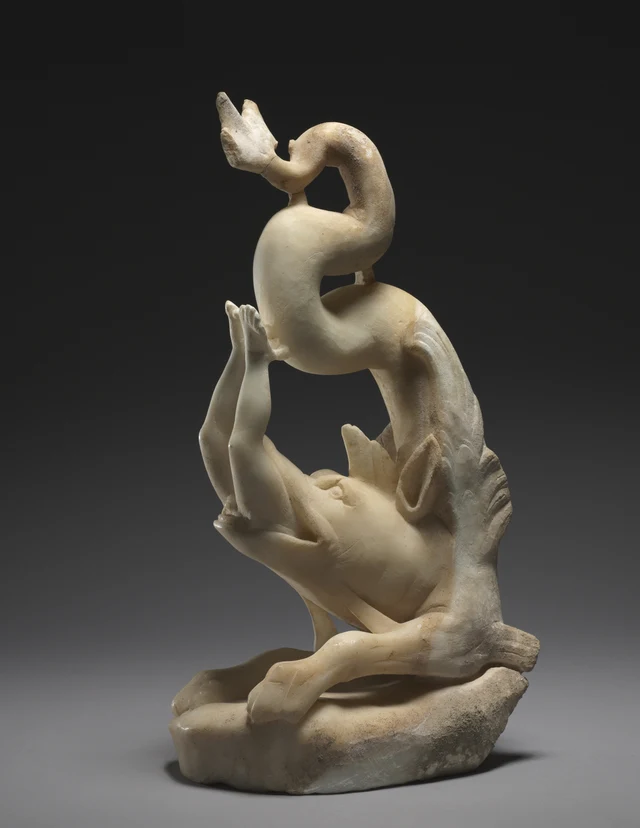
The opening mouth is not a round black hole. Long upper and lower jaws part upward, and the human body enters at an angle. One side of the mouth lies close against him; on the other, a narrow, darker gap appears. We do not see a whole Jonah through an opening. We see a body that stops being visible here. This edge separates the visible from the invisible and gives the pose a sequence: the head has gone in, the legs remain outside.
Nothing moves, yet we can see a process because this boundary has not quite taken the person away.
With only an empty open mouth, the swallowing might be over or might not yet have begun. With the entire man outside, the scene would instead become a capture. The length preserved here is specific. It suspends our looking between two outcomes, rather than using a complete human figure to explain that “Jonah once faced danger.” What we see is the encounter at a particular stage.
This also explains why the action remains vivid without a human face. The monster has recognizable eyes and a mouth, but the man cannot answer with an expression. Our attention is forced toward the contact between the two bodies: how the mouth surrounds him, how the legs continue outward from that point. His plight is conveyed not by fear on his face but by how much space he can still occupy outside.
Viewers who know the rest of the story may already anticipate Jonah’s release. Cleveland also holds Jonah Cast Up, showing the monster expelling him. That is another object, not an ending revealed by turning to the other side of this sculpture. Collection record for Jonah Cast Up The stage arrested here holds its own. His later survival does not cancel the danger now present at the mouth.
3. A Swimming Curve Must Stand Firm in Stone
The human legs lead us upward, but what lies there is no exit. It is the monster’s own tail.
Follow the elongated body from the lower part of Figure 2. It rises behind, bulges toward the left of the image, folds back to the right, and finally narrows to carry the tail fin. It changes direction several times, retaining a full thickness at each turn. From farther away, it resembles a flowing line. Up close, it becomes a series of rounded volumes occupying space. They both enclose openings and constrict them.
Beside this coil, the human figure looks narrower. The tail curves close to the feet from above, enclosing even the direction in which they might otherwise extend. The mouth swallows from below; the tail turns back overhead. We need not imagine the monster deliberately trapping Jonah with its tail to see that the composition has already tightened the space outside his body.
Notice, too, a few less conspicuous connections. Where two stretches of the tail come close, short stone links bridge the gap. Beside the man’s feet, small points of connection lead toward the monster’s curved body. They do not enter the story as immediately as the mouth and paws, but they contribute to our understanding of this stone sculpture. The apparently suspended parts are not independent everywhere; physical connections remain between the curves. Photographs cannot establish when every connection was made or repaired. What they do show is that the visible form today is not a free curve without attachments.
A particular rhythm of looking emerges. Our eyes glide upward along the long tail, meet a small connection, and become aware again that we are facing stone. It has to turn like an animal while remaining connected as an object. Flow does not arise only once the material has disappeared from awareness. It emerges while these curved masses, gaps, and junctions remain present together.
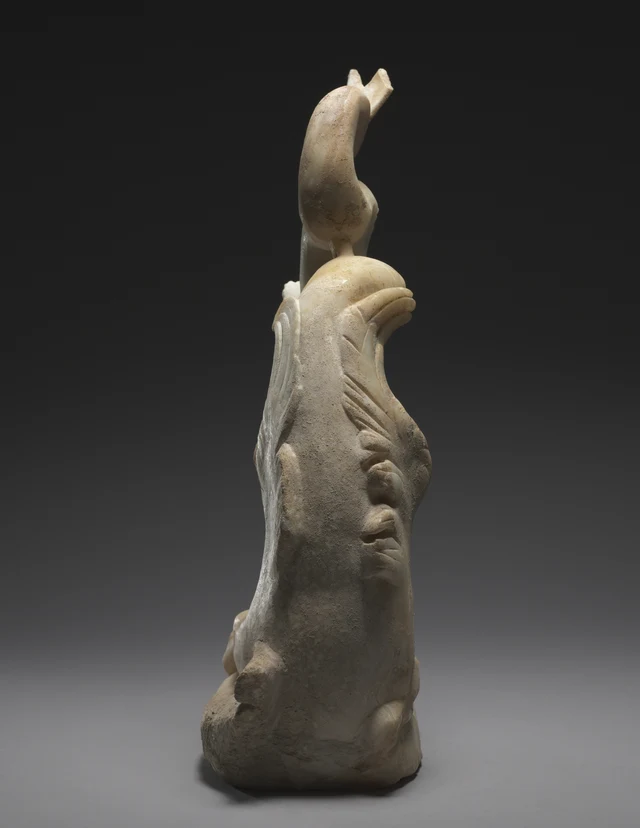
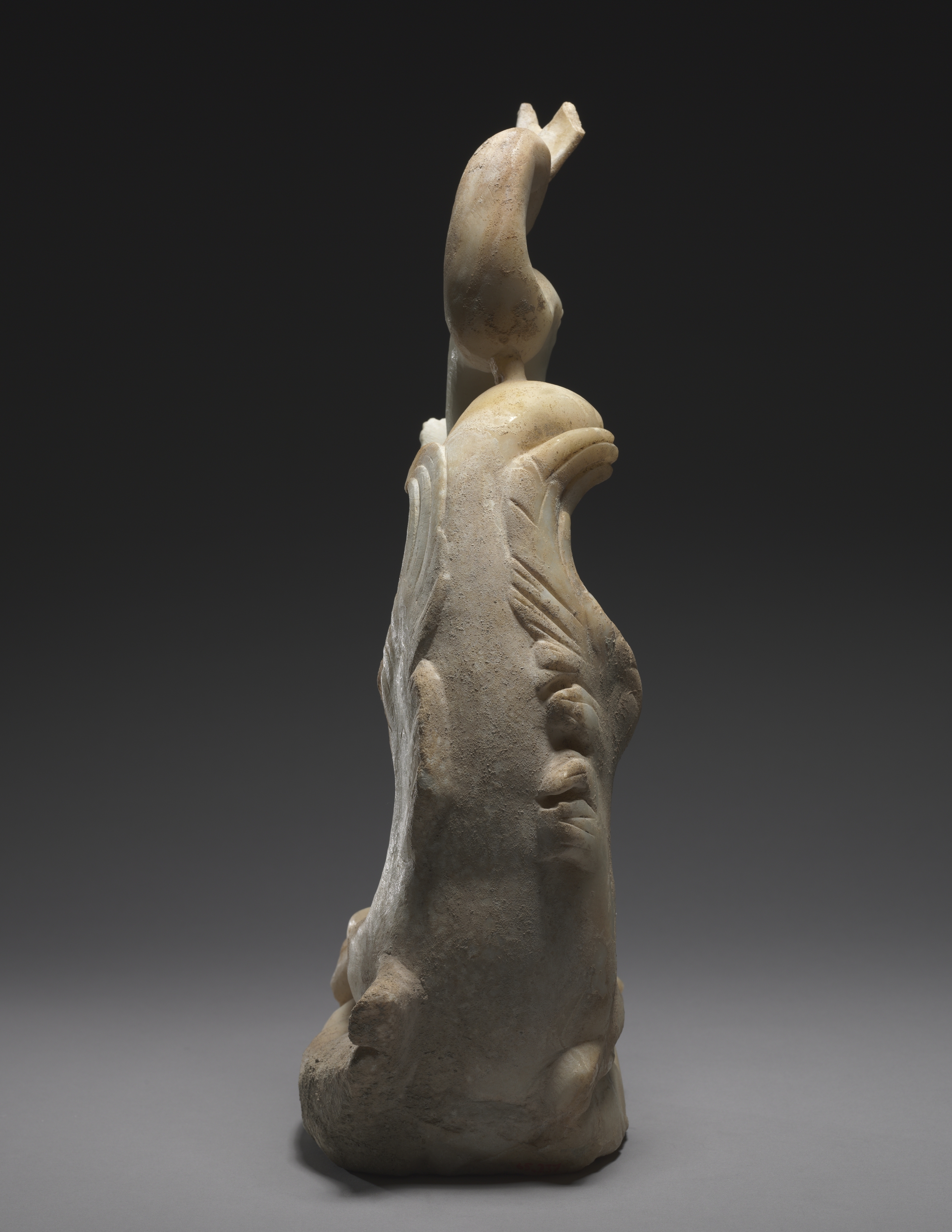
Figure 3 makes this more tangible. From this direction, the legs and great mouth have almost withdrawn to the object’s far side, and its outline becomes slender. The monster’s back is not covered in a uniform field of tiny scales. Local bulges, groups of diagonal grooves, and an undulating edge give variety to a long surface. Light continues across broad planes and breaks at the grooves. The body that turned our gaze in the first two images also has a substantial, solid stretch of back here.
This photograph does not supply a “true back” concealing some secret. It lets us test an impression the first two views can readily produce: that great coil is not a spherical mass equally broad on every side. The thickness and arrangement of its principal volumes have a definite orientation. The sculpture brings tail, mouth, and legs together so that some directions tell the swallowing clearly, while others first reveal the stone’s continuous mass.
This cannot reconstruct where ancient viewers stood. The original setting is unknown, and three photographs do not provide a complete circuit. But they show enough to establish that the clarity of the story in one broad view depends on how this three-dimensional form is organized in depth.
4. Why the Sea Monster Holds Our Attention
If danger required only a fearsome mouth, this sculpture would have invested far too much form in its tail.
The creature combines many familiar parts: a long snout, projecting ears, grounded forepaws, a long coiling tail, and a fin-like form spread at its end. They do not belong to any ordinary animal found in nature, but each offers a route for the eye. The forepaws spread the bottom outward; the back gathers upward; broad tail curves fill the height; the tip opens outward again. This opening and gathering give it an appeal that exceeds the word “frightening.”
The tail matters especially. We can travel upward along it, or follow it down from the fan-shaped tip, through a narrower bend, then a thicker coil, and finally back toward the open-mouthed head. It repeatedly delays our arrival at the site of swallowing. Jonah’s tiny remaining stretch of exposed body and the monster’s long, repeatedly explorable body receive very unequal amounts of looking time.
That inequality is the tension this essay finds most worth retaining. The monster possesses the richness of form; the person in danger is compressed into a bundle of legs outside its mouth. We may know it is swallowing someone and still be attracted to its curves. Admiring those turns does not mean endorsing the harm in the story. Yet saying only “this is a beautiful shape” would erase the unease introduced by the legs. Both responses arise in the same small sculpture. One approving or disapproving word cannot cancel either of them.
The ancient ketos entering Jonah’s story gives this richness of form a historical lineage. Early Christian content did not make the established sea-monster form disappear. A new narrative setting used a familiar creature’s body. The museum interprets the Jonah marbles in relation to resurrection. That reading connects danger with the rescue that follows it, without requiring the monster’s existing body to change. Curator’s account
For viewers who know that Jonah survives, the swallowing gains another contrast. The monster taking him away is also the creature that temporarily contains him and later returns him to the outside world. But this meaning cannot be gained by calling the monster gentle. It still has a mouth that draws a person inside. Precisely because danger has such a definite shape, the later deliverance is more than an abstract promise requiring no passage through crisis.
The sculpture therefore need not choose between a “dramatic story” and “decorative curves.” It turns swallowing upright, makes the man disappear downward and the creature unfold upward, and holds both directions together in firmly connected marble. Those feet with nowhere to stand ultimately prevent the beautiful raised tail from becoming an ornament in which nothing is happening.
Optional Reading: Does Recognizing Swallowing Mean We Have Finished Looking?
Try a small comparison on screen: reduce Figure 1 until you can just make out its overall outline, then restore it to a size at which toes and small stone connections become distinct. What changes here is the displayed size of the photograph. We are not imagining the original as a sculpture of different dimensions.
In the smaller image, the broad tail coils, open mouth, and upward-pointing legs may still let us recognize “a sea monster swallowing a man.” But the separations between toes, the narrow gap between mouth and human body, and the little links between the coils become difficult to distinguish sooner. The basic story can remain legible while the relationships between details do not.
After enlarging the image, ask whether we have merely gained more information. The small connections can make the long tail’s suspension look less free; recognizable toes make us feel more specifically that these are human feet. Neither changes the subject’s name. Both can change the perceived weight of the curves and our sense of distance from the person being swallowed. Not every enlarged detail matters equally. What matters is whether it changes our judgment of the overall relationships.
This separates “I recognize what it depicts” from “I have looked at how it works.” A clear subject does not guarantee a form that rewards sustained attention, nor do plentiful image details automatically make a work better. Here, the question worth pursuing is whether the sweeping coils seen at a glance hold up to closer scrutiny of their connections, thicknesses, and human details.
The general account of SAE aesthetics distinguishes understanding, pleasure, and beauty. This work gives us a concrete place to begin: if the story of swallowing is already recognizable in a thumbnail, what relationship do we see when details return that no title could replace? This is an inquiry grounded in a specific comparison, not a theoretical ranking of the work. General account of SAE aesthetics
Images and Sources
This close reading uses three photographs supplied by the Cleveland Museum of Art of the same marble sculpture: oblique views from two sides and a narrow rear-side view. Each measures 3,400 pixels on its longest side. The museum’s downloaded files are retained without color adjustments, recompression, retouching, or generation. This essay does not draw on in-person observation or touch. Lighting, lenses, occlusion, and framing affect how surfaces and depth appear, and these three images do not constitute a complete 360-degree record.
Related works such as Jonah Cast Up have not been presented as other views of this object. Nor has an unverified original setting been used to reconstruct viewing in a fountain, tomb, or church. For image sources and licensing, see Image Credits; for documentary sources, see References. The formal interpretations offered here do not imply endorsement by the museum.