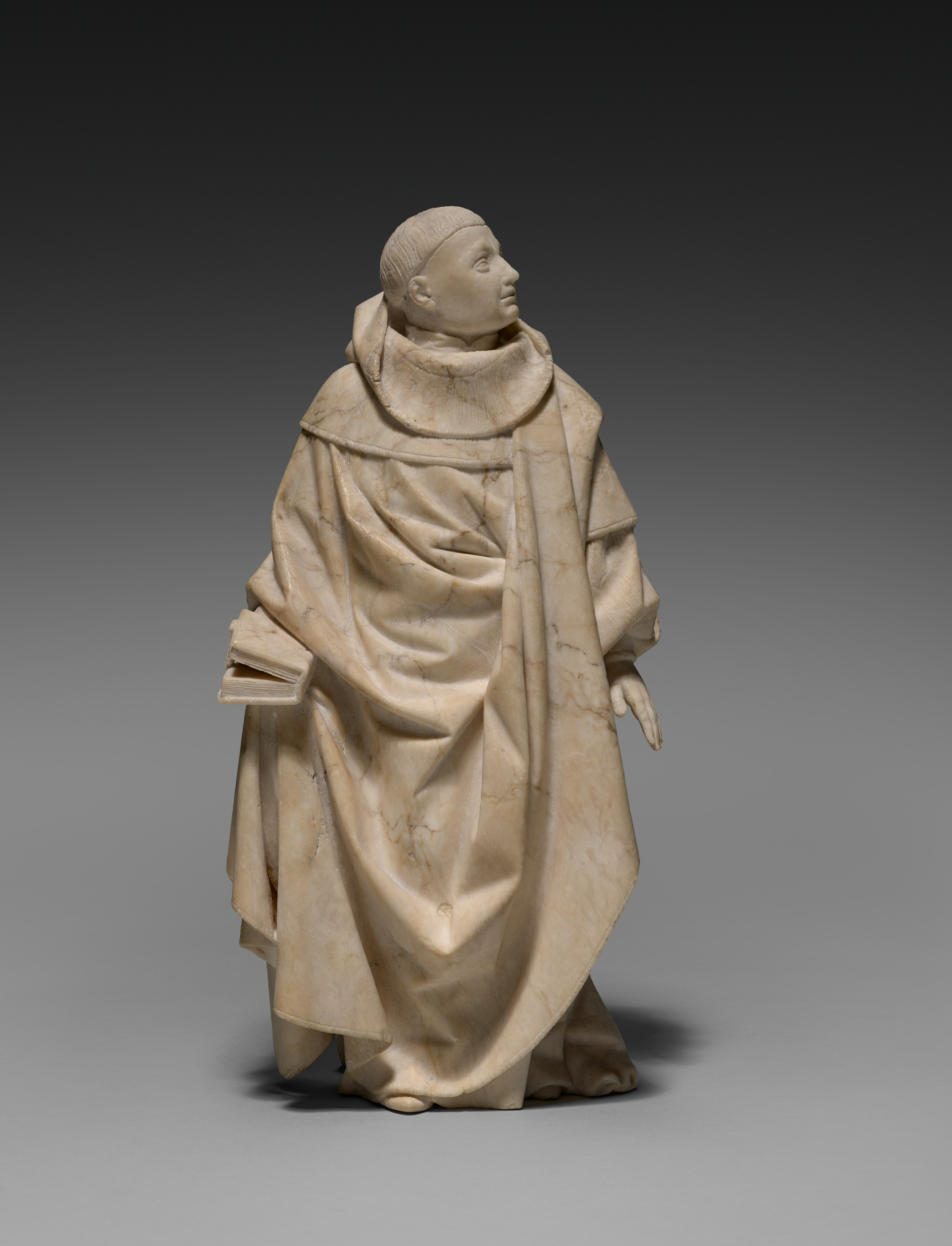
His book has not closed, but his eyes are not on it.
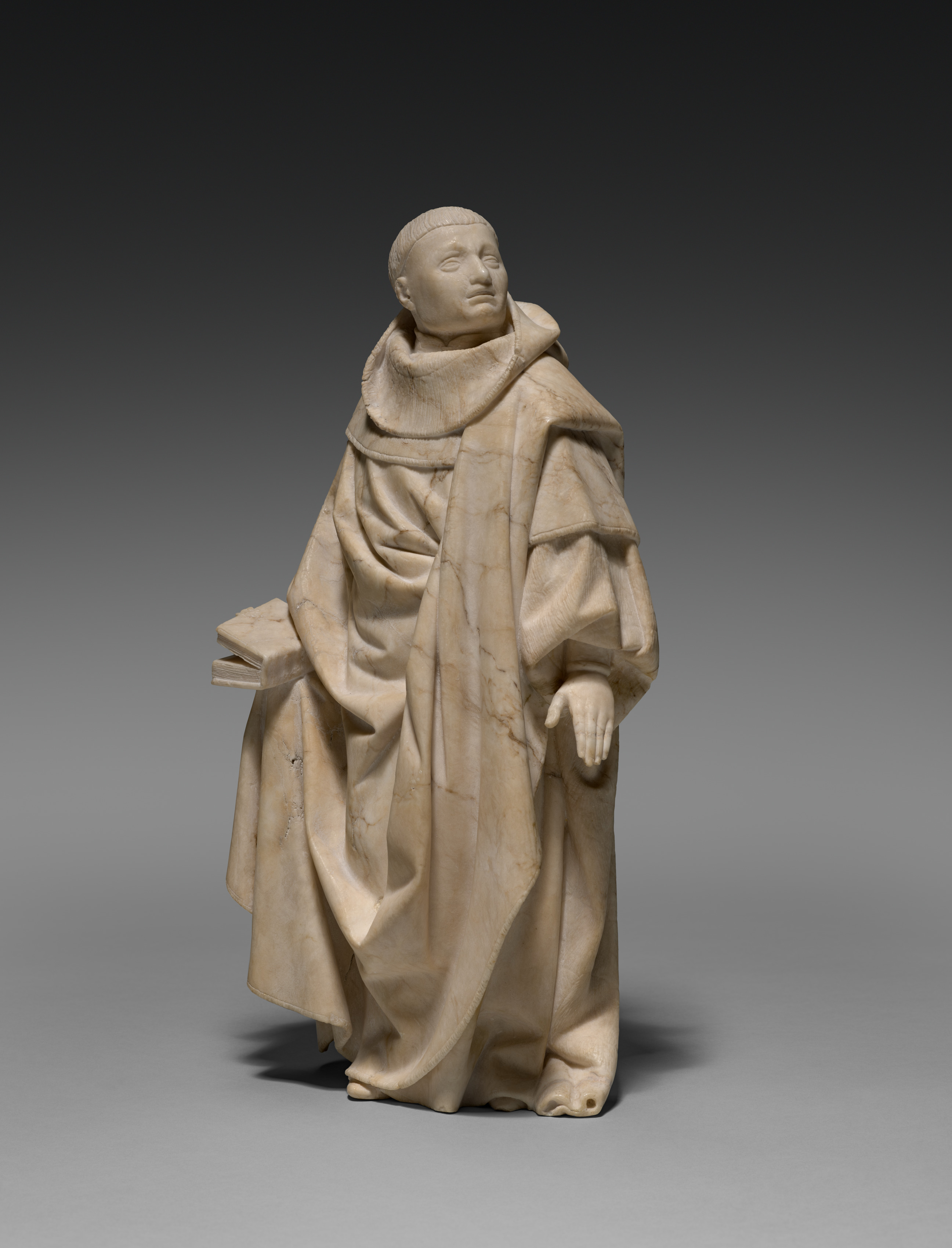
On the left side of the image, his right hand supports a slightly open book. Its thick pages form two stacks, one above the other, with a dark slit between them. On the other side, a hand hangs below a broad sleeve, its fingers pointing toward the ground. His head turns to his own left, his face slightly raised. The clothing around his neck and shoulders does not hide his face. Instead, it frames it with a thick border that makes this turn particularly clear.
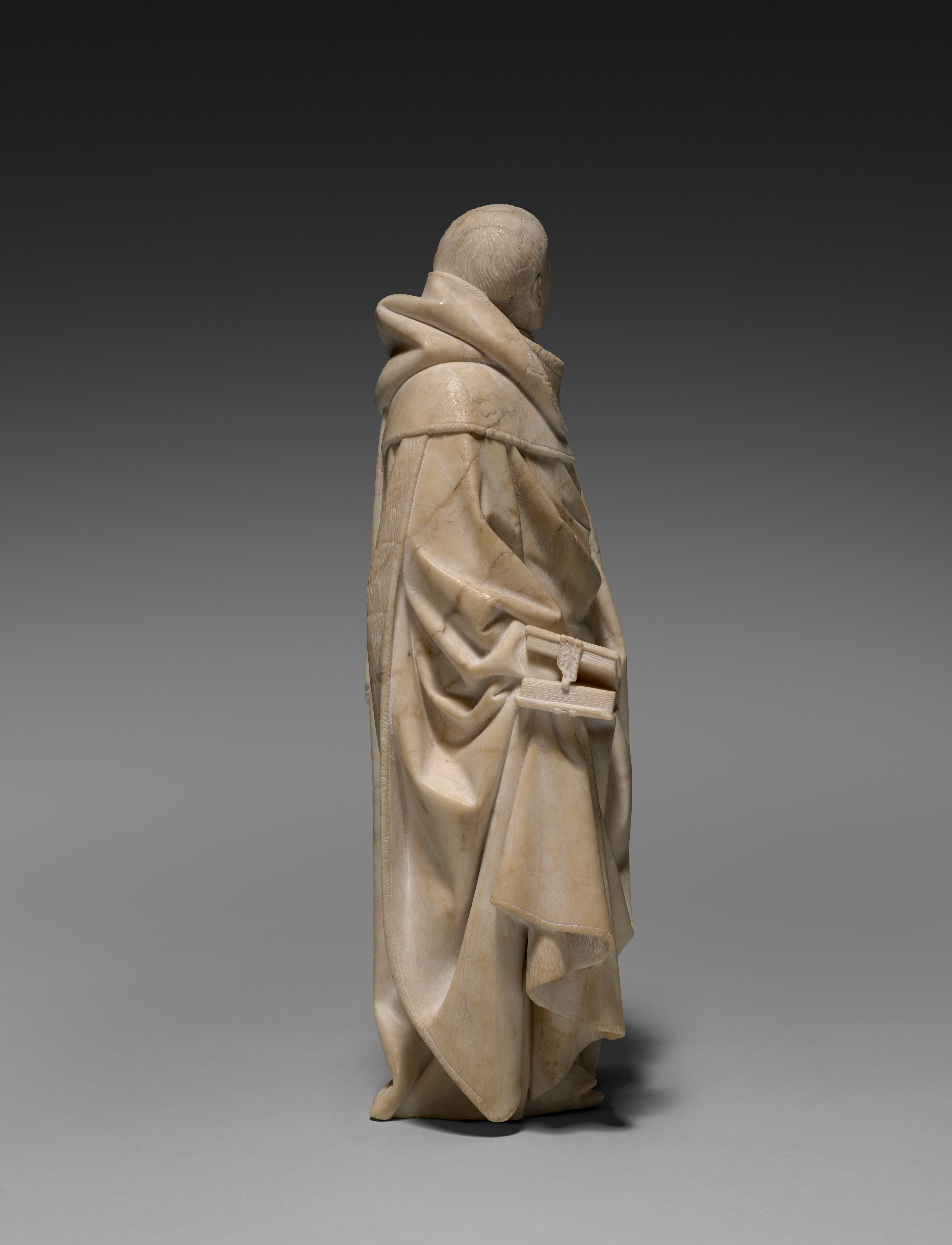
Folds descend in layers over his chest and abdomen. The book extends to one side, the face turns to the other, and most of his body remains within the mass of the long robe.
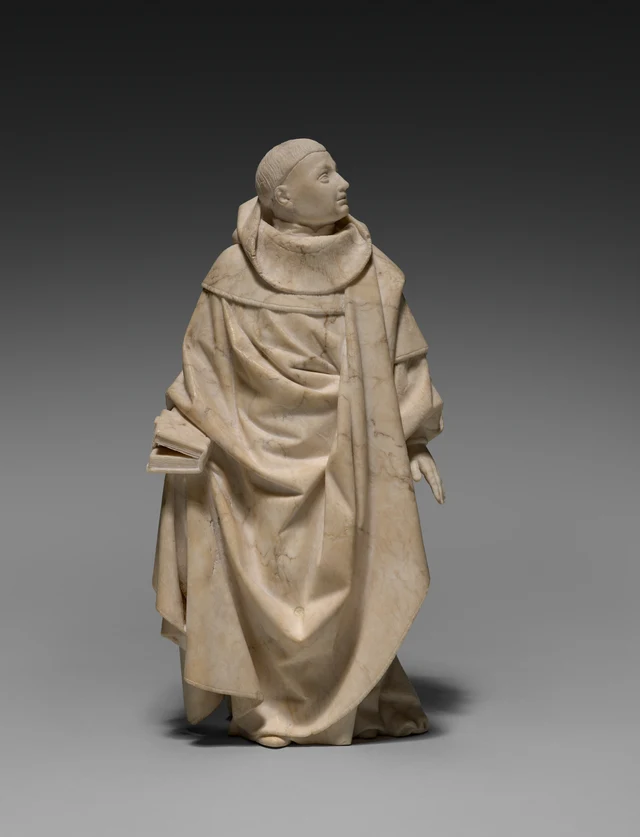
The small sculpture’s strength lies in carving a shift of attention together with a body that stays in place. His face has turned aside, while the book remains where it was. The broad robe gathers his body into a stable whole, making the turn above it especially distinct. Mourning acquires duration: a person remains within a ceremony, yet his actions have not congealed into a single, uniform face of sorrow.
The figure originally belonged to a ducal tomb at the monastery of Champmol near Dijon. Philip the Good commissioned the tomb for his father, John the Fearless, using the earlier tomb of Philip the Bold as its model. Dressed in clothing resembling a monk’s habit, this figure was one of forty mourners beneath an alabaster arcade. The Cleveland museum currently attributes the sculpture to Jean de la Huerta and dates it to 1443–1445. Museum account
1. A Book That Has Not Been Raised to the Eyes
Follow the book’s position toward the arm.
It is held low, roughly beside the waist, with its page edges angled outward. It has not been lifted to the chest in both hands or spread into a plane suitable for reading straight on. On the book-holding side, a broad sleeve encloses the wrist area, leaving the book to project outward. On the other side, an empty hand extends its fingertips beyond the cuff and straight down.
These actions have different weights. The book has square corners and thickness; its projection creates a short but distinct horizontal volume. The empty hand is slender and hangs beside the robe. Tracing the figure’s outline, we find it interrupted by the book on one side and slightly lengthened by fingers on the other. The robed body has not become a symmetrical little tower.
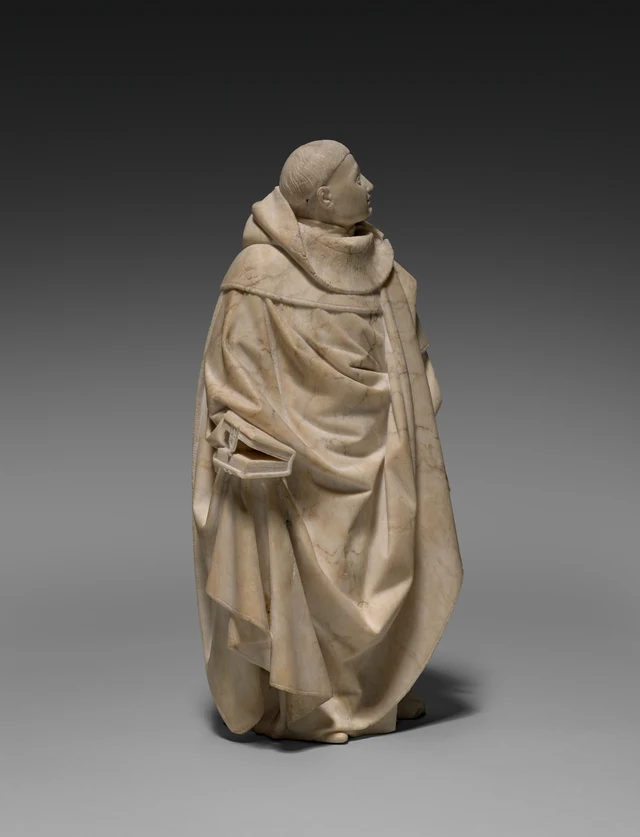
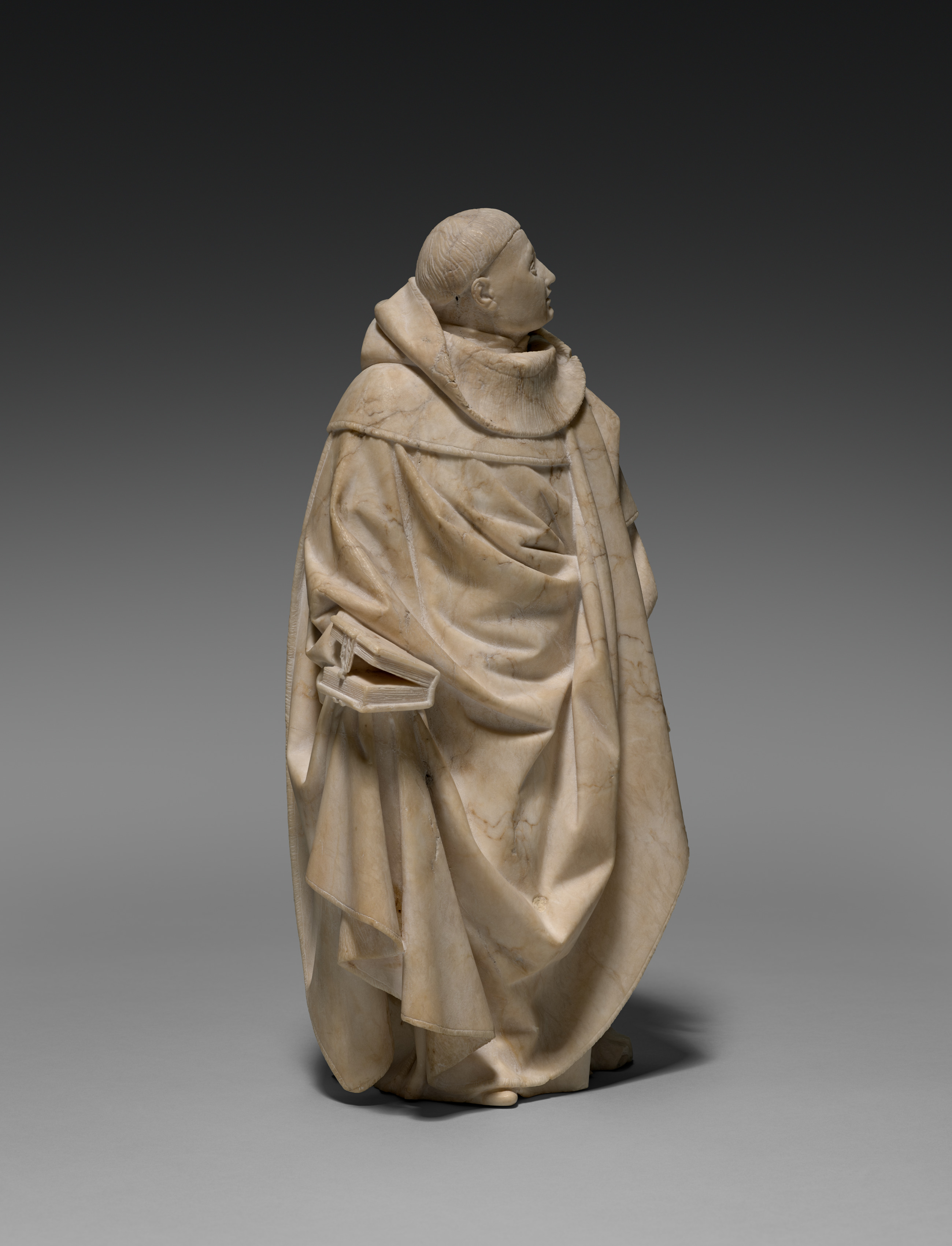
In Figure 2, the pages resemble bundles of thin sheets contained by a harder outer edge. The book is neither fully open nor tightly shut. That small interval matters: it leaves the book in a state in which it could still be used. As face and book point in different directions, we sense a time between actions that have not quite joined up.
It is easy to supply a small story here: he has just looked up from reading, or heard a sound beside him. The sculpture selects neither story. It gives us a simpler, more enduring relationship: a book not yet closed, a hand not helping to hold it, and a face turned elsewhere. Our eyes can move among these three places and encounter the same misalignment each time.
This gives the figure a rhythm of his own within the procession. A funeral procession can move together without everyone lowering their heads or joining their hands at the same moment. This figure still relates to the space around him, although we do not know exactly whom he is looking toward. The direction alone is enough to open the independently displayed sculpture outward.
The face’s role becomes more precise here, too. Brows and eyes, nostrils, and lips all have subtle variations, but what first changes the entire figure is that head and shoulders no longer face the same way. Even if we suspend judgment about his expression, we can see attention shifting from directly in front of the body to one side.
2. The Robe Keeps the Turn in the Upper Body
Look down from the chest. Almost no exposed contour directly locates waist, knees, or thighs. What the robe presents is its own course.
Below the neckline, a horizontal border crosses the upper chest. Farther down, the cloth first recedes diagonally, then swells outward into successive hanging curves. A longer edge descends from near the figure’s left shoulder and extends down the front toward the hem. Short, closely spaced folds, broad hanging surfaces, and an edge running almost the whole length of the body occupy the same area.
These are not repetitions of the same wave. The chest folds bunch together and turn sharply; below the abdomen, hollows gradually enlarge and illuminated surfaces broaden with them. As our eyes descend, the same downward movement seems to lengthen. Finally, the garment edge curves back beside the feet, and barely exposed shoe tips remind us that a person stands within this clothing.
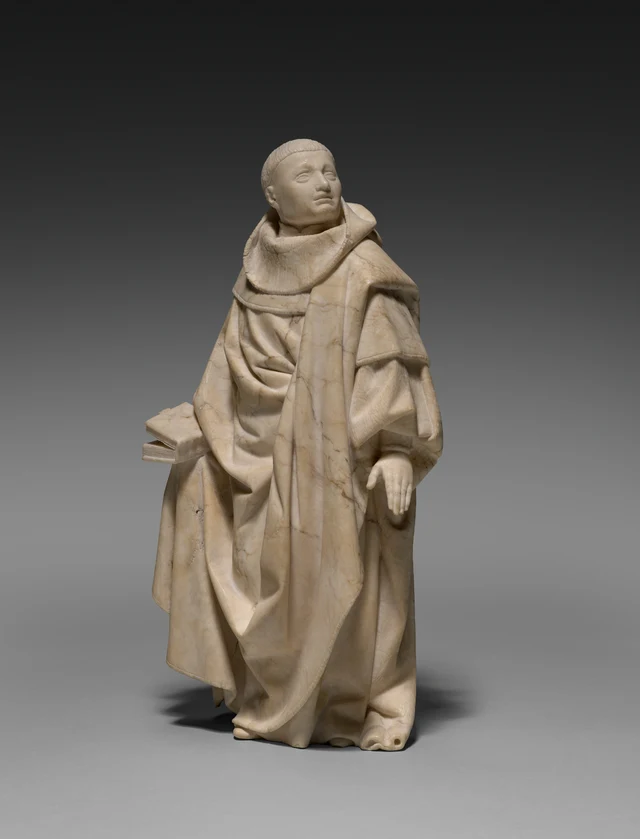
The head’s turn therefore does not develop into a large twist of the whole body. Above, nose and chin point outward; below, the robe’s apparent weight repeatedly brings our eyes back to the ground. The man can look sideways while the mass of his body remains steady.
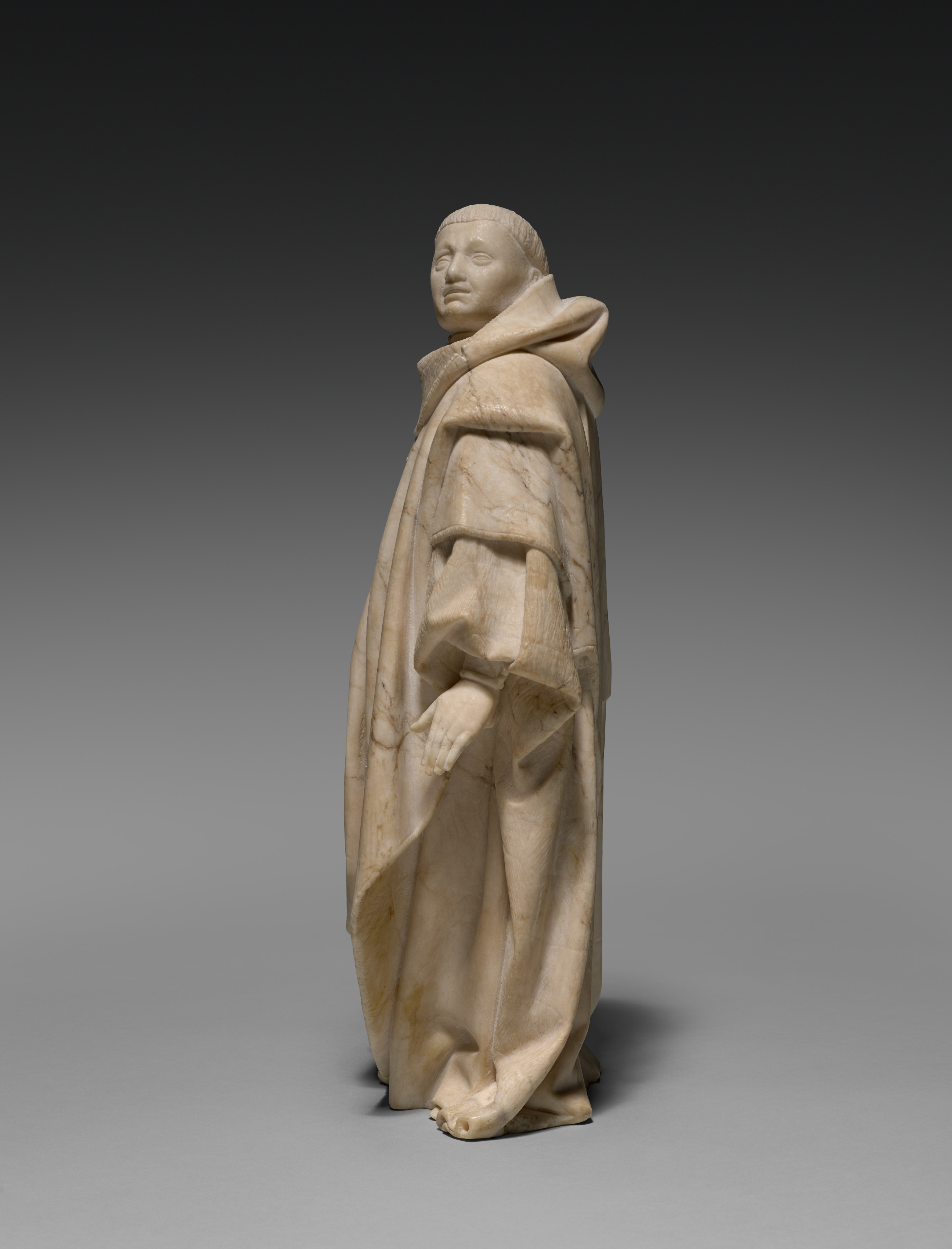
Look again at the empty-hand side. Clothing over the shoulder covers the upper arm, with a broad sleeve below. Near the cuff, cloth folds into a dark recess from which the hand emerges. It neither grips the robe nor explains a mood through an exaggerated gesture. Its smaller, flatter shape simply continues below the broad, layered clothing. Against the folds, the hand’s quietness becomes especially apparent.
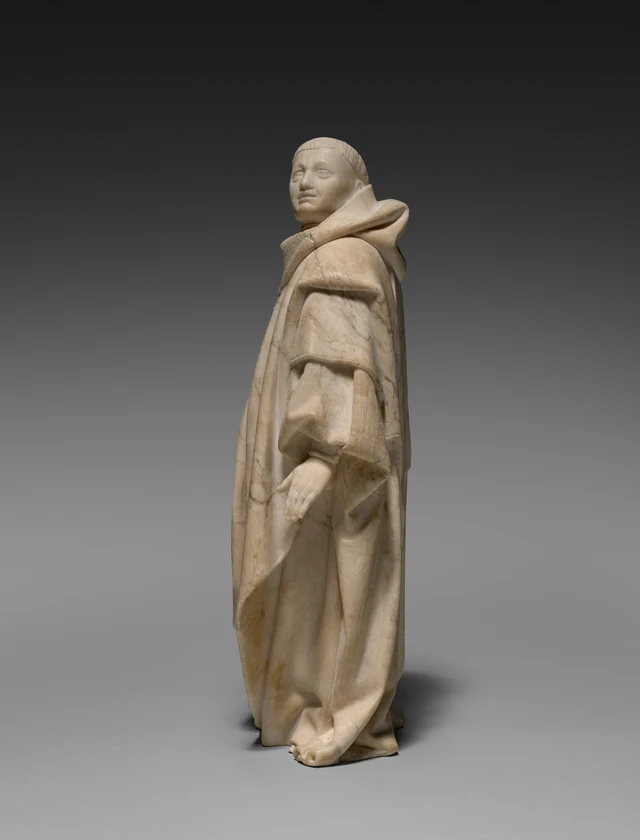
The museum gives a depth of only 12.4 cm, compared with a width of 20.3 cm. These measurements correct the screen’s impression: folds that look substantial and full from the front do not require an equally broad, thick stone body. The side contour is more contained, while the front retains enough relief to unfold an entire arrangement of light and shade.
This is part of the sculpture’s precision. Instead of spreading the limbs to create liveliness, it places one turn, several projections, and extensive downward folds within a compact volume. Small actions are not swallowed by the robe. The more substantial the robe feels, the clearer that lifted head becomes.
3. One Pale Stone Must Let the Eye Distinguish Several Things
From a distance, the figure is almost one color. Closer up, that unity begins to differentiate.
Rows of fine lines in the hair curve with the head. The cheeks are smoother, allowing light to spread continuously across them. The thick clothing border before the neck, however, is covered in short, fine incisions; the inside of the broad sleeve receives similar close treatment. At the book’s edge, fine lines become straight and closely parallel, suggesting stacked sheets of paper.
Short lines, long lines, and smooth surfaces all consist of pale stone, yet the eye reads them as different textures. Pages must be thin, regular, and stackable; clothing must be thick, able to bend and turn back at its edges; cheeks should not wrinkle everywhere like fabric. Differences in carving allow each to establish itself within one material.
The museum specifically notes how the sculpture uses alabaster’s relative softness and suitability for fine carving to render cloth, fur, and pages. Materials and details Returning to the photographs makes this more than abstract praise for “fine craftsmanship.” The dense texture at the neck lies close to the broad chest folds, so that the fine suggestion of fur and the large cloth surfaces can be compared almost in a single glance.
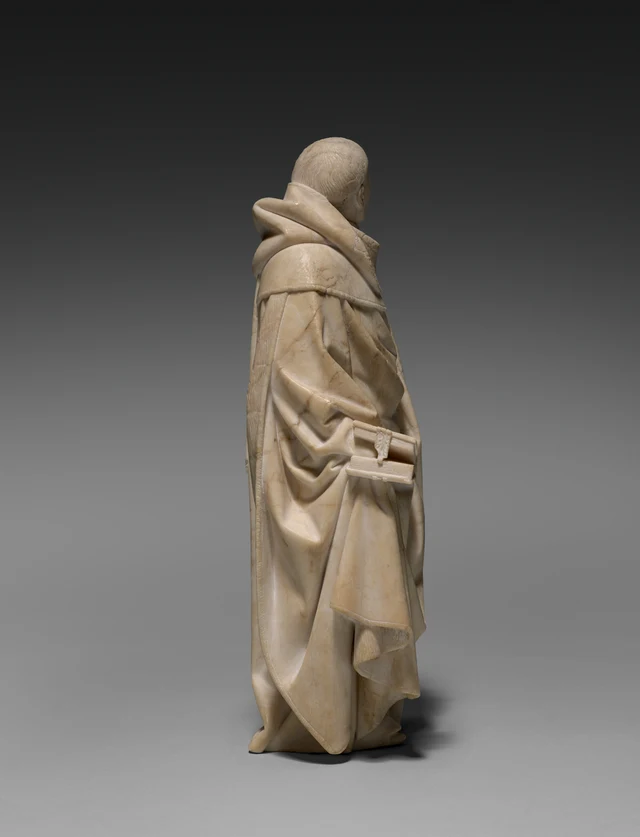
In Figure 5, the book resembles a short projecting beam, while the robe behind it descends in broad sheets. Moving our eyes from garment folds to page edges suddenly seems to reduce the scale: a moment ago we were traveling across cloth; now we are counting thin layers. The work is only forty-one centimeters tall. This shift from large surfaces to fine lines actually occurs over a very short distance.
Nor does the stone itself disappear. Pale brown markings visible in the photographs cross the illuminated clothing surfaces without always following the folds of the “cloth.” They allow the simulated fabric and actual stone to remain visible together. We need not interpret every mark as a wound left by time: visible coloring, surface traces, and restoration joins may have different causes, which photographs alone cannot individually establish.
What deserves more attention is that unity of material has not flattened differences in texture. From afar, the figure remains a pale, stable mass; close up, fur, cloth, skin, and pages have different rhythms. The small sculpture can thus accommodate two viewing distances: a first glance takes in a man turning his head; a closer look reveals how the things about him acquire their own substance.
4. This One Among Forty
Now bring its size and original purpose back into view.
The forty-one-centimeter figure originally stood beneath the tomb’s arcade, forming a procession with other mourners. The arcade gave the procession a rhythm, while individual figures took different postures within its architectural order. Today’s photographs of a single object remove the surrounding architecture and neighboring people. Book and turning head become more prominent, as though the sculpture had always been made to be viewed alone.
Within the procession, this sideways action also gains relational meaning. A figure facing entirely outward could confront the viewer like an individual portrait. This turned face, however, directs attention beyond the photograph. Following it, we find no object of its gaze and realize that the image’s empty surroundings once belonged to a larger arrangement.
We need not supply a particular neighbor. What we can genuinely recover here is the scale of the relationships: he was one of forty, taking part in a shared funeral rite while distinguished from an undifferentiated crowd by his book, hands, and the direction of his head. The original tomb and procession
This distinction means a “mourner” need not perform weeping in every detail. The ceremony continues, a book must be held, someone looks up, clothing keeps falling. The sculpture lets these specific actions carry a sense of time. We are not seeing a measurement of sorrow’s intensity, but how a person remains within something that has not yet ended.
We must also distinguish the original object from the tomb today. The Cleveland museum explicitly states that a plaster cast of this mourner is now displayed on the Dijon tomb, while the Salins alabaster original shown in these photographs is in Cleveland. The sculpture entered the collection in 1940. The surface of the replacement now on the tomb cannot be treated as the same physical object as the stone in these images. Collection record and provenance
Once this is clear, we can better understand what present-day viewing gains and loses. Independent photography makes the sides, page edges, and garment borders easier to examine. The relationships with the original procession and arcade require sources to reconstruct our understanding. They offer different experiences.
Return to Figure 1. The book remains low, the face still turns upward to the side, and the robe has not left its points of rest. This lack of simultaneity makes the mourner rewarding to revisit. One person within a shared ceremony has a pause of his own, and sculpture preserves it in forms we can examine repeatedly.
Optional Reading: Using SAE to Distinguish the Visible Shape from the Action We Await
We can look again in two different directions. The first begins with how stone appears; the second asks how we supply an action with context.
Non Dubito’s “As the Light Fades, the Garden Appears Differently” discusses perceptual beauty: the way an object appears depends on the object, but also passes through light and sensory conditions. Recognizing something does not mean perception has finished its work. Read the essay on perceptual beauty
Applied to the neck and chest in Figure 3, this distinction offers something specific. We already know that the carving represents clothing, yet the fine interplay of light and shade across densely packed short marks differs in rhythm from the continuous light spreading over broad folds. The former asks for close inspection; the latter can be followed from farther away. Even when we stop naming them, “how this area lights up” and “how that line sinks inward” remain worth looking at.
This also reminds us not to attribute every dark color in a photograph to the stone. Deep darkness within a fold comes partly from the recess and the photographic lighting; pale brown markings on flatter stone do not adhere to projections and hollows in the same way. Distinguishing these differences first lets us say more accurately what makes clothing look thick and what keeps the stone visible. Beauty here does not require the figure’s expression to please us. It lies in these differences becoming fully apparent.
The second direction comes from “The Note Has Not Sounded. You Are Already Waiting.” This essay on cognitive beauty considers how memory participates in the next moment. Familiar experience leads us to anticipate a sound or a corner; when expectation fails, we need to ask whether to revise memory, our present judgment, or our understanding of the version before us. Read the essay on cognitive beauty
A similar expectation easily arises before this book-holder. Seeing book and hand, we may naturally await a face lowered to read. Our eyes continue upward, but the face turns the other way. “He has just stopped reading” may then appear in our minds without prompting. That supplied previous moment is not carved on the pages. It comes from our familiar experience of holding and reading books.
Try changing just one condition in your imagination: close the book entirely while leaving the rest of the pose unchanged. The sideways gaze still works, but the sense of “reading temporarily interrupted” may diminish. Returning to the actual photograph, the dark slit between the pages becomes more than fine carving. It participates in how we organize the action in time. This comparison is a device for looking, not proof that the figure has indeed just read something.
The two rays therefore ask different questions. The perceptual direction asks how short marks, broad surfaces, and dark slits actually appear in the photographs. The cognitive direction asks what unseen sequence of actions I have supplied from them. Mixing these together makes it easy to mistake a vivid little story for a fact the work has already told us. Separating them lets us keep imagination alive while knowing where it begins.
This small figure is particularly suited to that back-and-forth. It gives the pages a sufficiently clear shape while directing the figure’s gaze away from them. The carving preserves a stable relationship. The viewer’s experience gives that stability a time whose successive moments connect, but not quite completely.
Notes on Images and Sources
This essay uses five photographs published by The Cleveland Museum of Art of the same object, accession number 1940.129, including oblique frontal views and different views from both sides. Image files remain as officially downloaded, without color adjustment, recompression, cropping, retouching, or generation. Lighting, lenses, and backgrounds belong to modern photographic conditions; the essay does not use them to reconstruct actual lighting at the original tomb.
All five images show object 1940.129. The Dijon cast and Cleveland original are distinguished in the text. Title, attribution, date, material, dimensions, and relationship to the original tomb follow the museum’s current record. Readings of the posture’s rhythm and sense of time are this essay’s interpretations of the images. Individual image sources are in the image credits; sources and further reading are in the references.