The small images below correspond to the photographs analyzed in this essay. Reproduction permission has not been obtained; copyright remains with the respective rights holders. Click to view the official source.
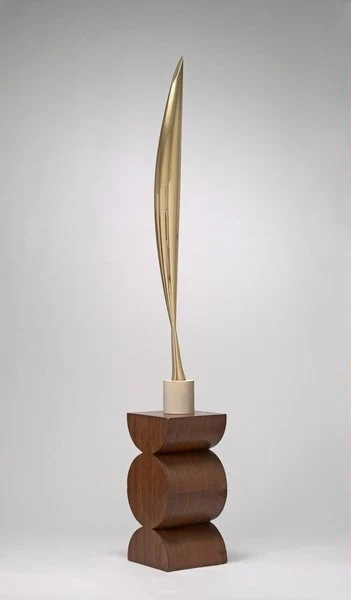
First find the narrowest part.
The long golden form gathers inward as it descends, almost shrinking to a line. Farther down, however, it opens again into a narrow conical foot resting on a pale cylinder. Its thinnest point does not touch the ground. A very long body is arranged above this slender waist.
The eye follows it upward. The form gradually fills out, then tapers at length through its upper half. The final tip leans to one side, with a small sloping facet beside it. No horizontal line cuts this journey abruptly short. Seen from below, it seems just to have risen; reaching the top, we feel that its upward momentum is not yet exhausted.
View the museum’s full-length image; open the work page. Image description: A slender golden bird stands on a short pale cylinder, below which a dark-brown wooden base repeatedly narrows and swells. The photograph presents one oblique overall view of the same work.

This essay examines the 1927 Bird in Space in the National Gallery of Art, accession number 1989.31.3. The bird is 185.4 cm high; the entire work with its base measures 287.7 cm. The museum’s current medium field lists brass, limestone, and wood. Keep this particular version in mind: it is neither the Metropolitan Museum’s marble bird of 1923 nor a standard image interchangeable among all golden Birds in Space. Collection record
The title “Bird” suggests flight. What the sculpture first gives the eye, though, is a series of very different widths and the gradual or abrupt transitions between them. Its sense of ascent must grow out of those transitions.
Brancusi began the Bird in Space series in 1923. The earliest version was marble, followed by explorations in metal and plaster. This 1927 work belongs to his sustained effort within twentieth-century modern sculpture to reconsider flight through proportion, material, and simplified form. Background to the series
1. The Narrowest Point Joins Two Forms
Looking from tip to floor in one sweep, we might take the golden portion for an elongated spindle. Pause at the slender waist below, and that impression changes.
Above the waist, two contours spread outward to form the principal volume. Below, two contours also open outward, but quickly reach the stone base. Both portions expand, over vastly different lengths. The short one steadies the area of contact; the long one carries the gaze upward. They meet at the smallest width, as if compressing “support” and “departure” into the same place.
This keeps the meeting of metal and stone from looking cumbersome. The bird’s fullest part does not press directly onto the base, nor does a separate exposed rod prop it up. Support has entered the changes of the golden outline: narrowing downward, becoming extremely thin, then opening. We see a point of rest and, just above it, a lifting away.
This thinness is no negligible transition. Reduce the image and the narrowest point almost disappears, leaving the long upper form apparently more detached. Restore the viewing size and the short foot becomes clear again, reconnecting that seemingly floating volume to the stone. No mysterious mechanism separates these impressions. Differences of width are already at work.
The principal volume, too, is no uniform straight rod. In the photograph, the long left contour swells more noticeably, while the right looks straighter. Nor are the upper and lower tapers equally long. Follow one side up and the other down, and the routes are not identical. The form has an axial direction without closing itself into a symmetrical emblem. A slightly offset tip gives its entire vertical a leaning tendency.
Ascent therefore does not come merely from being “tall and thin.” The relative lengths of foot and body, the different widths of waist and fuller middle, and unequal turns of the two contours jointly give this still object the appearance of stretching.
2. The Golden Surface Lengthens What Lies Inside the Outline
Having followed the contour, move your attention within it.
There is no feather texture here, no engraved lines separating breast, neck, and head. The golden surface is narrow across, but vertically it accommodates several long bands of light and dark. These spread apart in the fuller area and crowd together near the waist. Some shine like a thin blade; others seem dark as a fissure.
Those dark bands are not feather shafts cut into the body. Strong reflections remind us that the visible internal pattern is not entirely the material’s inherent color and grain. Part comes from how the surface returns surrounding light and darkness to the camera. This photograph cannot identify every reflected object, but the elongated reflections already clearly participate in viewing.
The outer contour tells us where the metal ends; bright and dark bands within divide its body into several vertical currents. At times the eye follows the outer edge, at others brightness draws it toward the middle. The solid occupies little width, yet contains more turns of light and shade than we initially expect.
This also changes what “smooth” means. Smoothness has not made the surface blank paper. Precisely because dense incisions are absent, long reflections become especially evident. We do not identify a hundred feathers and assemble them into a bird. Across a largely continuous surface, our gaze is drawn over a considerable distance.
Below, the wooden base also has a sheen, but shows itself differently. Grain on its brown curved surfaces is more stable, and the wood turning away in the photograph still feels substantial. Light and shade pass gradually around the pale cylinder without the metal’s sharp bright lines. Together, the three surfaces make the metal’s shimmer more pronounced. Its agility comes from specific neighboring relationships, not from gold being inherently lighter than brown.
If only a black silhouette remained, the main volume would still be slender, its narrow waist and pointed tip intact. But all those long, narrow internal bands of light and dark would disappear. We can now separate two layers: contour organizes extension; surface makes that extension less fixed.
3. The Base Takes the Eye Through Several Steps First
Set aside the golden portion for a moment and look only at the wooden base.
Its broad bottom narrows upward, then swells out again. The middle resembles a thick disk, gathering inward above before the topmost section opens into a flat supporting surface. Along the visible edges, breadth alternates with narrowness; two inward contractions cut out definite dark areas. It is both an upright rhythm and a piece of wood occupying considerable ground.
These curves imitate neither a tree trunk nor a bird’s nest. They directly turn looking into a sequence of movements: outward, inward, outward again. Before reaching the bird, our eyes have already experienced several contractions and expansions.
The golden portion, however, does not simply repeat the beat. After the wooden base’s short, broad undulations, the pale cylinder offers a brief pause. Its sides are nearly vertical and its upper and lower edges relatively level, as if temporarily arranging the preceding active curves into a quiet interval. Higher up come the metal’s short foot, then its narrow waist, followed by an extension far longer than any undulation in the wood.
A short rhythm joins a long breath. The base makes the length above seem longer; that length, in turn, makes the repetitions below seem like a gathering of energy. Treating the wood merely as furniture used to raise the sculpture for a photograph misses this sequence.
We can test the judgment in reverse. Begin at the tip and look downward. After the long expansions and contractions, the eye slows at the waist, meets short foot and pale cylinder, then enters the wood’s broader curves. What previously carried us upward now offers places where looking can gradually come to rest. The base provides both departure and return.
The sculpture’s boundary, then, is not simply the boundary of the golden portion. Metal, pale stone, and dark wood have definite material divisions, but no simple division of visual labor, with art above and mere stability below. Each section changes how we see the next.
4. How Tall Is This Line on a Screen?
The photograph sets the whole work against a pale gray background, without people, doors, or windows for comparison. We may imagine a small object on a table. Title, golden color, and polished surface may also suggest a trophy or fine ornament.
The dimensions expand that mental picture.
The bird alone is taller than many adults; with its base, the work approaches 2.9 meters. At actual scale, the vertical that seems so easily scanned in the photograph would extend from relatively low down to above our heads. We can no longer control its size in imagination as easily as if pinching a small ornament. Instead, its height begins to arrange how we raise our heads.
This does not mean the photograph replaces standing beside it. Photography fixes viewpoint, lighting, and distance, and compresses a three-dimensional volume into a long shape. Yet remembering the dimensions changes how we understand its surrounding blank space. Large empty areas on either side help us imagine how an extremely narrow solid can divide its surroundings across considerable height.
It does not open broad wings to fill the space. Most of its surroundings remain empty, yet the eye follows the long form upward and is carried into blank space beyond the top. Occupying an area and directing attention need not require equal breadth.
The tip therefore matters especially. This is not a thick column suddenly cut off. The two sides have already narrowed gradually toward each other before the small sloping facet provides the final end. We can see that material really stops there, while readily continuing its established direction a little farther upward. Form is finite, but the gaze has been carried just beyond its edge.
5. One Theme, Made Anew Again and Again
As he continued the series, Brancusi did not settle on one fixed shape. MoMA’s research emphasizes that the metal birds are not identical repetitions in the same dimensions. Readjusting proportions belongs to the making itself. MoMA exhibition labels, PDF page 2
Having looked at waist, reflections, and base, we can now imagine specifically what a change of proportion would affect.
Raise the narrow waist, and the principal volume seems to begin elsewhere. Move the widest part upward, and expansion before ascent is delayed. Alter the relative lengths of wooden base and bird, and the passage from “short rhythm to long breath” changes too. These are comparisons we can propose while looking, not claims that the artist actually made these particular alternatives. They make “making birds repeatedly” more than repeatedly asserting a concept. It becomes repeated work on relationships that cannot readily substitute for one another.
Beyond detailed animal description, Brancusi moves sculpture’s work elsewhere. A body need not be itemized to possess fullness and contraction, direction and a resting point. Once certain details disappear, the remaining proportions must do more. Simplification does not automatically make sculpture’s problems fewer.
Return to the slender waist we began with. It is no longer alone. Below are the wood’s contractions and expansions and the cylinder’s pause; above are a full volume, elongated reflections, and a gradually tapering tip. Before a still object, we are not believing in flight without grounds. We see how that object arranges an upward passage specifically enough to be convincing.
It remains standing. Ascent happens through the way it stands.
Optional Reading: Another Look with SAE
Perceptual Beauty: Brightness Does More Than Identify the Material
Non Dubito’s eighth ray essay, “As the Light Fades, the Garden Appears Differently,” begins with flowers at dusk. How things appear is shaped jointly by light, objects, and the senses. Once an object has been identified, its particular colors and light and shade still merit attention. The essay also distinguishes beauty from simple comfort, refusing to make visual pleasantness its only condition. Read the eighth ray essay
Return to the bird’s middle. The thin bright band is enough for us to judge that the surface is smooth. But dismissing it with “polished metal” misses how it actually appears. A broader bright area narrows downward, its narrowness sharpened by the dark band beside it. They run alongside each other within one solid without entirely following its outer contour.
This ray opens further the relationship between surface and viewing conditions. We need not attribute all sheen to features carved into the work, nor dismiss it as accidental interference because lighting affects it. The photographed reflections are not the work’s fixed appearance in every setting, but they are one appearance this smooth form can genuinely produce. A fixed contour and environmentally dependent light and shade support each other here.
Nor must we prescribe astonishment for the viewer. Someone may find the brightness glaring or prefer the wood’s darker brown. They can still accurately describe how three surfaces differ and how they meet vertically. Clear perception need not require a shared preference for the same sheen.
Cognitive Beauty: Before the Tip Arrives, the Eye Is Already Continuing
The ninth ray essay “The Note Has Not Sounded. You Are Already Waiting.” considers something else: memory participates in present expectation, and expectation is adjusted when it encounters what is actually there. A familiar melody makes us await the next note; a discrepancy can prompt us to return and check. Read the ninth ray essay
Try a small exercise with this sculpture. Start at the bottom of the wooden base, follow its two marked contractions, then look at stone cylinder and short metal foot. On reaching the bird, notice whether you still expect another contraction soon. What you actually encounter is a prolonged expansion, only gradually tapering much higher up. The short rhythm just traversed may be participating in how this long form feels.
This does not turn the sculpture into music with one uniform speed. The image lets our eyes jump at will, and not everyone expects a turn in the same place. What matters is a specific back-and-forth we can identify. Short sections already seen still help measure the current long one; after reaching the top and looking back, the repetitions below appear more compact.
Look up from the wood once more. The cylinder offers brief steadiness, the waist gathers width inward, and bright bands in the metal then lengthen the gaze. The turns just traversed below remain in our experience of the long form above. Even if we ultimately take the whole work in at a glance, the varying lengths of that route have not disappeared.
Notes on Images and Sources
This essay closely examines one official full-length NGA photograph of the same 1927 work. Judgments about angle and surface are limited to that image. Its native resolution is 527 × 900 pixels; enlargement adds no original detail. Online viewing does not confer redistribution rights.
Materials are given as brass, limestone, and wood according to the collection’s medium field. Differences of wording in the same page’s audio and dimensions fields are detailed in the references. This essay does not infer hidden connections or the stone base’s manufacturing technique from the photograph. Formal analysis and SAE applications are readings open to discussion against the image.
Work and research links are in the references; official image links and viewing limitations are in the image viewing notes.