The added thumbnails are supplementary photographs of the same original sculpture. Close readings of a particular background or viewpoint still refer to the official images linked in the essay. Click a thumbnail to open the museum’s work page.
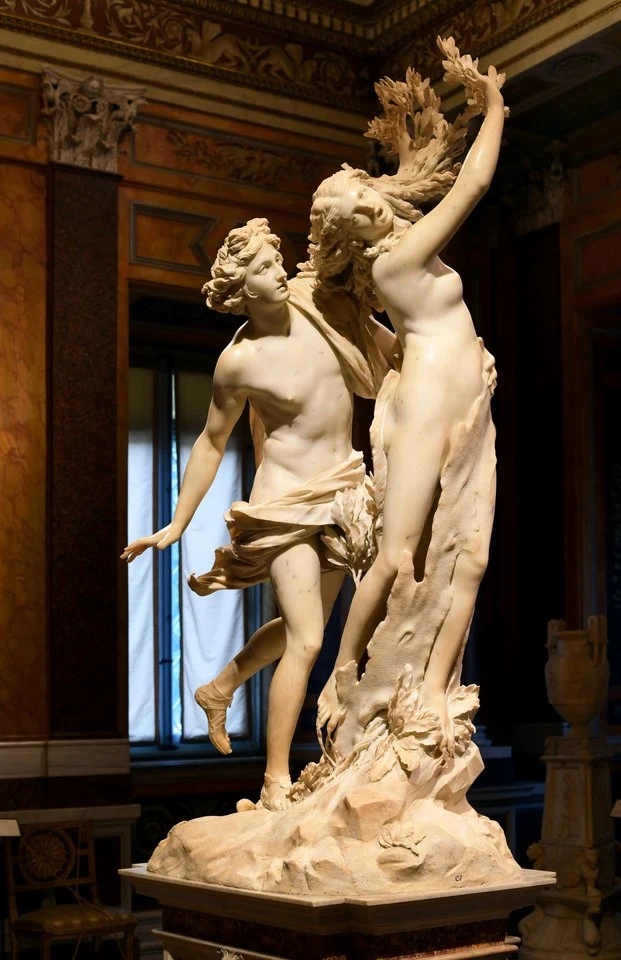
One of Apollo’s feet is still in the air. Daphne’s feet have already joined the roots.
Begin with those two places, then look upward. The man’s drapery curls backward, his waist and shoulders still carrying him forward. The woman’s torso stretches upward, her arms reaching over her head, but their ends disperse into clusters of leaves. Her face is still turning, her mouth still open; broad areas of bark already rise beside her legs. Running, turning, rooting, and branching crowd around this one body without waiting for one another.
Open the museum’s high-resolution image: full view and details of transformation
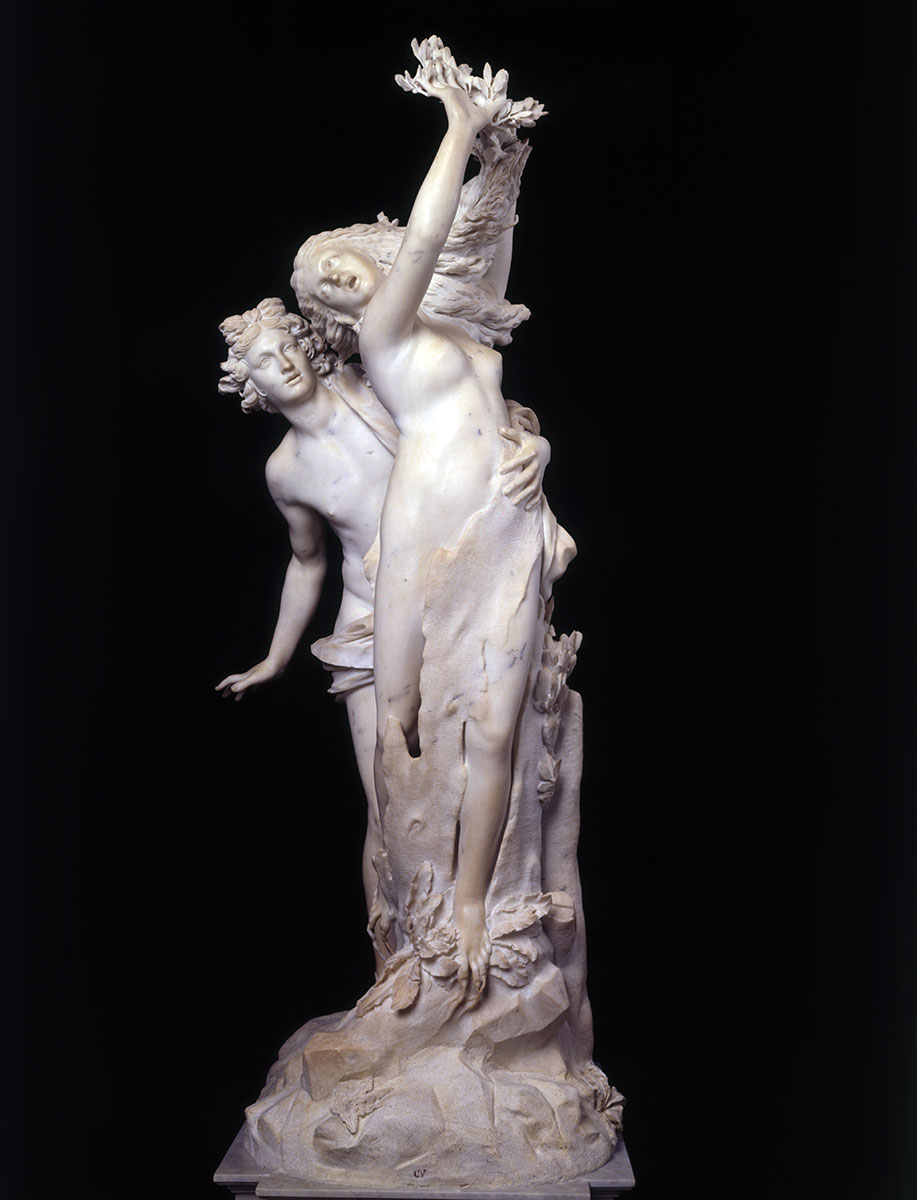
Viewing guide: Apollo stands on the left of this official photograph, Daphne on the right. Compare the raised foot and roots below, follow the bark on the right toward the waist, then examine how the raised arms enter the branches and leaves. Gian Lorenzo Bernini, Apollo and Daphne, 1622–1625, Carrara marble, height 243 cm. Galleria Borghese, Rome, inventory number CV. Official detailed work record
The work is often said to freeze a moment. But if that means only “all movements paused together,” it misses the strangest thing here. Apollo’s action still aims at catching a person; Daphne’s body has already begun unfolding in the directions of a tree. The chase has barely reached its endpoint before that endpoint changes.
Made for Cardinal Scipione Borghese, this group is among the important works Bernini produced for him in his youth. Its story comes from Ovid’s Metamorphoses: Daphne rejects Apollo, appeals while fleeing to her father, a river god, and becomes a laurel. Bernini chose neither a regretful god beside a tree nor two people running far apart. He brings increasingly close bodies up against a transformation already underway. Museum account of the story and production
1. One Step Has Not Landed; the Other Can No Longer Be Taken
Apollo’s grounded leg is relatively straight. The other bends backward, the tip of its sandal lifted from the stone below. The gap between the legs makes clear that he is not standing securely on both feet. His upper body has already reached Daphne’s side; his other arm, extended backward, opens this forward-rushing body into space.
The cloth refuses to settle quietly either. It passes from the shoulder between the figures, turns across the waist, and flips its edges behind Apollo. Its folds do not run exactly parallel to the legs, yet together they preserve the aftereffects of movement. Treat the foot as an elegant pose and the drapery as an independent decoration, and we dismantle the force carrying the whole man forward.
Daphne’s lower limbs offer a different outcome. In the leg nearest the camera, knee, calf, and instep remain recognizable, but elongated forms at the foot already intertwine with roots. On the other side, bark climbs higher, joining leg and trunk. Unlike Apollo, she has no raised foot reserving a place for the next step.
Yet her upper body does not obey this arrest below. Her waist presses forward, chest and abdomen arch upward, head attempts to turn, and both arms continue reaching high. The body’s middle still seems to flee, while its lower end has acquired another way of joining the ground. This makes her pose especially elongated: the ground retains the lower end while the upper part reaches away.
Movement in the sculpture therefore depends on more than familiar signals such as bent legs and flying hair. It also depends on incompatibility. Following the legs upward, we expect the torso to continue the run; following the bark downward, we discover the same route leading to fixity. Both readings arise from the visible forms, and neither completely cancels the other.
We can imagine where Apollo’s foot will land by following his run. Daphne’s next step can no longer be imagined in the same way. Much of a runner remains, but the conditions that make running possible have already been withdrawn beneath her feet. This gives the group its greatest urgency: transformation does not wait for the body to finish its present action before rewriting what that action can become.
2. The Bark Does Not Enclose Her Evenly
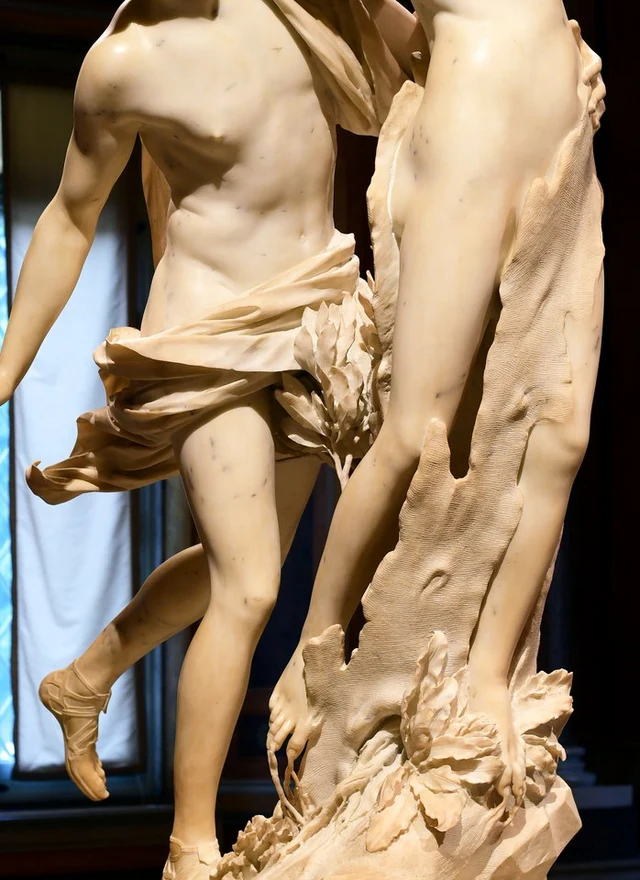
Look again at the bark.
It is not a long skirt falling neatly from the waist. Its upper edge is uneven, rising near the waist in some places and exposing a long stretch of leg in others, with projections and downward notches. This border does not form a detachable seam. The bark is not a complete outer casing with an intact body waiting to be lifted out.
This boundary is crucial to the metamorphosis. If the whole lower body had become a straight trunk with a woman’s bust attached above, we would see two halves joined together. Instead, skin remains visible between areas of bark, while bark extends upward along the body’s varying heights. Human and tree do not each occupy a half. They repeatedly interleave along an irregular line.
In the same photograph, Daphne’s abdomen carries a broad, gently lit surface, and continuous gradations round her leg. Beside them, dense bark texture breaks up the light with shallower but more frequent irregularities. Moving between them, the eye passes from gradual turns into small interruptions. We have not touched the stone, but the difference between fine and coarse already changes the rhythm of looking.
Enlarge the boundary between bark, waist, and legs in the official original image
Apollo’s approaching left hand reaches this very area. The museum specifically notes that he touches bark. The distance of his pursuit has finally become small enough for contact, but its object has already changed at the point of touch. Official detailed record
No more forcefully carved fingers are needed to intensify the drama. The hand arrives, but the surface no longer answers its previous expectation. In the photograph, fingers appear at Daphne’s side beside the uneven edge. Following the smooth abdomen toward them, we can understand why this hand seems slightly late.
“Late” is not a few seconds measured on a clock. It is produced by the boundary between two surfaces. While other parts remain unmistakably human, the point of contact has already changed. If metamorphosis occurred everywhere to the same degree, this sense of misalignment would weaken.
3. The Arms Still Reach; Their Contours Already Branch
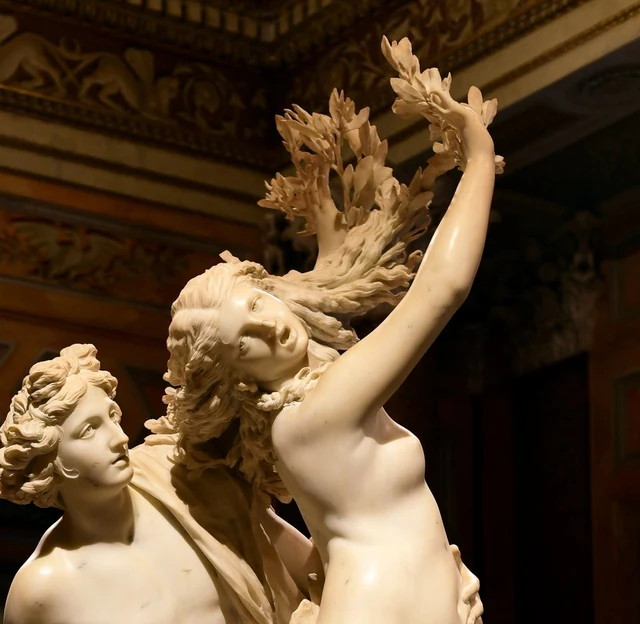
The bark slows our gaze; the leaves overhead suddenly scatter it.
An arm rises continuously from the shoulder. Elbow, forearm, and wrist still offer familiar lengths. At the hand’s end, that continuous line branches. Slender twigs and pointed leaves extend in different directions, giving the outer edge more than one destination. The other raised hand also enters a denser cluster of foliage. The arm’s movement is not finished, but the shape to which it leads has changed.
Hair helps this dispersal. It spreads from behind the turning head, sending many long lines upward. Near the branches, these become harder to read simply as locks of hair. This is neither a bunch of laurel placed in a figure’s hand nor a wreath set on her head. Foliage joins the body’s lines of extension, so that following the human form outward in search of an endpoint suddenly brings us to many endpoints.
The black background makes the photograph’s gaps especially clear. Small dark spaces separate light-colored stone between forearm and hair, and among branches and leaves. The upper portion is not carved as one continuous mass. Points, thinness, and separation make it visually lighter than the torso and bark below. Yet the leaves are not actually trembling in wind. That sense of trembling comes from abrupt turns and intervals that prevent the eye from smoothly following a single steady edge.
Connect this with the feet, and the directions of transformation become distinctly different. Roots move downward, fastening the body to the ground; branches and leaves spread upward and outward, dispersing its boundaries. The still-smooth chest and abdomen lie between contraction and expansion. Change does not evenly coat the body in a tree-like appearance. It gives opposite spatial consequences to the two ends of the same body.
Daphne’s face remains between them. Her open mouth and turning head carry a different urgency from the leaf tips. The face keeps the change within the posture of a person whose alarm remains recognizable; the leaves already take our attention beyond her pose. Bernini lets us see at once that form continues extending while the figure’s possible actions diminish.
4. Marble’s Labor Hides Where It Looks Lightest
At 243 centimeters high, the group exceeds most adults’ height. A slender twig may occupy only millimeters on a screen, but the upward expansion of the actual group has considerable scale. Remembering its dimensions keeps the openness above and solidity below from becoming merely the delicacy of a small ornament.
The same Carrara marble takes the forms of skin, cloth, bark, roots, and leaves. Their distinctness depends on more than outlines. Skin joins larger areas of light and shade; cloth abruptly redirects a bright surface at a fold; bark interrupts smoothness with dense, fine marks. The sameness of material makes these differences more compelling. No real fabric is flying, no actual branches have been attached to a stone figure.
The museum’s technical account relates these differences to drills, chisels, and varying degrees of surface finishing. Conservation research also found that plaster pads protected slender parts during production, reducing vibrations from subsequent work before being removed on completion. Museum account of making and protection
This material history changes the claim that “stone has become light.” The leaves look delicate in the finished work not because stone suddenly lost its vulnerability. The making process had to provide protection for that vulnerability. The separated contours we enjoy in the photograph once required the sculptor to shelter them during other stages of work.
Look upward again. Leaves spread along slender branch tips; branches gather back toward thicker wrists and locks of hair. Our eyes enter small gaps, then meet continuous stone. The photograph cannot reveal the complete distribution of forces, but it shows that thinness does not occupy every part. It alternates with thicker forms. This lightness retains its own thickness, and during making it also had a protective layer later withdrawn.
5. When Viewers Must Also Arrive
The full-length photographs familiar today give us both faces, bark, and foliage together. The most important clues seem available from the beginning.
The original arrangement, however, involved a sequence. Drawing on documents, the museum explains that the group first stood against the wall near the chapel and spiral staircase, on a lower base than today. The arrangement guided viewers along Apollo’s right side, gradually revealing the pursuit’s arrival and the metamorphosis. When the group moved to the center of the room in the late eighteenth century, that privileged viewing position changed. Original placement and later relocation
This does not oblige viewers today to stand in one “correct” position. It tells us that bodily volume could originally control when clues appeared. Seeing the pursuer first and gradually discovering what he has caught up with differs from receiving the whole answer at once.
Set this arrangement beside the actions within the sculpture, and another layer of time appears. Apollo approaches Daphne; viewers also approach a position from which the change becomes clear. Both undergo an arrival, but arrival does not deliver the result previously imagined. The sculpture does not turn, yet the viewer’s movement shifts the story’s center of gravity.
The single official photograph used here does not reenact that historical route. Documents let us understand the arrangement, but an imagined circuit on a screen is not firsthand experience. The photograph has already selected a position where the clues are well unfolded. It makes forms easier to compare while weakening the lateness that the original encounter may have involved.
Returning to this photograph, then, we can deliberately avoid beginning with the faces. Follow Apollo’s leg and drapery forward, then pause at bark and roots. This does not copy earlier viewers’ footsteps. It simply makes the sequence within one image clearer again: pursuit establishes a direction, metamorphosis interrupts it, then distributes our attention upward and downward.
6. Not Everything Has Stopped
The original base once bore admonitory verses by Maffeo Barberini, turning the pursuit of fleeting beauty toward moral reflection. That was one historical framework for reading this work. Account of the base inscription But if we return armed only with a lesson about frustrated desire, bark, feet, and leaves easily become footnotes to a single conclusion.
The sculpture is more specific. Apollo does not immediately withdraw his movement, nor does Daphne’s upper body become wholly quiet because she has taken root. The distance between them is tiny, yet transformation makes their actions belong to different processes. One is still completing a pursuit; the other has moved from flight into another form.
For me, the work’s greatest force lies in this lack of synchronization. It does not set out two clear versions, “the person before” and “the tree after,” for us to compare. Instead, parts that remain human lose their former continuations to different degrees. Feet can no longer step, the ends of hands can no longer form an ordinary grasp, yet the face still has time to turn.
Rescue within the story is therefore not made into an effortless escape. The pursuit will be interrupted, but the runner’s possibility of continuing to run is taken away with it. We need not declare this outcome happy to see how the sculpture works, still less praise her alarm as the price of exquisitely carved foliage.
Look again at the first two places: the lifted sandal and roots reaching the ground. They are close, but the futures they offer have divided. One unmoving marble contains movement continuing, action ceasing, and a new form unfolding. Bernini has not made stone catch up with speed. He has made speed lose its previously shared destination.
Optional Reading — Biological Beauty: What Still Happens When Running Stops?
Non Dubito’s sixth ray essay, “It Keeps Changing, Yet Holds Together,” discusses fission yeast and trees to ask how life maintains itself through change. It emphasizes that a living thing’s continuation does not mean sealing up its present material. Activities proceeding at many different speeds sustain its existence together. Even a seemingly quiet tree continues absorbing, transforming, and growing. Read the essay on biological beauty
This adds a necessary question to the close reading: because running has stopped, have we assumed that all activity has stopped?
Return first to the roots. Comparing them with Apollo’s raised foot, the main essay saw a next step cut short. Now move from roots to bark, then to the uppermost leaves. This route does not return to another foot capable of stepping. Instead, it connects a tree’s different relationship between top and bottom. Roots and leaves are more than shapes enclosing or dispersing a human body. Recognizing them as parts of a tree brings to mind activities unlike walking, such as absorbing water and unfolding leaves.
Those activities were not photographed here, and the marble is not metabolizing. The ray helps by keeping our interpretation from revolving exclusively around human movement. A mythical figure’s loss of the ability to run and the cessation of all living activity are different things. For a real tree, being rooted can be precisely a condition of continuing to live.
The same transition from foot to root can therefore sustain two questions. How can this runner still leave? What continuation does this emerging tree form bring to mind? The first question returns us to the raised sandal and fleeing torso; the second connects roots to foliage overhead. These routes need not cancel one another, nor must we decide on the myth’s behalf what inner life the figure possesses in her new form.
Look again at Daphne’s still-smooth abdomen between roots and leaves. This human area keeps the memory of running present, while the branching upper end means that “continuing” no longer has only the image of running on. The lack of synchronization discussed above acquires another layer. We see one action reaching its limit while beginning to recognize another form’s organization. The ray narrows the scope of “stopping” and keeps the emerging tree from being merely a symbol of an ending.
Notes on Images and Sources
This essay examines one official full-length photograph measuring 2625 × 3500 pixels. No other version, rear view, or generated detail image was used. Public viewing on the museum website does not establish permission for free redistribution. Background, lighting, and framing participate in the viewing described above. The original viewing route comes from museum documentation and is not presented as an on-site account.
The work’s identity, production, and display history follow Galleria Borghese materials. Judgments about action, rates of metamorphosis, and spatial direction are this essay’s close readings. See the image links for viewing and the references for sources.
.jpg)