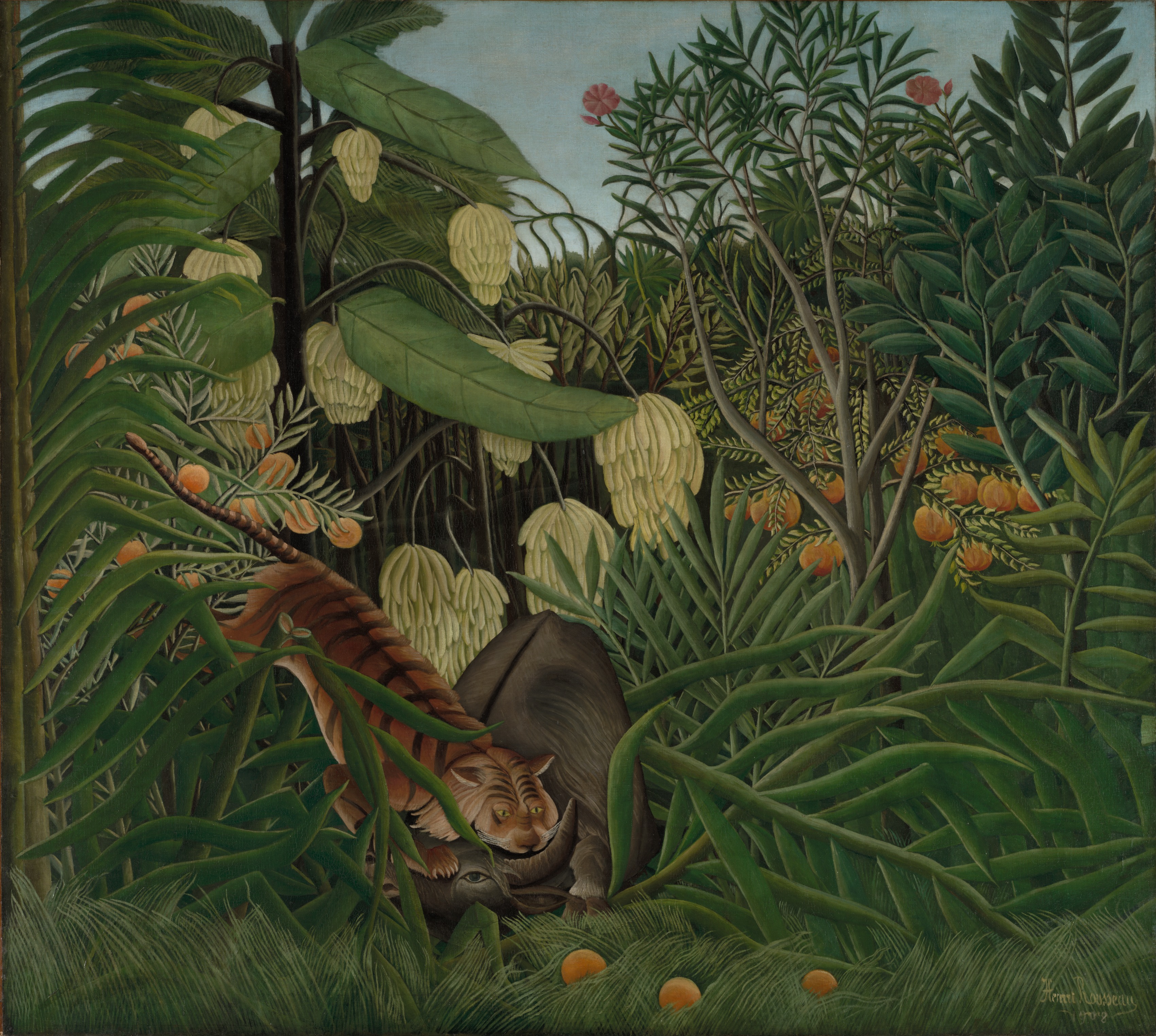
Begin by following the upper edge of the painting. On the left, long leaves overlap and curve inward. On the right, narrow leaves spread in groups along their stems, cutting the blue-gray sky into irregular openings. Lower down, broad leaves, pointed leaves, round fruit and pale yellow hanging clusters occupy almost the entire canvas. The two animals named in the title are crowded into the lower part. Even their heads have to be found among the leaves.
There is something peculiar about this forest: much of it is perfectly legible, yet it is difficult to imagine walking through it.
Rousseau lived in France and never visited the tropical jungles he painted. The Cleveland Museum of Art identifies travel books and the Paris botanical garden as sources for his imagined distant places; this painting appeared at the Salon des Indépendants in 1908. That background helps us see the vegetation as selected, enlarged and combined images. Nature and pictures available to a city dweller supplied the material, but the resulting place has no ready-made map. Historical background
What matters most in this reading is the way the plants become both a setting and a barrier. Individual leaves have distinct shapes, and their overlaps often make their order clear. Across the whole canvas, however, the layers press against one another. Clarity does not make the forest accessible. It gives its congestion an unusually precise form.
1. Each kind of leaf takes a different route
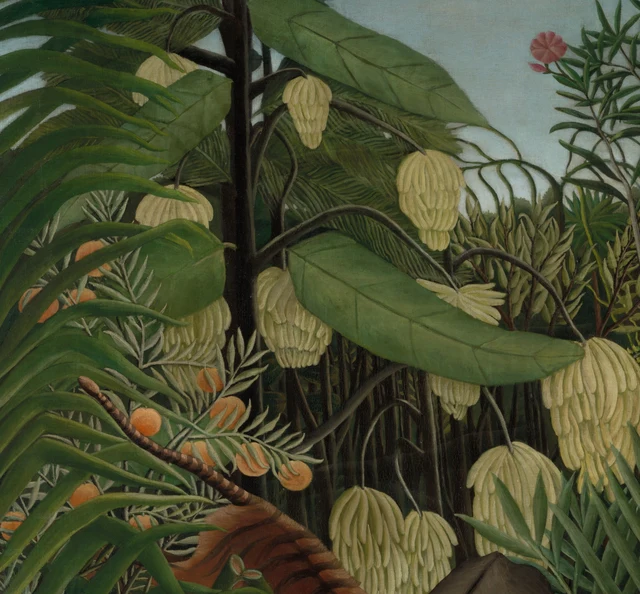
The outermost leaves on the left enter from the edge and bend into a succession of large arcs. They differ in length and spacing; some tips point right, others downward. The eye can glide along one edge, pause at its tip, then be taken up by the next. This passage feels almost continuous, although it consists of many separate shapes.
Behind them lie much broader, flatter leaves. One in the upper middle extends to the right from a dark stalk. Its veins divide a large green surface into sloping areas. A slight curl at the edge and variations of light and shade suggest its thickness and turns. At the same time, it acts as a broad horizontal shape, abruptly interrupting the fine vegetation behind it.
On the right, the rhythm changes. Pointed oval leaves line the two sides of upright stems, one pair after another, making little ascending steps. Farther back, shorter and more crowded leaves seem to repeat a similar branching pattern on a reduced scale. Resemblance never becomes a formula from which every part can be predicted. The leaves lean in different directions, and the clusters vary in density.
These distinctions are essential. To say that the picture contains “a lot of green” misses how its forest is organized. Long leaves bend our attention; broad leaves let it rest; paired small leaves move it upward by increments. Different shapes produce different speeds of looking. Each seemingly self-contained unit helps set the pace of the whole.
2. Overlaps establish depth, but no path appears
The painting certainly has depth. Long leaves on the left pass in front of the tiger, which in turn covers some vegetation behind it. A gray-brown tree rises on the right, its forks crossing darker foliage. Overlap takes us into the picture one step at a time. Yet every step inward brings another leaf into our way.
We often expect distant forms to grow paler and softer, opening a larger interval between foreground and background. Here, many leaves farther back retain crisp outlines and intricate markings. We can tell that one group stands behind another without being able to judge the distance between them. Depth is repeatedly proposed, then drawn back toward the surface by sharply defined forms.
The sky provides a pause. Its blue-gray area in the upper center does not spread uninterrupted to either side; leaf tips and twig ends project around it. It is a lighter, emptier ground against which the plants separate more easily. But it does not extend downward into a passage. Our eyes can look outward without finding a route from the forest floor to that open space.
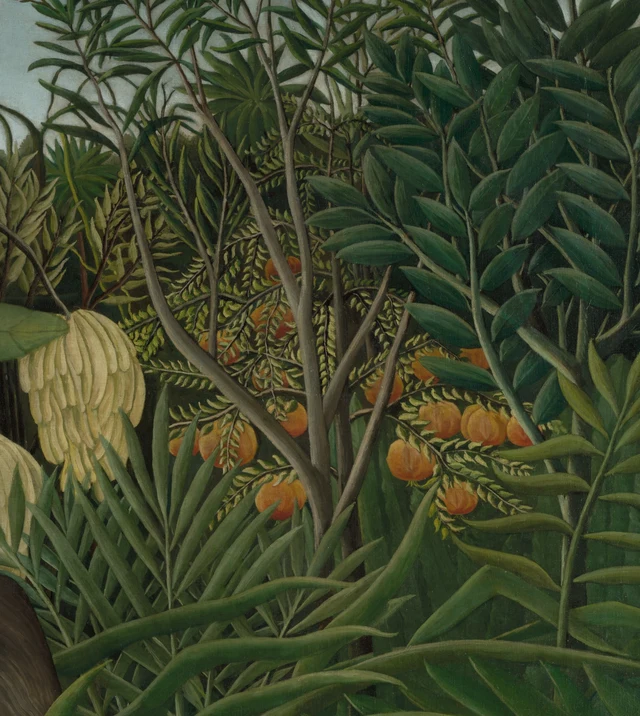
The tree makes this spatial peculiarity especially clear. A light edge and dark side give its trunk a solid, rounded presence, and the forks are readily distinguishable. The dense leaves tell us little about where it enters the ground or how much room surrounds it. Local volume is firmly established; a continuous, measurable terrain is not.
“A wall of plants” is therefore a useful metaphor, with limits. There are actual foreground and background relationships here; everything is not spread onto one plane. More precisely, many shallow layers sit close together. Sight can penetrate some gaps, while an imagined body repeatedly comes to a halt at the next layer.
3. Pale yellow and orange travel differently
Green occupies most of the canvas, ranging from yellowish fresh tones through muted grays to almost black recesses. These differences help distinguish one group of leaves from another. Two other color families stand out: pale yellow hanging clusters on the left half, and round orange fruit on both sides and along the bottom.
Each pale cluster consists of many elongated parts, its outline rather like a gathered tassel. The bunches hang before dark stems. Some are half concealed by broad leaves; others appear more fully below. Repetition makes them recognizable, while obstruction gives each a different way of appearing. Starting with a brighter cluster above, the eye can find another below, then another, making a broken vertical connection.
Orange follows another route. Round fruit emerges between leaves on the left, gathers on the right, and appears again at the lower edge. It connects separated areas without forming a strict series that diminishes into the distance. These small warm circles act like color signals passed between different patches of green. We look across and down for their relatives, rather than concentrating exclusively on the animals.
The tiger's orange-brown coloring enters the same network. Its body is, of course, more complicated than a piece of fruit: it has a back, a head, fur and a position in the struggle. Seen in the whole painting, however, its warm color is not isolated from the vegetation. The surrounding orange notes make the striped body conspicuous while keeping it within the forest's color relationships.
Two pink flowers above are more sparsely placed. They appear against the pale sky, with a different spacing from the crowded orange below. The painting does not fill every gap to an equal density. Its few looser intervals make the congestion in the lower part more noticeable.
4. The animals join the arrangement of leaves
Return now to the struggle below. The tiger's body runs diagonally toward the upper left, its tail raised between the plants, while its lowered head faces us. Beside it rises the buffalo's gray-brown back. The buffalo's head is held very low, with one eye and a curved horn emerging beneath the green. One of the tiger's forepaws presses on its head, while the tiger's mouth meets the area around its head and neck. Their close bodily contact is enough to establish the conflict named in the title.
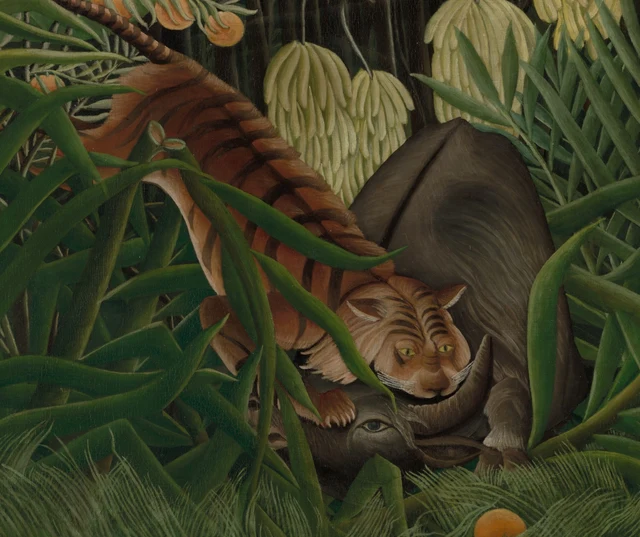
The plants have not cleared a stage for them. A curving leaf passes across the tiger's back and shoulder; other pointed leaves cut into its outline. Although the face is relatively unobstructed, leaves and grasses still conceal the continuation of its action below. We have to connect separated fragments to read the posture.
The buffalo's back forms a comparatively broad gray-brown area, solid among the thin leaves. A dark ridge and shifts of shading around its flank give the body volume. Below, its head is compressed into a narrower, darker space. The tiger's face and the buffalo's single visible eye gather near the bottom, making the conflict both clear and confined.
For me, the tension comes chiefly from that confinement. The struggle is happening, yet the vegetation has made no sweeping movement aside, and no open ground is available for the bodies to turn across. The animals seem gripped between long leaves, the encounter held within a restricted space. Contact and pressure are visible, but a complete story does not unfold through an unambiguous sequence of actions.
At the front edge, fine grasses make a band of curving lines, concealing more of the feet and ground. They are almost feathery rather than wall-like, yet they form the final barrier at the bottom of the canvas. Here tiger stripes, leaf veins and grass lines echo one another: the surfaces of animals and plants are articulated by repeated linear marks. That is a visible formal relationship, without having to become an allegory of a law of nature.
5. A forest that holds together on canvas
Remember its actual size: 170 cm high and 189.5 cm wide. The canvas stands close to the height of an adult. Reduced on a screen, its leaves can look like delicate ornaments; at this scale, broad leaves, branches and animal bodies confront a viewer more directly. The sense of something clearly seen yet difficult to enter has a bodily dimension as well.
The museum specifically notes that the bananas grow in a botanically incorrect direction. This matters because it changes the question of accuracy. The forest cannot serve as a botanical survey of a particular tropical location. At the same time, the outlines, repetitions and overlaps within the painting remain open to exact, patient description. Museum commentary
Calling the whole thing “naïve” too quickly skips over these arrangements. The large arcs on the left differ from the upright stems on the right; pale yellow tassels differ from orange dots; broad animal bodies differ from the finest foreground grasses. The forest's overall effect comes from bringing these unlike shapes together on one canvas. Filling an area with plants would not by itself produce this result.
My judgment is that the painting is most persuasive in the way it makes abundance legible while preserving abundance as an obstacle to movement. Each group of leaves invites scrutiny. Many such invitations laid over one another prevent the eye from leaving any area quickly. The struggle gives the forest danger; the forest determines how that danger appears and how it is enclosed.
This is also why the whole painting matters more than an isolated close-up of the tiger's face. The animals' drama is one of several active forces. Across the large canvas, vegetation continually distributes positions, intervals and degrees of visibility. Even the protagonists must find room to emerge among the leaves.
Optional: one question through SAE
The following contemporary viewing exercise draws on Han Qin's SAE, or Self-as-an-End, aesthetics. It makes no claim about Rousseau's intentions.
The SAE framework distinguishes beauty from factual correctness, and personal preference from grounds that can be discussed. That distinction suggests a precise question: where does this picture's organization still hold together when its plants do not entirely agree with botany? SAE Judgment and Aesthetics
Choose two groups of leaves, perhaps the long arcs on the left and the small paired leaves on the right. Without identifying species for the moment, describe their repetitions, their changes of direction and their overlaps. Then ask whether they give the eye the same pace. Do they organize their surroundings into different densities? An answer should point back to a location in the picture; otherwise, “it looks rich” remains too general.
Now bring botanical knowledge back. Does the direction of the bananas make the forest seem more deliberately assembled? If so, what exactly changes: your trust in its truth to a location, or the relationships between its arcs and intervals? Both may change, and they need not change equally.
The exercise does not require everyone to end up liking Rousseau. Repeated leaves may seem rhythmic to one viewer and cramped or overinsistent to another. The useful discussion begins when we can identify the same repetition and explain how it supports our different judgments. Botanical fact and pictorial effect can then each be taken seriously, without sacrificing one to defend the other.
Images and sources
Visual descriptions are based on direct examination of the Cleveland Museum of Art's official 3400 × 3046-pixel image and its details. The full image is the unchanged downloaded file. The three details are crops only, preserving source pixels and the embedded ICC color profile; no color adjustment, sharpening, retouching or generated content has been added. Screen color, scale and viewing distance differ from conditions before the original.
Identification, dimensions, exhibition history and historical background follow museum documentation. The account of space, rhythm and viewing effects is this essay's interpretation. No sequence of painting or pigment layering is inferred from the digital reproduction. The image falls under the museum's CC0 open-access policy; this does not make all museum prose freely reusable. See the accompanying References and Image credits.