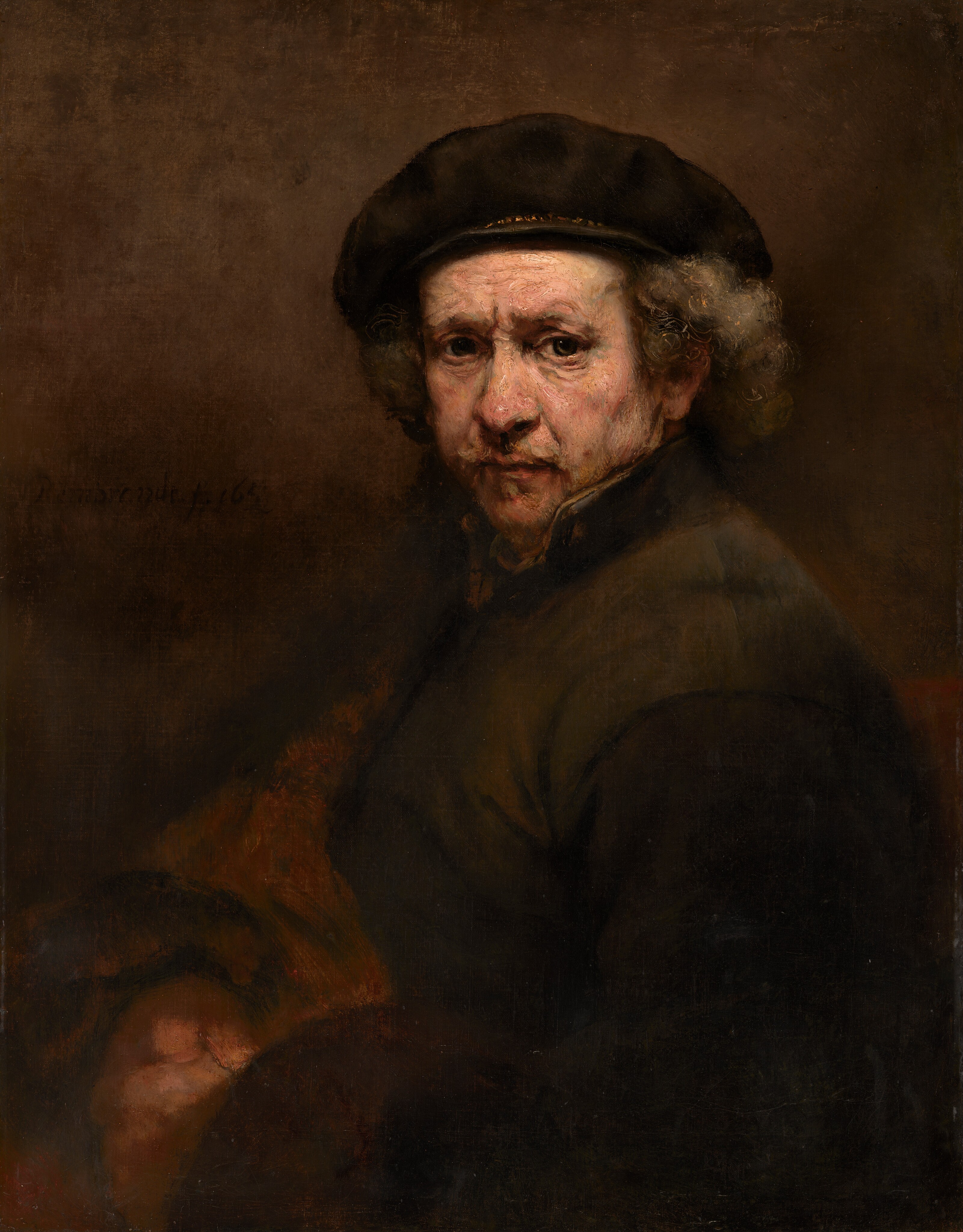
The pale paint on the forehead rises in short ridges. Let your eye move down into the sockets, and the color suddenly cools: gray-green remains between areas of pink skin. Move sideways, and fine lines curl through the hair. All three passages describe the same head, but they do so differently. Paint is added in one place, an underlying color is allowed to show in another, and elsewhere a line is cut through paint that was still wet.
These differences deserve to be seen together. The face owes its vivid presence both to the eyes looking toward us and to the changing ways its surface has been made.
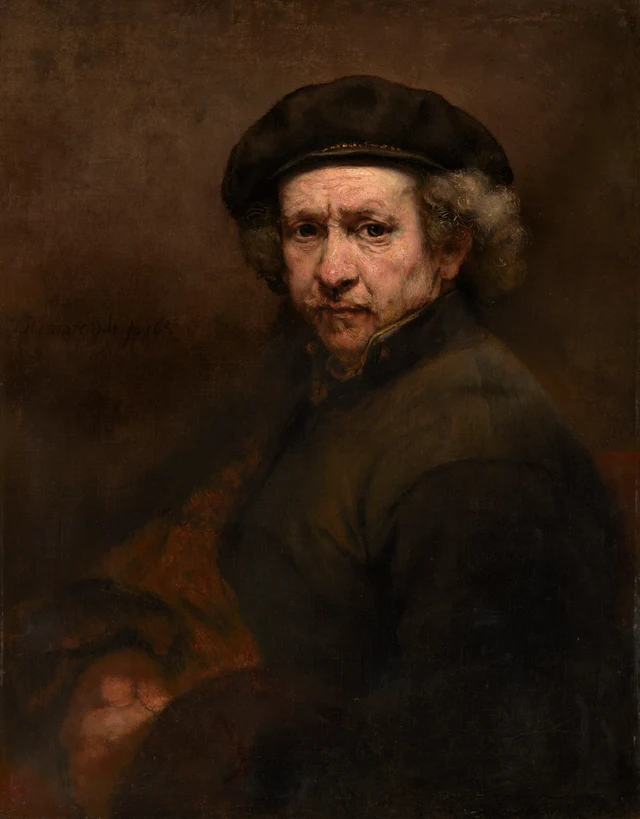
The argument of this essay is that the painting's force lies in the way several distinct states of paint combine to establish a definite, solid face. Thick passages, thin passages, and incised lines have not been smoothed into a uniform skin. They retain their own shapes while working together across face, hair, collar, and shoulders. We recognize a person while continually seeing the painter's craft in bringing him into view.
In 1659 Rembrandt was fifty-three and living in Amsterdam. By then he had repeatedly represented himself in paintings, prints, and drawings over many years. A self-portrait can record an appearance; it can also shape an artist's public image and enter into conversation with earlier portraits. The beret, turned head, and clasped hands here belong to that second line of inquiry. This apparently direct encounter has also been shaped by composition and tradition. Scholarly study
1 Building up light and leaving room for shadow
Begin with the forehead. It is not one smooth expanse of pale pink. Short strokes run across it near the brim. As they approach the space between the eyebrows, the marks tilt and curve; a group of pale strokes toward the right spreads around a small swirling center. Ridges of paint, narrow gaps between strokes, and the light and shade of skin crowd together. We see both the turning plane of the forehead and the unevenness of the actual paint layer.
Those two kinds of unevenness do not correspond point for point. Every ridge of paint need not represent a wrinkle. Some marks cross a light plane to distribute its illumination; certain darker lines near the brows deepen a hollow. To read every brushmark as damage to the skin would be to count the activity of painting as the aging of a person.
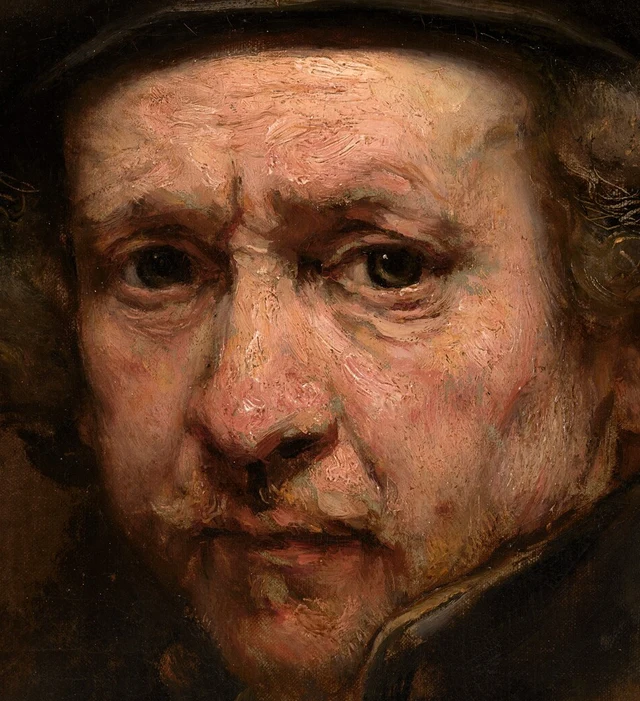
The nose makes the method especially legible. A narrow light runs down its bridge to the reddish tip. Pale color on the right meets deep brown around the nostril, abruptly bringing the volume forward. The tip needs no complete outline to establish its roundness. A few adjacent colors change direction and press against one another, and the eye reads a projecting form.
The cheek makes a different transition. On the right of the image, short pink strokes slant downward, picking up cool gray near the sideburn. Toward the jaw, luminous flesh tones gradually join brown and the collar. The turning surface extends over a longer distance than the sudden projection of the nose. Within one face are both sharp protrusions and slowly receding planes. The direction of the strokes and the abruptness or gradualness of their color transitions distinguish those distances.
The museum's technical account describes facial highlights begun with short, heavily loaded strokes, some swirled into wet paint without being fully blended. Separate dark strokes were added after drying. Around the eyes, the greenish gray also makes use of a preparatory color layer beneath. The differences in paint thickness therefore have a material basis; they are not deductions from a photograph alone. Technical Summary and catalogue entry
This makes the eye sockets particularly interesting. A painter could fill a shadow with more paint, or allow an earlier color to keep working. Between the thicker forehead and cheeks, the cool passage seems to step backward. Each eye emerges from it differently: the one on the left of the image is more deeply embedded, while the lower lid on the right is brighter. The concentrated gaze includes this inequality between the two sides.
The mouth draws that activity tighter. The upper lip and corners make a dark passage, followed by a paler lower lip and then the small, mottled area of the chin. Eyebrows, nose, and mouth are not neatly fenced in with fine lines, yet each has a sufficiently definite place. The varied surface and the firm organization of the features remain present together. That is what makes the face both substantial and supple.
2 A strand of hair can be drawn out of paint
On the right of the image, the gray hair below the beret works at two scales. Broad gray masses establish its puffed-out volume. Within those masses and along their edges, yellow-brown lines loop into irregular curls. Some travel downward together; others suddenly double back. A few extend into darker areas like fine, loosened springs.
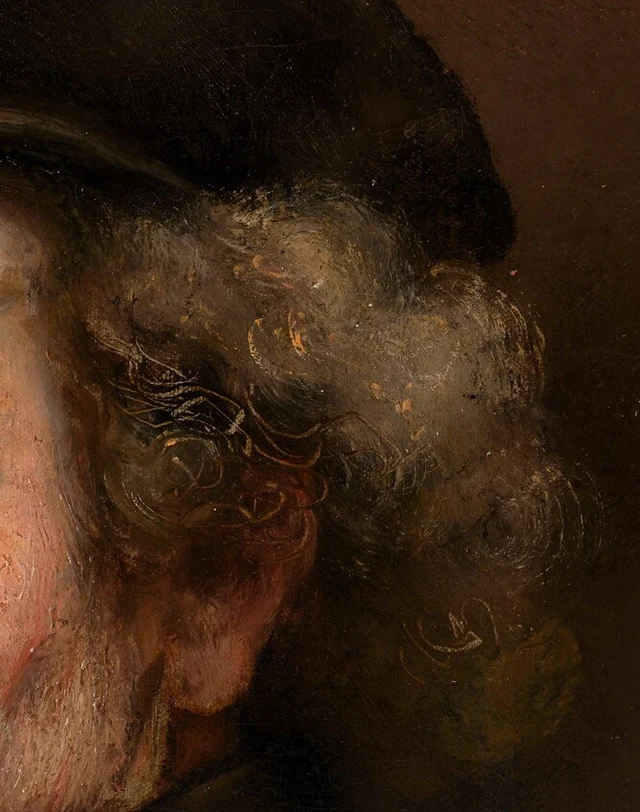
Technical examination identifies lines scratched into the wet hair paint with the butt end of a brush, alongside passages made with fine brushwork. Painting a strand of hair therefore need not mean adding another colored stroke. Moving aside or cutting through paint already laid down can also make a line appear. Technical Summary
These lines differ tellingly from the forehead's loaded strokes. Its light plane has the compactness of paint built up stroke by stroke; the curls are loose and agile. Above the ear especially, lines cross while broad adjacent areas of gray remain undivided into individual hairs. We get both a soft body of hair and a few curls that can be followed along their course. The painter does not have to account for every strand.
Look higher, at the beret. It is broad and dark, with a relatively continuous outline and only a short warm glimmer of ornament on the brim. The forehead meets its lower edge; gray hair spreads from either side. The large dark shape gives the busy hair and active flesh tones a stable neighbor. Calling all this “Rembrandt's chiaroscuro” would leave out the coordination of large and small forms, dense and open passages, and different kinds of line.
The beret itself was revised. The museum records lighter paint beneath the present dark layer, indicating an earlier, lighter plan for its color. Knowing that a revision occurred does not tell us all the painter's reasons. What we can judge in the present image is that the dark beret gathers the top of the head into one broad shape, concentrating the smaller, brighter variations below.
3 The face needs these shoulders
At 84.5 centimeters high, this is a half-length portrait. To remember it as a face alone would lose much of its composition. The face sits slightly right of center in the upper portion. The broad arc of the shoulder occupies the right side, while the hands lie far from the face at lower left. No bright route leads directly between these two areas of flesh. The eye has to pass through a large expanse of brown clothing.
Beside the chin, the collar turns upward to the right and joins the shoulder. Its narrow light edge acts like a joint between the intricate changes in the face and the larger shapes of the body. Light on the shoulder is broader and weaker, and much of the sleeve below falls into darkness. These passages give the head a place to sit and the body thickness without competing with the features.
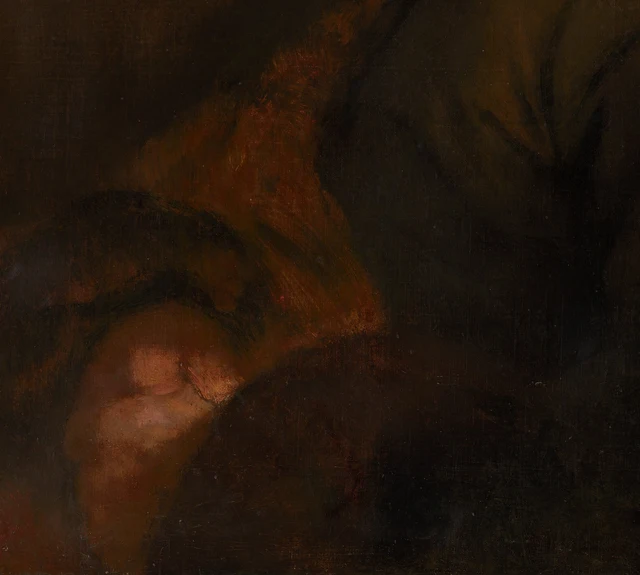
The hands are broadly stated. We can recognize the back of a hand, the meeting of fingers, and the position of the cuff, but cannot trace the same profusion of red, gray, and pinkish white that appears in the face. The clasped hands gather the lower forms together; above, the face opens out. This distribution gives the half-length portrait a clear center of gravity: stability below, concentration above. Fewer details do useful work here. Their absence is not simply a sign of something left unfinished.
There is another, quieter consequence. The hands hold neither brush nor palette. No professional prop immediately announces the sitter's identity as a painter. We are looking at the way a man sits and turns his head, and at the other portraits with which that manner of presentation resonates.
The National Gallery of Art catalogue connects this painting to Raphael's Portrait of Baldassare Castiglione. Rembrandt saw it in Amsterdam in 1639 and made a sketch. Clasped hands, a turned body, a head facing the viewer, and a beret framing the head offer specific grounds for comparison. The catalogue uses the connection to discuss an image of the artist as a learned painter. Catalogue comparison and illustration
The connection complicates the apparent simplicity. Ample clothing, restrained color, and a pose without props do not exclude art history. Tradition can reside in the angle of a turned shoulder or the position of joined hands. Rembrandt draws on that substantial arrangement and makes it his own through stronger light-dark contrasts and paint handling that leaves its marks plainly visible. The portrait's dignity is established through both the organization of the body and the skill of its making.
4 The shadows have passed through time too
Biography can now be placed more precisely. Following his financial crisis, Rembrandt lost his house and many possessions; this painting dates from after the associated sales. That fact can easily lead to a ready-made story: a defeated artist recounting his life through a darkened face. But the colors we see today contain another history as well: what happened to this painting after it was finished.
Treatment in 1992 removed discolored varnish and some later overpaint. The museum study explicitly notes that the old varnish had intensified the portrait's somber character. Cleaning made pinks and other flesh tones easier to distinguish and clarified the torso's volume. Some effects once treated as direct expressions of personal tragedy thus arose partly from subsequent changes in materials. Conservation and the history of interpretation
We need not exchange “sad” for “happy.” More useful is to watch the colors at work. The red nose is warmer than the sockets, the pale forehead brighter than the beret, and a little light reappears on the chin beside the collar. They give the face changing planes, temperature differences, and chromatic activity. A single prevailing impression of gloom flattens distinctions that are available to be seen.
Nor has the painting returned undamaged to 1659. The Technical Summary records abrasion on the clothing and the background at left, and explains that dark paint and coatings from earlier restoration remain in some areas. Not every blackened, patchy, or blurred passage in the background can automatically be praised as the painter's deliberate arrangement. We can attend to the large relationships between beret, face, and shoulder while remaining cautious about local condition.
For me, the most important lesson of the conservation history makes this self-portrait more rewarding to look at. “Seeing Rembrandt directly” has passed through the artist's arrangements, changing materials, and later treatment. Distinguishing them does not reduce the vivid presence before us. It makes that presence more specific. Loaded paint on the forehead, cool color in the sockets, incised curls, and broad shoulders share the work of making a person appear. Any one of them explains the painting's achievement better than a tragedy written for it in advance.
Optional reading The time of making through SAE
The following uses SAE, Self-as-an-End, to pose a contemporary question about looking. It does not infer the painter's theoretical intentions or the sitter's inner life.
Cleaning altered the visible colors. Learning about that cleaning changes which colors we attribute to whom, and to which moment. One change occurred on the painting; the other occurs in our understanding of this physical object. The “internality of context” in SAE's general account proposes that context helps constitute beauty. Applied here, the question becomes: when we admire the face's light and shade, does what we admire also include the material layers and history of making that we can now distinguish? SAE Judgment and Aesthetics, section 3
The gray-green of the sockets offers a particular place to begin. Knowing that it uses preparatory color reveals an additional relationship: an earlier passage, surrounded by later lights, continues to serve as shadow in the finished work. It makes the eyes recede and makes leaving an underlying layer visible an active means of shaping a face. Knowledge has added a way of painting that we can attend to.
We can also follow the visible curling lines in Figure 3 slowly, noticing how they bend, cross, and enter the gray hair mass. Then consider the technique of incising into wet paint documented by the museum: if the surface paint had already hardened, would the same incising action still produce this kind of mark? The question moves from visible lines to an operation established by research. SAE's direction of causation helps us ask how a shape depends on the state of the material at the moment of the action. The Beauty of Causation
The forehead offers another relationship: loaded strokes met while wet, and later dark strokes landed on a dry layer. Those successive moments now appear together on one surface. Compared with sockets and hair, they reveal several ways of keeping earlier work active: leaving it, adding to it, cutting through it. These operations preserve a record of making and contribute to the face's present light, shade, and form. A curl belongs both to the depicted head and to the painting that was physically made. The two ways of looking meet along the same line.
Images and sources
The visual descriptions are based on the National Gallery of Art's 3202 × 4096-pixel image and three details. The full image is the unchanged downloaded file. Crops preserve the source pixels losslessly as PNG files and retain its ICC color profile. No color adjustment, sharpening, restoration, or generated content has been applied. Screen color and magnification still affect viewing.
The images fall under the museum's CC0 Open Access policy. The close reading and contemporary theoretical exercise are independent writing; facts about making and conservation are supported by the linked museum research. Open image rights do not imply open rights to the research text. Raphael's painting is linked through the scholarly discussion; its comparison photograph is not included. See also References and Image Credits.