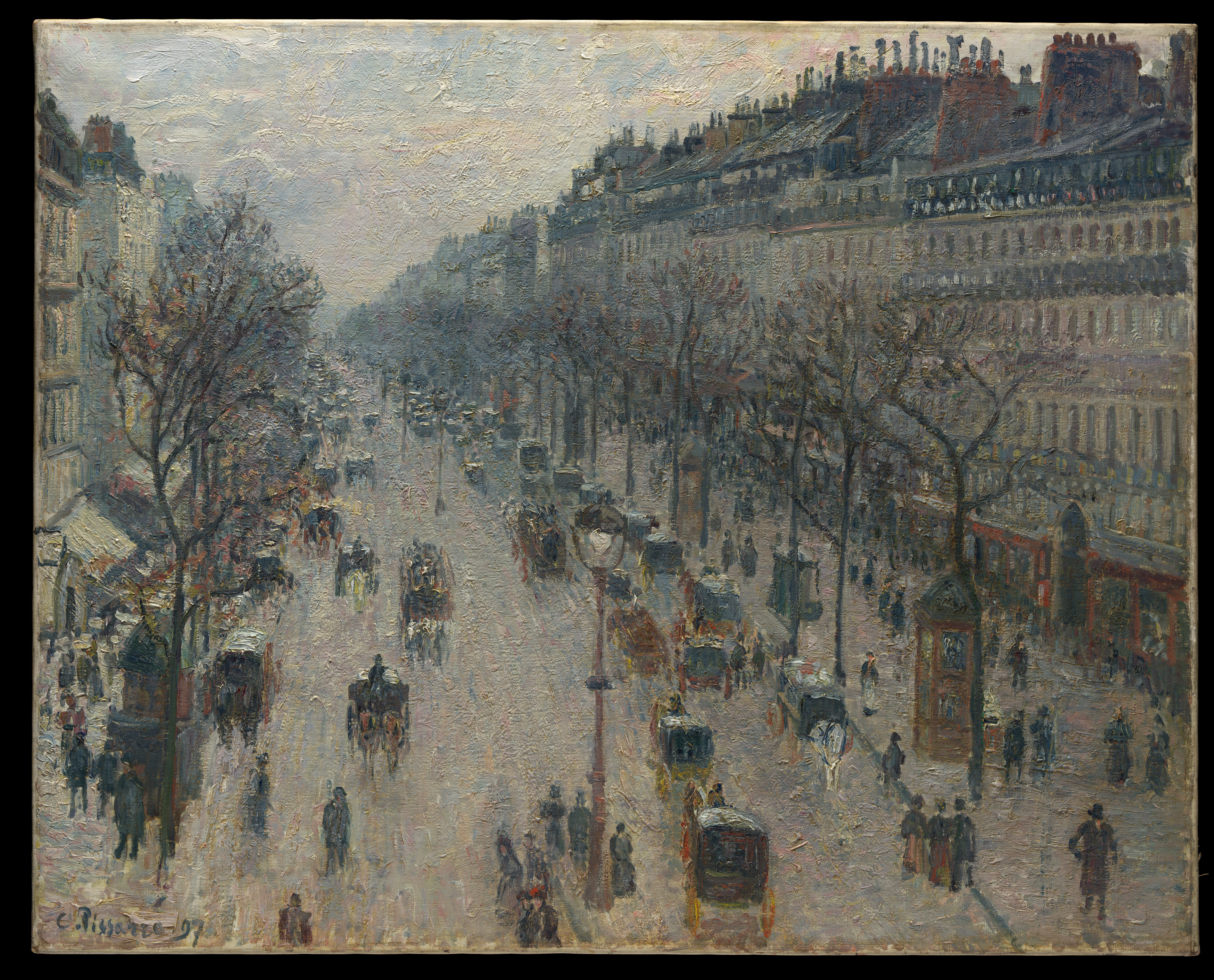
Let your eye travel down the street. In the foreground, a broad stretch of pale gray, pink, and creamy yellow road opens between several carriages. Farther away, the dark carriage bodies become smaller and crowd more closely together. The road narrows toward a point just left of center, yet nothing suggests that the traffic ends there. On the pavement at the right, little upright figures gather in loose groups; in the foreground just left of center, other figures are cut off by the lower edge. We are looking at a section of a street and sensing movement that will continue beyond it.
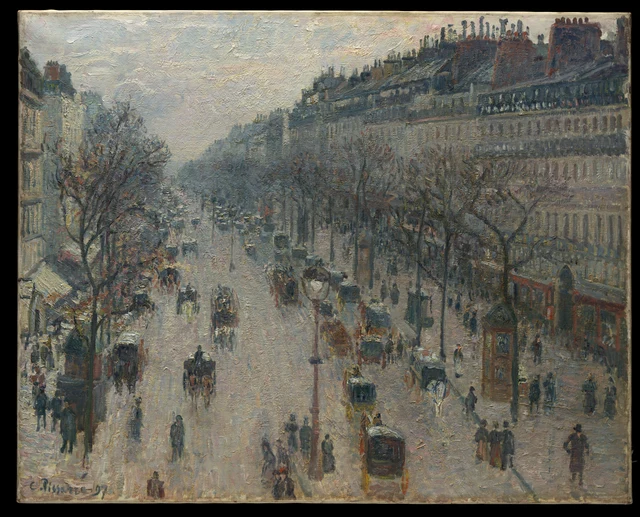
This reading focuses on the way a stable, elevated viewpoint accommodates a city with no single beat. Buildings, curbs, and rows of trees establish long, persistent directions. Unequal intervals between vehicles, people, and touches of color keep those directions alive. Pissarro gives the still canvas a sense of ongoing movement without choosing one conspicuous event to carry the scene.
Early in 1897, he took rooms at the Grand Hôtel de Russie in Paris and looked out over the boulevards. The Met records fourteen paintings of the Boulevard Montmartre and two of the Boulevard des Italiens between February and April. Despite its name, this boulevard is not on the hill of Montmartre. Nor was it a new street cut by Haussmann: the City of Paris dates its completion to 1705. Nineteenth-century trade and traffic were using an inherited route. This distinction matters. The changing life of a city and the street that supports it need not begin at the same moment. The Met's account; National Gallery on the location and series; City of Paris street history, page 4
A long view from a window
No window frame appears in the picture. Even so, the tops of objects tell us that we are looking from above. The pale roofs of the nearest carriages are conspicuous, with their dark bodies set beneath them. The roofs of the buildings spread within our field of vision. Pedestrians have become narrow, elongated shapes, while the road occupies a generous area. From this position we can see both a nearby stretch of street and the way it continues into the city.
The buildings on the right take up a substantial part of the canvas. Cornices, balconies, and successive rows of windows converge obliquely into the distance. Much less of the buildings on the left is exposed, and large branches intervene. The two sides are unequal, yet both direct us toward the street's depth, just left of center. The pale sky tapers downward and the pale road tapers upward. The blue-gray distance becomes a seam between them.
Follow the roofs and a strong diagonal order emerges. Follow the carriage tops and the passage becomes less continuous: bright marks bunch together, then skip a small interval. Tree trunks and lamp posts contribute further runs of verticals. They shorten and draw closer with distance without becoming a regular picket fence. Several kinds of evidence support the depth of this one street. Pissarro does not need to give every object a complete outline for its position to become convincing.
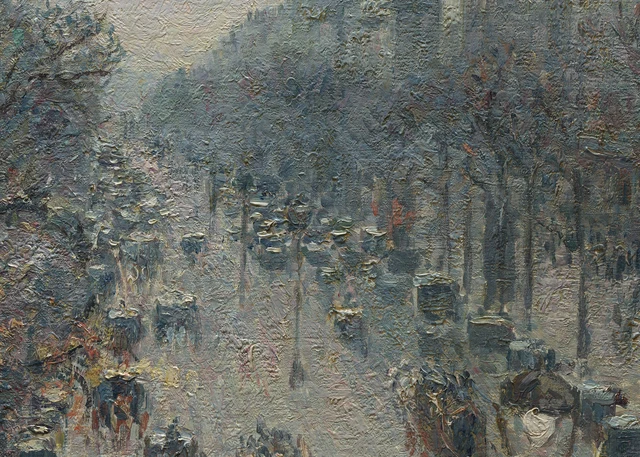
There is no brilliantly illuminated monument at the far end to receive our gaze. The farther we look, the harder it becomes to distinguish each person and carriage, although the direction of the road remains clear. The distance offers a sense of more street ahead rather than a single destination we must reach. We can follow it, then find our attention pulled back by a larger, clearer carriage in the foreground. Pictorial depth and the eye's back-and-forth movement operate together.
Traffic with an uneven beat
Some of the most telling parts of the foreground are the spaces that the traffic leaves unoccupied. Toward the lower left, a carriage faces us, its horses' slender legs extending into the pale road. On the other side, larger dark bodies follow one another, pale roofs above them and touches of red and yellow around the lower bodywork and wheels. A broad light area remains between the two groups.
That opening lets the traffic breathe. If the carriages were packed evenly into one dense band, we might first see an orderly pattern. Here the distances between dark shapes expand and contract, and the eye accelerates, pauses, and reconnects. The denser distance and more open foreground also do the work of perspective: as the road recedes, its intervals occupy less of the painted surface. Rhythm and space reinforce each other.
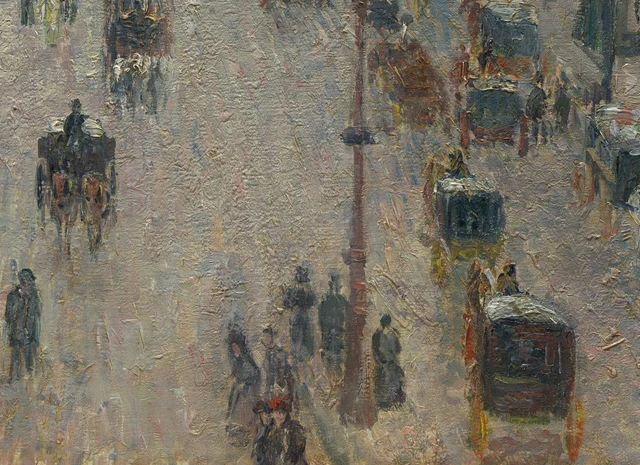
Vehicles and people are not abbreviated in the same way. A carriage tends to be a substantial dark block, capped by a horizontal touch of light paint. A pedestrian is often a narrow vertical mark with a very small head; below it, the shape may divide into legs or continue as a long garment. Nearby hats, collars, or hems occasionally distinguish one figure from another. At a distance, such differences quickly diminish. The contrast in shape already gives roadway and pavement their different densities of activity.
A sense of passage does not depend on every figure displaying an unmistakable walking pose. Several figures draw together; a gap follows; then a solitary figure appears. We begin to read along the pavement. The reddish-brown kiosk-like structure at the right and the darker lamp posts provide more enduring points of reference for these small bodies. No crowd clusters around a protagonist, and no foreground carriage is elevated into the center of an incident. The subject is the circulation itself.
The orientation of the carriages, the shapes of the figures, and the changes from crowded groups to open gaps make this stretch of street seem continually active. Our eyes encounter pauses and onward movements in succession, and a sense of the city's time unfolds through these relationships.
Buildings assembled from lively marks
The little street figures readily call attention to the liveliness of the brushwork. The buildings on the right deserve equally close inspection. They seem solid, yet many windows are only broken dark strokes. Cream, gray-green, and pale pink emerge between them. Horizontal divisions between floors join those scattered marks into successive buildings. The order is clear enough to hold, while the surface keeps varying.
Reddish-brown chimney stacks carry chimney pots of different heights and tones. The pots repeatedly rise against the pale sky with irregular spacing, a looser sequence than the windows below. Broad blue-gray roof planes support these little uprights, while the red stacks place heavier pauses along the skyline. Repetition and variation, encountered in the traffic, return at another scale above the street.
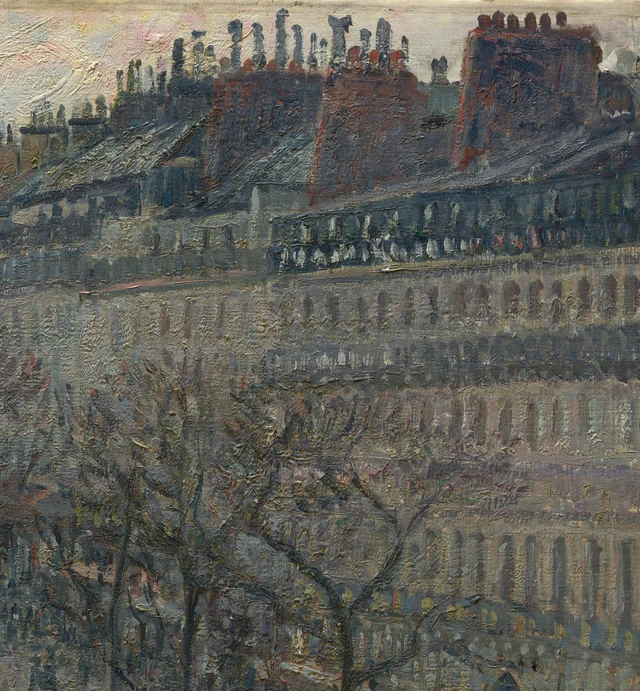
The branches are particularly important. Dividing from thicker dark trunks, they bend and cross in front of the façades, interrupting the windows' repeated beat. Some fine branches run continuously; others consist of short linked segments. The light wall remains visible through the openings. A tree is not treated as a single brown silhouette. The spaces between its branches allow the building to remain legible. Winter's sparse foliage makes the branching structure of plants and the repeated divisions of architecture visible at once.
To regard these buildings merely as a motionless backdrop would miss a considerable part of the painting's energy. Their architectural relationships are stable, but the marks that sustain them are as numerous and active as those on the street. Pissarro does not make every fixed object smooth and every horse or pedestrian blurred. He gives them an animated surface in common, then uses differences in direction, proportion, and connection to make buildings stand and traffic continue.
As a result, the picture does not divide into an exact city model with hastily added people and vehicles. The buildings and road emerge from a related painterly language while sustaining different kinds of duration. A façade remains available for recognition again and again; the combination of vehicles below seems ready to change.
The pale colors of winter
A first look may leave an impression of grayness. Look again and the road contains pale rose, cream, cool blue-gray, and light brown. Pink and yellow also pass through the cooler tones of the sky. Marks of different lengths and directions meet across these areas, giving subtle variation to large expanses of light paint. Gray consists of differences. The street never becomes a dead white interval between the carriages.
Sky and road are both light, but their jobs differ. The sky surrounds roofs and chimneys, clarifying the dark shapes above. The light road travels between wheels, horses' legs, and figures, separating groups of nearby activity. Related colors return on the façades, where windows and floor divisions break them into more regular sections. A shared mixture of warmth and coolness enters air, ground, and masonry through different arrangements.
The road in Figure 3 rewards sustained attention. A longer pale stroke runs beside a carriage; many shorter marks cross obliquely around it. Some pinkish-red strokes extend along the length of the street, while blue and yellow marks cross that direction. The larger arrangement leads the eye into the distance, but the smaller marks keep the surface from submitting to a single perspective line. The road stretches away and remains before us as a textured, colored canvas.
Winter enters our reading through bare branches, clothing, and the overall character of the light. No clear covering of snow can be made out on the pale road. Adjoining colors, exposed branches, and blue-gray air give visible form to the season and time of day named in the title.
Returning to the same view
The value of a fixed viewpoint becomes especially clear across the series. If Pissarro had moved to a different street for every painting, changes in architecture and terrain could have dominated the comparison. Returning to the same boulevard allowed the more persistent roofs, curbs, and trees to act as reference points. Within a related spatial arrangement, he could examine what weather, light, time of day, and activity did to the picture's relationships.
The National Gallery in London owns The Boulevard Montmartre at Night from the same series. Its account emphasizes differences in color temperature among the light of street lamps, shop windows, and carriage lamps. This related work makes clear why serial painting involves more than tinting one city image in several colors. At night, the location of the brightest passages, the forms that merge, and the means by which the street establishes depth all become fresh problems. The night view and the National Gallery's discussion
In the Winter Morning, the light road remains an extended area of space, interrupted by dark carriage bodies. Windows, roofs, and chimneys can still be read in successive layers. The atmosphere softens the distance without swallowing the foreground. This morning's particular achievement lies in the coexistence of clear spatial organization and small changes everywhere within it.
The series also makes “capturing an instant” a phrase worth refining. Pissarro was certainly facing changing light and traffic, but returning repeatedly to a subject is itself a sustained investigation. Fleeting appearances meet a longer practice of observation: repeated attention to the same place makes it possible to distinguish what is different today from what could be seen at another time.
For this reading, the painting's finest achievement is that it does not entrust the city's continuity to one line of action. Our eyes travel along the boulevard, encounter a foreground carriage, jump to figures beside the road, and follow floors or trees back into the distance. Each route remains constrained by the same space without proceeding to exactly the same beat. The stable viewpoint makes room for change. The city's time stays open in the unequal intervals between recurring forms.
Optional reading A question from SAE about the same place
The following exercise draws on Han Qin's SAE, or Self-as-an-End, aesthetics as a contemporary approach to looking. It makes no claim about Pissarro's theoretical commitments or intentions.
The useful question here comes from the general framework's “internality of context.” In this account, context is a component of beauty; a change of context rewrites the particular beauty that takes shape. Applying that proposition to Pissarro's series is the present essay's move. A shared street name and a similar viewpoint do not mean that the canvases all show one beautiful view that could exist independently of weather and time. SAE Judgment and Aesthetics, section 3.2
Place this complete image beside the night picture on the National Gallery's website. Choose one strip for comparison: the area where the buildings at the right meet the roadway. First note which lights separate the carriages in the morning painting and which dark lines make the architecture continuous. Then look at the night view and note how light and dark regroup in that area. Rather than choosing a preferred mood, test whether the same street requires a different set of color relationships to establish its space, vehicles, and buildings.
The exercise makes context something we can locate. Weather and time of day are more than information appended to a label: through the distribution of light and relationships among objects, they enter the paintings themselves.
If the comparison produces only “morning is light and night is dark,” take it one step further. Does the broad pale area of the morning road still connect foreground and distance in the same way in the night view? Ground an answer in one visible patch or edge. The theory is useful here if it turns “one place at different times” into a specific painterly question, rather than leaving it as a description of the series.
Images and sources
The visual reading uses the Met's 4000 × 3230-pixel image. The complete image is the unchanged official download, including its narrow black photographic surround and the signature at lower left. The three details are original-pixel crops saved as lossless PNGs with the source ICC color profile preserved. No color adjustment, sharpening, restoration, or generated content has been applied. The black surround is not part of the depicted sky or architecture. Digital images help with checking details but do not reproduce the original's scale, surface, or exhibition lighting.
The images fall under the Met's CC0 Open Access policy. Museum accounts and the philosophical text provide historical and theoretical sources; their use does not imply endorsement of this essay's interpretation. The related night painting is linked on its museum website, not reproduced in this package. See also References and Image credits.