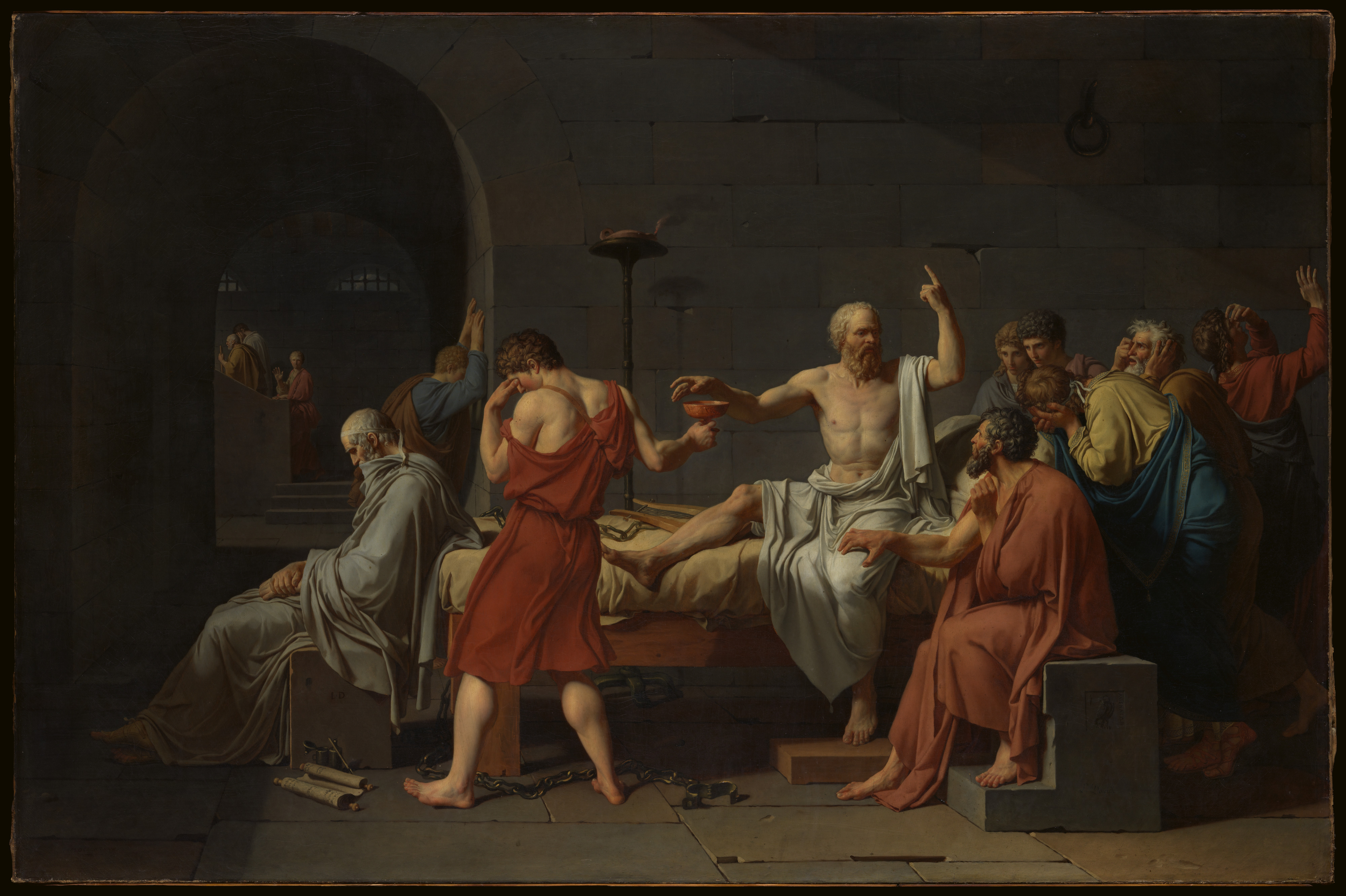
Start with the hand that has not yet taken the cup. Its fingers curve above the rim; the other hand rises high, its index finger extended. The man seated on the bed is about to accept his death, but he seems to have more to say. The young man offering the cup turns his face away while keeping his arm outstretched. Across this small interval, the two men come together without meeting each other’s eyes.
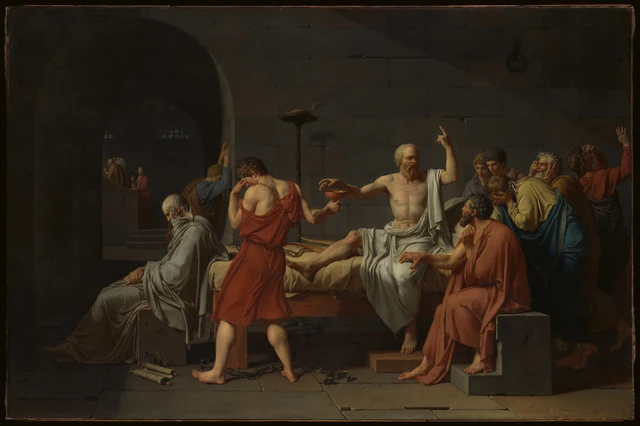
The event depicted took place in Athens in 399 BCE. Sentenced to death, Socrates spent his last day discussing the soul and death with his friends. Plato’s Phaedo is one of the most important surviving accounts of that farewell. More than two thousand years separated the event from David’s painting. Commissioned privately by the Trudaine family, the work was exhibited at the Paris Salon in 1787, two years before the French Revolution. Enlightenment concerns with personal principles, public judgment and the virtues of antiquity gave such subjects a contemporary urgency. To understand this painting, we should first keep its particular moment, 1787, in view. Scholarly catalogue, entry 106
The reading proposed here begins with that unfinished act of taking the cup: death approaches, while the argument continues. The painting establishes Socrates as a figure of resolve, yet allows the bodies around him to retain the pain of losing him. Following those bodies, we will also encounter someone who was not there. His presence gives this death a relationship with what comes afterward.
One more thing to say before the cup
The prison first strikes us as a place of hard surfaces. Large blocks form the wall, their joints extending horizontally behind the figures. The bed frame and stone seats have clearly defined edges. Light does not penetrate every part of the chamber. The depths of the archway on the left remain dark; as figures recede up the steps, their bodies become smaller and less distinct. In the foreground, a stretch of empty floor gives our eyes a route across the paving stones toward the assembled people.
The bodies, arranged across the picture, are as readily distinguished as figures in a relief. The folds of the white drapery have definite planes, while exposed shoulders, backs and chests gain their volume against the shadows. Color is restrained, too. Amid broad areas of gray-brown wall and floor, red, yellow and blue gather around the figures. The cupbearer’s red garment is particularly effective: it draws the eye toward the area just left of center, then sends it along his arm to the cup. Here the clarity and order associated with Neoclassicism take visible form. They do not require everyone in the painting to suppress their feelings.
Socrates’ body is the brightest and the most exposed. Drapery falls from his shoulder and gathers at his waist, leaving most of his chest and abdomen bare. His head is raised, his torso upright, and one leg extends along the bed. This powerful body is idealized, some distance from the historical man of about seventy. It makes us feel first how much life remains in him. The death announced by the title consequently presses closer: the life about to be cut short belongs to this person who can still speak, reach out and turn toward others.
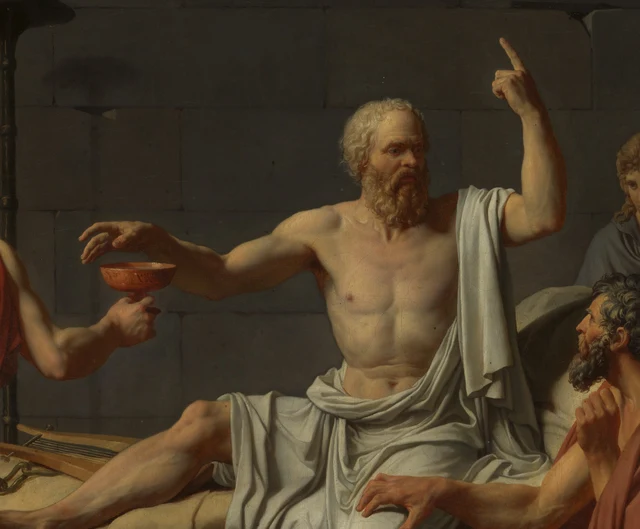
The movement of the right hand is slight. His fingertips have neither grasped the cup nor drawn back. A little farther forward, and the handover will be complete. The left hand extends the action above his head, its upright index finger conspicuous against the dark wall. Between the two arms are his chest, face and open mouth. We can read these relationships as two kinds of time unfolding together: one hand moves toward an irreversible ending, while the other still makes room for another sentence.
The eyes also contribute to this sense of speech continuing. Socrates does not lower his gaze to the rim of the cup. He turns his face toward the side where his listeners sit and stand. With the cupbearer, the relationship is reversed. His body and arm carry out the task, while his head lowers and turns away, his other hand close to his eyes. The cup connects the two men without establishing a shared gaze. One looks toward a conversation that can still continue; the other bears the weight of what he must hand over.
This is the moment before Socrates takes the cup, not the weakened condition of a body that has already drunk the poison. In the Phaedo, the main discussion, the drinking, the friends’ tears and the final lying down occur in sequence. David concentrates the force of discussion and farewell in this moment of transfer, allowing us to see them together at a glance. Painting can bring the whole span of the last day to bear on a single cup without retelling it episode by episode. Phaedo, 117a–118a
The finished image looks assured, but its making involved revisions. Technical examination at The Met has revealed changes to the position of the forearm and the contours of the fingers. The almost-touching distance above the cup’s rim is a relationship the painter worked out. Technical research Knowing this, we can look again at that small gap. It makes the handover legible while preserving the tension of an action not yet completed. The painting places the crisis in the next moment, without needing a more violent struggle to make us feel it.
Reasons do not bring grief to an end
The people to Socrates’ right crowd close together. In front, a man in reddish ocher looks up at him, one hand near his own chin and the other resting on the drapery over Socrates’ thigh. Behind him, two young faces lean forward over shoulders, their eyes still fixed on the speaker. Farther right, someone bows his head and hides his face in his hands; another raises both hands beside his cheeks and leans back. At the far edge, a man tilts his head upward, a palm reaching beyond the picture.
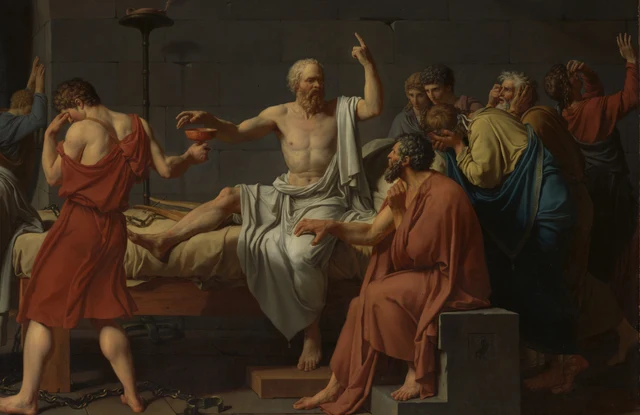
These responses do not form an orderly sequence. Some people still move forward; others have begun to draw back. Some hold on to Socrates with their gaze, while others can only cover their eyes. Even the red garments of the two men nearest him work differently. The cupbearer’s cloth connects a back turned away with an arm extended forward. The folds of the seated man’s garment fall downward, settling him into a lower position from which he looks up at the man on the bed. These warm-colored bodies approach the central white drapery from opposite sides, without making the same gesture.
The hand touching Socrates’ thigh deserves a longer look. His raised finger points beyond his immediate surroundings, while his friend’s hand rests on the body that can still be touched. Even if someone understands his arguments about the soul, the person remains here: warm, weighty, occupying a place that will soon be empty. The hand does not stop him from taking the cup, nor does it visibly pull him back. It maintains contact. Grief does not have to prove itself more correct than an argument. It makes that argument face the impending loss of a particular companion.
The Phaedo, too, presents more than unanimous praise. At the beginning, its narrator recalls moving between pleasure and sorrow. After the drinking of the poison, he explains that his tears are for the loss of such a companion. Discussion may change how people understand death without immediately releasing their attachment to one another. The figures in the painting can therefore be seen as those who must bear this death, rather than serving only as a background that makes the central figure look more resolute. Phaedo, 58e–59b and 117c–e
This changes the weight of the word “courage.” If we look only at Socrates’ raised hand, he can readily become an isolated maxim. Turn instead toward the bodies that touch him, lean toward him and withdraw from him, and his decision emerges within a set of relationships. The painting does indeed honor steadfastness. Its cost remains visible in the gestures of others. We do not have to think less of those who cover their faces in order to recognize the central figure’s strength.
Look a little lower. Open shackles and a chain lie on the floor, and Socrates’ ankles are exposed. The restraint has been removed, but imprisonment has not ended. His body can move; the outcome awaiting him cannot be escaped within this room. The chain lies against the paving stones, its few metallic highlights interspersed with feet, fabric and the wooden bed. These things give the ancient story tangible material conditions. David locates philosophical discussion in a place where one can sit down, stretch a leg and also be put to death.
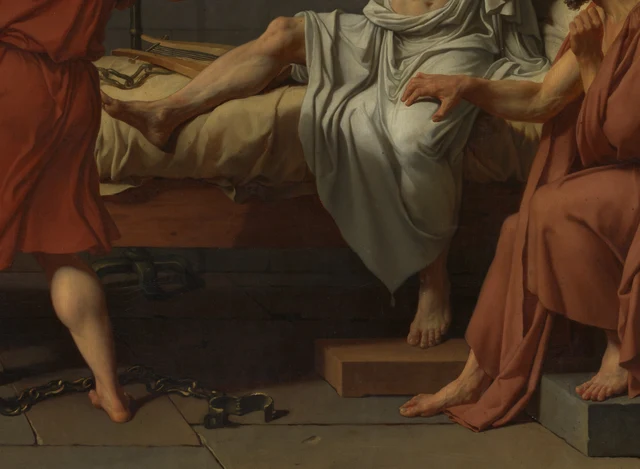
There is a lyre on the bed, close to the outstretched leg. It does not demand attention, but it can take us back to questions still under discussion in the dialogue. In the Phaedo, Simmias raises an objection through the relationship between an instrument and its harmony. If the soul resembles the harmony produced by an instrument, how can it persist once the instrument is destroyed? Socrates subsequently answers this analogy. Earlier in the dialogue, he also describes trying his hand at poetry in response to a dream, linking philosophy with the command to make music. The painted lyre can connect with these strands without being confined to one allegorical meaning. Phaedo, 60d–61b, 85e–86d and 91c–95a
The raised index finger now invites another reading. It has an air of authority, but the text around this scene still makes room for questions, replies and revisions. In the dialogue, Socrates reminds his friends to care about whether an argument is true, rather than simply agreeing with him. This essay proposes returning the painted gesture of speech to that process. Resolve can take the form of continuing to discuss; it need not mean that every question has already disappeared. Phaedo, 89d–91c
Why an absent man sits here
If our eyes keep following the cup and the crowd on the right, it is easy to miss the elderly man at the lower left. He sits at the foot of the bed, his body turned in the opposite direction, his head lowered and his hands folded in his lap. Gray-white cloth wraps around him, its close folds descending over his knees. He does not reach out to join the action at the center. Beside his feet, however, lie scrolls, writing implements and an ink vessel. While other people’s responses move outward, his posture seems to gather everything inward.
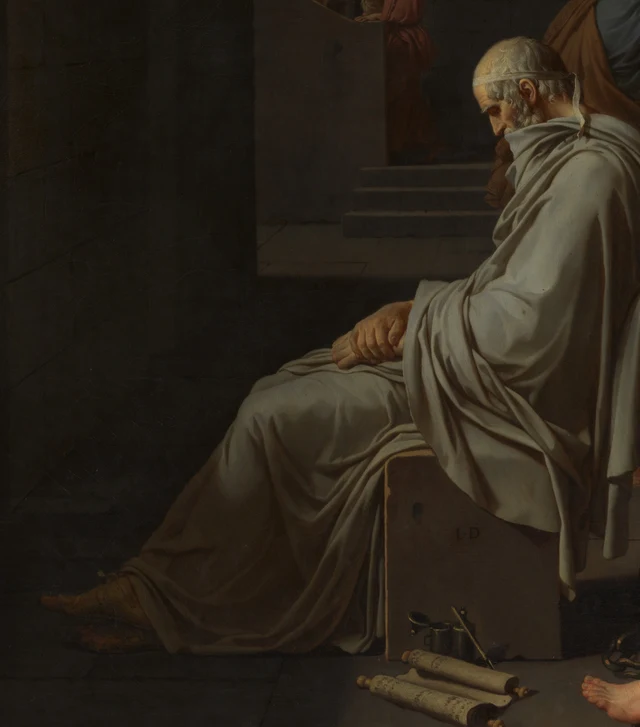
This man is usually identified as Plato. Yet when the Phaedo lists those present on Socrates’ last day, it specifically says that Plato was probably ill. He was still young when Socrates died; in the painting, his hair is already white. More importantly, the narrator of the Phaedo is Phaedo himself, recounting what happened in the prison to someone else. Plato is the author who wrote the dialogue. The event, the witness’s account and the author’s writing already belong to different layers. Phaedo, 57a–59c
The painted old man therefore cannot simply be understood as remembering a scene he witnessed. David brings a later author into the prison, arranging different times within the same room. At the center are words about to be interrupted; at the foot of the bed is the writing through which words continue to circulate. One canvas depicts a loss and also accommodates its retelling. This is the present essay’s interpretation of the arrangement.
His stillness also has a formal relationship with Socrates’ upright body. One lowers himself while the other rises; one is wrapped in cloth while the other exposes his chest; one folds his hands while the other opens his arms. They do not look at each other, yet the viewer’s eye can connect them. The gray-white fabric on the left answers the bright white drapery at the center across a distance, ensuring that this man at the margin does not disappear from the composition.
The difference between the two sides of the room now extends beyond the relative density of their figures. On the right, the crowd turns farewell into many bodily responses in the present. On the left, the elderly man and his writing materials carry it forward. Farther back, people depart through the archway, and the stairs lead somewhere we cannot see. The prison confines Socrates, yet the painting gives the event more than one way out: through those who leave, those who continue to write, and those who return to the story in front of the painting.
This helps explain why history painting cannot be judged solely by how closely it resembles an actual scene. The clearly rendered stone walls, objects and folds make the setting materially convincing, even as the ages of its figures and the sequence of events are rearranged. David brings together ancient material he had read, his own choices as a painter and the questions that mattered to eighteenth-century viewers. What we see is a way in which history takes shape afterward. The presence of Plato places that “afterward” directly before us.
Return now to the first hand. It has still not taken the cup, and the surrounding people remain caught in different actions. Knowing the outcome does not leave us with only that outcome to look at. We can now also see how a speaker faces his listeners, how those listeners endure a loss, and how later people continue to recount it. Death will put an end to one body’s actions, but the painting keeps the final discussion directed toward others. This is the unfinished conversation that the present reading still wishes to hear within its image of resolve.
Optional reading Questioning resolve through SAE
The following section draws on SAE (Self-as-an-End) aesthetics to pose a further question about looking. The preceding guide can also be read independently. SAE distinguishes how an individual is moved by a work from the structural grounds that can be discussed together. Its different “rays” offer directions for inquiry, rather than ranks to which artworks must be assigned. SAE’s general account of aesthetics
Faced with this painting, we may readily say that it represents courage. Without immediately disputing that judgment, try following the relationships between the hands: the hand reaching for the cup, the raised hand, the hand covering the eyes, the hand touching the thigh, and finally Plato’s folded hands. Every move alters the situation of the central figure. He is accepting his sentence and continuing to speak. Someone offers him death; someone else still wants to remain in contact; another person gives the event a place in later accounts. If the overall impression of courage is to hold, it must accommodate these relationships. A single heroic gesture cannot guarantee it.
We can also compare two judgments made after looking. One simply admires Socrates’ fearlessness. The other still admires his strength but can no longer overlook the cupbearer’s averted face and the friend’s lingering hand. What the second adds is not a louder word of praise, but details that the interpretation must answer for. SAE’s proposal that beauty remains open to further questioning becomes a practical demand here: our judgment of the work should withstand putting the people we overlooked back into the picture.
Theory can help us return “courage” to relationships in the painting that remain open to questioning. What would our understanding of this courage lose if we left out the cupbearer’s averted face or the friend’s hand resting on the thigh? To answer, return to the figures around the cup and consider whether your initial admiration can still be expressed quite so simply.
Images and sources
The visual observations in this essay are based on the official 4000 × 2663-pixel image supplied by The Metropolitan Museum of Art. The full view is unchanged from the downloaded file. Figures 2–5 are rectangular crops only, with no color adjustment, restoration, overpainting or generated content. Digital images help us compare gestures and details, but screen brightness, display size and viewing conditions differ from those of encountering the original.
The museum marks the painting’s image as Public Domain and makes it available under its Open Access / CC0 policy. This release does not extend to all rights in its modern articles, scholarly catalogues and technical images. The essay is based primarily on independent close looking and original paraphrases of the ancient text, with sources provided for relevant historical facts and technical findings. Its proposed interpretations do not imply museum endorsement. See also the accompanying references and image credits and permissions.