Begin with the great dark-blue shape on the right. It reaches from the middle of the picture almost to the bottom, sending a broad arm across the brighter woman and child beyond. We recognize a man’s back, yet recognizing it does little to open up our view. His body still occupies the space. Beneath the cap we catch only part of his profile. Before we can read an expression, we meet the sheer presence of someone sitting close by. Follow his hand toward the lower left and a yellow-green oar draws the eye into the boat.
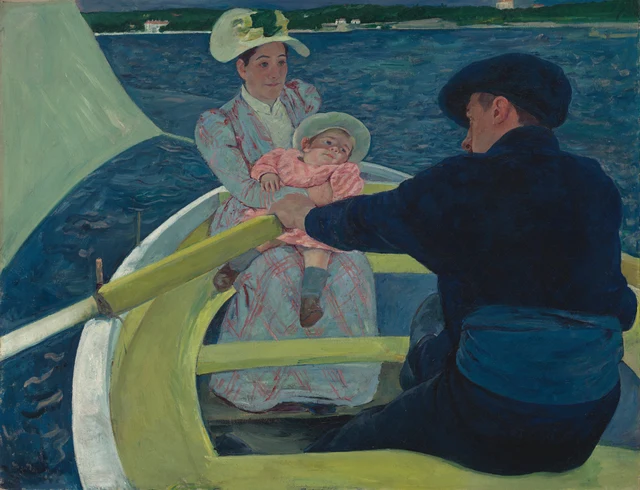
Cassatt was an American artist who spent much of her life in France and took part in four Impressionist exhibitions between 1879 and 1886. Modern life supplied her with subjects in theatres, on outings and wherever women cared for children. This painting belongs to her experience of Antibes, on the Mediterranean coast: the National Gallery’s 1970 catalogue records a winter stay there during which she painted it. Biographical context; Antibes documentation, printed pp. 16 and 28
The reading offered here begins with that obstructing back. Cassatt gives an outing the physical substance of several people sharing a confined space. Holding a child, handling an oar and keeping one’s seat require different movements, all accommodated in the same small boat. Bright color does not make the bodies weightless. The picture’s intimacy includes the practical business of making room for one another.
A back that takes up room
The canvas is a little over a metre wide. At that scale, the man is a substantial presence, far larger than a figure incidentally placed in a landscape. His shoulders spread, his upper body pitches forward, a brighter blue sash encircles his waist and his lower body extends toward the left. Those changes of direction give his seated posture the look of exertion.
Although the back first registers as one dark mass, it contains variations. Blue marks run along the sleeve. The shoulder and the middle of the back differ in density; the sash makes a clear division below them. Seen from a distance, the differences gather into a single heavy shape. Across the boat, pink lines break up the woman’s pale-blue dress, while the child’s clothing forms a brighter pink patch. Against these smaller divisions, the man holds together as an unusually solid whole.
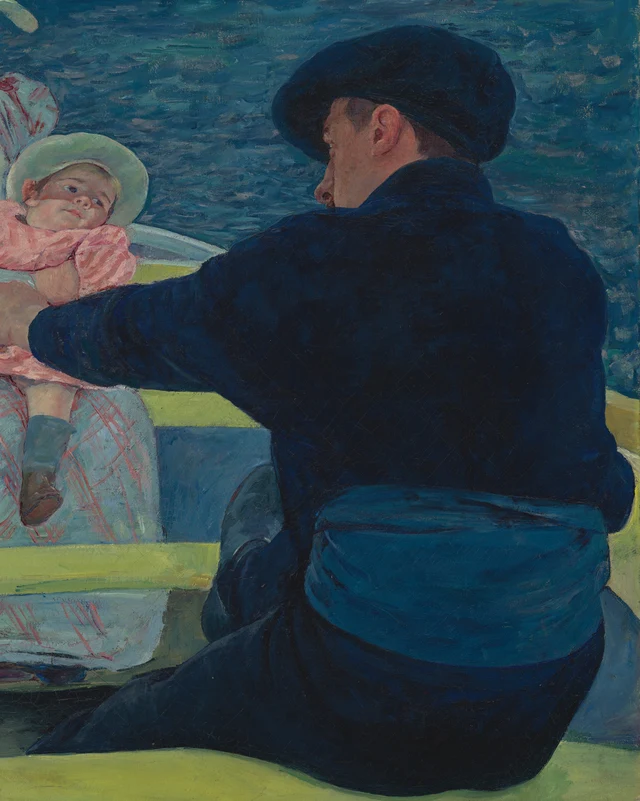
Faces usually draw us into figure paintings. Here the largest figure turns away. Enough of his ear, nose and cheek remains visible to give him a particular profile, but the eyes recede beneath the cap. Our attention moves between the person and the large shape he makes. Just as we begin to seek his expression, the breadth of his back returns us to the near edge of the painting.
Try comparing his head with the child’s. The child is easier to find, enclosed by a pale hat and pink clothing. The man’s head is larger, yet its angle and darkness make it less readable. Scale, brightness and importance do not fall into a single ranking. We may look at the child first, but the man cannot be reduced to a supporting detail.
Where does this leave the viewer? The near end of the boat is cut off at the lower edge. There is no generous opening on the right through which we might imagine stepping around the rower. We also look slightly down, far enough to see legs, crosspieces and small areas of the boat’s interior. The viewpoint feels close to another passenger’s position, without yielding a seat that can be precisely reconstructed. Cassatt has not cleared the middle for us. We have to find our bearings in a space already occupied by bodies and actions.
The oar brings two actions together
The outstretched arm leads toward the centre, where the man grips the oar. Its yellow-green length runs diagonally down to the left, crosses the white gunwale and continues beyond the picture. Lower down, a wooden crosspiece runs almost horizontally. The similar colors can initially merge into a decorative pattern. Separating oar from crosspiece lets us see a moving diagonal passing through a more stable structure.
The oar has a considerable width on the canvas. A lighter upper edge gives it definition as it cuts across the spaces around water, boat and dress. At its higher end, the man’s hand meets the dark cuff. Cloth, skin and wood come together in a small, sharply useful sequence of light and dark. The grip acquires weight through these painted transitions.
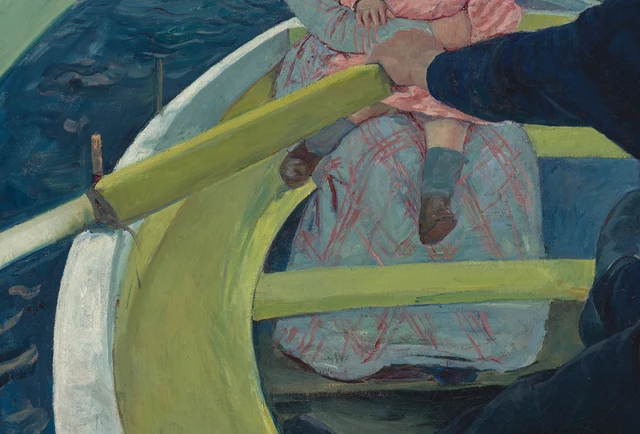
Very close to that grip, another action is taking place. The woman supports the child. Her pale-blue sleeve crosses in front, while a hand holds the small body from the other side. The child leans obliquely, head tilted to our right, one hand resting on her sleeve. The legs hang down, the two brown shoes at different heights. Their unevenness gives the small body a palpable weight, sustained by the woman’s arms.
Care becomes visible in these adjustments. The child does not sit in a neat vertical line against the woman’s upright torso. Her arm has to reach across and hold that sideways inclination. A face may remain quiet while an arm continues working. We can attend to the sustained act of holding without first supplying the woman with a particular emotion.
Holding the child and handling the oar remain distinct, yet their edges nearly meet. The man’s hand is in front, the woman’s sleeve and the child’s pink clothing behind. The oar occupies space beside the small legs; a shoe comes close to the side of the boat. This is how the outing gains its physical density. The figures feel close because each action must fit into the same limited interior.
We cannot derive the boat’s speed from this single moment. The blade extends out of sight, and the picture gives no sequence of strokes. Still, the forward arm, leaning torso and downward legs introduce several directions of force. The crosspiece and curving sides contain them. What feels stable in the image is an arrangement of different tendencies holding together for the moment.
Faces close by, actions connecting
Look now at the upper half. The woman’s head is relatively upright, the child’s tilts, and the man turns his face into the boat. The two pale hats, one large and one small, stand at different heights against the blue water; the dark cap rises again on the right. Our eye follows this uneven rhythm from person to person.
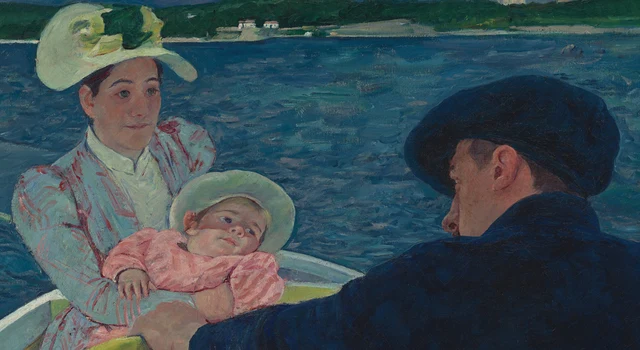
The woman and child appear to look toward the man, or perhaps just past him. Keeping that small distinction open makes a difference. A shared direction is not enough to establish an exchange of looks, especially when one pair of eyes is obscured. Assigning happiness, worry or estrangement too quickly would pass over a more interesting possibility: people can be physically close, and their actions closely coordinated in space, without their faces offering one common message.
The child’s expression rewards this pause. The cheek is rounded, the head tipped, the eyes turned to one side; the mouth does not open into an unmistakable smile. We might read drowsiness, or attention directed elsewhere. In either case, the hand still lies on the sleeve and the legs still hang. Expression draws us toward the figure; posture keeps us looking.
This scene belongs to the kind of subject often called “mother and child,” although the available collection documentation does not establish the three sitters’ kinship. The woman holding a child and the man rowing already give us enough to work with. Care becomes concrete in where the sleeve passes and how the hand takes the weight. The visible relationship is sustained by what the bodies do.
Clothing extends those connections. Fine, uneven pink lines cross the woman’s pale-blue dress. They cluster around the chest, spread across the knees and turn with the skirt. While they help describe the cloth’s folds, they also carry the child’s pink into a much larger area of the picture. Contact is reinforced by color repeating across two bodies.
Below the pink, the dark-blue sleeve brings us back to the man. Though turned away, he enters this neighboring group of colors through his arm. The three figures form a whole without three matching expressions. Their closeness has more room to develop than a quickly deciphered anecdote would allow.
The sea rises, the boat spreads out
Once the figures have become familiar, give the water some attention. The distant shore lies close to the top edge: a narrow green band of trees, interrupted by a few pale houses. There is scarcely room for the sky to open. The sea, which ought to carry the eye away toward distance, instead spreads across the canvas as a broad blue area pressed against the hats, shoulders and sail.
Yet it never becomes a uniformly painted wall. Short pale strokes lie across the water, sometimes bending, with deeper blue between them. Near the left gunwale, individual marks are relatively easy to follow. Toward the shore, they gather more closely. We can still read distance, even as the breadth of the color returns our attention to the surface of the canvas.
The sail on the left makes that surface particularly active. A pale greenish-gray expanse enters from beyond the frame and narrows to a point on the right; its lower edge slopes back toward the lower left. Below, the boat curves upward in white and yellow-green bands of different widths. A strip of blue water is held between sail and gunwale, its shape cut out by their neighboring contours.
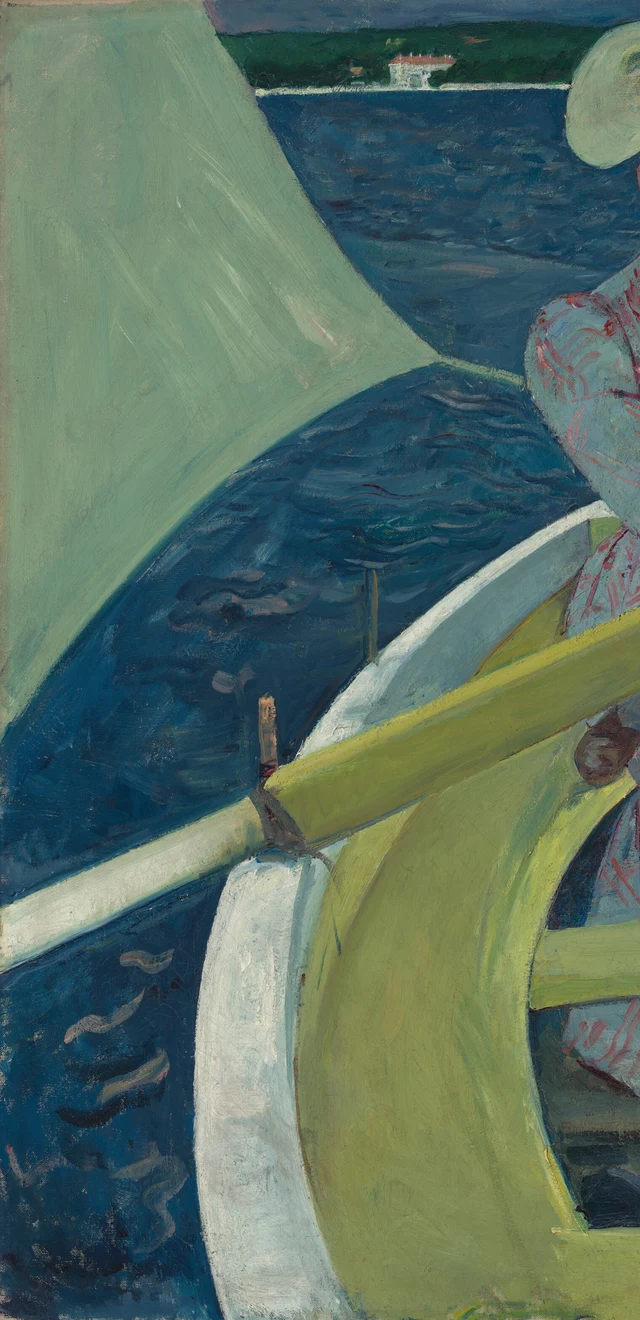
Those curves carry the eye inward; the man’s back stops it on the other side. Pale sail and dark body enter from opposite edges, different in shape and weight, leaving the woman and child a narrower space between them. The canvas feels full. Even so, blue intervals pass between shoulders and hats. Its crowdedness retains openings.
Cassatt saw an exhibition of Japanese prints in Paris in 1890 and subsequently produced a series of color prints herself. That experience gives a historical setting for her interest in strong contours, broad color shapes and oblique viewpoints; the National Gallery also connects this painting with Japanese prints. Printmaking context; Museum commentary The painting itself allows us to follow two kinds of organization at once: the boat recedes into depth, while its colors spread outward across the canvas.
“Flattening” therefore needs a little care as a description. The child sits in front of the woman, the man in front of both. The oar crosses the gunwale; a wooden crosspiece hides part of the dress; small openings reveal the bottom of the boat. The overlaps remain precise. What changes is their rhythm. Each time the eye goes inward, the broad yellow-green, deep blue and pink draw it sideways again. Depth and surface keep one another active. The boat accommodates bodies while also becoming a shape that firmly fills the picture.
Return finally to the dark back. At first it may have seemed a large obstacle. Now the grip, oar, sash, child’s shoe and curving side of the boat have connected it to everything around it. Its weight gives the lighter, brighter forms something to settle against. Here the painting gains its force: an apparently easy outing becomes a space maintained by bodies together. At such close quarters, our looking must make room for the bodies already there.
Optional: looking again with SAE
SAE, or Self-as-an-End, offers a way to pause separately over liking a color and attending to how it appears. Before using the blue to identify water or the darker blue to identify clothing, we might dwell on widths, brightness, edges and adjacent shapes. The Beauty of Perception
Try moving from Figure 2 back to the whole painting. In the detail, the back can seem almost a wall. In the full image, the pale sail, yellow-green curve and pink near the centre give it a different weight. The back has not changed color; the available relationships have changed. “Heavy” becomes a judgment that can be discussed through visible area, neighboring brightness and the obstruction of our view.
Recognizing an oar and imagining the direction of effort in a grip already call on experience. The title may have led us to expect an open, leisurely boating scene in which everyone was easy to see. The high-set expanse of water and oversized back might then oblige us to revise that expectation. SAE’s discussion of memory and anticipation helps direct attention to the way an earlier image in the mind is rearranged by newly noticed details. The Beauty of Cognition
Viewers need not undergo the same change. Some will notice the deep blue first, others the child. A useful test is more particular: follow the oar to the grip, then the woman’s sleeve to the child’s body. On returning to the whole, can you feel the interior’s crowding, support and necessary accommodations more distinctly? If so, the theory has helped turn a general impression of intimacy into a more exact experience of being there together.
Images and sources
Visual observations are based on the National Gallery of Art’s official 4096 × 3136-pixel image. The full downloaded image is unchanged. The four details are rectangular crops only, without color adjustments, sharpening, restoration, repainting or generated content. Screen color and enlargement differ from the conditions of viewing the painting itself.
The image is covered by the museum’s CC0 Open Access Policy, which does not extend to all modern research writing. Historical claims are linked to their sources. The central reading is a present-day interpretation, not an account of the artist’s stated intention or a museum endorsement. See the references and image credits and licensing.
