Near the beginning, 車, “carriage,” in the second column extends a long straight line downward. Above it, 五雲, “five-coloured clouds,” has already made several turns; below it, 飄, “drift,” occupies the foot of the column. The straight stroke descends through that circling and gives the column an axis. To its right, the small 北, “north,” sits low, separated from the fuller shapes above; to its left, 飖入倒景出沒 changes the spacing again.
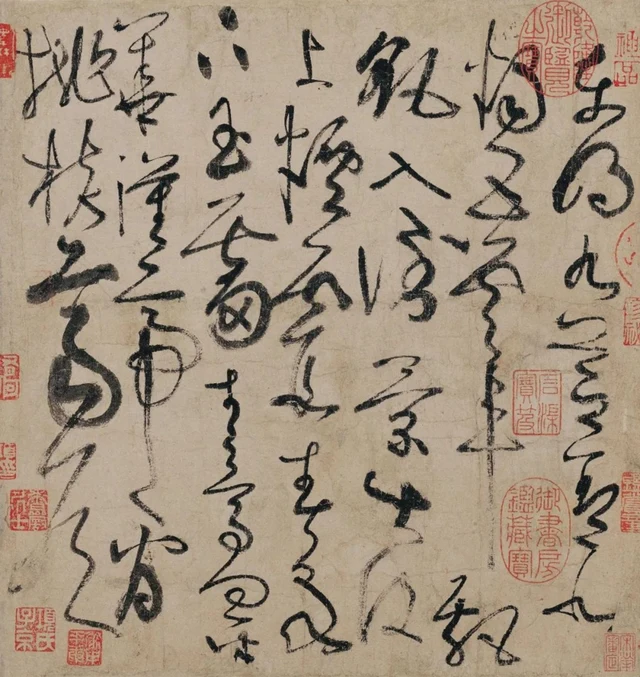
This cursive scroll does more than send lines racing. It repeatedly establishes places where the eye can rest: long verticals, heavy turns, loops enclosing paper, and unexpectedly open intervals. Rotation has not abolished support. Beginning with these supports makes “wild cursive” something more specific than a single speed maintained throughout.
The object is Four Ancient Poems in the Liaoning Provincial Museum. It has no original signature identifying its writer. Its traditional attribution to Zhang Xu therefore remains an attribution. It copies two Steps into the Void poems by Yu Xin and two encomia bearing Xie Lingyun’s name: the poets and the person holding the brush are different questions. A Suzhou Museum account of its 2026 loan, republished by Sina, confirms its collection and contents. Our pictures reproduce the same scroll in the Peking University article, not newly commissioned museum photography.
Reading all four poems and encomia
The following reading text uses familiar characters, modern punctuation, and poetic line divisions. The titles do not constitute the calligrapher’s signature. Readable manuscript variants are retained, obvious extra or transposed characters adjusted, and 玉策 restored from the transmitted poem. The detailed differences are collected at the end; this edited text and the photograph must be checked separately.
Yu Xin, first Steps into the Void poem
東明九芝蓋,北燭五雲車。
飄飖入倒景,出沒上煙霞。
春泉下玉霤,青鳥下金華。
漢帝看桃核,齊侯問棘花。
應逐上元酒,同來訪蔡家。
The immortal Dongming’s canopy of nine sacred fungi;
the immortal Beizhu’s carriage of five-coloured clouds.
Drifting into the inverted radiance above,
they emerge and vanish, rising through mist and rosy vapour.
Spring waters flow down from jade eaves;
a blue bird descends toward Jinhua.
The Han emperor examines a peach stone;
the lord of Qi asks about the thorn-tree blossom.
Surely, following the wine of Lady Shangyuan,
they will come together to visit the house of Cai.
Following Ni Fan’s historical commentary, 東明, Dongming, and 北燭, Beizhu, are read here as names of immortals. 金華, Jinhua, is retained as a proper name: the commentary offers both a palace and a mountain. 倒景 imagines a realm above sun and moon, where their light appears inverted. The peach stone, flowering tree, and Cai’s house draw on different tales of marvels and immortals. The poem moves between the short scale of human life and the vast duration of the immortals.
Yu Xin, second Steps into the Void poem
北闕臨丹水,南宮生絳雲。
龍泥印玉策,大火煉真文。
上元風雨散,中天歌吹分。
虛駕千尋上,空香萬里聞。
The northern palace overlooks vermilion water;
crimson clouds arise from the southern palace.
Dragon paste seals the jade tablets;
great fire refines the sacred writing.
Shangyuan: wind and rain disperse;
In mid-heaven, song and pipes sound apart.
The celestial carriage rises a thousand fathoms;
fragrance through the void is sensed ten thousand miles away.
“A thousand fathoms” and “ten thousand miles” enlarge the imagined height and distance, rather than inviting literal measurement.
Encomium on Prince Jin, bearing Xie Lingyun’s name
淑質非不麗,難之以百年。
儲宮非不貴,豈若上登天。
王子復清曠,區中實囂喧。
既見浮丘公,與爾共紛翻。
Fine qualities are indeed beautiful,
yet difficult to preserve for a hundred years.
The crown prince’s rank is indeed exalted,
but how can it compare with ascending to heaven?
The prince is clear and unconfined;
the world below is truly clamorous.
Having met the immortal Master Fuqiu,
with you I shall soar and wheel.
The poem places beauty beside limited lifespan, worldly rank beside ascent to heaven. Withdrawal from the world receives reasons that can be compared one by one.
Encomium on an old man and four or five youths beneath a cliff, bearing Xie Lingyun’s name
衡山採藥人,路迷糧亦絕。
回息巖下坐,正見相對說。
一老四五少,仙隱不可別。
其書非世教,其人必賢哲。
A gatherer of herbs on Mount Heng
lost his way, his food exhausted.
Turning aside, he sat beneath a cliff to rest
and saw people talking face to face.
One old man and four or five young ones:
immortals or recluses, he could not distinguish.
Their books were not the teachings of this world;
they must surely be wise and worthy men.
The reading combines inspection of the pictures with Qi Gong’s column-by-column transcription. Uncertain characters are not treated as settled evidence. All four pieces look from human life toward an immortal realm. Lifespan, office, lost paths, and exhausted provisions keep this otherworldly imagination attached to earthly measures.
A long line makes the surrounding space visible
Return to Figure 1. 車 is not an isolated enlarged character: it belongs within 五雲車飄. The turns above concentrate black marks and inner spaces. Once the vertical extends downward, the paper on either side suddenly seems wider. The lower 飄 opens diagonally and occupies the foot again. The stability of the long line arises together with changes in its neighbours.
The first column is not uniform either. 東 and 明 are relatively full at the top; 九 becomes smaller; 芝 and 蓋 expand again. At the bottom, 北 has not been inflated into a closing emblem. It rests after a larger interval. The first poetic line, 東明九芝蓋, is already complete, but the column has added the first character of the next line, 北. The next column resumes with 燭. Five-character verse and vertical column have different boundaries.
This gives the viewer two footholds. The transcription tells us 北燭五雲車 is a line; the handwriting leaves 北 low in one column and lengthens 車 in another. Understanding does not erase those positions. Once we know the sentence, finding its distribution reveals how continuous meaning occupies unevenly apportioned paper.
Compare 車 with 玉霤, “jade eaves,” farther left. The small marks above 玉 descend separately; the turns of 霤 surround a larger patch of paper. Finer lines resume below. Thick strokes, thin strokes, and exposed paper alternate. A heavy shape is not necessarily solidly filled: its ring can keep paper visible inside.
On blue paper, three characters occupy a whole column
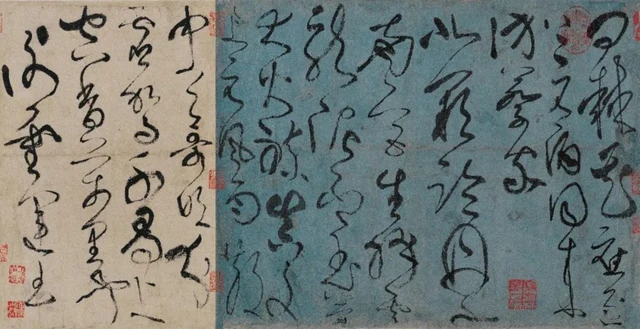
The rightmost column 問棘花應逐 first completes 齊侯 from the preceding paper section, then begins the poem’s closing movement. In the next column, 上元酒同來, the long vertical of 來, “come,” establishes another relatively straight passage. To its left, 訪蔡家, “visit Cai’s house,” contains only three characters yet occupies substantial height. Fewer characters make the spaces between them carry visible weight.
After 訪蔡家, the next poem begins 北闕臨丹水. No large separate title announces the transition. The words and the newly established columns do that work. If cursive is treated only as continuous pattern, the change of poem may disappear; if we read only typeset verse, we miss the way a three-character column opens room among denser ones.
Blue paper changes how the black marks appear, but is not evidence of a sudden change in writing speed. Across 龍泥印玉… and 大火煉真文, some characters tighten inward, others lengthen their endings. These changes continue on the pale paper to the left. Colour, joins, and text columns create different kinds of boundary; none decides all the others.
The traditional term 章法, compositional arrangement, concerns more than an attractive overall layout. It asks how a character occupies ground, how the next approaches it, and how one column makes room for its neighbour. 訪蔡家 shows that fewer characters do not automatically mean less visual weight. Its expansion can counterbalance a more populous column. Number and weight are not interchangeable.
Heavy turns and fine supports
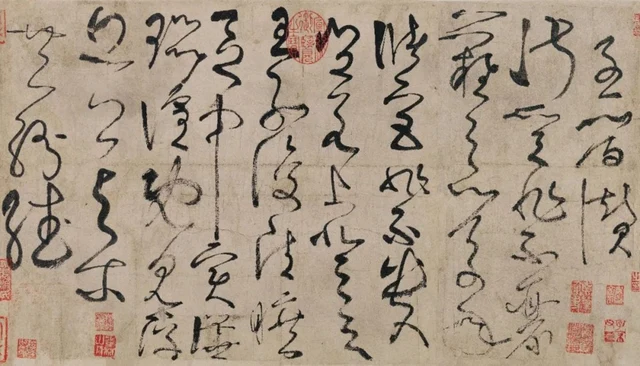
In 儲宮非不貴, “the crown prince’s rank is indeed exalted,” relatively fine passages continue for some distance before gathering into a lower loop. The neighbouring 豈若上登天 has heavier parts and more closely grouped characters. Similar column heights contain different distributions of black and white. Their comparison separates “strength” from the assumption that every stroke must be thick.
In 區中實…, the central stroke of 中, “within” in this phrase, extends markedly downward, while horizontal elements remain around it. More characters follow below. It does not leave the same kind of space as 車 in Figure 1. An impressive stroke cannot be removed from its setting and assigned one fixed effect. Its distance from the column’s end and the density of neighbouring characters alter what it does.
Calligraphic discussion uses 使轉 for the changing directions, turns, and loops of brush movement. Here the loops are not uniformly smooth: some turns thicken, some thin afterward, some interiors close, and others expose broad patches of paper. Their contours can be followed and compared. The exact wrist action or instantaneous speed would require evidence beyond one photograph.
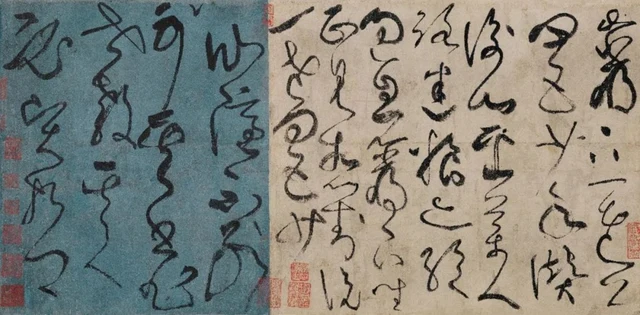
The final words, “Their books were not the teachings of this world; they must surely be wise and worthy men,” continue across papers of different colours. Once 必賢哲 is read, no further equivalent text column follows to the left. The herb gatherer has encountered people he cannot immediately classify; the reader, after identifying the words, still faces curves and distances that transcription cannot carry away. Both belong to our encounter, without making each stroke a picture of an immortal.
An uncertain name need not suspend looking
Dong Qichang attributed the scroll to Zhang Xu. Qi Gong later challenged that judgment through colophons, earlier records, and textual differences. In particular, he connected 丹水 in place of 玄水 to Song naming taboos and argued for a Song writer. This is a reasoned attribution argument, but one altered character should not be made to settle the whole debate here. We retain “attributed to Zhang Xu,” without inserting stories of his drinking or watching dancers as eyewitness explanations of these strokes. Qi Gong’s full argument
The distinction matters. A name affects historical placement but cannot explain by itself why an object deserves attention. The vertical of 車 remains; the paper inside the loops remains; the three-character 訪蔡家 maintains its distance from neighbouring columns. Our judgments about those relations can be firmer than our identification of the writer.
The scroll’s movement depends on many different supports. Long lines direct loops, blank paper defines heavy ink, and sparse columns make dense ones weigh differently. The whole seems continually in motion. Close attention discovers how often it finds its footing.
Optional reading: recognizing “wild cursive” is not the end
First isolate 車 in Figure 1, then include 五雲 above and 飄 below. The vertical does not change, but its role does: from a conspicuous line it becomes part of a relationship joining turns, open space, and the next character.
“Naming the Stars Does Not Finish the Sky” suggests that names and maps help us see without exhausting what appears. “Wild cursive” is a useful point of entry, not a signal to stop. After recognizing the script, we can still point to straight lines, heavy loops, and the place where another poem begins. SAE’s Judgment and Aesthetics discusses explanation and particular appearance; here it prompts another look at the picture.
Images and editorial readings
- First poem: 棘 follows the scroll; the transmitted Yu Xin poem has 棗. 下 in the blue-bird line follows the scroll; some circulating transcriptions give 向.
- Second: 丹水 follows the writing, while the poem tradition has 玄水. Qi Gong transcribes the uncertain manuscript character as 榮; this reading edition adopts 玉策 from the transmitted poem and translates it as jade tablets. 哥 is normalized to 歌.
- 上元, Shangyuan, is retained as a celestial title following the earlier source quoted by Ni Fan; no specific action is supplied for the verse’s elliptical connection.
- Third: an extra 譁 after 區中實 is removed to restore the five-character verse; its ink remains in the photograph. 難之以百年 follows the scroll, not the online variant “ten thousand years.”
- Fourth: 不別可 is reordered to 不可別; 回息 follows Qi Gong’s column transcription.
This is a digital-image reading of photographs published by Peking University’s calligraphy institute, not firsthand inspection. The four main images were proportionally reduced; a text overview is also included. No strokes or seals were altered, no colours changed, and no AI images used. Photography and screens affect paper colour. Published dimensions commonly give 28.8 × 192.3 cm, with other measurements also circulating; no dimensions or paper dates are inferred from these images. Reproduction permission has not been obtained, and the webpage has not been found to grant an open licence. Rights must be checked before public republication. Seals, mounting, and colophons belong to different historical moments.
