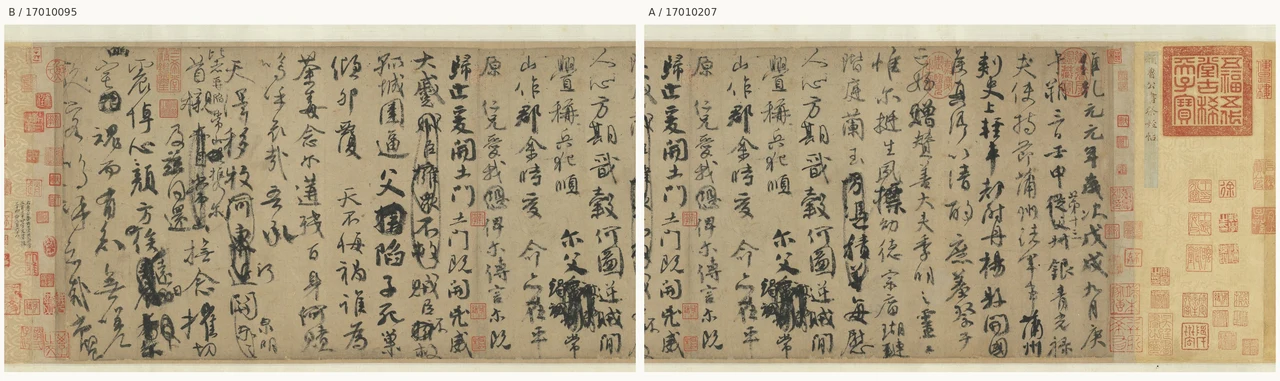
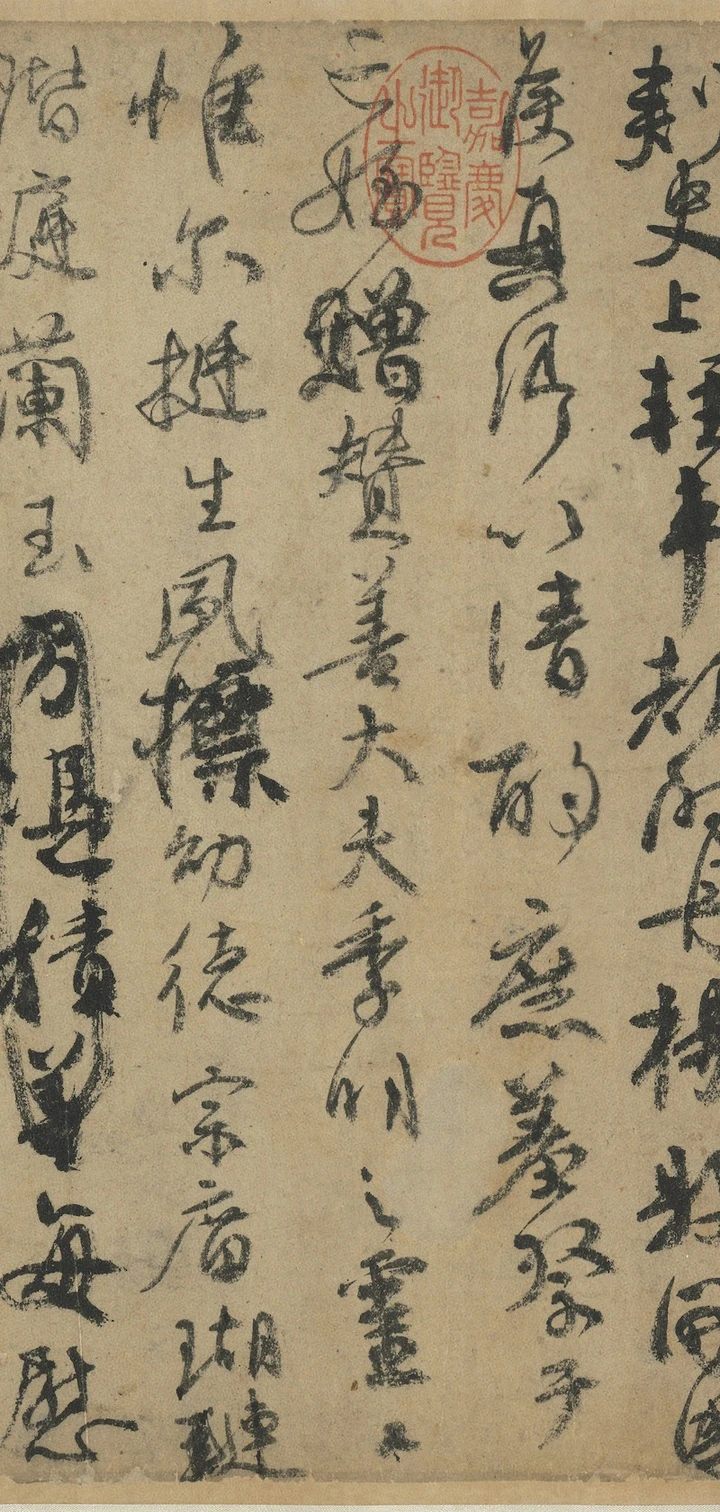
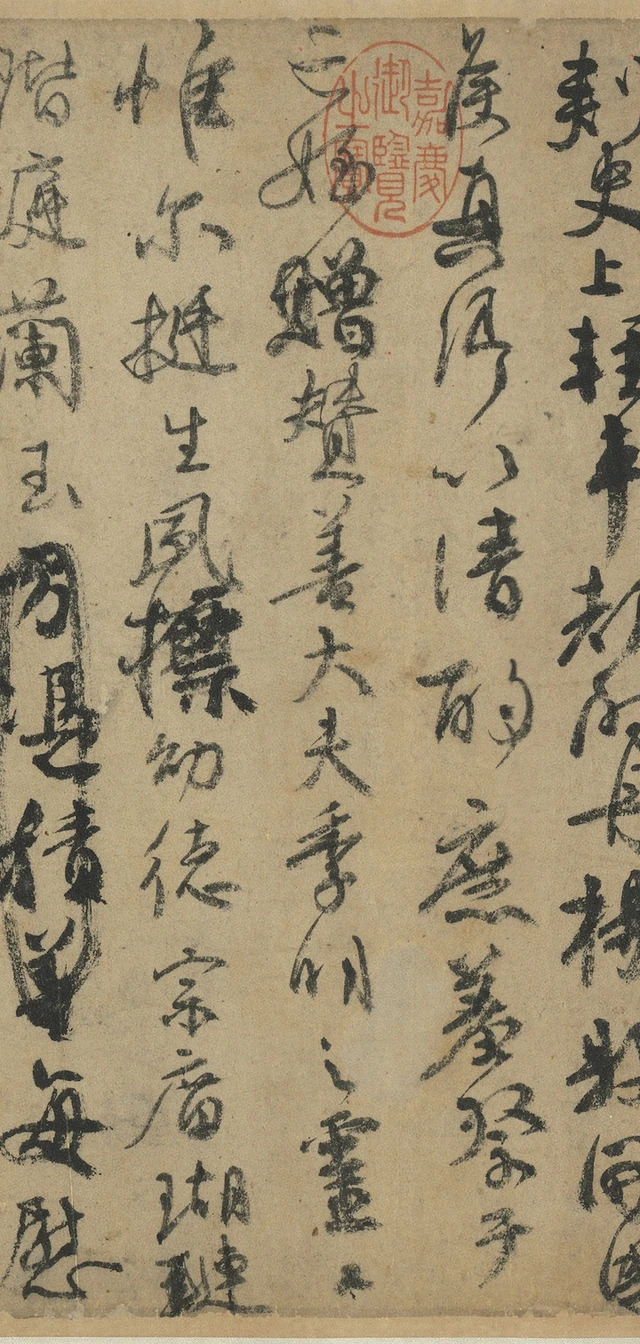
First find the two characters 季明, Jiming. They appear in the lower half of a column, beneath 贈贊善大夫, “posthumously appointed Grand Master for Admonition,” and above 之靈曰, “to [his] spirit, saying.” The last stroke of 季 extends delicately downward; paper remains visible between the two parts of 明. The name has not been placed at the darkest or largest point in the work, nor given a column to itself. It is spoken solemnly within a sequence of titles.
Finish that column and move to the upper left. There stands 惟爾挺生, “You were born outstanding.” The deceased, just named by office and personal name, now becomes “you.” 惟 opens out at the top, 爾, “you,” contracts, and 挺, “outstanding,” spreads again to either side. As the eye returns from the name below to the top of the next column, the requiem begins speaking directly to Jiming.
Accounts of the Draft of a Requiem for My Nephew, or Ji zhi wengao (祭侄文稿, traditionally 祭姪文稿), often begin with grief and anger. The text does describe the violent deaths of family members, and the paper does bear extensive corrections. Yet if every dark character becomes anger and every fine stroke sorrow, this particular calligraphy recedes behind its story. The appearance of a name, the change from designation to direct address, the resumption of speech after a lament: each has a specific shape and position.
This is where I want to begin: Jiming is dead, but his uncle is still speaking to him. Writing proceeds, then is interrupted by revisions. The narrative has already reached an irreversible death, but the sentences repeatedly return to 爾, “you.” Following those returns gives the columns and corrections a more particular weight.
Yan Zhenqing wrote this draft in 758, the first year of the Qianyuan reign, for his nephew Yan Jiming. Jiming and his father Yan Gaoqing had been killed during the An Lushan rebellion; Gaoqing was Zhenqing’s older cousin. The paper handscroll is now in the National Palace Museum, Taipei. It opens from right to left, with each column read downward. Later inscriptions and collectors’ seals belong to other moments in its history. Museum introduction, in Chinese; collection record and transcription, in Chinese
First hear what the requiem says
The Chinese text below follows the museum’s transcription of the corrected wording, using ordinary simplified characters. The missing 大 in an official title is supplied in square brackets. Punctuation and paragraphs are editorial reading aids, not a reproduction of the manuscript’s columns. Cancelled words are excluded. In the photographs, 贈贊善大夫, 季明之靈 and 惟爾 correspond to simplified 赠赞善大夫, 季明之灵 and 惟尔: “posthumously appointed Grand Master for Admonition,” “Jiming’s spirit” and “you.” Historical forms are retained when locating the writing.
维乾元元年,岁次戊戌,九月庚午朔,三日壬申,第十三叔银青光禄[大]夫、使持节蒲州诸军事、蒲州刺史、上轻车都尉、丹杨县开国侯真卿,以清酌庶羞,祭于亡侄赠赞善大夫季明之灵曰:
惟尔挺生,夙标幼德。宗庙瑚琏,阶庭兰玉。每慰人心,方期戬谷。何图逆贼间衅,称兵犯顺。尔父竭诚,常山作郡。余时受命,亦在平原。仁兄爱我,俾尔传言。尔既归止,爰开土门。土门既开,凶威大蹙。贼臣不救,孤城围逼。父陷子死,巢倾卵覆。天不悔祸,谁为荼毒?念尔遘残,百身何赎!呜呼哀哉!
吾承天泽,移牧河关。泉明比者,再陷常山,携尔首榇,及兹同还。抚念摧切,震悼心颜。方俟远日,卜尔幽宅。魂而有知,无嗟久客。呜呼哀哉!尚飨!
Complete translation of the requiem
In the first year of Qianyuan, the year wuxu, in the ninth month, whose first day was gengwu, on the third day, renshen, I, your thirteenth uncle Zhenqing, Silver-and-Blue Grand Master of the Palace, bearer of the imperial tally over the military affairs of Puzhou, Prefect of Puzhou, Senior Commandant of Light Chariots and founding Marquis of Danyang County, offer clear wine and assorted foods to the spirit of my late nephew Jiming, posthumously appointed Grand Master for Admonition, saying:
You were born outstanding and showed virtue from your earliest years. You were a precious ritual vessel in the ancestral temple, an orchid and a jade tree in the family courtyard. You constantly comforted our hearts; we were only beginning to look forward to your blessings and prosperity. Who could have imagined the rebels exploiting an opening, raising arms against the rightful order? Your father devoted himself wholeheartedly, governing Changshan. I too had received my commission and was at Pingyuan. My kind elder brother loved me and sent you to carry his message. When you returned, the Tumen passage was opened. Once it was open, the rebels’ power was sharply checked. But the treacherous official would not come to the rescue. The isolated city was besieged. The father fell into enemy hands, the son died; the nest overturned and the eggs were shattered. Heaven did not relent in calamity. Who brought about this cruel devastation? Remembering the violence you suffered, how could even a hundred lives of mine redeem you? Alas, what grief!
I received the sovereign’s grace and was transferred to govern Heguan. Recently Quanming went again into fallen Changshan and brought back the coffin containing your head; you have returned together to this place. Recalling you rends and crushes me; grief shakes my heart and countenance. I await a suitable day and will choose by divination your resting place in the earth. If your spirit has awareness, do not lament your long sojourn away from home. Alas, what grief! May you partake of these offerings!
The first paragraph gives the date, the officiant’s identity and the recipient of the offering. On the third day of the ninth lunar month in the first year of Qianyuan, Zhenqing, the uncle ranked thirteenth within the family, enumerates his offices and offers wine and food to his nephew’s spirit. Jiming’s office has been bestowed after his death. This opening is not a disposable formula. A living uncle faces a nephew whose public rank now survives only as a posthumous honour; the ritual first establishes who each is to the other.
The second paragraph says that Jiming had distinguished himself from childhood. His family valued him as it valued costly temple vessels, orchids and fine jade, and expected a fortunate future. Then rebellion arose. His father governed Changshan, Zhenqing governed Pingyuan, and Jiming carried messages between them. His return and the opening of Tumen helped check the rebels. Yet relief failed to arrive; the city fell, the father was captured and the son killed. The overturned nest and broken eggs express the family’s destruction. Zhenqing asks who caused this devastation and admits that even a hundred lives of his own could not buy Jiming back.
The final paragraph turns to what is happening around the offering. Zhenqing has been transferred to Heguan. Quanming has returned from Changshan with a coffin containing Jiming’s head. Recollection is crushing, yet a burial date and grave must still be chosen. The uncle speaks to the spirit conditionally: if you know, do not grieve at remaining so long a stranger away from home. The lament returns; then the deceased is invited to receive the food and wine.
瑚璉, hulian, are ritual vessels; 蘭玉, “orchid and jade,” is an image of gifted family members. 戩穀 means blessings or good fortune. 百身何贖, “how could a hundred bodies redeem you?”, raises the imaginable price to an extreme while admitting that a life cannot be restored. 尚饗, “may you partake,” is the closing invitation of the offering. 再陷常山 is retained verbatim in the Chinese. In this translation it is understood, in the context of recovering the remains, as going again into fallen Changshan; it is not silently expanded into a claim that Quanming was captured a second time.
With these sentences in mind, return to the ink. Official titles, places and events are repeatedly brought back to “you.” This is not a biography describing Jiming from outside.
Long official titles do not turn the columns into a grid
The scroll begins with year, month and day, then the uncle’s identity and a long series of offices. At first the columns appear broadly upright. It is tempting to call the opening calm and orderly. Look more closely: variation is already present.
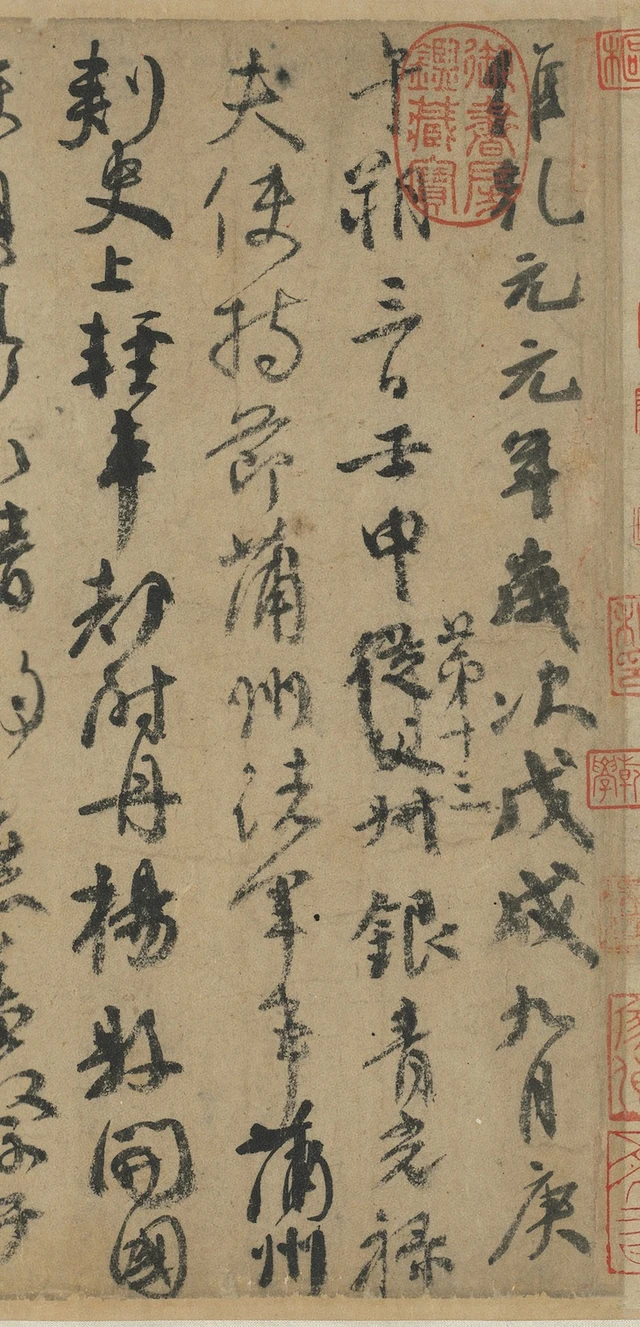
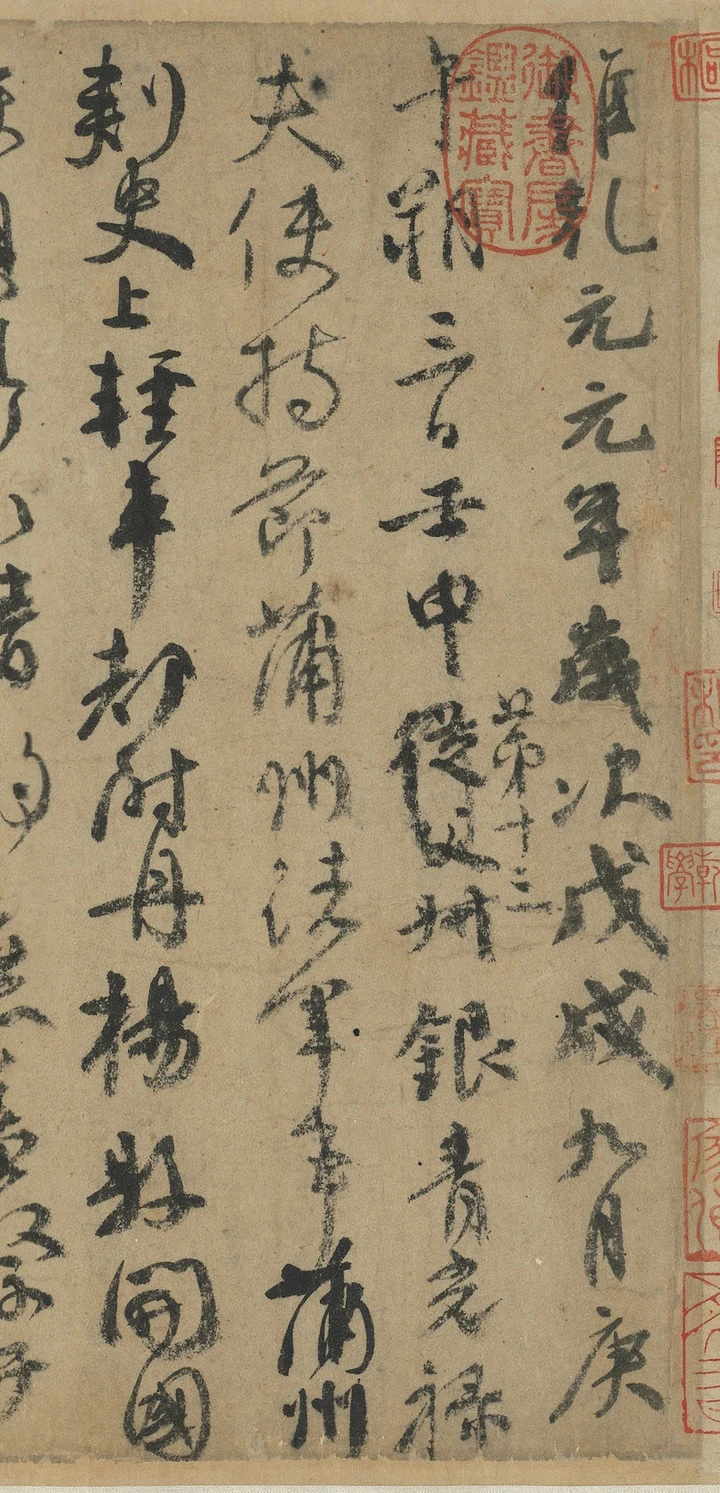
Below 壬申, the original 從父, a kinship designation, has been cancelled. 第十三, “thirteenth,” enters as small writing at the side and connects to the larger 叔, “uncle.” The writer has revised his own relationship designation. This happens at the beginning, before the siege and deaths have been narrated. It prevents us from assigning all the scroll’s corrections to one supposedly unrestrained moment on reaching the catastrophe.
The next column, 夫使持節蒲州諸軍事蒲州, continues the official titles and names Puzhou. From the top through the middle its lines are relatively fine, and paper shows through gaps in the strokes. Near the bottom, 蒲州 becomes markedly heavier. Farther left, the column beginning 刺史上輕車都尉丹楊縣開國, continuing “prefect,” military honours and the county title, also contains substantial dark writing. These are still official positions, not the account of the deaths. Differences in ink weight also depend on the brush, the ink and paper, and how the writing proceeds; they cannot be read straight off the words’ meaning.
Ritual form does not remove the life of the writing. Large characters sit beside small insertions; fine and solid strokes alternate; centres of gravity shift within a column. The titles continue while the page acquires different densities. The traditional calligraphic term 行氣, xingqi, continuity or flow through a column, becomes a visible question: how do successive characters remain connected without being drawn as one unbroken line? The inclination of 使 and 持, “commission” and “hold,” the weight of 蒲州 at the foot, and the starting position of 刺史, “prefect,” at the top of the left column together sustain the movement down and then left.
After the name comes “you”
Return to Figure 1. Above 季明, Jiming, 贈贊善大夫 indicates a posthumous appointment. In the column immediately to the right, 真卿, Zhenqing, names the man making the offering. The two names do not face each other in matching large characters. Zhenqing’s column continues with 以清酌庶羞, “with clear wine and assorted foods”; Jiming’s reaches 之靈曰, “to [his] spirit, saying.” One person states what he has brought. The other is placed as the recipient whom these words seek to console.
This relation belongs to meaning, but the arrangement of columns gives it a specific form. Jiming’s name gains weight through the addresses that follow throughout the work. Beneath it, 之, the possessive link, is small; 靈, “spirit,” gathers tightly. When the column finishes, 惟爾, “you,” at the top of the next one opens the passage anew. The recipient is first identified at the end of one column, then called upon at the head of another. The reader must make the passage from designation to address.
Below 惟爾挺生, “you were born outstanding,” 夙標幼德, “you showed virtue from childhood,” is not evenly spread. 標, “manifest” or “distinguish,” gathers into a relatively solid form. 夙, “early,” before it and 幼, “young,” after it appear more open; 德, “virtue,” leads toward 宗廟瑚璉, “precious vessels of the ancestral temple.” Dark and light alternate within this column of praise. The local black-and-white relations establish accents that prevent the eye from sliding down at an even rate.
There is no need to make 爾, “you,” into a mysterious word that must always be largest. It matters because every recurrence makes the direction of the sentence explicit. Its size and position must nevertheless be examined afresh each time. The next telling instance is 仁兄愛我,俾爾傳言: “my kind elder brother loved me and sent you to carry his message.”
Family voices pass through the account of war
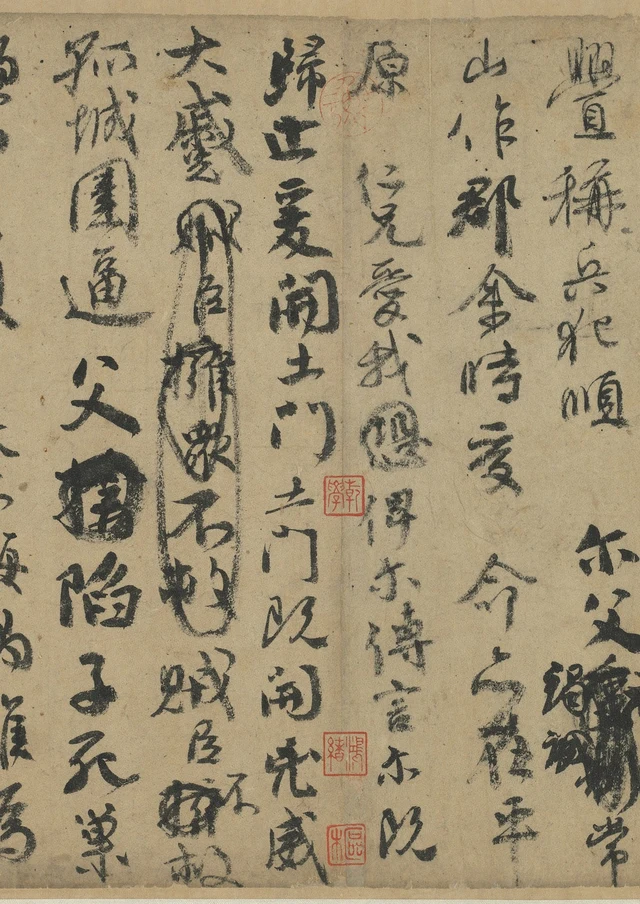
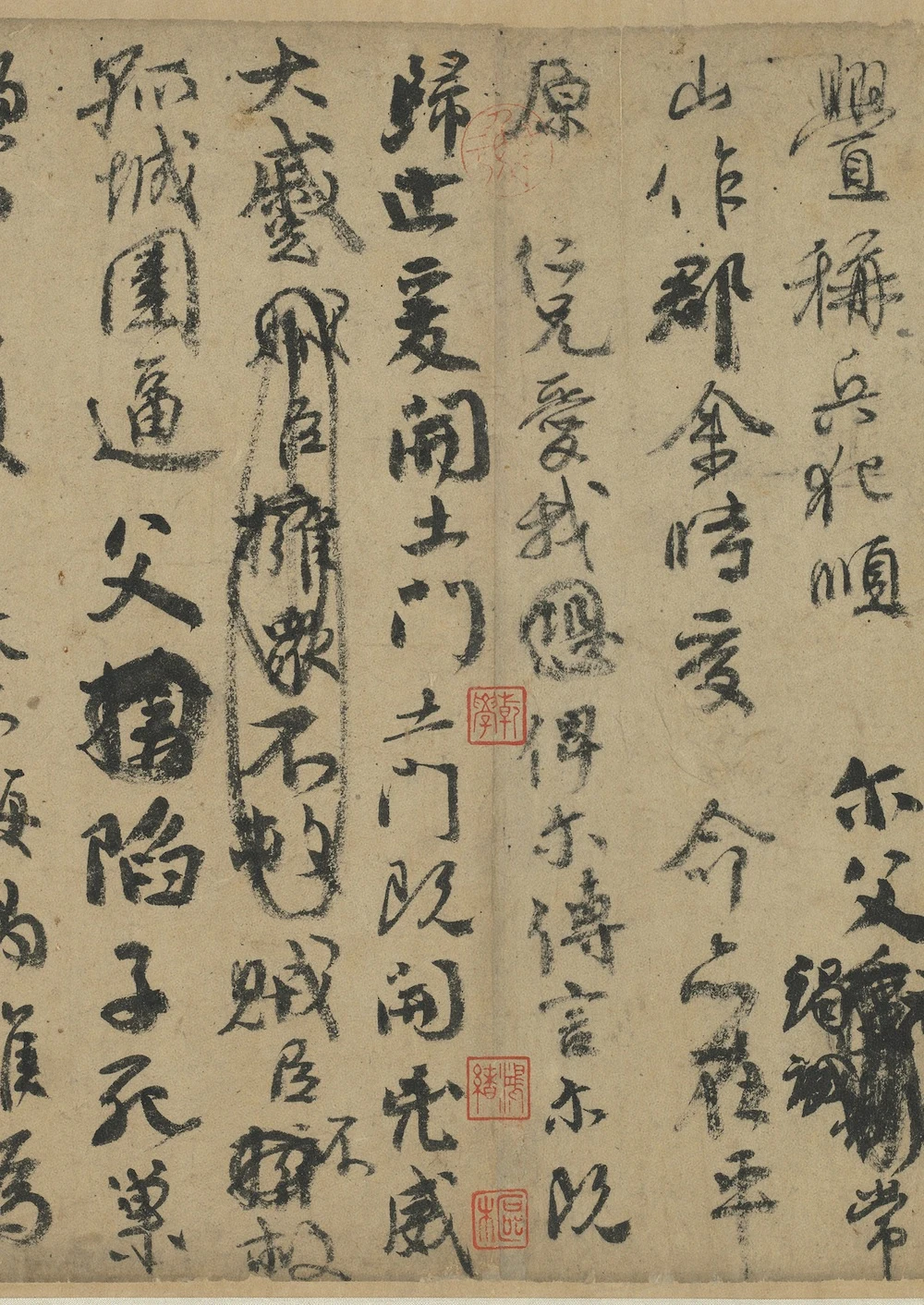
Find that pale column just right of centre. At the top, 原 completes 平原, Pingyuan, begun in the preceding column; 仁兄愛我 follows beneath it. 兄, “elder brother,” and 愛, “love,” do not build into large black masses. Clear paper remains between the characters. Below 我, “me,” a character has been circled and cancelled; farther down, 俾爾傳言 continues toward the column’s foot.
仁兄, “elder brother,” is Jiming’s father, Zhenqing’s older paternal cousin, whom the text calls “brother”. The person he loves is “me”; the person he sends to carry words is “you.” These designations reveal uncle, brother and nephew within an exchange of military and political messages. The fine writing does not make the sentence frivolous. Its continuing legibility and intervals let us read how these people are connected.
The neighbouring column at left, 歸止爰開土門, “when you returned, Tumen was opened,” becomes distinctly substantial. Its upper 歸, “return,” 止, a grammatical particle, 爰, “then,” and 開, “open,” form a succession of heavier points. These are the words narrating Jiming’s return, the opening of the passage and the check to rebel power. The dark ink first gathers the upper part of the column; farther down, 土門既開, “once Tumen was open,” again contains more open internal spaces.
Farther left, the deleted 賊臣擁眾不救, “the treacherous official, holding troops, did not rescue,” is enclosed by a long cancellation. The revised 賊臣不救, “the treacherous official did not rescue,” remains, and the sentence proceeds to 孤城圍逼,父陷子死, “the isolated city was besieged; the father was captured, the son died.” Here 父, “father,” spreads sideways. Beneath it, the cancelled 擒, “capture,” forms a dark mass; then come 陷, “fall into enemy hands,” 子, “son,” and 死, “die.” An eye attending only to blackness might mistake a rejected word for the most emphatically stressed keyword. Reading the transcription alongside the image distinguishes darkness made by a character from darkness produced by repeated ink or the overlap of corrections.
The words supply direct grounds for speaking of grief. The production of each black mass still has to be distinguished by its particular traces. This does not diminish the calligraphy’s force. We see how a passage continues to exist with its changed choices, and how family designations pass through the military narrative to arrive at irreversible death.
After “alas,” a resting place still has to be found for you
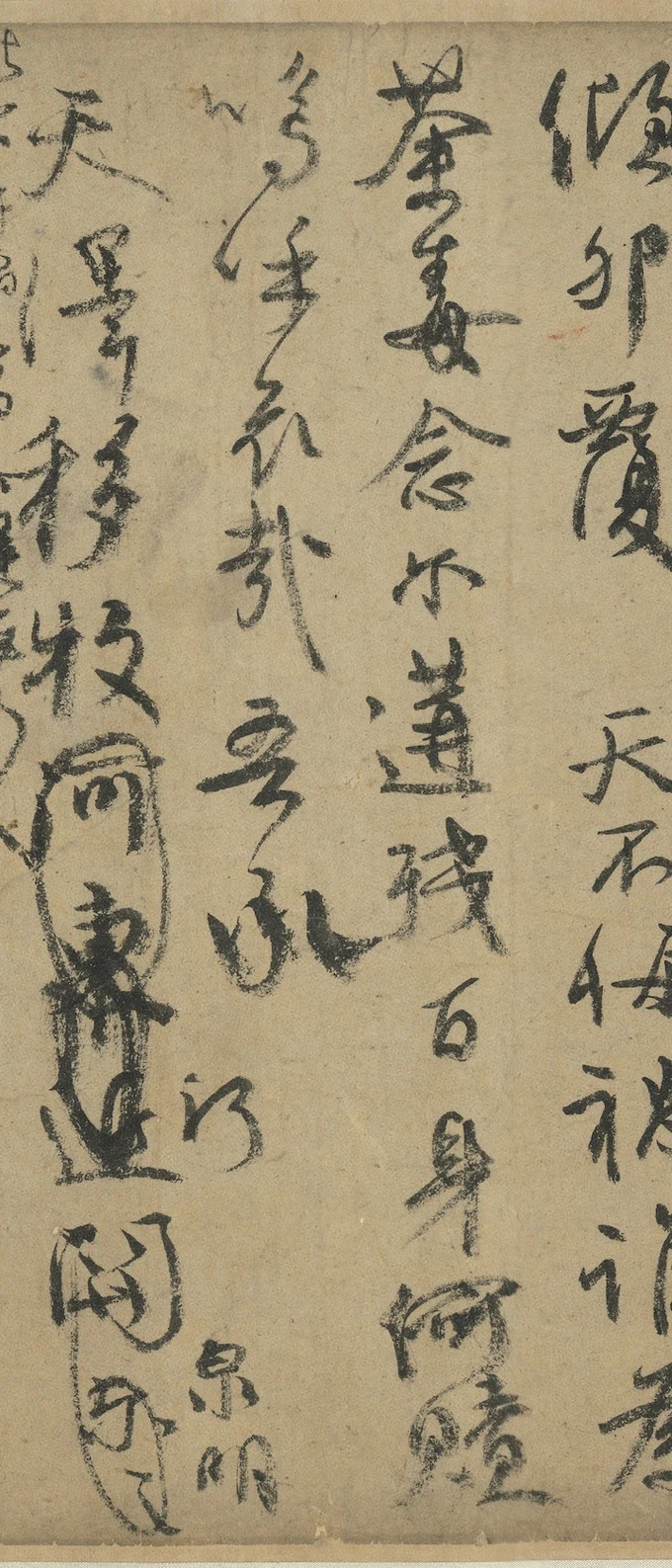
念爾遘殘,百身何贖, “remembering the violence you suffered, how could a hundred lives redeem you?”, turns narration into the uncle’s direct lament to Jiming. In Figure 4, 荼毒, “cruel devastation,” stands near the top of a column, with 念爾, “remembering you,” beneath. Farther down, 百身何贖 shows an increasingly dry texture, with many patches of paper visible in the ink. Those openings loosen the outlines of the last few characters against the concentrated forms of 荼毒 above.
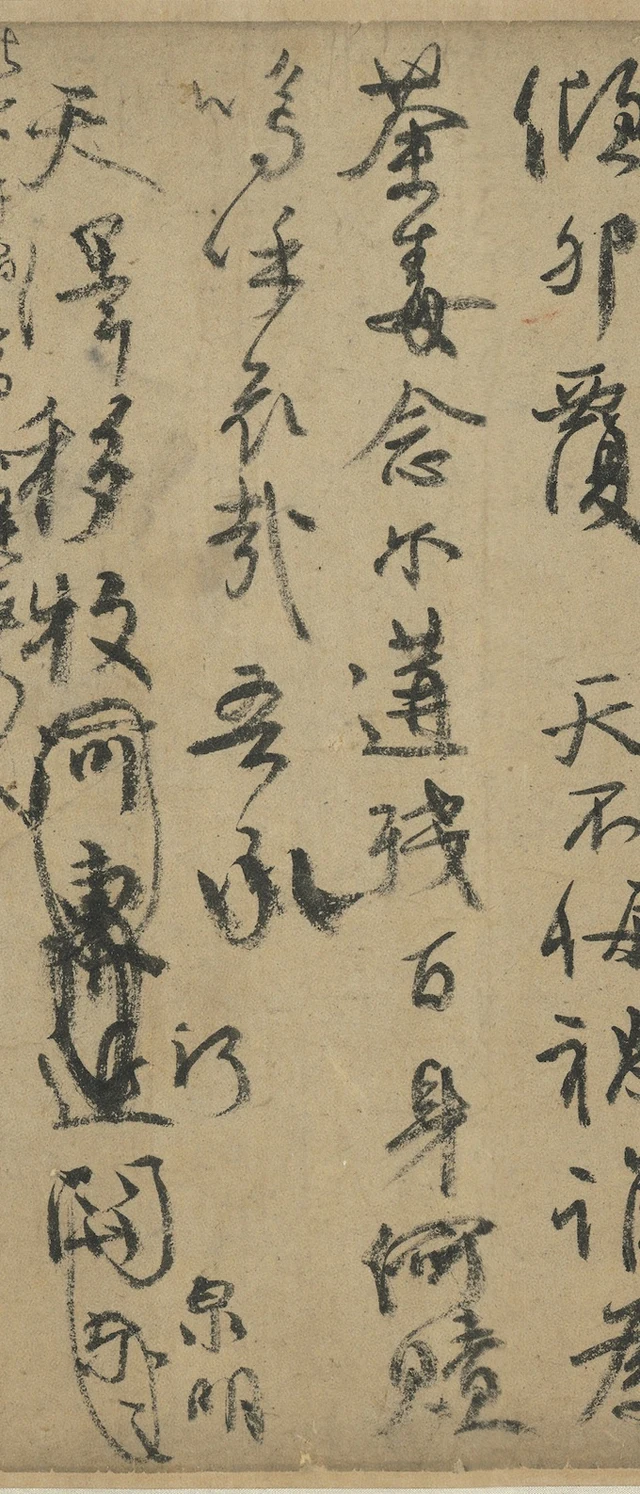
The adjacent 嗚呼哀哉 is comparatively slender. Its forms lean and succeed one another vertically rather than forming a huge square blockage. It closes the preceding lament without ending the whole requiem. 吾承, “I received,” beneath it takes up the narrative again. The next column names the sovereign’s appointment and the place of transfer; after that comes Quanming’s recovery of the remains.
That continuation deserves attention. The requiem cannot bring the dead back to life. The living still have things to do: burial, choosing a grave, ending the deceased’s long stay away from home. After 嗚呼哀哉 the paper still carries full columns. Lament and practical arrangements occupy the same draft. The practical content is not evidence that grief has subsided.
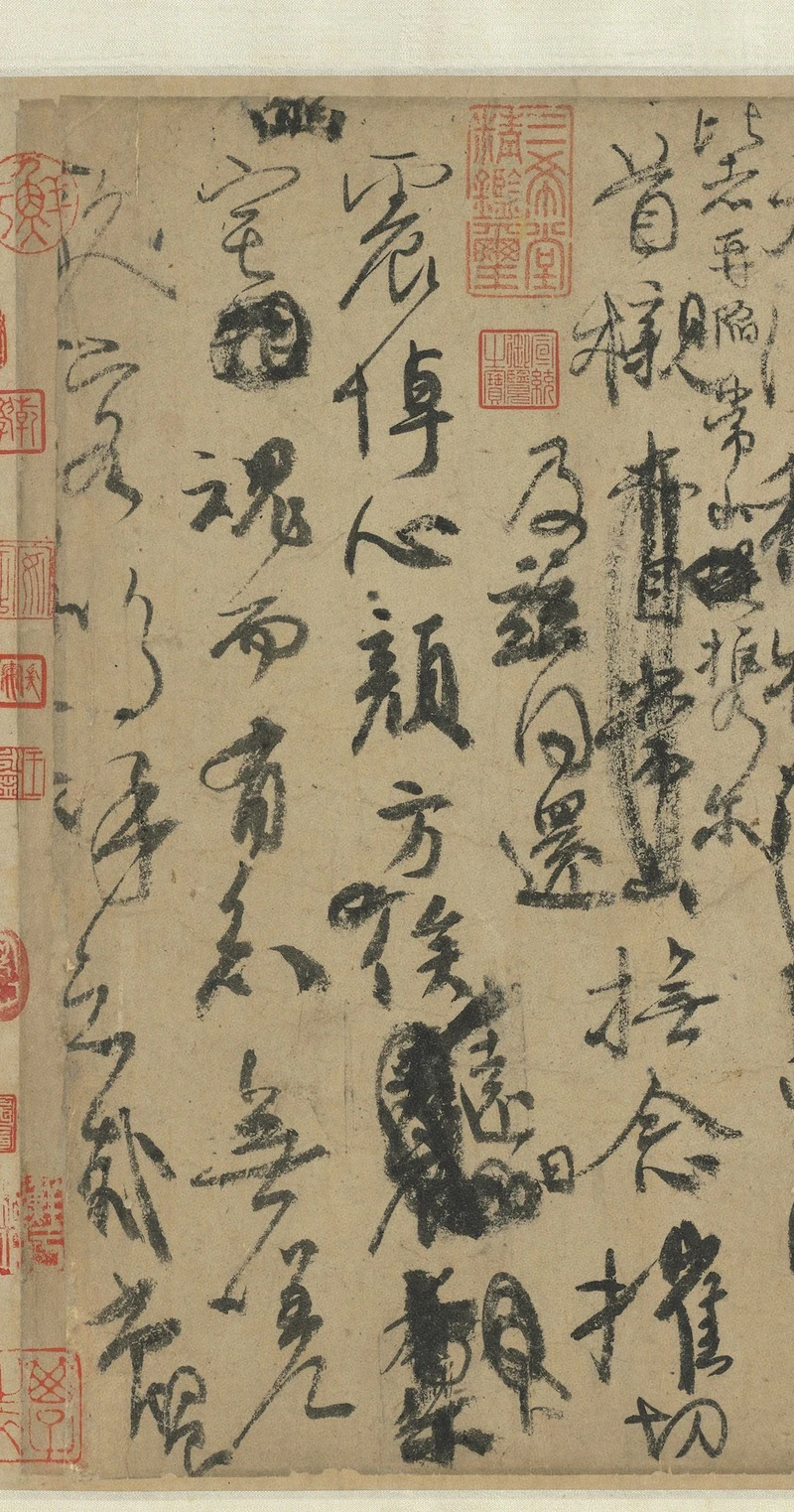
Corrections in the final columns are denser than those at the beginning. On the right of Figure 5, the passage around 攜爾首櫬, “bringing the coffin containing your head,” contains small side additions and vertical cancellations. After 及茲同還, “returned together here,” the larger 撫念摧切, “recollection rends and crushes,” opens downward. The neighbouring column begins with the relatively expansive 震悼心顏, “grief shakes heart and countenance,” and below 方俟, “awaiting,” meets another dense revision. The requiem moves toward burial while its wording still seeks what will finally remain.
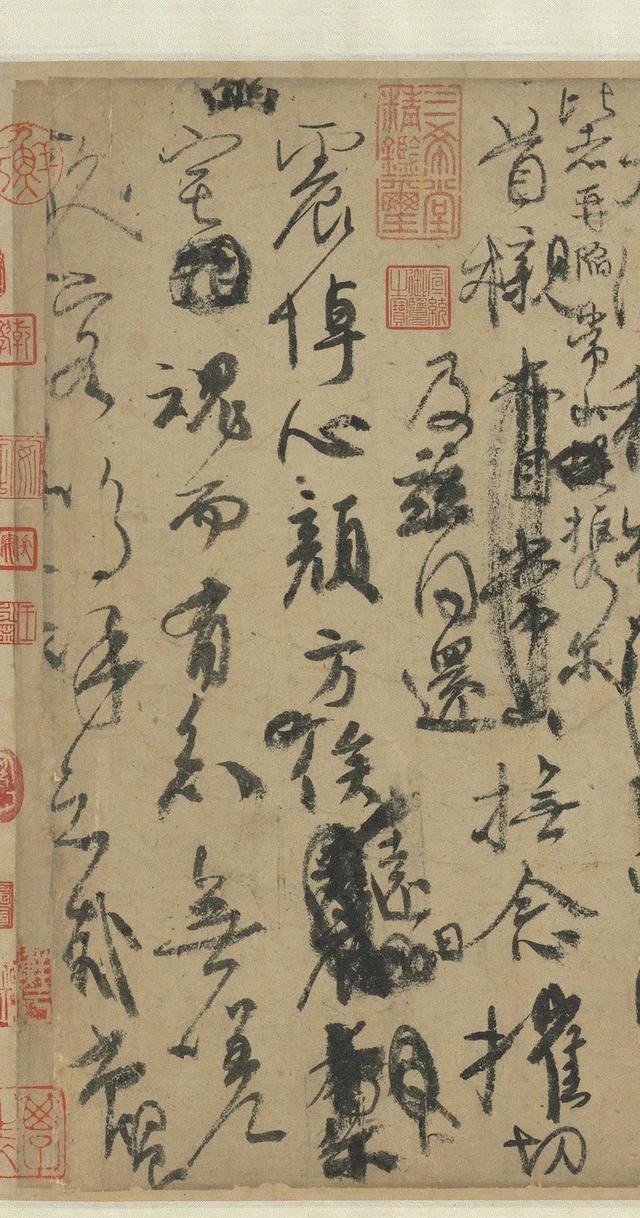
Below 魂而有知, the characters do not keep growing. 魂, “spirit,” is relatively dark; 而, “if” in this construction, extends sideways; 有知, “has awareness,” follows downward. 無嗟, “do not lament,” becomes more slender. 久客 and the lament in the far-left column also expose substantial paper within their strokes. At the bottom, 尚饗 still closes the ritual. The same 嗚呼哀哉 returns, but now the remains have been brought back and a burial promised. Its weight is no longer quite what it was the first time.
What moves me most is not the idea that ritual has finally been smashed by sorrow. These words are still trying to reach Jiming. 魂而有知 retains an “if”: if the departed spirit can know. The requiem does not claim to have received an answer. Yet the uncle continues with 無嗟久客, “do not lament your long sojourn,” and brings the offerings to the final 尚饗. Name, designation, narrative, lament and ceremony each continue to carry part of the work of speaking.
Return now to the two not especially large characters 季明 near the beginning. Their significance does not depend solely on the ink at that spot. The whole work returns to “you,” keeping the name present. Columns, revisions and dry or full ink give those returns different forms. We read how someone is mourned, and see how this particular act of mourning remains on paper.
Optional further reading on how far the paper’s past can be read
Look again at Figure 3 without rushing to assign an emotion to every black patch. Distinguish three checkable things: 仁兄愛我, “my elder brother loved me,” remains readable text; 恐, “fear,” has left the corrected sentence; the ink cancelling it has not left the paper. Beneath 父, “father,” 擒 was replaced by 陷. Two choices now leave different traces in one place.
These marks make an additional layer of time visible. We see not only an established requiem, but the result of its revision on this sheet. The earlier word was written before a cancellation acted upon it: that local sequence has material evidence. What precisely came to mind, or how long the writer hesitated, does not come with the image.
In “The Wood Still Holds That Dry Year”, I discussed how rings, worn stairs and repairs retain a past in the present. SAE, or Self-as-an-End, directs its “beauty of causation” here toward the way a history enters a form. It helps corrections emerge from the vague label “messy writing”: old words were rejected, but rejecting them left new ink. Later readers confront both at once.
A neat copy would therefore do more than make the same text easier to read: it would also take something away. We would lose the space still occupied by rejected words, the weight that overlapping ink gives a column, and the way an insertion enters an existing interval. Material traces give the past a position that can be examined. A clean transcription can explain that position; it cannot replace it.
The writing has a readable history, but the photograph does not deliver Yan Zhenqing’s whole inner life. We can value the surviving requiem while wishing that the person repeatedly addressed as “you” had never suffered such a death.
Image and textual notes including dimensions and image processing
This essay is based on the National Palace Museum’s published photographs, not a viewing of the original. Photography, paper colour, screens and enlargement affect appearances. Comparisons concern strokes, character forms and intervals within the same photograph. Ink colour is not used to infer exact pressure, speed or psychology.
- The museum records the principal sheet as 29.2 × 59.6 cm. The two main photographs overlap; they have not been joined into a seamless, measurable scroll. The two-panel locating image places the opening at right and the ending at left. Later inscriptions and red seals are distinguished from Yan’s text.
- All five figures use rectangular crops, proportional reductions and JPEG encoding. Adjacent columns, seals and paper are retained. No strokes were supplied, seals removed, sharpening applied or writing generated. Exact coordinates and high-resolution links appear in the image notes. Figure 1’s outer edges and the edges of Figure 3 retain fragments of neighbouring columns; the discussion identifies the complete main columns.
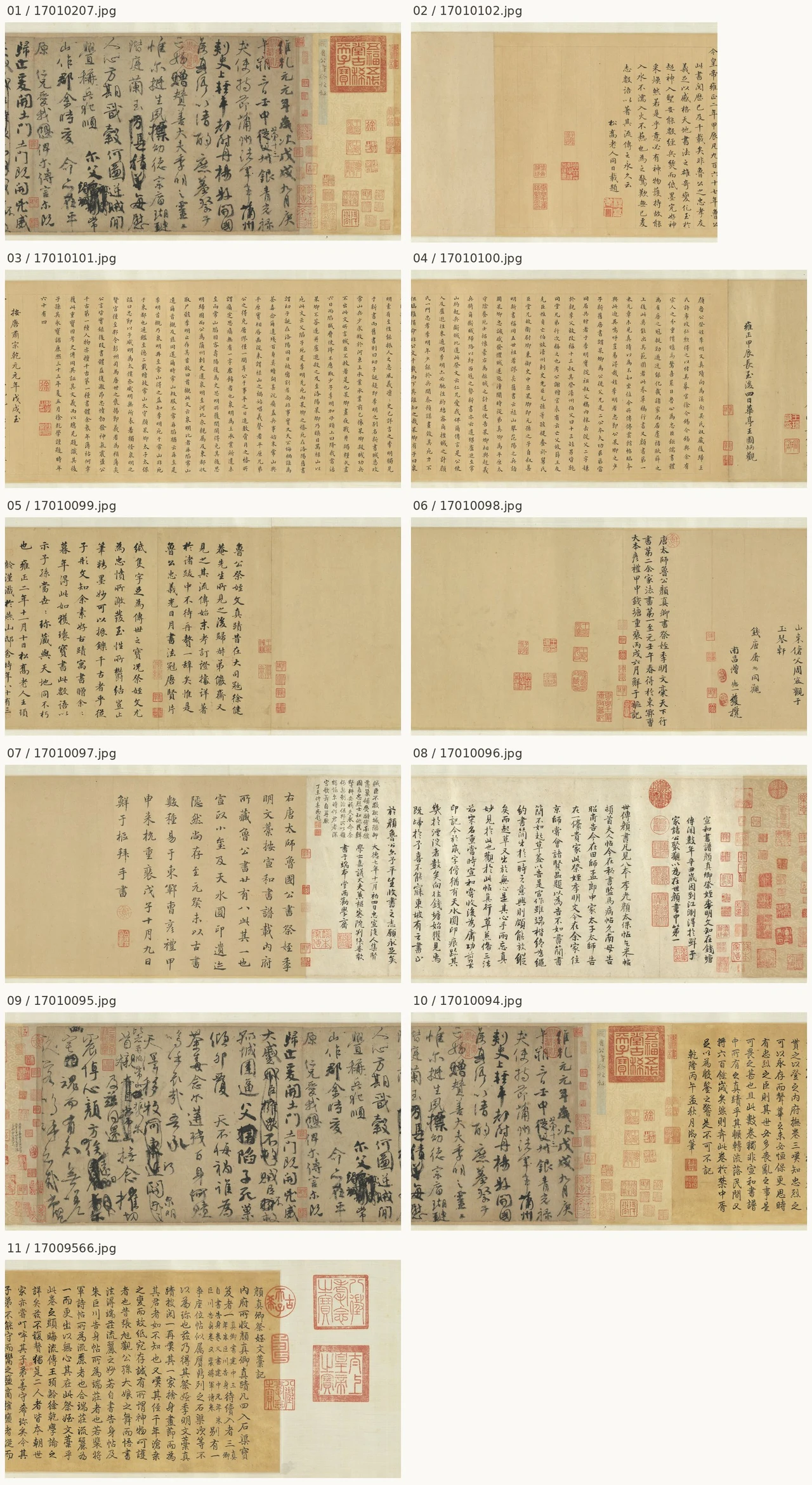
- The gallery index displays the museum’s eleven photographic views, labelled with their source filenames. It is an index to separate, overlapping photographs, not a reconstruction or a chronological arrangement of the inscriptions. The photographs include later writing as well as Yan’s manuscript. Follow the official gallery for the originals.
- Historical forms appear in the photographs; the reading text uses ordinary simplified Chinese. The captions retain forms such as 靈, “spirit,” and 爾, “you,” where useful. 丹楊, Danyang, follows the catalogue. The bracketed 大 in 銀青光祿[大]夫 supplies an omission; it is not claimed to exist on the paper. The deletion of 從父, insertion of 第十三 and replacement of 擒 by 陷 have been checked against the photographs and the museum’s transcription. Illegible cancelled words are not guessed.
- After 爾父, “your father,” 竭誠, “devoted himself wholeheartedly,” overlaps revisions in the same area; the whole patch must not be read as one enormous character. The interpretation of 再陷常山 is a translation choice, not an alteration of the Chinese. Other interpretations require historical discussion.
- The date is given as the manuscript’s first year of Qianyuan, ninth month, third day. Lunar month and day are not silently treated as a Gregorian date. “Second-best running script under heaven” is not used as an aesthetic conclusion, nor is handwriting treated as direct proof of character.
- The JPEGs come from the museum’s appreciation website. Attribution follows its Government Website Open Information Announcement, subject to any separately stated restrictions. CC0 or CC BY labels belonging to another download entry have not been transferred to these JPEGs. No separate case-specific permission was obtained, and attribution does not imply museum endorsement.