In 五十弦, “fifty strings,” the bottom stroke of 五, “five,” reaches a long way to the left. The strokes above it do not spread out with it. They remain gathered on the right, with their small inner opening, at one end of the long horizontal. Follow that horizontal alone and the character looks very wide. Return to its body and it is remarkably compact.
Above it, 皇, “sovereign,” here part of the goddess Nüwa’s title, stacks its horizontals. Below it, 十, “ten,” consists of just two strokes. In the neighbouring column to the left, 須, “need,” places slender oblique strokes beside its right-hand component. 五 does not fill all the paper between these characters: 十 still fits beneath its horizontal, and space remains between its left tip and 須. The line has travelled outward without the dense part of the character expanding equally in every direction.
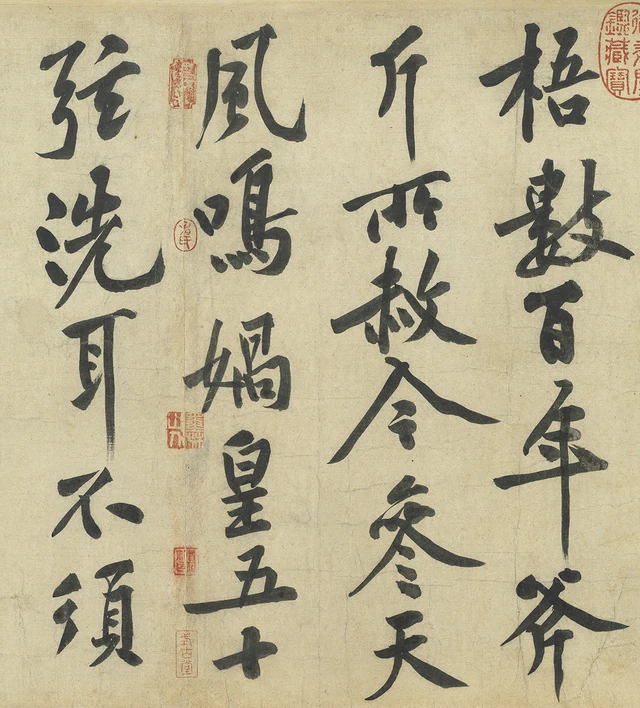
This is where I want to begin with Huang Tingjian’s Poem on the Hall of Wind and Pines, also known as the Songfengge shi tie (松風閣詩帖). His long strokes do not simply enlarge whole characters. Short, closely packed strokes remain together while a horizontal or a left-falling stroke goes out on its own. The outer contour widens; the interior stays tight. Our eyes move between two scales: the close distances that let strokes fit together and the longer distances over which they reach. Remembering only the familiar praise of Huang’s “long sweeping strokes” can make us miss what has not loosened.
The handscroll, now in the National Palace Museum in Taipei, is a major example of Huang’s late running script, a style between regular and cursive writing. The poem was composed in 1102 during a visit to Wuchang, in the area of present-day Ezhou, Hubei. It describes a pavilion among pines, a rainy overnight stay and thoughts of friends. The poem’s date need not be the exact date of the surviving writing: another museum account allows that the scroll was written somewhat later, no later than 1105. Huang’s poem is our main subject; later comments, called colophons, and collectors’ red seals belong to other moments. Museum exhibition, 2025; museum account distinguishing composition and execution
From the sound of pines back to 箕
Here are the opening seven lines. The Chinese poem is given in full across three sections, using standard traditional characters and incorporating the manuscript’s corrections. The punctuation and verse lines are editorial; they do not reproduce its columns.
依山築閣見平川,
夜闌箕斗插屋椽。
我來名之意適然,
老松魁梧數百年,
斧斤所赦令參天。
風鳴媧皇五十弦,
洗耳不須菩薩泉。
Built against the mountain, the pavilion overlooks the plain.
Late at night, Basket and Dipper thrust among its rafters.
I come and name it, finding the name just right.
The old pines stand mighty, hundreds of years old;
spared by the axes, they have been allowed to reach the sky.
The wind plays Nüwa’s fifty strings;
to wash my ears, I need no Bodhisattva Spring.
箕斗 names two asterisms, the Winnowing Basket and the Dipper. The apparent meeting of stars and rafters places the pavilion high up. Bodhisattva Spring is a local spring; washing the ears also suggests release from worldly concerns. Uncut by human axes, the trees have lived for centuries. The wind now passes through precisely those surviving trees. The landscape moves from visible mountain and river to audible sound. The pavilion’s name becomes more than words on a plaque.
Seeing old pines in the poem and long strokes in the writing, we may readily compare the strokes to pine branches. The comparison is evocative, but it can be made more exact. 五 counts strings; it does not name a tree. Its long horizontal works even apart from the poem’s pines.
Return to the opening. In 築, “build,” closely gathered small forms occupy the upper part, while a lower horizontal projects left. 平, “level” or “plain,” also lengthens a horizontal; its central vertical descends through a point towards the right. Their leftmost tips do not align. No invisible ruler levels all these outward extensions.
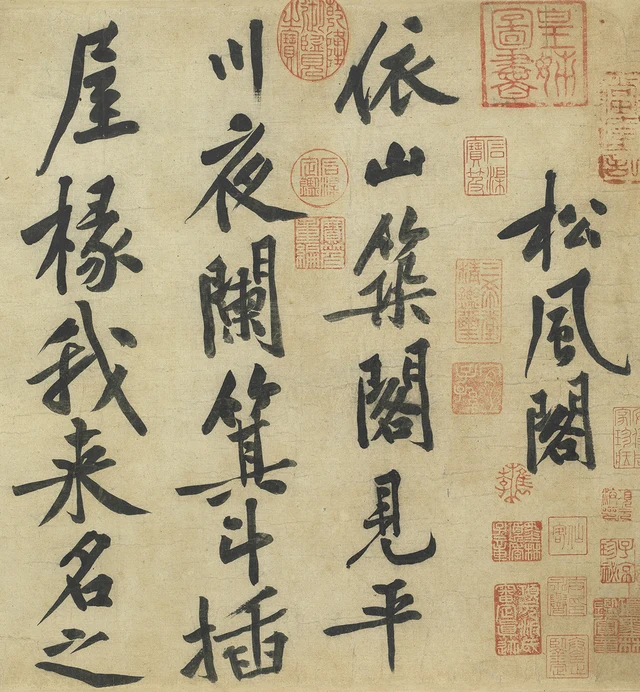
箕 makes the coexistence of compactness and extension particularly clear. Its bamboo component at the top and its central horizontals and verticals build up closely, layer against layer. A lower stroke then takes the eye left, away from that gathering. It does not enlarge every internal interval. Across a short space below, 斗, “dipper,” continues with very few strokes. The complex 箕, the economical 斗 and the substantial 插, “insert,” at the column’s foot successively change how much the eye has to take in.
Traditional descriptions often place Huang’s compact construction beside his long, spreading strokes. Read together, these observations offer more than praise of expansiveness. An extended stroke is conspicuous precisely because the whole character has not been enlarged proportionally. The short strokes that remain close together make the outward part look farther-reaching. Length and compactness are not successive states: both exist in one character.
Rain stays on, and the writing has different surfaces
The next eight lines describe companionship and an overnight stay:
嘉二三子甚好賢,
力貧買酒醉此筵。
夜雨鳴廊到曉懸,
相看不歸臥僧氈。
泉枯石燥復潺湲,
山川光暉為我妍。
野僧旱饑不能饘,
曉見寒溪有炊煙。
How I prize these few friends, so devoted to worthy people;
poor though they are, they buy wine and make us drunk at this feast.
Night rain sounds along the corridor, hanging there till dawn.
We look at one another, stay, and lie on the monks’ felt.
The dry spring and parched stones run murmuring again;
mountain and river shine, beautiful as if for me.
Drought has left the country monks hungry, unable even to eat gruel;
at dawn I see cooking smoke beside Cold Stream.
饘 means thick gruel. 力貧 describes making an effort despite poverty, not lavish entertainment. From wind the poem turns to rain, from staying the night to a spring flowing again in the morning. Human hunger then gives the rain a weight beyond picturesque scenery. A thread of cooking smoke rises in the distance, bringing human life back into the morning view.
Look at 歸, “return,” in this passage, alongside 耳, “ear,” in Figure 1. The vertical of 耳 extends downward and exposes fine threads of paper at its end. A descending stroke on the right of 歸 similarly changes from darker ink to a finer, dispersed trace. Neither is an unvarying black line.
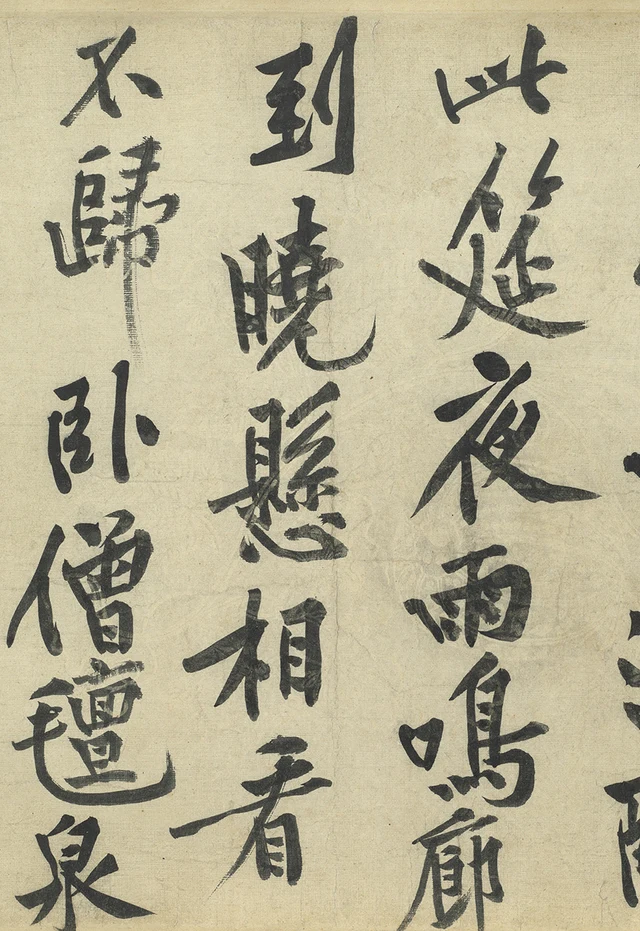
Below 歸 comes the relatively brief 臥, “lie down,” and then 氈, “felt,” enclosing numerous strokes. The bottom of 氈 turns into a curve around its interior. The descending stroke of 歸 opens a narrow vertical passage; 氈 concentrates repeated turns within a small area. Different characters do not merely carry the same amount of ink to different positions. They let paper appear beside and within the ink in different ways.
The paper itself belongs in this account. The museum identifies it as decorated, burnished paper with a prepared surface, whose processing and patterns affect ink absorption. Research on Song decorated paper specifically discusses the paler ink at patterned areas of this scroll. We can follow the exposed paper in a stroke, its edges and its relation to darker ink nearby, without converting every pale passage into greater speed or a desolate state of mind. What we see is a surface that brush, ink and paper have left together. He Yanquan, museum study of Song decorated paper
Long strokes consequently offer different routes. The base of 五 retains a relatively continuous ink surface; the end of 耳 disperses. Both project beyond their character’s main body, but one gives the eye an edge to follow, while the other asks it to keep finding the direction as the trace thins and pales.
Remembrance and waiting at the poem’s end
The last six lines name the people missing from this landscape:
東坡道人已沈泉,
張侯何時到眼前。
釣臺驚濤可晝眠,
怡亭看篆蛟龍纏。
安得此身脫拘攣,
舟載諸友長周旋。
The man of the Way, Dongpo, has already sunk beneath the springs;
when will Master Zhang appear before my eyes?
By Fishing Terrace, amid startling waves, we could sleep at midday;
at Yi Pavilion, see seal-script forms like intertwining dragons.
How may this body shake off its constraints,
and a boat carry all my friends, in lasting companionship?
Dongpo is Su Shi, who died in 1101. The springs in 沈泉 are the underworld: the line means that he has died. Master Zhang is Huang’s friend Zhang Lei. Fishing Terrace, Yi Pavilion and Cold Stream are local places; the seal-script inscription at Yi Pavilion brings the viewing of an old monument into the poem. 拘攣 means restraint or constraint, broader than one particular official duty. Sound, wine, rain and scenery converge on the wish for a boat in which friends can be together. Local historical account republished by Echeng District
“Already beneath the springs” and “when will he appear?” cannot smooth each other away. One friend cannot return; another can still be awaited. The ending does not fill both absences. The wish is expansive, yet loss remains within it. This preserves the force of the lines more fully than reading the whole poem as an accomplished escape.
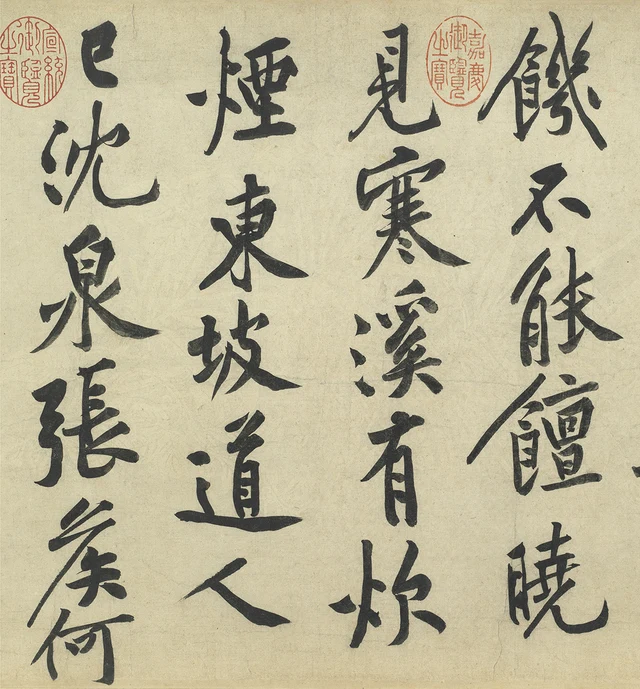
The exhibition account relates this passage to mourning Su Shi, noting tilted characters and weightier strokes. That reading invites us to pause before 東坡道人. Once there, we can still identify what each character actually does. The central horizontals and verticals of 東, “east,” gather together while diagonal strokes extend to either side. 坡, “slope,” is more densely articulated. The final stroke of 道, “way,” supports the upper part horizontally; 人, “person,” at the bottom joins only two oblique strokes, sending its right stroke outward.
These characters have not all taken one shape. The density of 坡 and openness of 人 are distinct within a single column. The lower half of the neighbouring 泉 also spreads sideways. Yet 泉 occurs both in “Bodhisattva Spring” and in “already beneath the springs”: related forms carry very different meanings. The same character’s different poetic work sends our eyes back and forth between shape and sense.
The poem explicitly names remembrance. The writing carries it through the density of 坡, the openness of 人 and the spread of 泉. What happens within this one passage is richer than a general account of increasing heaviness.
The final 舟 leaves its body to one side
In 舟載諸友, “a boat carries all my friends,” the long horizontal returns. 舟, “boat,” has a slender, upright body and closely spaced inner strokes. Its horizontal crosses the middle, extending considerably farther left than right. Like the earlier 五, it lets the outer contour and internal density go separate ways.
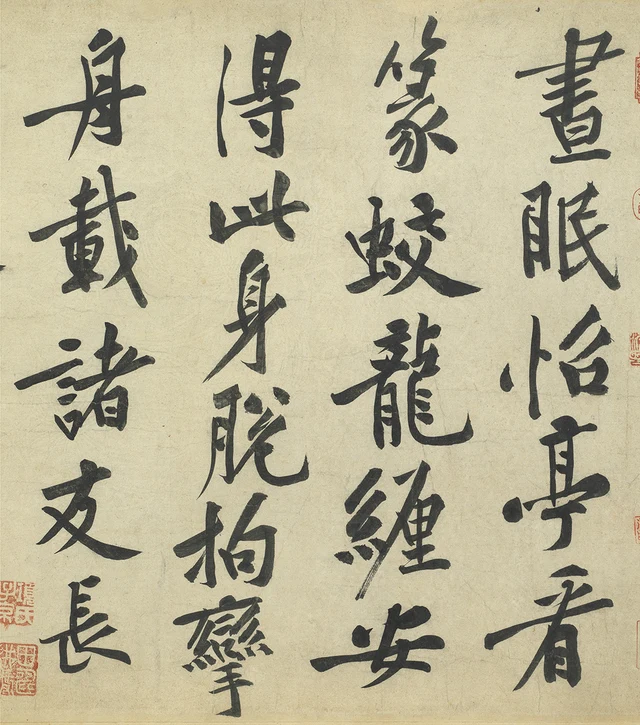
Now look at the column immediately right of 舟: 得此身脫拘攣, “may this body escape constraints.” The left side of 得, “obtain” or “may,” lengthens downward, while several horizontals on the right remain packed into a small area. 身, “body,” is narrow; the lower-right curve of 脫, “escape,” opens outward; the final 攣, “bind,” compresses many fine strokes into a tighter contour. These characters do not all gain roomy forms merely because the words wish for release.
Farther right, 安 sends its lower horizontal leftward while its upper strokes stay gathered. It is separated from 舟 by a column and stands at a different height. The two long strokes do not form a bar across the paper. Appearing successively, they let the eye remember a way of constructing characters without imposing a uniform size or beat on the passage.
We can now draw the meaning of a long stroke back from our first impression. It does open out, but opening out need not loosen the interior. Compactness remains, giving the extension its distance from something. The contour stays uneven and the character retains a direction of its own.
The poem ends with 周旋 in a further column to the left, expressing the wish for enduring company and shared travels. Huang’s poem text then stops. The later colophons go on to tell how other people read this writing. Official view of the ending and the first colophon

The Wind and Pines scroll offers both extended strokes and places that remain compact after the extension. Bring your eyes back from a striking horizontal to the body it crosses, then to a shorter neighbour. Huang’s expansiveness becomes specific: not every place is spacious, but the short strokes have stayed together while the long stroke has gone far.
Optional further reading: taking back a hasty sentence
On first looking at 五, I can readily say, “The character has been stretched wider.” That sentence catches the horizontal but assigns its change to the whole character. Looking again at the short strokes above, I find that what needs changing is my sentence: chiefly one stroke has reached left, while the compact body on the right has not dispersed with it.
This correction does not invalidate the first look altogether. The broad outer contour really is there. “The entire character has spread out” merely goes one step beyond the evidence. We can check 舟 in the same way: first point to the horizontal’s two ends, then to where its dense strokes sit. The two indications do not coincide. My generalisation should become more precise.
In “I Was Mistaken.”, I describe someone mistaking a stranger for an old friend. Beyond replacing an answer, there is a turn back towards oneself: that confident judgment was one’s own. The “beauty of the self” in SAE, Self-as-an-End, directs attention here to this turn by the viewer, rather than assigning Huang a personality through his handwriting.
There is no need to punish oneself for looking too quickly, or to call a compact form loose in order to protect a first admiration. Let the short strokes above 五 keep the appearance they have shown, and let one’s sentence return to what they support. The image has not changed; the viewing has gained clarity.
Image, text and processing notes
This essay studies publicly available National Palace Museum photographs rather than an in-person encounter with the original.
- The museum records the main work as 32.8 × 219.2 cm, ink on paper, handscroll. Read each column downward and the columns right to left. Modern verse lines do not reproduce the manuscript’s columns.
- All 21 lines are present above. The catalogue reading 令參天, “allowed to reach the sky,” is followed; some other museum and received texts give 今, “now.” After 嘉 the manuscript initially has 三二 with a reversal mark; the reading is 二三. An extra 早 after 野僧 is cancelled, followed by 旱饑. 沈 in 沈泉 is retained.
- Standard printed forms identify the writing, without claiming to trace every historical form. The discussion’s 饑 follows the catalogue; 纏 identifies the written variant 緾. Red seals belong to collecting history, not automatically to the sheet as Huang faced it.
- The five details are rectangular crops with JPEG re-encoding. No strokes were added, seals removed, colours changed or handwriting generated. Source links, crop coordinates and checksums are in the accompanying image manifest.
- The orientation image of the opening and middle sections is the museum’s separately published low-resolution file. It ends at the characters 時到眼前釣 and does not include the final section. Use it for orientation, not stroke analysis or measurement.
- The exhibition JPEGs are attributed under the museum’s general website open-information statement, not labelled with the separate Open Data download licences. Attribution does not imply museum endorsement.

Further images and reading
- Museum’s 2025 exhibition, section two: high-resolution gallery and work description.
- Collection record 43: transcription, dimensions, colophons, seals and bibliography.
- Museum’s Age of the Great Khans account: distinction between the poem’s date and the writing.
- Museum study of Song decorated paper: surface patterns, processing and ink absorption.
- Han Qin, “I Was Mistaken.”: complete companion essay.


