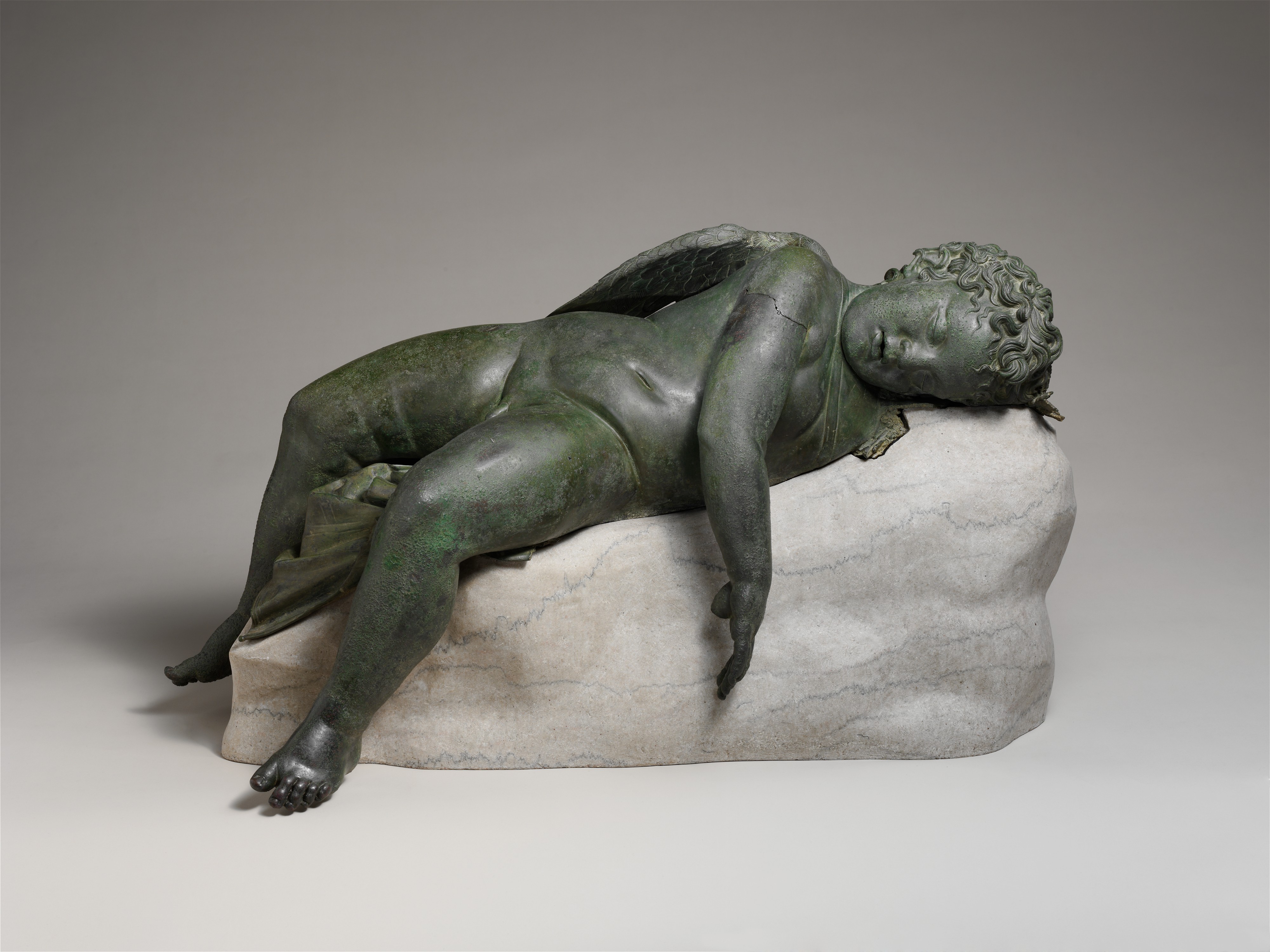
Begin with the dangling hand.
The arm slopes from the shoulder, passes in front of the chest, and extends beyond the edge of the support beneath the body. The wrist does not lift the palm. The fingers point downward, neither grasping nor bracing against anything. Beside them, both lower legs also fall over the edge. At the other end, the head tips to one side, while the swelling abdomen remains higher in the middle.
Sleep has weight here. It is written not only in closed eyes but in which parts of the body are supported and which are allowed to hang.
The hand looks tiny, yet the whole arm carries our eyes downward. Follow it to the fingertips, then return to where the head and torso rest, and the principal action of this sleep emerges as surrendering weight. The body does not stand on its feet or prop itself up on its arms. It has given those tasks to what lies beneath it.
Yet the sleeper is Eros, the Greek god of love. The feathered wings on his back have not disappeared. A being with divine power occupies space through the utter relaxation of a child’s body. The sculpture keeps the god’s power within a recognizable image while temporarily suspending the action that exercises it.
The work belongs to the Hellenistic period. In early Greek literature, Eros can overwhelm the minds of gods and humans; in the Hellenistic period, the infant god of love became increasingly popular. This historical change makes the relaxation before us more than a description of a physical state. It also raises the question of how a god is represented. Exhibition background
1. The Belly Stays Above, Hands and Feet Hang Below
In Figure 1, the abdomen is a conspicuous bright plane. It swells forward, the navel making a small hollow in its rounded surface. The transition between chest and belly is gentle, allowing the eye to pass slowly across it until a deeper turn appears where thigh meets abdomen.
This body has not been drawn into a long straight line. The head tips sideways, the torso rests diagonally, and both legs bend at the knees. The nearer thigh looks broad and substantial, while its lower leg reaches down. The farther leg bends too, its foot extending outward. The knees are not neatly aligned and the toes do not point toward one destination. Each part seems to have found its own place to rest.
The hanging right arm is especially important. The shoulder still swells, the elbow bends slightly, and the forearm falls beyond the edge. The fingers reach low without becoming a support for the body. Seeing the suspended palm makes us more clearly aware that the torso has already found support elsewhere.
We do not need to calculate the bronze’s actual center of gravity to distinguish these relationships: some forms rest above, while others hang over an edge. The first lets the body rest; the second makes the rest seem complete. If the whole figure lay like a straight wooden stick on a horizontal plane, closed eyes would still indicate sleep. Here, differences in height, bends, and hanging limbs carry sleep through the whole body.
This is also why the rounded body deserves a close look. Belly, thighs, and upper arms are all substantial, but they have not piled into an indistinguishable cluster of balls. The bend at the elbow, the direction of the knees, and the narrowing at the groin distribute softness among different parts. Softness is not shapelessness. It takes shape through contact and suspension.
2. Closed Eyes Do Not Make the Face Blank
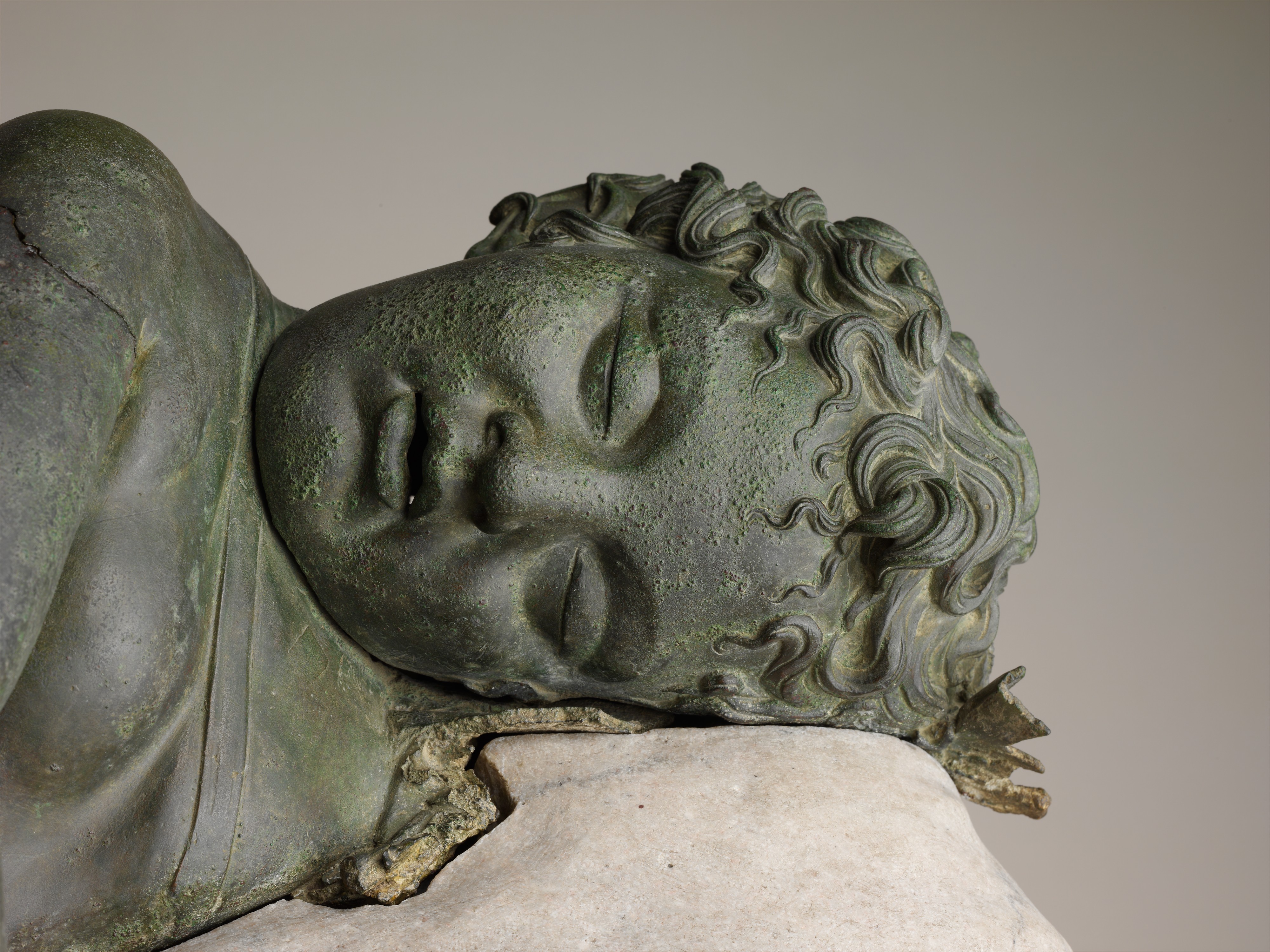
Up close, the face still has plenty going on.
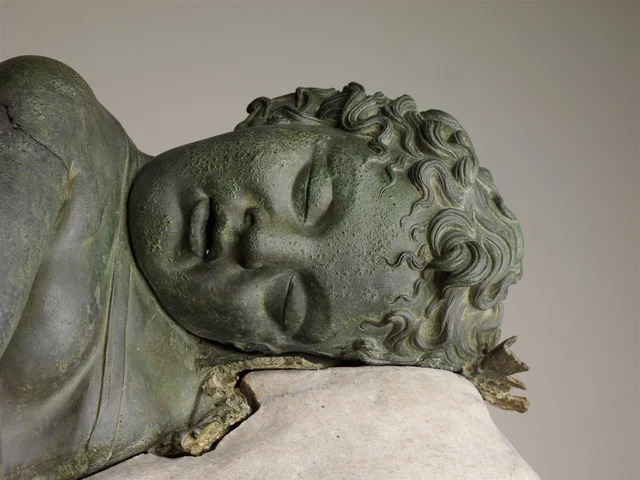
The lids beneath the brows still have thickness. Their two fine closed lines contain the gaze that might otherwise look outward. Eye sockets and nose remain, but no direction of looking draws us beyond the image. Slightly parted lips leave a small dark area at the center of the mouth. The head tips to one side, taking the rounded cheek with it.
These shapes make sleep recognizable: lids close, lips part slightly, and a face capable of looking out and speaking now inclines quietly to one side.
The hair, meanwhile, retains dense movement. Locks turn in circles, some reaching onto the forehead, others curling back from the crown, with deep grooves beside raised strands. The short lines of the eyelids are calm; those of the hair keep turning. This difference prevents sleep from becoming poverty of form. The figure is still, but the surface offers plenty of directions to follow.
Nor is the face detached from the body. Its tilt toward the support joins the downward direction of the fingers, turning head and hand from active working parts into parts that need somewhere to rest. Closed eyes tell us he is asleep; tipped head, hanging hand, and bent legs give that judgment a body.
In the photograph, the metal edge beneath the cheek is irregular. What survives is not an unchanged, intact ancient setting for the sleeping pose. Faced with these edges, we should first acknowledge the limits of preservation, then consider which relationships remain clear.
3. From Behind, the Wings Rest Too
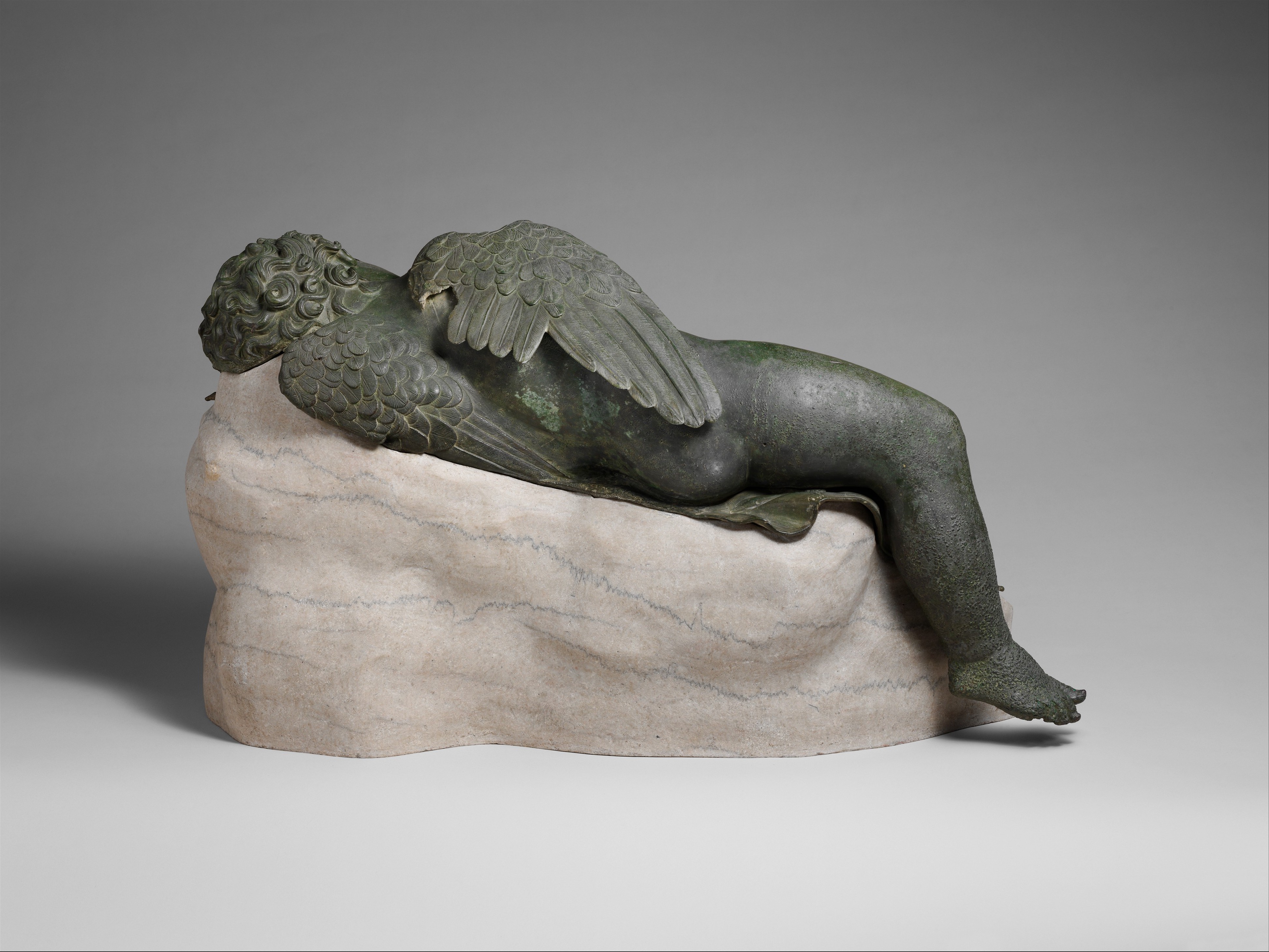
From the front, the wing showing behind the shoulder occupies only a small area. From behind, the wings become some of the sculpture’s clearest and richest forms.
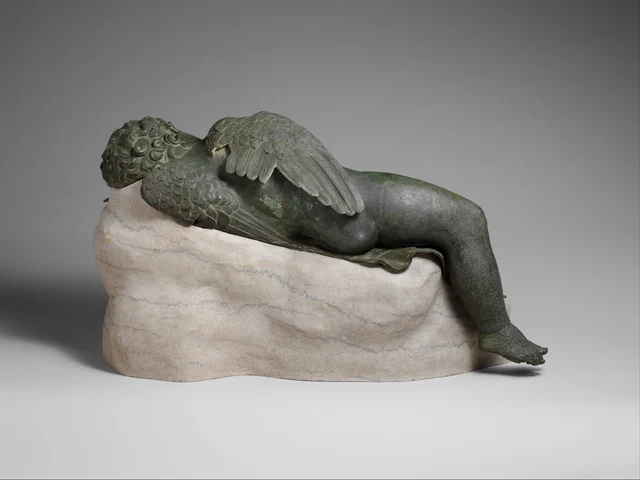
The upper wing extends diagonally downward from the rise of the shoulder and back. Near its root, feathers are short, rounded, and layered. Farther out, they lengthen into several clearly directed long feathers. The lower wing lies closer to what supports the body, extending horizontally along it. The two do not spread symmetrically to either side or form an emblem around an upright torso.
They follow the levels of a reclining body. The upper wing has room to lift slightly away; the lower one is brought closer to the supporting surface. From this angle, sleep has rearranged not only hands and feet but the god’s identifying attribute as well.
Feathers and skin are both made in bronze, yet their surfaces have different rhythms. Back and buttocks form broad, continuous curves; the wings have many small, narrow edges overlapping layer upon layer. Moving from body to wing, the eye slows and begins distinguishing individual feathers. The wings remain unmistakable. The god’s identity has not been swallowed by the soft body.
At the same time, the long feathers run roughly along the back and the surface beneath, rather than pulling our eyes sharply upward. We see organs capable of flight, but no action of taking off. The body has lain down; its wings still belong to it and have acquired a reclining shape too.
The child figure here is more than a miniature adult or an endearing ornament. Round belly, short legs, and full cheeks make relaxation almost tangible, while the wings prevent us from treating him as an anonymous everyday infant. Their coexistence gives this rest its particular significance: power has not been abolished, but for now it is not acting.
4. Today’s Support Is Not Entirely Ancient
The large pale form beneath the figure nearly fills the lower half of the photographs. It profoundly affects how we see the sculpture today and is also especially easy to misdate.
The museum explicitly states that the current base is a modern addition. The original would have had a separately made base, probably of stone. We can use these photographs to study how the body reclines and the limbs fall beyond an edge, but cannot attribute every irregularity of this support to an ancient artist’s arrangement of sleep. Collection record
Another distinction lies between the legs. The sharply folded bronze drapery adjoins the rounded belly and thighs and can easily look as though it was all made at once. Technical research at the museum, however, identifies the drapery as an ancient repair: its alloy differs markedly from the rest of the body, and the repair may date to the early Roman Imperial period. The research supports identifying the statue as Hellenistic without fixing its production to a particular year. 2013 focused study
These distinctions do not prevent a coherent experience of the work. They clarify that the continuity we see can be produced jointly by original making, ancient repair, and modern display. We can still follow belly into legs, but the drapery’s technical history needs separate treatment. The head remains asleep in its pose, while the pale form now supporting it is not the ancient original.
Comparisons with other versions also lead the museum to suggest that a small bow originally fell from the open hand, with a quiver beside the head. The head would have rested on the left arm and a bundle of drapery used as a cushion. This is a reconstruction grounded in comparison, not a list of everything still present in the photographs. Study of missing elements
Knowing a bow once belonged here adds meaning to the empty hand: a hand capable of holding a weapon has now relaxed its grip. Without knowing that reconstruction, the drooping wrist and fingers still convey relaxation. Sources and close looking do different work here. Sources help identify what is missing; the eye confirms how the surviving pose expresses “no longer holding.”
5. The God Has Not Left
With this background, return to Figure 1. The first change occurs in the hand. It is not a hand inherently incapable of action, but one temporarily inactive. The same is true of the wings. We do not call them meaningless ornaments because they are not beating. They keep the body’s unused capacities present.
The sculpture’s tenderness therefore need not depend on forgetting divine power. Wings remain on the shoulders and back, the hand retains a shape capable of grasping, and the eyes are simply closed. These capacities are present without gathering into an outward action. The body relaxes in different directions, returning attention to weight, contact, and placement.
This also changes the viewer’s position. We can move around the body, examine hair and feathers, and look at the distance the hand hangs below the edge, while the figure never looks back. No gaze instructs us where to look; no gesture presents a trophy. Our looking can slow and linger beside a rest that seems to need no audience.
Of course, the sculpture was still made to be seen. Sleep does not mean the artist actually withdrew from arranging it. Quite the opposite: the arm’s droop, the legs’ bends, and the wings’ inclination must work together within a low, horizontal volume to make everything seem as though it no longer needs arranging.
Look at the hand again. Initially it helped us recognize relaxation; now it connects divine identity with bodily weight. The god of love, able to exert power over others, temporarily lets his own body be supported by something outside it. Divine power has not been extinguished. The sculpture gives the god a stretch of time in which he need not exercise it.
Optional Reading: Another Look with SAE
If we did not yet know that this was the god of love and looked only at these shapes, what would we miss?
Separate the answers first. Closed eyes, tilted head, hanging hand, and bent legs do not require mythology to recognize; the relationship between wings and the body’s different levels is also directly visible. Even without a name, the weight of sleep holds. But “a god capable of exerting influence has ceased to act” requires Eros’s identity and its background. The two ways of looking meet in the same hand, yet they are not the same judgment.
Try again, keeping Figure 1 unchanged. First read the hanging hand as “He is asleep, so he is not holding anything.” Then, with the reconstructed small bow in mind, read it as “A hand that could hold a bow has now let go.” The fingers have not moved, but the before-and-after relationships joined by looking have changed. The second viewing does more than add a name to the photograph. An action that is not occurring enters our understanding of the present pose.
This offers an entry into SAE (Self-as-an-End) aesthetics. In section 3.2 of SAE Judgment and Aesthetics, Qin Han argues that context is a constituent of beauty, not merely an external condition affecting it. Original theoretical text Here that claim prompts a small, testable question: exactly which part do we see differently after learning about the god of love and the bow? If the answer can only be “It moves me more,” we need to return to the relationships among hand, wings, and closed eyes.
Remember his divine power and look at that hanging hand again. It no longer says only “asleep,” but also “power not being used.” The hand still looks heavy; that weight now carries another meaning.
If you feel that learning the myth actually draws attention away from the hand, keep that objection. Comparing the two viewings again, and specifying where knowledge helps the eye or may decide for it in advance, is more useful than rushing to fit the work into a theory.
Notes on Images and Sources
This essay is based on three official Met photographs of the same bronze, 43.11.4: full-length front, full-length rear, and a head detail. Their longest edges measure 4,000, 3,893, and 4,000 pixels respectively. All were downloaded from the museum’s original image addresses, without color adjustment, recompression, repainting, or generation. Lighting and framing affect impressions of surface, weight, and distance. This essay is not a record of direct observation on site.
The dating follows the museum’s current range of the third–second century BCE. The current pale base, ancient drapery repair, and scholarly reconstruction of missing elements have been distinguished in the main text. Other versions do not stand in for this object, and neither its original setting nor its precise use is treated as settled. Image sources and licenses appear in the Image Credits; research sources and the scope of their use are in the References. The visual judgments in this essay do not imply museum endorsement.