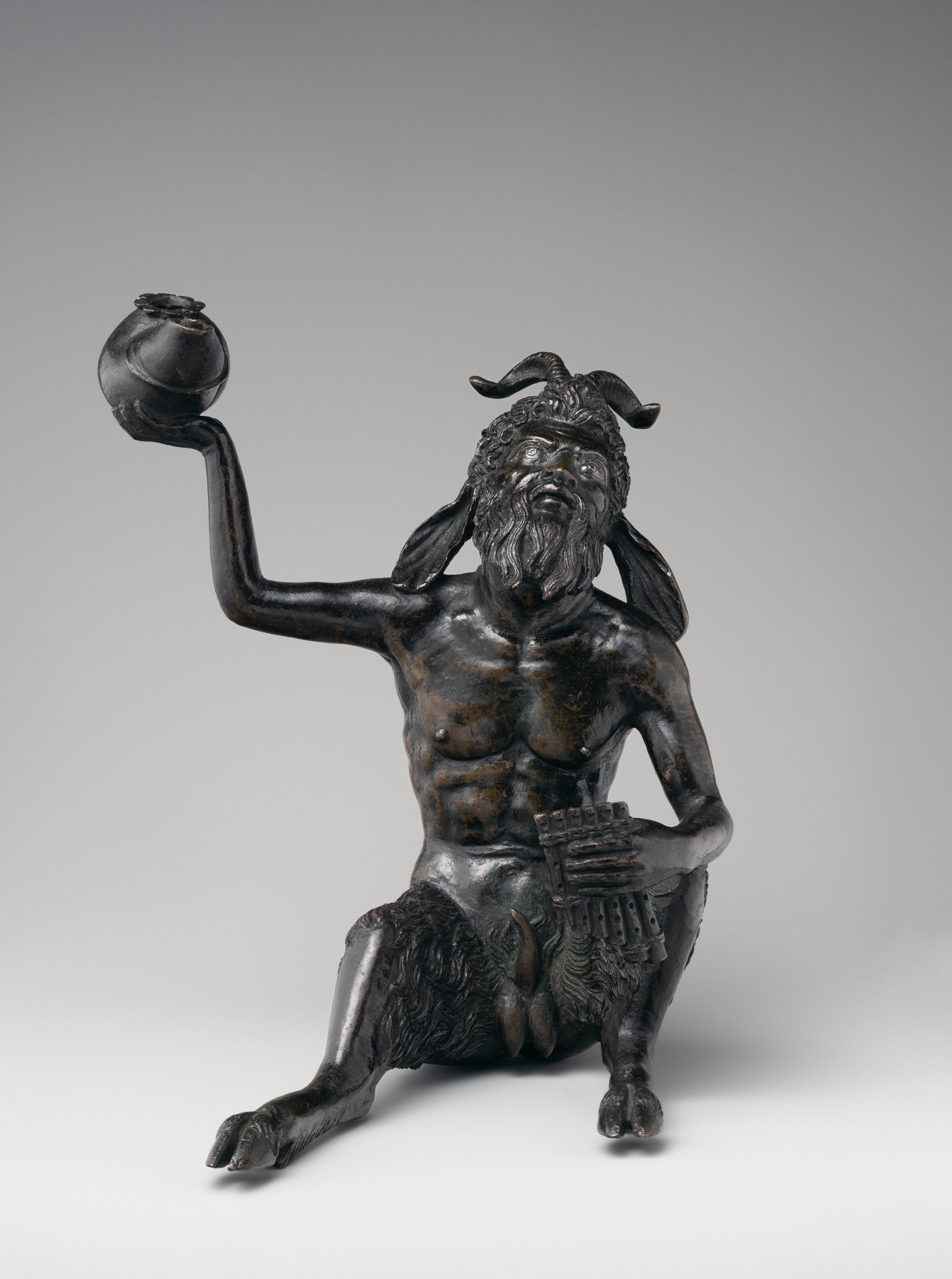
Begin with his raised hand.
The palm faces up, four fingers extending beneath a rounded vessel. The forearm rises, the upper arm reaches out, and the elbow makes a broad bend between them. The vessel comes close to the top of his head without resting on it. Gray background remains between it and the curved horn, like a sentence deliberately leaving a little room at this point.
Below sits a figure with horns, drooping ears, and a beard. His chest and abdomen resemble a human body; curly hair covers his thighs, and his feet end in divided hooves. He lifts his face. In his eyes are two small patches of brightness unlike the surrounding metal. His other hand holds a set of panpipes against his side.
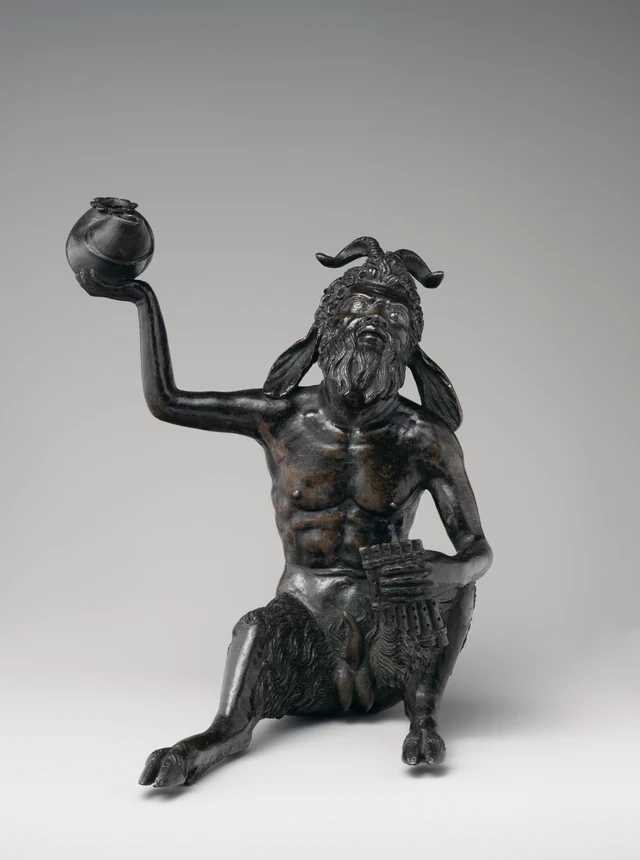
What he raises is an oil lamp. That fact adds another relationship to the pose: we can look at him, but we could also use the lamp he supports to look at something else. The sculpture is no longer only the destination of our gaze. It may also help that gaze reach beyond the work.
The satyr belongs to the woodland world of classical mythology, associated with the wine god’s company, wine, and music. During the Renaissance, ancient statues and reliefs supplied models for small sculptures of this kind; panpipes also carried associations with pastoral music. These connections help identify him without requiring us to read the action before us as a particular episode from a myth. Met research on related subjects
1. The Lamp-Bearing Hand Opens Out the Body
First, move your eyes from the vessel to the shoulder.
As the right arm reaches outward, the chest does not topple sideways after it. The chest is broad, the abdomen narrows, and the legs spread to either side below. The highest and most off-center object above is the lamp; the widest area below comprises the extended legs and seated body. This is not a compact mass gathering everything into its center.
Look especially inside the right arm. The broad bend of the elbow, the ear drooping over the shoulder, and the outer edge of the head divide the background into several differently shaped openings. The farther the arm reaches outward, the more distinctly the lamp emerges from the body. Our eyes can follow the wrist to the lamp’s outline without passing through beard and curls.
The left side, by contrast, is crowded. Fingers press across the panpipes, which lie close to the hairy thigh below and meet the abdomen above. The bent arm gathers them near the body. Both hands hold something, but one opens out while the other draws inward. The lamp receives an open position; the instrument stays close at hand, ready to be noticed.
This difference affects how we understand “raising.” Looking at the forearm alone, we might simply call the gesture holding something up. Including the other hand reveals that the two objects receive different conditions of display. The lamp projects beyond the figure’s outline; the panpipes remain within it. One object acts upon the surrounding space, while the other preserves the figure’s identity.
The lamp’s outward reach lets a user approach its opening from beside the body, without reaching across the whole torso. The space left by the raised arm both makes the lamp easy to see and leaves room to approach it.
2. An Opening Changes How We Read the Vessel
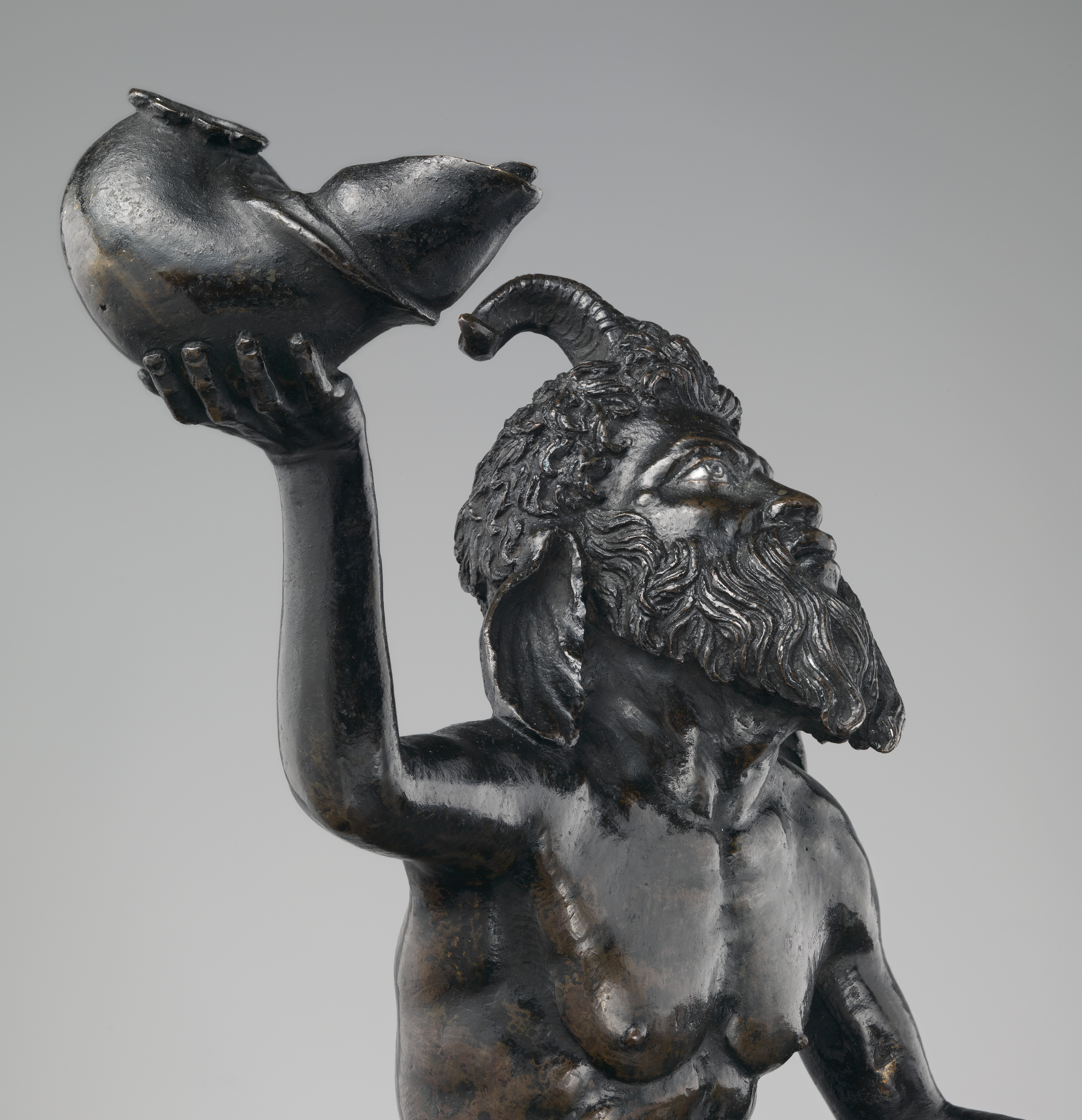
In the full-length photograph, the raised vessel is almost a dark ball. In the museum’s head-and-shoulders detail, it suddenly becomes longer.
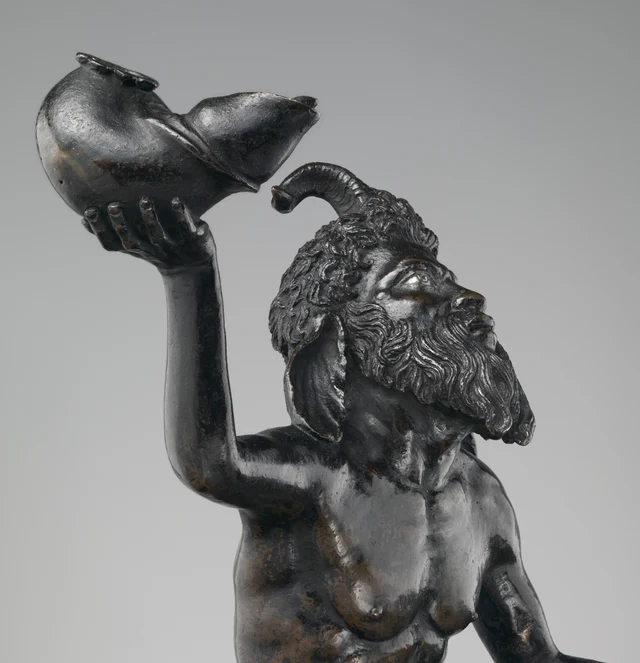
The body is broad and round, the spout projects forward, and a sloping break in the contour runs between them. The broader rim at the upper rear is not a smooth circle: its edge rises and falls. The front narrows to a much smaller opening. Four fingers spread beneath it, their tips at different heights, without enclosing the entire vessel.
These details break “a ball” into a structure that can contain something and open to the outside. We do not need to see inside to distinguish closed volume from an opening into it. A dark hole alone, however, cannot establish the object’s purpose. We need to consider the size and position of the openings together with the projecting spout.
The museum identifies it as an oil lamp and notes a channel for the wick in the narrowing section. Research on function With that information, the point where our eyes pause at the spout changes. We were comparing roundness and taper; now we also look for where liquid stays and where a wick emerges. Knowledge of use has entered our looking. No flame has appeared in the photograph.
In Figure 2, both the lamp’s spout and the satyr’s nose project toward the right of the image, but they do not form a single line. The lamp is above, the face below; horn and background separate them. Vessel and head can be seen together while keeping their own outlines. This makes “he holds up a lamp” far clearer than “a lamp grows from his head.” The hand connects the two and also keeps them apart.
The full-length view compresses the lamp into a rounder shape; the detail opens out its projecting spout. Neither angle corrects the other to produce one uniquely right photograph. They show how roundness and projection can alternately dominate as we turn around the same vessel. Its function depends especially on the projecting part, although our first glance may register only the rounded body.
3. Silver Eyes Draw Us Back
Now look at his eyes, then his cheeks.
In Figure 2, the forehead, bridge of the nose, and chest also have bright areas. Reflections occur across the metal, not only in the eyes. But a highlight on a cheek spreads along a swelling surface, while the pale color in an eye is enclosed by the lids; small circular markings can still be made out within it. Its position is very specific.
The two kinds of brightness therefore differ. Bright planes on the chest help us sense volume; brightness in the eyes readily suggests a direction of attention. The brow ridge casts a dark edge above, and the eyes show beneath it. His nose lifts, his lips part, and his beard falls from the mouth in bundles of waves. We may feel that something has caught his attention, but the photograph does not supply that object.
It is worth leaving that place unfilled.
The lamp rests on his right hand, yet his face does not lower to inspect it. Nor does he bring the panpipes to his mouth. Each object is in place, but the pose does not confine us to a moment of “operating” either one. We can follow the arm up to the lamp, be drawn back to the face by the silver eyes, then realize that the face’s orientation still points beyond the photograph.
The work thus creates two kinds of space outside itself. The lamp’s purpose suggests surroundings in need of light; the face’s direction suggests a possible object of attention. These spaces can intersect, leaving us first wondering where the lamp could cast light and then where he is looking.
4. From Behind, the Lamp Is More Than an Accessory to the Face
Move behind him. The eyes disappear, but the lamp remains.
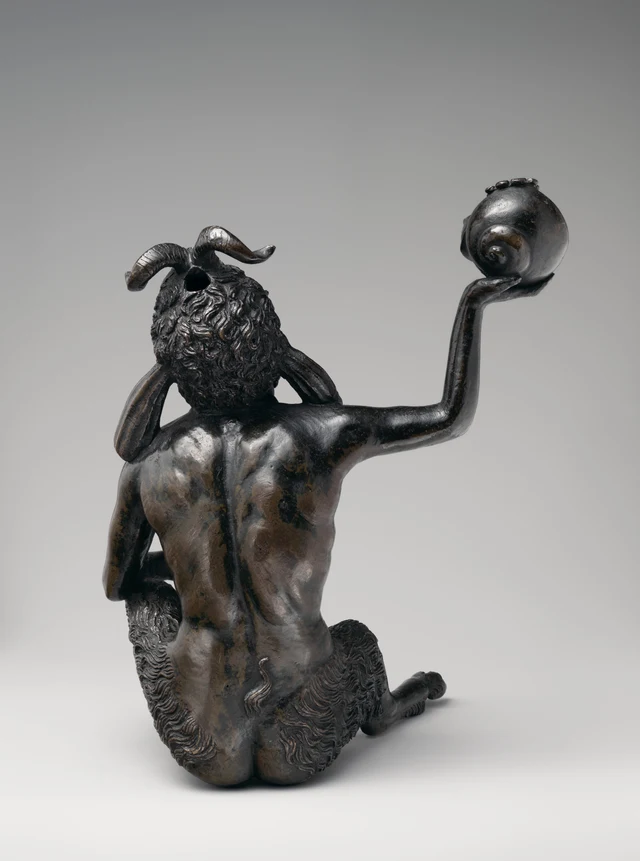
A groove descends along the middle of the back, with unequal swellings on either side. On the raised-arm side, the shoulder continues into the outward-reaching upper arm; the other arm drops sooner beside the torso. This difference between the shoulders and sides of the back carries the same action around behind. The pose does not stop at the chest visible from the front.
Farther down, the waist narrows and the short tail curves into a tiny hook. Beside the large outlines of lamp and curved horns, the tail is easy to miss. The skin around it is smoother, giving way to dense hair markings farther out on either side. The body is not covered from head to foot in one pattern. The relatively clear area around the little tail lets us distinguish it despite its size.
The back also reveals a raised spiral on the lamp’s belly. What appeared simpler from the front now has a coiling surface. If we treat the lamp only as a prop beside the face, this side’s modeling can easily be dismissed as “more detail around the back.” But once we actually turn here, the lamp still occupies the hand projecting beyond the outline and remains one of the main volumes we notice first. It does more than complement the figure frontally; it occupies space around itself.
This angle changes a habit of looking. We often take the face-bearing side as the place where a work speaks to us, leaving the other sides to supplement it. Here we can temporarily stop reading expressions and follow only the continuous relationships from back to shoulder, elbow, wrist, and vessel. The lamp retains its place, and the whole lifting gesture still holds together. Seeing the work as a usable object is therefore more than adding a footnote to a frontal portrait.
5. When We Use Him to Look Elsewhere, Are We Still Looking at Him?
The work is only about twenty-three centimeters tall. When enlarging the silver eyes and beard, remember that the lamp is small along with the sculpture as a whole. The close view afforded by a screen does not give it the original scale of a large lighting fixture.
Its function as an oil lamp allows a limited reconstruction of use: when filled with oil, fitted with a wick, and used, it need not keep attention fixed on the satyr. A user might care about whatever was illuminated. We will not specify reading, dining, or listening to music, because the three photographs do not establish those particular activities.
Yet attention moving elsewhere does not cancel the sculpted figure. The extended hand takes the lamp away from the torso, and its opening allows it to function. These arrangements for use are the very places our eyes followed while admiring the forms. Use is not hidden somewhere behind the work. It appears through the same hand, the same opening, and the same distance.
Conversely, the figure changes how we understand the object. Place a lamp on a stand, and we say the stand supports it. See this open palm, and we readily say, “He is holding the lamp.” Bodily language reorganizes the same supporting relationship.
The most suggestive back-and-forth happens here: when we need light, our eyes pass beyond the sculpture to surrounding things; when we return to admire it, they come back to the pose that makes that use possible. The lamp turns our looking outward, the silver eyes bring us back, and the palm stays at the boundary between vessel and figure.
What he raises is no label we could casually remove from the body. The lamp determines how the body opens outward and lets our looking extend beyond it. This small sculpture brings “looking at something” and “using something to look” into the same gesture.
Optional Reading: One More Question with SAE
Once we know that this is a usable oil lamp, might its useful design make us too quick to declare it beautiful?
Try stating the two judgments fully and separately. A judgment of function asks whether the vessel can hold oil, how the wick is placed, and whether it sits securely. A judgment made in looking still needs to explain why this particular open hand, outward-reaching arm, and distance between lamp and head make the work worth seeing repeatedly. The first set of questions requires functional and technical evidence; the second returns us to these specific visible relationships.
The two sets meet, but cannot answer for one another. We have not tested this lamp and cannot guarantee its performance because we like its shape. Equally, even a reliable lamp’s ability to light up does not explain why it rewards sustained looking. The significance of use here is that it reveals another intelligible relationship in openings and distances that we had first treated as contours.
Return to Figure 1 after reading this. First consider only the shapes, then look again knowing that this is an oil lamp. Where have the shapes remained the same while your attention has shifted? Explaining that change is more worthwhile than giving the whole work a score for “functional beauty.”
The general account of SAE (Self-as-an-End) aesthetics explicitly distinguishes beauty from usefulness and proposes that context itself is a constituent of beauty. This essay uses that distinction to pose the questions above, not to prove the object beautiful because it works. General account of SAE aesthetics, section 3
Notes on Images and Sources
The Met’s basic catalog fields still list Andrea Briosco, called Riccio. The 2022 research on the same page, however, suggests that the body may derive from his model and have been completed by a later sculptor, or be connected with an associate or his workshop. It cannot simply be attributed to Riccio’s own hand. The basic material field says bronze, while the technical discussion identifies brass; this essay therefore uses “copper alloy.” Collection record and research
All three photographs are the museum’s original JPEG downloads, each 4,000 pixels along its longest edge. They have not been color-adjusted, recompressed, repainted, generated, or independently cropped. This essay observes the photographs, in all of which the lamp is unlit. Photographic highlights cannot reconstruct the actual effect of lamplight. The object has not been touched or lit for this essay; the reconstruction of use and interpretations of the figure are not presented as museum conclusions. Image sources, dimensions, licenses, and checksums appear in the Image Credits; research sources are in the References.