Begin with the curved surface reaching forward at the upper right.
It swells high, lowers gradually toward the right, and ends in a blunt point. Beneath it, a narrower form curves downward to a small rounded tip. Joining the two, we can readily make out a horse with its head lowered. Yet just as our eyes begin to follow the neck down, they encounter a recess framing a circular projection and a thick rod extending diagonally downward.
The head remains, but the body begins to resemble an assembly of machine parts.
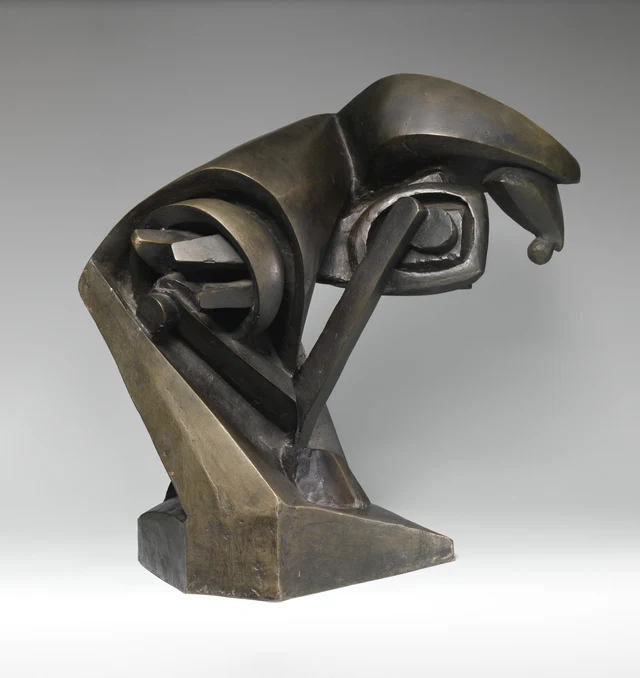
The sculpture does not spread a run across a long distance. It compresses bends, turns, and forward reaches into a fairly compact form. Our eyes follow different directions; the more we try to join them into a continuous route, the more we feel an energy accumulated within, not yet released.
This also offers a way into its historical setting. In the early twentieth century, artists’ interest in motion extended beyond depicting a pose to organizing continuous change into form. Discussing Duchamp-Villon’s Horse, the Peggy Guggenheim Collection traces its development from a more naturalistic image toward a synthesis of horse and machine, linking associations of pistons, wheels, and shafts to an age of new technology. That account concerns a different cast. What we borrow here is the background to the conception; date, dimensions, and surface of the physical object remain those of the Met’s bronze. Guggenheim museum account, page 16
1. Horse Outside, Machine Within
Moving from the photograph’s upper left toward the right, several broad curves join into an undulating outer edge. It is not smoothly continuous: near the middle, a deep fold separates two volumes, and the right end abruptly contracts downward. This outline retains the connected directions of back, neck, and head, allowing us temporarily to gather very nonnaturalistic parts into a horse.
Looking inward, we find a different organization.
A thick arc on the left opens toward us, containing several short, horizontally projecting blocks. Near its lower end is an almost circular end face, followed by a long bar sloping down to the right. On the right is a squarer frame with rounded corners and another circular projection at its center. A thick rod extends in front of it diagonally down to the left. The sides do not repeat the same shape, but both present enclosing and enclosed forms, a relatively round core, and projecting bars.
This resemblance matters. A lone circle might look like incidental decoration. When both sides combine enclosure, center, and diagonal extension, the eye begins reading parts that could transmit movement to one another. The sense of machinery develops through these relationships, not simply because bronze looks metallic.
Outer and inner layers, however, do not divide neatly into two systems. The large left arc resembles both a casing over a body and a wheel’s thick rim. The swelling volume above helps us recognize an animal while continuing the clear, component-like edges. The horse is not wearing mechanical armor. The same forms serve two ways of seeing, bringing muscular contraction and mechanical linkage closer together.
This makes “abstraction” specific. The change concerns more than how much ear, eye, or hair has been omitted. Body parts begin appearing through another way of connecting. Instead of identifying every muscle along the skin, we follow curves, recesses, and rodlike forms to find where action leads.
2. Curves Bring the Eye Back
Look at the thick left arc. Its brightest areas lie along the upper edge and outward-facing curve; toward the interior, color quickly darkens. Light and shade clarify its thickness. It is not a circular line drawn on a surface, but a volume swelling forward and curving inward.
Following it downward, our eyes meet the internal horizontal blocks, then turn toward the diagonal bar. The arc does not let us complete a smooth circuit. It keeps encountering cuts, obstructions, and other directions. The right side works similarly: a frame surrounds the center, but the rod in front connects that center to the lower area. Circular and diagonal routes cross.
The sense of rotation therefore comes neither from the sculpture actually turning nor from a photograph blurring movement. Contours are clear, edges stable. Our eyes repeatedly switch routes between curve and straight line: turning inward along an arc, moving outward along a rod, then meeting another curved volume.
Nor are these circles regular. The right frame is flattened, its corners unequal. The left arc changes apparent width with its orientation, and blocks interrupt its interior. Such irregularities preserve sculptural depth rather than reducing the forms to a few symbols completed on paper. Rings, short blocks, and long bars occupy different depths; their directional relationships must always be seen through overlap.
Reducing Horse to a black silhouette would erase most of these internal relationships. The rightward-reaching head and contracted lower stance would remain, but it would be difficult to see how the parts seem to set one another in motion. Its energy needs both the outer contour and the darker, less immediately readable places within it.
3. Contraction Below Tightens the Forms Above
Now look at the two most conspicuous diagonals.
The long bar on the left descends rightward from near a circular end face; the thick rod on the right descends leftward from the higher frame. In the photograph they converge downward. Gray background visible between them shows that these diagonals are not incisions on a solid mass, but forms crossing an interval toward the lower section.
That interval does important work. It prevents the upper portion from looking like metal piled continuously to the ground. Head, neck, and side curves are full, while diagonal parts narrow the form below. Volume is lifted and connections appear tight, as though several directions were pressing simultaneously toward a smaller area.
Farther down, a broad, thick slope on the left meets the lower section, which then spreads rightward. The large upper arc, internal diagonals, and flatter point of rest below establish three rhythms: curving back, tightening, spreading out. At last we find somewhere to pause, though we still remember the opposing directions above.
“Gathered energy” thus has a traceable basis in looking. Forms expand above, diagonals concentrate below, and the bottom reconnects that concentration to a wider footing. This makes action feel temporarily held in check. How actual weight travels through the bronze would require structural information. The photograph supplies visible connections and space, not a load diagram.
The work is 43.2 cm high and 45.4 cm at its widest. It is a compact sculpture whose connections can be examined individually at close range, not a monumental horse the size of a real animal. Enlarged on screen, its slopes and curved shells may resemble parts of industrial architecture. The dimensions bring that imagining back to a specific object. Many directions occupy less than half a meter; compactness itself contributes to the sense of concentrated energy. Dimensions and weight
4. Bronze Has Not Become a Flawless Machine
The bronze in this photograph is not uniformly black. Light-facing surfaces shine yellowish brown, inward-turning areas approach blackish gray. Light changes gradually across the broad upper curve, while a narrower bright band flashes along the right frame’s edge. These differences reveal broad curved surfaces and harder boundaries in their own ways.
Closer looking also reveals that the surface is not entirely even. The interior of the right frame undulates; edges of the short left blocks are slightly irregular. Color patches and small uneven traces appear on the larger lower surfaces. They coexist with the relatively regular edges of several bars, maintaining a distance between the work’s mechanical associations and the actual bronze surface before us.
Rings, rods, and nearly circular end faces may suggest machinery, but we do not see a device with bearing clearances that could actually be started. Wheel-like parts still belong to one sculpture, and every variation has not been smoothed away to imitate an industrial product. Seen this way, a machine is not the thing the work ultimately impersonates. It supplies a vocabulary of forms through which the horse’s body is reorganized.
The material’s date also requires care. The museum dates the work to 1914 and tentatively dates this bronze cast to 1921, while the artist lived from 1876 to 1918. The date of conception and the date of this bronze’s production differ, and that uncertainty must remain. We cannot identify every unevenness on this surface as a mark personally left by the artist in 1914. The Met’s current record
This distinction does not hinder viewing. It lets us face the object more accurately: a sculptural conception of 1914 reaches us through a bronze with its own date and history. The volumes, color, and sheen before us belong to this physical object and need no other cast to complete them.
Return to the upper right. The curve that first helped us recognize a horse’s head still reaches forward. But it no longer expresses “forward” alone: the frame, diagonal rod, gap, and lower section connect that reach to the entire sculpture. Running need not depend on four legs each assuming a definite pose. Here, animal movement has been rewritten as relationships among volumes. The forward impulse emerges through an organization tightening inward from many points.
Optional Reading: Two Rays—Change the Question, Then Examine Expectation
Does it look like a horse or a machine?
The question is natural, but it can turn looking into a vote too soon. Viewers recognizing the head say horse; those noticing rings and rods say machine. Both can find evidence, without necessarily seeing more as the argument continues.
Try separating the question for a moment. Which forms let us recognize a horse, and which relationships make us sense energy being organized? The first leads to the lowered head at upper right and the connected back-and-neck outline. The second follows the ringlike sections on either side, diagonal bars, and contraction below. We can begin explaining how the same sculpture retains an orientation toward a particular body while rewriting how its parts connect.
Non Dubito’s philosophical-ray essay “The House Is Still Unsold. The Argument Has Changed.” considers precisely how a question can distinguish reasons that previously blocked one another. It also reminds us that a useful distinction must remain revisable. Having opened a route, it must not immediately confine the object to two fixed columns. Essay on philosophical beauty
Back at Horse, this reminder quickly proves useful. Assigning the upper outline entirely to “horse” and all internal rings and rods to “machine” would miss the thick left arc. It both maintains bodily fullness and makes the gaze circle. The upper-right head and neck likewise help identify the animal while contributing to the organization of energy through their forward, downward direction. The distinction began our close looking; close looking now requires the categories to overlap again.
This gains more than an argument over how much it resembles a horse. Recognition of an image and relationships of movement can be discussed separately without necessarily being assigned to different components. The question’s value is to make this particular situation articulable, rather than to give the sculpture a more sophisticated name.
The second direction asks how much of the energy we describe has already entered our expectations.
Seeing a circular end face attached to a rod, we may expect it to rotate or push and pull another part. Seeing the lowered head and contracted lower portion, we may expect the horse to leap. Both expectations arrive before any actual motion, while the sculpture never starts.
The cognitive-ray essay “The Note Has Not Sounded. You Are Already Waiting.” examines this structure: past experience reaches toward the next moment; expectation may fail and need to be checked again. It does not automatically equate surprise with beauty or turn personal habits into rules for everyone. Essay on cognitive beauty
Through this direction, we can ask more specifically what starts our expectation of rotation. If it is the circular end face on the left, its connection to the diagonal deserves another look. If it is the upper curve leaning forward and downward, the expectation may owe more to familiarity with animal posture. Both kinds of experience meet in the same work, without necessarily carrying equal weight for every viewer.
Nor does the sculpture merely disappoint expectations. Circles, diagonal rods, and the lowered head still support associations of movement; they simply do not deliver them as a playable next frame. What needs revision is our habit of treating these forms as a ready-made set of operating instructions. They can respond to one another and make energy perceptible without specifying which part moves first and how motion is then transmitted.
The two rays do different work. The philosophical ray gives “what it resembles” and “how it organizes movement” separate places to be questioned, then allows them to overlap. The cognitive ray exposes the next step supplied by the viewer and tests whether expectation has been mistaken for a fact about the object. This motionless bronze need neither start up to justify itself nor sacrifice the horse’s image to acquire modern force. Within one set of volumes, it keeps two familiar experiences of movement in contact.
Notes on Images and Sources
This essay examines the Met’s Horse, accession number 2025.616.7, using only one official full oblique side photograph of this object, measuring 3774 × 4000 pixels. The JPEG remains as officially downloaded, without cropping, color adjustment, recompression, retouching, or generation. No other casts, enlarged versions, or unverified viewpoints have been included, and the essay does not claim an in-person examination from all sides.
Date, material, dimensions, weight, and collection information follow the Met’s current record. Background to the conception draws on the Guggenheim’s account of another cast, without conflating their casting dates. Directions among forms, gathered energy, and routes of looking are readings this essay proposes from the photograph. Image sources and permissions are in the image credits; supporting sources are in the references.
