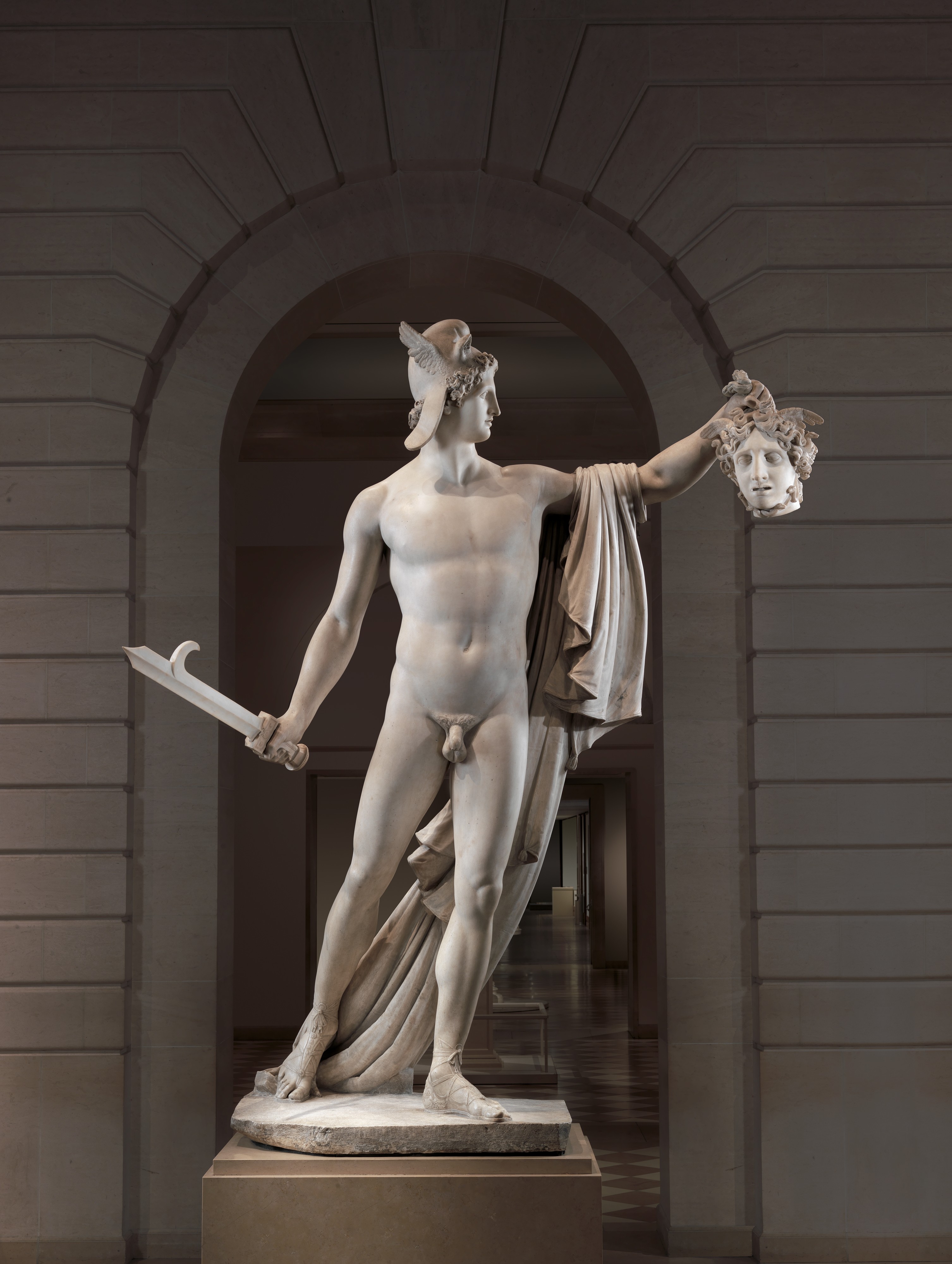
Begin with the height of the two hands.
One holds a sword beside the waist; the other reaches upward, gripping a mass of curling hair. Beneath that hair hangs a face. Perseus turns his head toward it, while his body opens toward us. Sword and head occupy opposite sides of his body, separated by a broad expanse of calm, smooth chest and abdomen.
He has stopped killing. He is still doing something else: holding up the result for others to see.
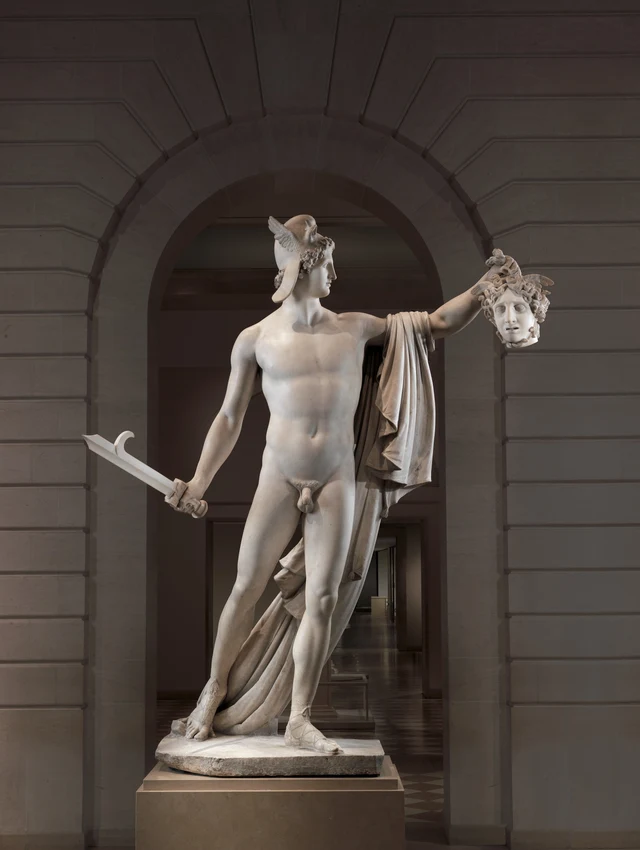
Canova arranges an intensely violent story into forms we can contemplate at leisure. The killing has not disappeared from the work: the severed head is right before us. But the hurried struggle has receded, leaving an extended arm, a composed face, and the positioning of what is displayed. This transformation is what most deserves our attention: how do we look from a whole, beautiful body toward the other face held in his hand?
The work belongs to the Neoclassicism of the early nineteenth century. Canova studied ancient Greek and Roman sculpture, reworking ancient subjects through refined bodily proportions, clear contours, and restrained expressions. “Classical” here does not mean merely copying an antiquity. What matters is giving a new composition the dignity and persuasive force of ancient sculpture. V&A introduction to Canova
The version examined here was made for Count and Countess Tarnowski and is now in New York. It postdates the Vatican version, and the two are not identical in every detail. Let us identify this particular work before looking at how it places victory before us. Met collection study
1. The Sword Remains. The Sword Stroke Is Over.
The right hand holds the hilt low, with the blade extending diagonally outward. A conspicuous hook at its end distinguishes it from an ordinary straight rod. Yet the hand is not raised above the shoulder, and the body does not twist violently after the blade. The sword can tell us what has happened without propelling the body before us into another blow.
The other side does the opposite. The left upper arm extends almost horizontally, the forearm lifts, and the hand grips above the head. Both blade and head move away from the body, one low and one high, opening out the torso to either side. Between them is no opponent engaged in combat, only a body opened to the viewer.
In familiar versions of the myth, Perseus is charged with obtaining Medusa’s head. With divine assistance, he uses a reflection in a shield to avoid her petrifying gaze and beheads her while she sleeps. It is an attack dependent on special equipment and timing. The statue before us does not reenact these steps: there is no sleeping body, no blade approaching a neck, and no shield in which the hero can see a reflection. Met: Medusa in Ancient Greek Art
“Victory” is therefore a well-grounded traditional interpretation. The trophy is already in his hand, the weapon has left its attacking position, and the figure is no longer evading danger. Museum curator Peter Bell emphasizes that the action here is one of presentation rather than killing. He also suggests that the work may evoke the hero offering the head to Athena. Met commentary
The photographs alone do not establish the recipient of an offering. What viewers can first confirm is that the left hand has carried the head out from beside the body into a position where others can see it. The gesture turns a dangerous task accomplished in private into a publicly visible result. Standing before the statue, we find ourselves at the receiving end of this display.
2. His Body Opens Toward Us, His Face Turns Elsewhere
This sculpture stands more than 2.4 meters tall. In Figure 1, the figure almost fills the architectural arch, his shoulders and arms opening out the upper body’s width. Once we know the actual dimensions, the raised head is more than a small accessory on a screen. It hangs in the hand of a tall figure, a considerable distance above the ground.
Nor do the legs share the image’s directions equally. The hero’s left leg is straighter, on the right of Figure 1; his right leg angles toward the other side, its heel lifted. The upper body does not tip after the slanting leg. Waist and abdomen turn between the legs, and the shoulders spread more widely above. Looking up from the feet, we follow several slight changes of direction before our eyes reach the extended left arm.
This makes the hand holding the head look effortless. The whole figure is large, but the gesture produces no gritted teeth or hunched shoulders. The hilt is gripped, as is the hair, yet chest and abdomen retain broad, continuous surfaces. Force lies in the arrangement of the pose rather than concentrating in a single eruption of facial expression.
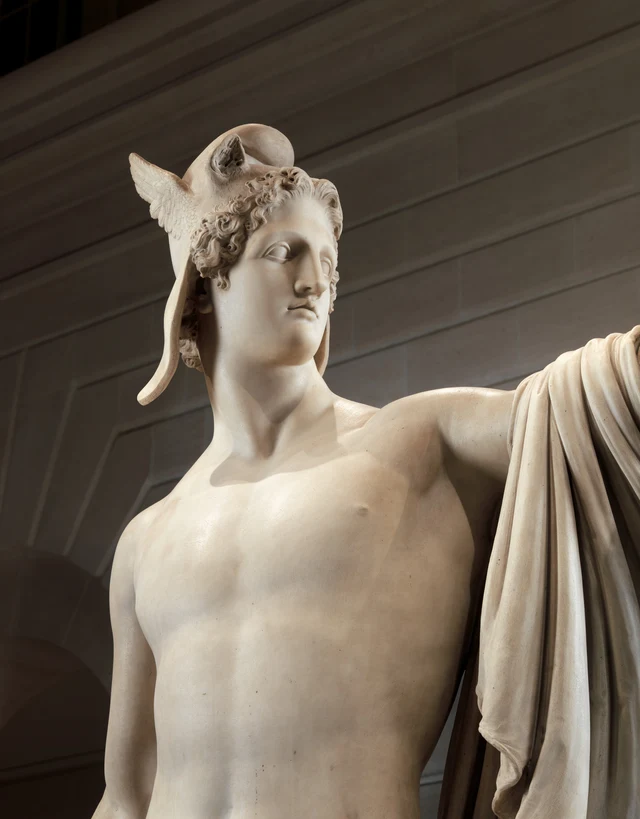
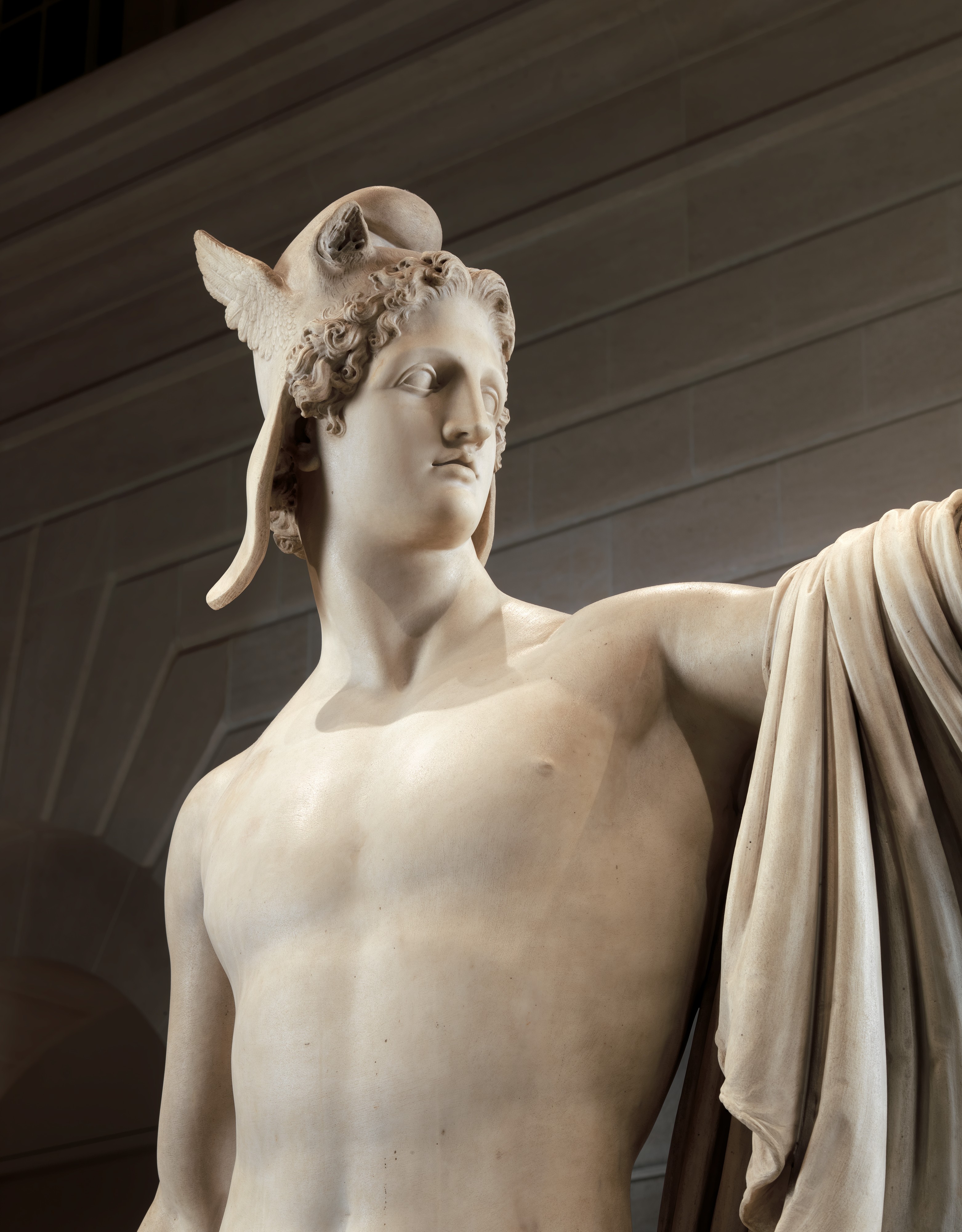
Up close, his lips are closed and no deep furrows gather between his brows. Thin plates descend at either side of the helmet, while curls form dense small undulations around the temples. They make the smooth cheeks and neck more noticeable. We might read confidence or feel a distance; whatever name we choose, the sculpture does not hurry us with a dramatic expression.
The turn of the head is especially important. His chest faces the viewer, but his face turns toward the side holding the head. We can see his body fully, yet cannot easily take that openness as direct communication with us. The direction of his attention leads us away from his face, along shoulder, arm, and hand, in search of another face.
The ancient Apollo Belvedere was an important reference for this composition. Met collection study Even without knowing that antiquity, we can see how dignity is achieved here: the torso stays open, the limbs leave one another room, and the turn of the head gives that openness a direction. The ideal body is more than a set of attractive proportions. Here it does the work of guiding our eyes.
3. Medusa, Too, Has a Calm Face That Invites Looking
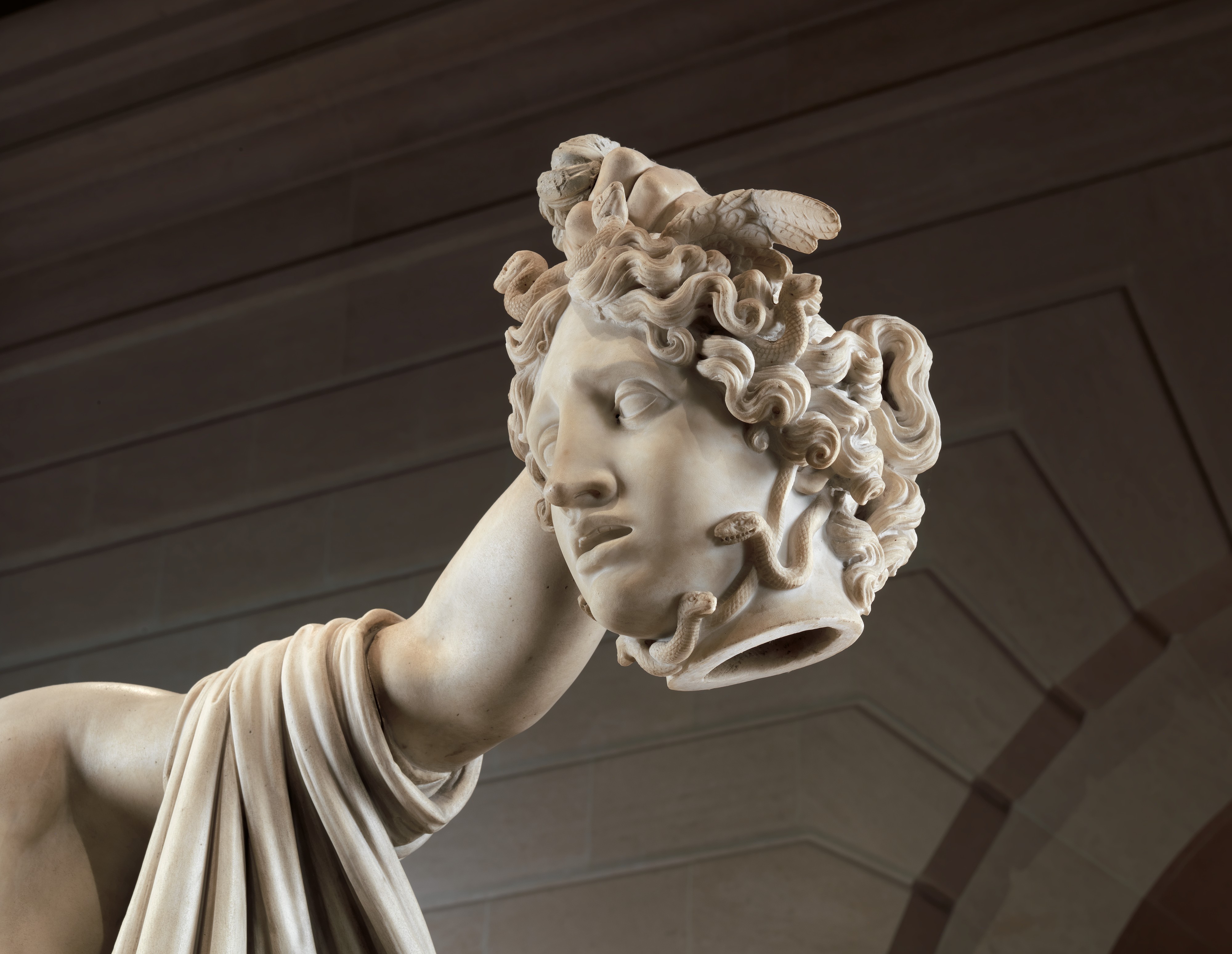
Follow the left arm, and the first things to catch your eye may be the snakes. They emerge from the curls and coil around temple and jaw; their tiny scales differ from the broader locks of hair. Yet the center they surround is not a snarling animal face.
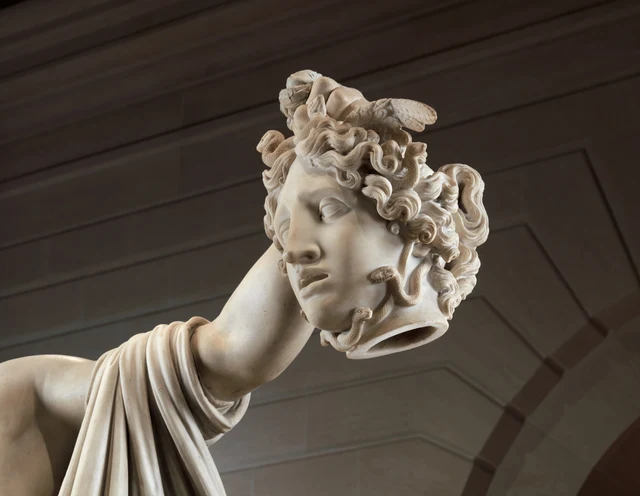
The bridge of her nose is slender, her cheeks even, her mouth open only a narrow slit. The eyelids have distinct edges; the face is not covered with a profusion of wounds or blood. Her first resemblance to Perseus lies in the equally careful carving of their facial structures: elaborate curls surround smooth skin, and both faces allow us to stop and look closely.
The difference lies in how this face stays in the air. Perseus’s head rises from a neck supported by shoulders; Medusa’s is held by a hand above. One rests on a body, the other hangs by the hair. Even if we set the sword aside for a moment, the different means of support already make their relationship clear.
The oval opening beneath her neck makes the distinction more concrete. It has not been fashioned as a wound with flesh rolling outward, but from below it clearly reveals the darkness inside. The face may be as delicate as skin, yet the head is still held up as something separated from a body. Calmness cannot erase that severance. It shifts our attention from spurting blood to lifting, suspension, and display.
We need not fill in the story with the assumption that “a monster must be ugly.” Medusa already took many forms in ancient Greek art, with beautiful images appearing in the Classical period; her head also long served in protective imagery intended to ward off evil. Met study of Medusa Knowing this makes Canova’s choice clearer: snakes and severance still signal her dangerous identity, while her face retains forms we can admire.
Remember the myth’s rules, too. Even after her death, Medusa’s head can turn people to stone. We cannot say that beheading has eliminated its danger simply because Perseus now turns toward it. Myth and image history Directing his face toward the head creates a powerful compositional relationship; the sculpture does not also provide a plot explaining how its supernatural power has been disabled.
Our position as viewers of this face is therefore unusual. The story tells us not to look, while the work has gone to great lengths to make it worth looking at. Medusa is raised as a trophy, yet her own forms hold our attention. She has not regained her body, but neither has she shrunk to a small token serving only to prove a victory.
4. Drapery Connects the Two Faces to the Ground
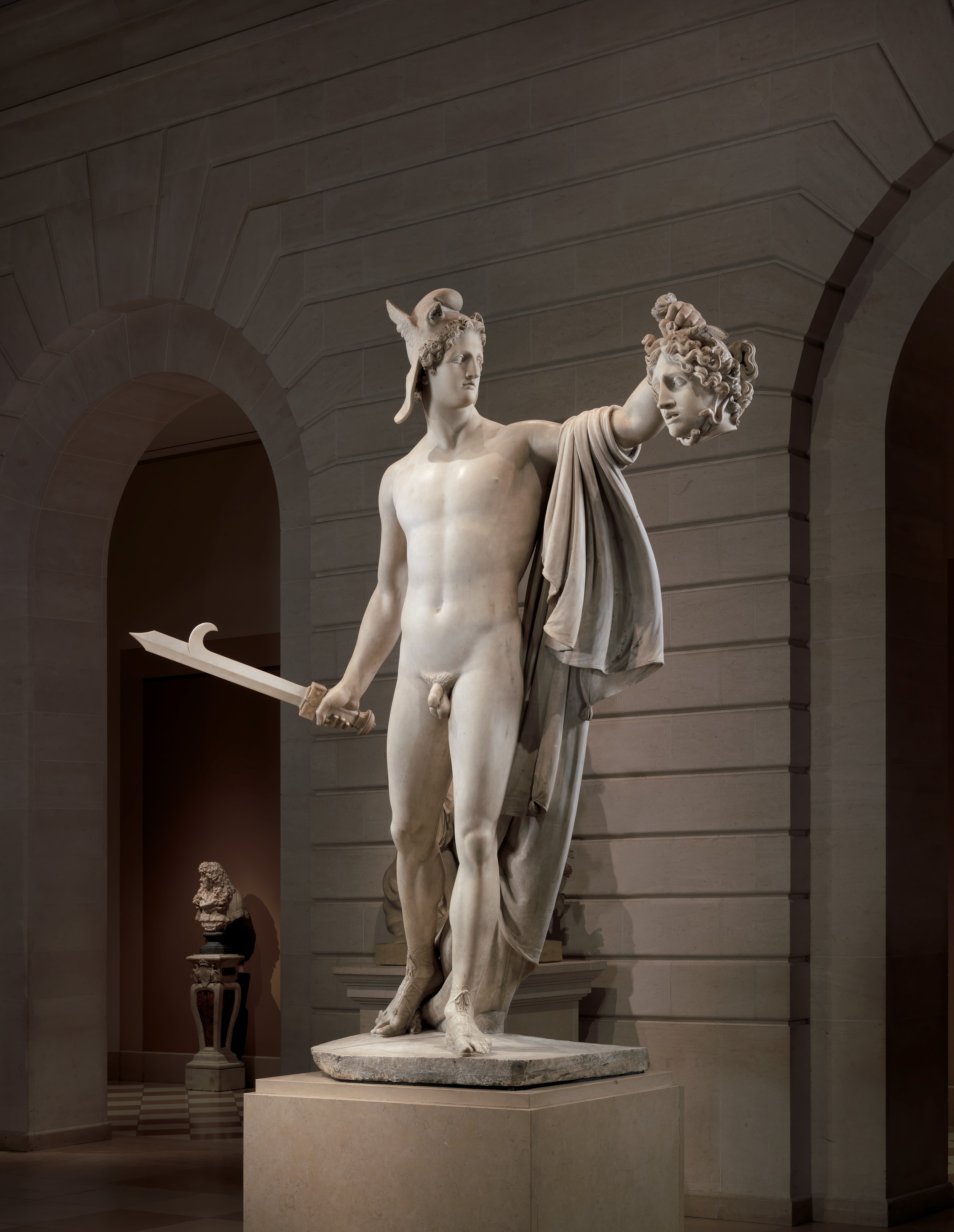
Turn to Figure 4 and, for a moment, leave the heads aside to look at the cloth on the left arm.
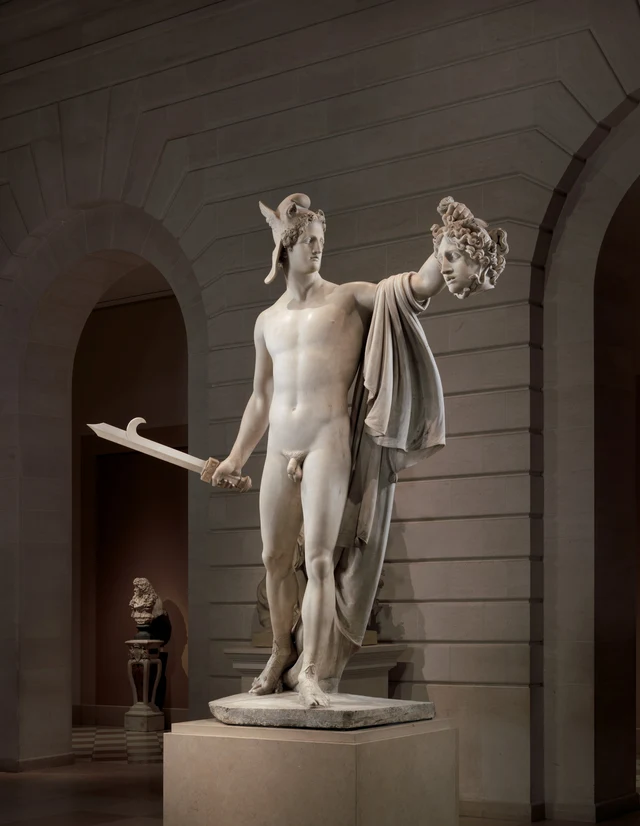
Near the upper arm, the cloth gathers into narrow, closely packed folds that broaden as they descend. Its outer edge curves beside the waist, while deep folds within keep carrying the eye behind the legs. Lower down, long folds angle toward the foot on the other side before coming to rest on the base.
Seen alone, the nude chest, abdomen, and legs form a fairly clear human figure. The cloth adds an independent route beside it. Above, it approaches the raised hand; in the middle, it keeps a distance from the abdomen; below, it draws close to the feet again. We can pass from the head along the arm into the folds and follow them all the way to the ground without descending along the naked torso.
This route also adjusts the sculpture’s balance of open and dense areas. The space beneath the left arm is not entirely empty; drapery gives it substance. Open space remains around the forearm and head, so the suspended face does not merge into the chest. The sword on the figure’s right extends alone, slender and rigid, contrasting with the closely packed folds on his left.
Figures 1 and 4 present different overlaps. In Figure 1, the left arm extends more fully across the image and Medusa’s face is nearly frontal. In Figure 4, the forearm points more clearly toward us and the head turns to the side. The raised object acquires depth: it occupies space in front of the hero’s body rather than lying beside him like a flat design.
Cast shadows in the photographs also remind us that marble folds are not lines drawn on a surface. Deep creases darken inside, outer edges catch light, and the cloth’s undulations genuinely extend forward and back. The nude body’s continuous curves, the channels in the drapery, and the small turns of the snake-hair organize three rhythms of looking in the same stone. Calmness is not an impoverishment of the surface. It lets these differences become visible one by one.
5. Victory Needs a Viewer
Now return to the two hands with which we began.
The sword is low, the head high. At first, they may merely help us recognize the myth. After looking at both faces and the drapery, raising the head has become more than a pose at the end of a story. It determines what is easiest to see, who appears as a whole person, and who appears as an object that can be picked up.
This is the unease that remains within the sculpture’s dignity. The hero receives a complete, composed body; Medusa is reduced to a head held in a grip. Both are delicately carved, but that does not put them on equal terms. Soft facial features and a tidy severed neck make the violence less glaring while keeping its result conspicuous.
The traditional interpretation of heroic victory is thus a useful starting point. It helps us understand how sword, helmet, severed head, and presenting gesture belong to one story. Continuing to look, we can also see that victory is available for such tranquil admiration because the struggle has been moved out of view and its trophy placed where it is sufficiently clear and beautiful.
Canova does not make us witness the sword stroke. He brings us before the moment after the head is raised, allowing us to marvel at stone becoming skin, curls, and folds while also requiring us to see the hand gripping the hair. Beauty prolongs our looking. That prolonged looking gives us time to recognize what this calmness consists of.
Optional Reading: Another Look with SAE
If we find Medusa’s face beautifully carved, does that mean we approve of her beheading?
We can first make the question smaller. Return to Figure 3 and identify two kinds of things that hold your attention. One might include the distinction between curls and snake scales, the thin edges of the lips, or the turn from cheek to jaw. The other might include the gripping hand above and the neck without a body. The first directs attention to how the carving works; the second makes us aware of what has happened in the image. Neither kind of attention needs to cancel the other within the same photograph.
Return to Figure 1 and see whether your judgment changes. The delicate beauty of the head in close-up, restored to the whole sculpture, now belongs to one person’s act of displaying another. You can admire the formal relationships while finding them unsettling. You might also think the work deserves continued looking precisely because it gives that unease such clear form.
This differs from simply changing a verdict of “pretty” to “ugly.” The question is what judgments of form, feelings of pleasure, and judgments of an action are each responding to within one act of looking. If we express them all with the single word “like,” we can easily miss distinctions we have actually seen.
The general account of SAE (Self-as-an-End) aesthetics explicitly distinguishes beauty from pleasure, and from other judgments such as correctness and usefulness. That distinction offers a way in here: recognizing that a sculptural relationship works does not require us to endorse every action it represents. Such distinctions help us keep looking rather than use a theoretical term to pass a final judgment on hero or viewer. General account of SAE aesthetics
Notes on Images and Sources
All four photographs come from the same Met collection record: two full-length front three-quarter views, a detail of Perseus’s head and chest, and a detail of Medusa’s head. Each measures 4,000 pixels along its longest edge. The official download files are preserved unchanged, without color adjustment, recompression, repainting, or generation. Lighting, architectural background, and framing affect the appearance of the forms; these photographs are not treated as a complete view around the sculpture.
This essay examines accession number 67.110.1 alone. Details from the Vatican version or treatments of the subject by other sculptors have not been substituted for its own. Sources for object information, myth, and historical interpretations are identified separately; the particular sequence of looking and the readings offered are organized by this essay. Full image sources, dimensions, licenses, and file checksums appear in the Image Credits; research sources are in the References.