Before smiling along with the boy, look at what his hands are doing.
At the center, one plump hand grips part of the dragon’s mouth, its fingers curled into a row. The other presses on the creature’s head. Its long snout points diagonally upward, the open mouth just before the boy’s chest and belly. Above it, the child tilts his head, the corner of his mouth slightly raised. The two mouths are close together. One looks relaxed; the other is stretched into an enormous opening.
The round face may attract us first. Following the arms, we discover that the smile has not told us everything about the action.
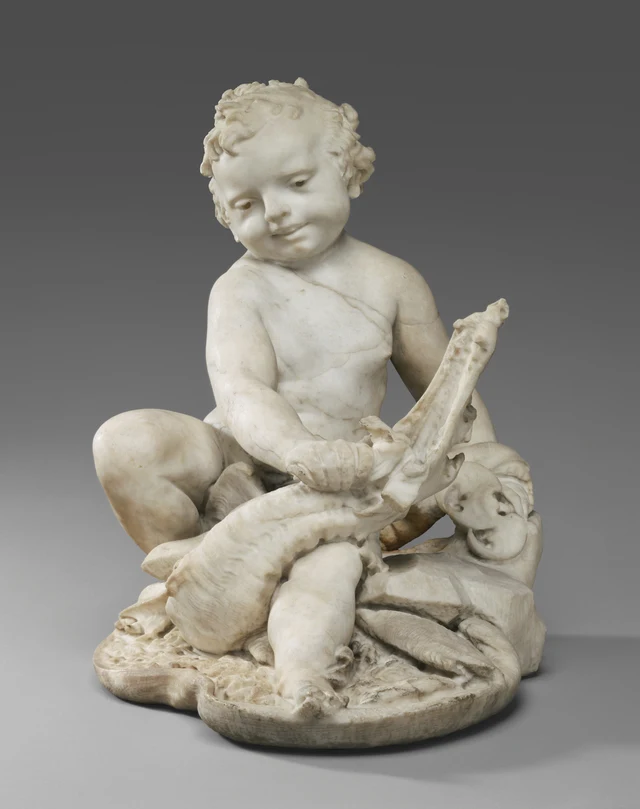
The sculpture puts exceptional strength into a body that still carries baby fat, without making that body look strained. How the child stays seated and how the dragon crowds among his limbs both contribute to this ease. The opened mouth also connects the compact group to its possible use as a fountain. The sense of play here does not mean combat has vanished. It means the figure exerting force need not look as though he is exerting himself.
Made in early seventeenth-century Rome, the work is now attributed by the Getty to father and son together. It was made for the residence of Maffeo Barberini, later Pope Urban VIII. The museum connects the boy with the ancient tradition of the infant Hercules overcoming serpents. In that tradition, a very young body and astonishing ability could already coexist. This sculpture goes further, making that ability appear to be something a child can exercise casually. Museum account That background helps explain why the child can defeat a monster. To understand why his strength looks so effortless, however, we need to begin with the way he sits.
1. Strength Hidden in the Sitting Pose
The child does not stand with his chest lifted or brace one leg behind him to spring at an opponent. He sits low. One leg opens wide toward the left of the image, its rounded knee projecting outward. The other lower leg descends in front, bringing the foot to the base’s forward edge. The space between the legs is not empty. The dragon’s curved body crosses it, joining the child’s belly, hands, and feet within a crowded little area.
Trace only the child’s outer contour for a moment: the head leans sideways, the shoulders differ in height, the forward-reaching arms bend, and the knee opens to the side. This is no neat, upright seated outline. Yet the extensions most likely to unbalance the body do not occur. The hands stay close, and the dragon’s mouth is brought before his belly. He need not pursue it, only keep it in front of him. The upper body’s actions can therefore remain short and near.
The lower volumes support this closeness. Spread legs, the crosswise dragon, and the lower leg in front all remain within the base, making a broad, substantial bottom. As the group rises, the forms become fewer, ending in the tilted head. The face can look lively while a dense set of contacts remains beneath it. Part of his apparent effortlessness comes from the fact that the sculpture has not made him into a pair of hands suspended in air.
Here, too, posture meets story. The dragon is both the creature he subdues and the body he sits on. Narratively, the two bodies oppose one another. Formally, they cannot be separated as readily as two independently standing people. The boy’s body is arranged along the dragon’s mass, while the dragon passes between his legs. The creature has not been lifted away from his body as a trophy that can be displayed separately. It remains close, sat upon, gripped, and pressed down.
The entire group is about fifty-six centimeters tall and fifty-two wide. These nearly equal dimensions remind us that its presence does not depend on towering height. The legs extending sideways and the dragon below matter almost as much as the height of the head. Enlarging only the face on screen would lose that broad lower body and the volume on which “ease” depends.
2. Rounded Flesh, Curving Claws
After taking in the seated pose, move to the child’s wrists. The gripping fingers are not long, distinct joints but little rounded segments crowded together. The forearm narrows at the wrist, then quickly swells into the palm below. The legs behave similarly: knees, calves, and ankles do not form straight rods but a succession of expansions and contractions. We recognize a young child’s softness through these changes.
The dragon offers another way of reading a body. Its belly has repeated transverse ridges, the edges of its long snout have pointed projections, and curled forms appear beside its head. The child’s skin lets the eye glide across broad curves. The dragon’s surface repeatedly interrupts it, asking us to distinguish a short stretch of relief or a curling edge. Both are marble, yet we do not read them as the same kind of body.
The difference exceeds “smooth” and “rough.” The dragon’s snout is also an elongated volume, but toward its upper end it becomes narrow and long, with sharp edges. The boy’s outstretched forearm retains its rounded thickness near the wrist. Two adjacent forms suggest, respectively, a hard mouth and flesh that might yield to a pinch. The stone has not actually softened. Softness arises from how the form changes between neighboring parts.
Look down again and notice that the boy has not kept the monster wholly apart from his own body. A dragon’s claw reaches beside the forward ankle, its curved tips close against the rounded lower leg. On the other side, the creature’s body obscures part of the leg’s course. Above, the hands control the mouth; below, legs are entangled with claws and torso. The child’s seemingly casual limbs have little space exclusively their own.
This small detail prevents the scene from becoming “a cute child plus a strangely shaped toy.” The dragon has its own claws and mouth, points that catch our attention, and a form that continues to approach the child. Yet no boy’s face tightened by pain answers those points in the photograph. We see contact without corresponding strain. Extraordinary ability emerges through that mismatch.
The two bodies share a similar marble color, so no strong color boundary divides their contact. Our eyes must follow recesses and occlusions to tell leg from dragon. Looking involves a little work of disentangling. Rather than recognizing two things first and then seeing them brought together, we gradually distinguish two bodies where they crowd against one another.
3. The Distance between Two Mouths
The child’s smile is understated. Only a fine gap separates the lips; one corner lifts, and the full cheek leads toward a short chin. The tilted head takes eyes and mouth off the horizontal, as though the whole face inclines with a little curiosity. In the photograph, his face turns outward, and his gaze does not follow the arms straight down to the dragon’s mouth.
That mouth opens on a very different scale. The long snout rises almost to his chest, and the diagonal of the opening enters the space before his upper body. Unlike the child’s fine lip line, which needs only a small part of the face to suggest expression, the dragon’s entire head is caught up in opening. Within a small area, we can move from a slight smile to a huge gape. The two hands connect them.
Those hands make the gape more than the dragon’s expression. On the right of the image, fingers spread over its head; at the center, the other hand tightly grips another part of the mouth. One presses, the other pulls and holds. The museum interprets the action as breaking the dragon’s jaw with bare hands. Collection account Even without reading the photograph as the exact instant of a bone breaking, we can see that the dragon cannot determine for itself how to close its mouth.
Smile and action thus become more than a pairing of “innocence” and “strength.” The face turns outward while the hands maintain possession of the dragon’s head. The face invites us to linger; the hands tell us what we are lingering over. Neither is hidden. The round face simply tends to get our attention first.
If this feels like mischievous play, that response has specific conditions: the child’s tilted head, his body, which is not held rigidly upright, the light lift of his mouth, and his apparent lack of need to concentrate on his opponent. If the dragon’s situation subsequently seems less easy, that too has concrete grounds: hands hold its mouth apart, and its body remains beneath the boy. This is not a character judgment of a mythological child. It is a way of recognizing how the work places unequal actions within closely joined bodies.
Because the action remains bound to the seated pose, the smile cannot simply become an expression after victory. The boy has not let go; the dragon has not closed its mouth. Ease continues during the action itself. That continuity gives the photograph’s stillness something strange: the entire scene seems capable of lasting indefinitely without the child needing to catch his breath.
4. What Else Might the Dragon’s Mouth Do?
This forced-open mouth may well have had a purpose beyond being looked at.
The Getty’s acquisition account, published in 1988, records a channel running from beneath the base to the dragon’s mouth and suggests that the work may have been intended as an indoor fountain. The distinction matters: the channel is a physical structure reported by the museum; the indoor fountain is an interpretation of use supported by it. The photograph does not show the channel’s entire course or establish the original basin, mounting height, or form of the water flow. Getty acquisition study, p. 184
Still, provided we retain the condition “if water ran through it,” the action gains another layer. The boy forces open the dragon’s mouth, and water issues from it. A mouth compelled to open also becomes an outlet through which real flow enters the sculpture. The outlet is not hidden arbitrarily somewhere. It occupies the action’s already visible center, between the hands, where the long snout neighbors the child’s upper body.
We need not add an exaggerated jet in imagination. Merely thinking of water emerging there changes the time of looking. The marble hands cannot pull farther, nor can the dragon keep struggling, but water would continually pass through that fixed point. Another, actual movement could travel through the action held still in sculpture. A permanently open mouth would then mean more than a prolonged instant: it could be a condition of the installation’s continued operation.
The uneven base and the bodies gathered low make this possible use seem less than wholly extraneous. Their shapes alone, however, cannot reconstruct an entire fountain. Today’s museum photograph, without running water, shows an independent, compact stone group. Knowledge of the fountain does not cancel its completeness as sculpture. It reminds us that the same opening may belong both to a story and to a use.
This also adds a layer to “play.” The child plays with the dragon in the image; viewers in the real world might in turn watch water emerging from its mouth. Without the child actually changing his gesture, the work could continue producing something new to see. Its liveliness comes not only from the smile but also from the place the stone carving makes for possible flowing water.
Finally, return to the tightly gripping hand. It keeps the dragon’s mouth open and keeps our attention there. Above is the soft little face; below, closely touching bodies; between them, an opening joining expression, strength, and use. The work’s wonder lies not in making strength and smallness cancel one another, but in letting us gradually discover how many forms must work alongside a child to make him look entirely effortless.
Optional Reading: Another Look through SAE
Try temporarily covering the head at the top of the photograph, leaving everything below the shoulders visible. The bent arms, hands gripping the dragon’s mouth, and widely spread legs remain. We can still recognize who controls whom, but we lose an important basis for calling the encounter “playful.”
Now uncover the face. Neither the hands’ positions nor the extent of the dragon’s gape changes. What changes is the tone of the same action. Smile and tilted head place ease upon a body exerting force. This comparison requires no alteration of the statue. By withdrawing and restoring part of our attention, we can discover that recognizing an action and experiencing the scene as a whole are not the same thing.
We should also distinguish this from adding irrelevant decoration to a judgment. The face belongs to the very body exerting force. Its ease makes the hands below seem less like they are laboring at a task and more like an action so practiced that attention can wander elsewhere. The local pose has not changed, but its significance within the whole body has. Calling the face “cute” and the hands “powerful,” then adding the judgments together, still does not explain this change.
This offers an entry into SAE aesthetics: how a visible part can reorganize our judgment of the whole. First identify what actually changes when the face is covered and restored. Then ask why the relaxed face and exerting hands can form so vivid a relationship. Theory offers a direction for further inquiry here. It cannot spare us the work of looking at those two hands. General account of SAE aesthetics
Images and Sources
This close reading uses one Getty photograph taken from the front and slightly above. The original measures 3,561 × 4,500 pixels and is identified by the museum as a post-conservation image. The official downloaded file is unchanged. The essay does not use other views to fill in invisible parts or treat the photograph as a record of in-person observation or touch. The channel from the base to the dragon’s mouth is documented by the museum’s research, not independently confirmed from this image.
Attribution and date follow the current collection record: Pietro and Gian Lorenzo Bernini, about 1617. Earlier publications’ single-artist attribution and different dates do not govern the credit here. Nor does this essay assign a particular hand or face to either father or son. For image sources and licensing, see Image Credits; for references, see Source List. The formal analysis and conditional imagining of fountain effects are this essay’s interpretations.
