Start by finding the balance. Follow the woman’s lowered gaze to her outstretched right hand, then look just below it. Fine threads suspend two shallow pans, their rims catching tiny glints of light. They are small enough to miss. The pearls on the table are more conspicuous, the white headdress brighter, the large painting behind her more imposing. Yet these two little pans will gradually change how we understand the whole room.
They are empty.
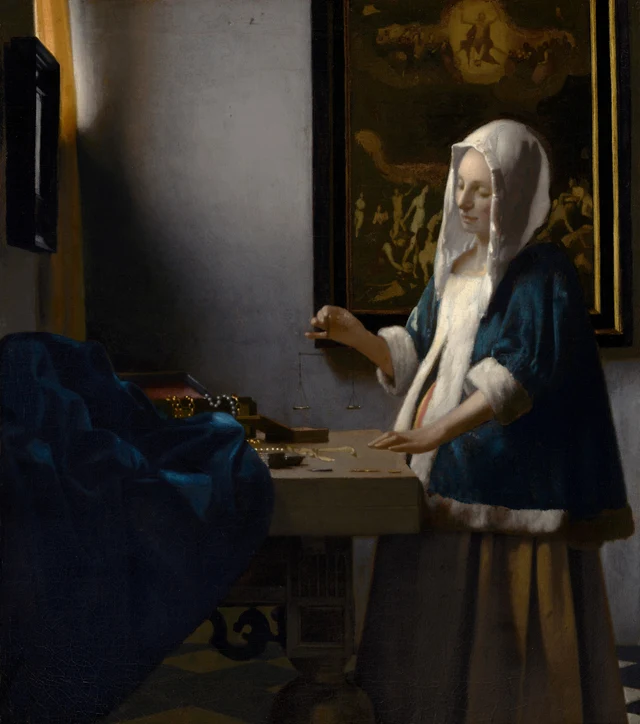
The reading proposed here is that this painting keeps the act of weighing before our eyes without giving us its result. With the empty pans, the jewelry and the judgment behind her brought together, our attention shifts from how much things weigh to how we weigh up everything before us.
Vermeer painted Woman Holding a Balance around 1664, when he was living in Delft in the Dutch Republic. Genre painting, with its subjects drawn from everyday life, flourished in the Netherlands in the mid-seventeenth century. Quiet domestic interiors became a recurring setting for some painters, who also drew inspiration from one another’s subjects, compositions and techniques. Vermeer began turning to such subjects in the mid-1650s, arranging people, objects and light within confined spaces. This work belongs to that tradition. The jewelry on the table and the Last Judgment on the wall share an everyday interior, bringing material life, faith and self-examination into the same room. This context helps us connect the tiny action of her hand with the objects and images around her. About the artist; the context of genre painting
1 Spend a little time in the room
This is a small painting, its painted surface less than forty centimeters high. An enlarged image on a screen makes that easy to forget. At the scale of the original, the woman’s face is quite small, and the balance smaller still. To notice these delicate relationships, we need to come a little closer and give the painting some time.
Only part of the window on the left is visible, with a yellow curtain hanging beside it. Light enters there, crosses the gray wall and falls on the woman’s forehead, the bridge of her nose and her hands. She wears a short blue jacket edged with white fur and a heavy yellow-brown skirt. Her shoulder and back on the right gradually disappear into shadow, while her face emerges within the white headdress. The light does not reach every part of the room. Under the table it remains very dark.
The room’s size is hard to grasp at a glance. A large mass of dark blue cloth blocks the lower left foreground, and the tabletop lies between us and the woman. Floor tiles appear only through a few gaps at the bottom. We seem to have come close in person, yet our eyes still have to find their way past the cloth and the table to reach her hand. The painting keeps a little distance between us: we can see what she is doing, without being free to step into her life.
She does not turn to explain herself. One hand is raised and the other rests at the table’s edge, with a space between them. The balance hangs in that space, unsupported by the tabletop. After a while, we notice that it is the lightest thing in the painting. The table is solid, the fabric hangs heavily, the black picture frame is broad. Only the fine threads and small pans look as though the slightest disturbance could set them trembling.
These differences between lightness and weight make balance something the eye can feel. We may not yet understand its possible symbolism, but we are already looking at a very small, very easily altered state.
2 The balance has yet to give a reading
The work was once known as Woman Weighing Gold, and also as Woman Weighing Pearls. Such titles immediately supply a sequence of actions: she takes something precious from a box, places it in the pans and checks its weight. Microscopic examination reported by the museum supports a different account. The bright marks in the pans are reflections; the pans themselves are empty. Today’s title says only that she is holding a balance, staying closer to what the painting actually shows. Research on the painting
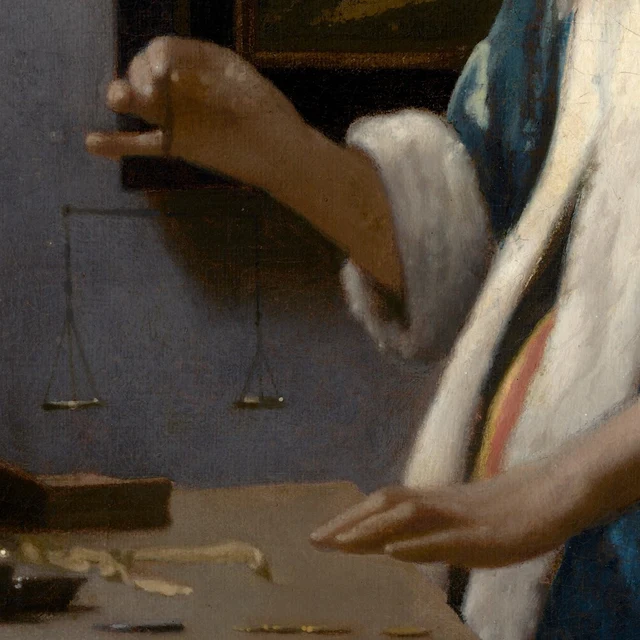
We might imagine that she is waiting for the balance to settle before weighing something. We might equally feel that she has just finished. The painting does not tell us whether this moment comes before or after a weighing. Those actions, about to happen or already completed, are supplied by the viewer. What Vermeer leaves us is the present moment.
Look again at her hands. The fingers of her right hand are not clenched; her fingertips make only a small point of contact with the metal. Below them, the fine threads almost merge into the gray of the wall. Her left hand rests against the table’s edge, several fingers extended. It is neither putting pearls into a pan nor gripping the jewelry. Each hand has paused, leaving the next movement open.
This gives the things on the table a particular presence. They are within reach. A box lid is already open, strings of pearls spill over the edge, and small pieces of metal are scattered across the tabletop. For now, however, they have not entered the act of weighing. Weight is one measurable property of these objects; what we encounter first instead is their sheen, their shapes and their positions.
The answer to “What is she doing?” is therefore slightly delayed. The delay is brief, but long enough for our eyes to move from identifying an everyday action to examining the world around it.
3 The judgment behind her
A painting of the Last Judgment hangs behind the woman. In Christian imagery, this is the scene in which humanity faces Christ’s judgment at the end of time. Near the top of the picture within the picture, Christ appears in a pool of light with both arms raised. Below him, figures twist, look upward or stretch out their hands. Large areas of darkness make the details difficult to distinguish, but we can still see the crowd’s gathering, surging movement.
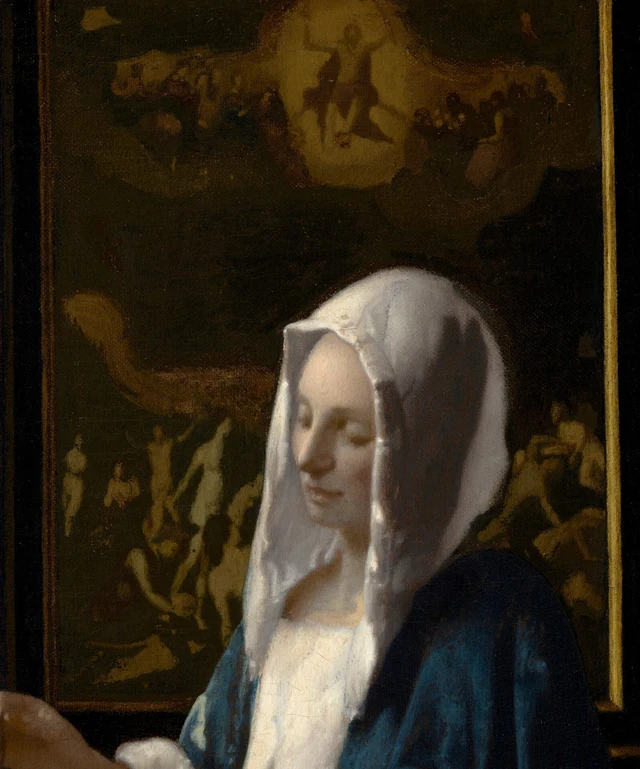
Once we recognize this subject, it becomes hard to see the balance beside the table as merely a household tool. Weighing things and judging how a person has lived begin to echo one another. Precious objects lie before her and an image of judgment hangs behind her. A single interior holds two kinds of measure: the value of things, and the terms on which a life will ultimately be weighed.
This connection has clear grounds in the imagery, but it allows different interpretations. Scholars have read the woman as a warning against attraction to earthly wealth, and also as someone capable of moderation and considered judgment. The National Gallery of Art’s account favors the latter, relating the scene to reflection and a temperate life. Both readings acknowledge the importance of the religious image. They differ in how they understand the woman’s relationship to the jewelry. NGA’s account of the work; scholarly catalogue
In the reading offered here, the painting’s strength lies in showing us the act of weighing without reducing the woman to an example of greed or moderation. She does not display the jewelry for us, and her expression gives no exaggerated sign of covetousness. The precious objects remain close at hand. Her lowered eyes concentrate attention on the balance, while the jewelry and the Last Judgment extend the action’s significance in two directions. The suggestion of self-examination emerges from these relationships; no single expression declares her virtuous.
The relationship between the woman and the picture behind her rewards more attention than a ready-made moral verdict. Christ above faces the assembled people; the woman at the table looks at tiny pans. In the background, many bodies stretch and twist; in front, a single pair of hands sustains a slight action. Her body also blocks part of the religious painting, so that its vast scene can reveal itself to us only around her.
If all we take away is “Do not covet wealth,” we miss these arrangements. Religious meaning does not hover outside the painting. It enters an ordinary room through differences of scale, obstruction and the pace of movement. Even viewers today who do not share the faith can see that this woman’s world includes more than the things on the table that can be picked up and priced.
4 How light brings the jewelry into view
Now we can return to the tabletop.
The jewelry is not evenly lit. Some pearls in the box at the back shine almost white; others are scarcely more than dim, round shadows. The golden chain appears and disappears, with a few small yellow glints emerging from the darkness. Farther forward, another row of small points of light lies close to the tabletop. Crowded together with the blue cloth, these objects overlap and obscure one another. It is hard to count them individually.
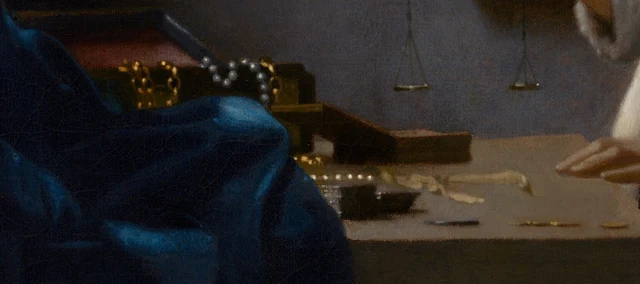
Enlarged, a highlight on a pearl is not always a neat little dot. Some are soft-edged; others run into the surrounding darkness. Return to the full painting, and these marks quickly join up into a recognizable string of pearls. Our eyes connect separate traces of paint into objects, adding a sense of their roundness, hardness and smoothness.
The blue cloth takes a different approach. It relies very little on sharp pinpoints of light. Between broad areas of deep blue, a paler blue gradually rises along the planes of the folds, then darkens again in their hollows. Following these changes, the eye feels the cloth’s thickness and its hanging weight. The blue jacket on the right also varies in tone, but the white fur edging contains it, making its outline easier to recognize than that of the mass of fabric in the foreground. The same blue does different work in the painting.
The gray wall is easiest to overlook. It occupies a considerable part of the picture and seems to contain nothing, yet its surface is not uniform. It brightens near the window and grows darker downward and to the left. The balance’s fine threads happen to fall against this area of wall, rather than vanishing into the crowd in the painting behind. The headdress, meanwhile, looks bright against a dark background. One becomes visible against a lighter area, the other against a darker one: the relationship of light quietly reverses between them.
This is a useful pause when looking at any painting. Once we have recognized “pearls,” “clothing” and “wall,” we can keep looking at how they have been painted into being. Their materials differ, yet all of them are ultimately given to us through pigment on a single canvas. Vermeer makes those differences clearly perceptible while bringing them into the same light.
5 How stillness is painted
The composition’s stability does not depend on symmetry throughout. The woman stands to the right; the blue cloth weighs down the lower left foreground; the large painting occupies the upper right; and a broad expanse of gray wall remains at the upper left. The two sides hold different things, with different visual weights. Our eyes travel between them and often return at last to the outstretched hand and the little balance.
Notice, too, the lower edge of the frame behind her. The section visible to the woman’s left sits slightly higher than the section behind her on the right. This small misalignment exposes a little more wall near the pans, helping us make them out. We may not notice the discontinuity at first, yet we can sense that there is just enough space around the balance. NGA’s discussion of the composition
Technical research tells us that the balance was not always positioned this way. Infrared imaging shows that Vermeer first painted it at an oblique angle to the picture plane, then turned it to face the viewer more directly, with the two pans in equilibrium. NGA’s account of the technical findings The ease we see now went through revisions. The finished painting does not display the process, but the finding tells us that even this small instrument was worth rearranging.
The painting does not give us enough to identify the woman. The rounded contour of her abdomen often suggests pregnancy, but her loose clothing prevents certainty. Identifying her directly with a particular member of Vermeer’s family, or building a story of motherhood on that identification, would require evidence from beyond the painting. Scholarly catalogue
Returning to the full image, we can now see much that we missed at first. A light object hangs among heavy ones. Space for a tiny action opens before a densely packed crowd. Light leaves different traces on different materials. The two empty pans keep weighing, for the moment, from yielding a result; the Last Judgment behind her connects this moment with questions of greater scope and gravity.
This is what the present reading wishes to emphasize: the painting’s stillness has weight. It brings together the allure of jewelry, the pressure of judgment and the slight movement of the hands, allowing the process of weighing to occupy our attention before an answer does. Look at her hand once more, and the empty pans become the pivot of the whole room.
Optional reading Another look through SAE
The following section tries two further approaches to looking, drawing on SAE (Self-as-an-End) aesthetics; the preceding guide can also be read on its own.
SAE examines “I am moved by this” separately from the question “What grounds can we identify together here?” Its “rays” can be understood as different directions from which to examine how beauty comes about, rather than a ranking of works. For this painting, perception is the best starting point. What relationships have we actually seen when we describe it as quiet, stable or delicate? SAE’s general account of aesthetics; the beauty of perception
Try a small comparison. Look first at the whole painting, then only at the detail of the balance in Figure 2. The detail makes the empty pans easier to recognize and helps us see the fingers and fine threads. It also removes most of the blue cloth, black frame and gray wall. The relationship between light and heavy forms in the full composition changes with their removal. We can then ask whether our sense of suspension comes from the object called a balance, or from its relationship with the larger forms, areas of light and dark, and intervals around it. Theory is useful here if it turns a vague impression of atmosphere into a question we can check against the image.
A second approach concerns memory and expectation while looking. Some viewers, familiar with weighing and seeing jewelry on the table, may initially assume that the pans already contain something being weighed. Once they look closely and see that the pans are empty, that judgment needs revision. Recognizing the Last Judgment may also lead us to reconsider an apparently ordinary domestic action. We bring past experience to a painting and allow its details to revise that experience. Whether this change takes place, and how it happens, can be tested in our own looking. The beauty of cognition
These are contemporary analyses of the work and the viewing process; they do not justify equating the calm of the figure or the painter with SAE’s concepts of self-legislation, “non-doubt” or “mutual non-doubt.” The beauty of non-doubt
Our overall impression of stillness can also be questioned. Does the surging crowd behind her give it an element of pressure? An interpretation concerned only with gentleness still has to explain that tension. This gives discussion something concrete to work with. We can agree on a detail we both see, then consider why it produces different responses, without treating the difference in feeling itself as proof that one viewer is right and the other wrong. If theory helps, it should make that conversation more specific and encourage us to look once more.
Images and sources
The visual descriptions in this essay are based on the 3620 × 4096-pixel image supplied by the National Gallery of Art and close examination of details from it. The full image is unchanged from the downloaded file. Figures 2–4 are crops only, with no color adjustment, restoration, overpainting or generated content. A digital reproduction helps us examine details, but screen display, magnification and the conditions of looking differ from those of viewing the original.
The museum provides its images under its CC0 open-access policy. Open image licensing does not mean that the text of the museum’s research articles can also be freely reproduced. This essay is primarily an independent close reading; historical facts and disputed interpretations draw on the linked collection records, scholarly catalogue and technical research. Its interpretations do not imply museum endorsement. See also the accompanying references and image credits.