Between two figures, two small lines of gold lettering hang in the air.
The line on the left extends from the angel’s mouth toward the right. The other lies close to the face of the woman in blue, but it is upside down. Our eyes follow the first line and reach the second, where the way we have been reading suddenly becomes awkward. There is no need to turn it around just yet. In a painting that takes such care over a single pearl or the thickness of a book, the direction of a few letters deserves the same close attention.
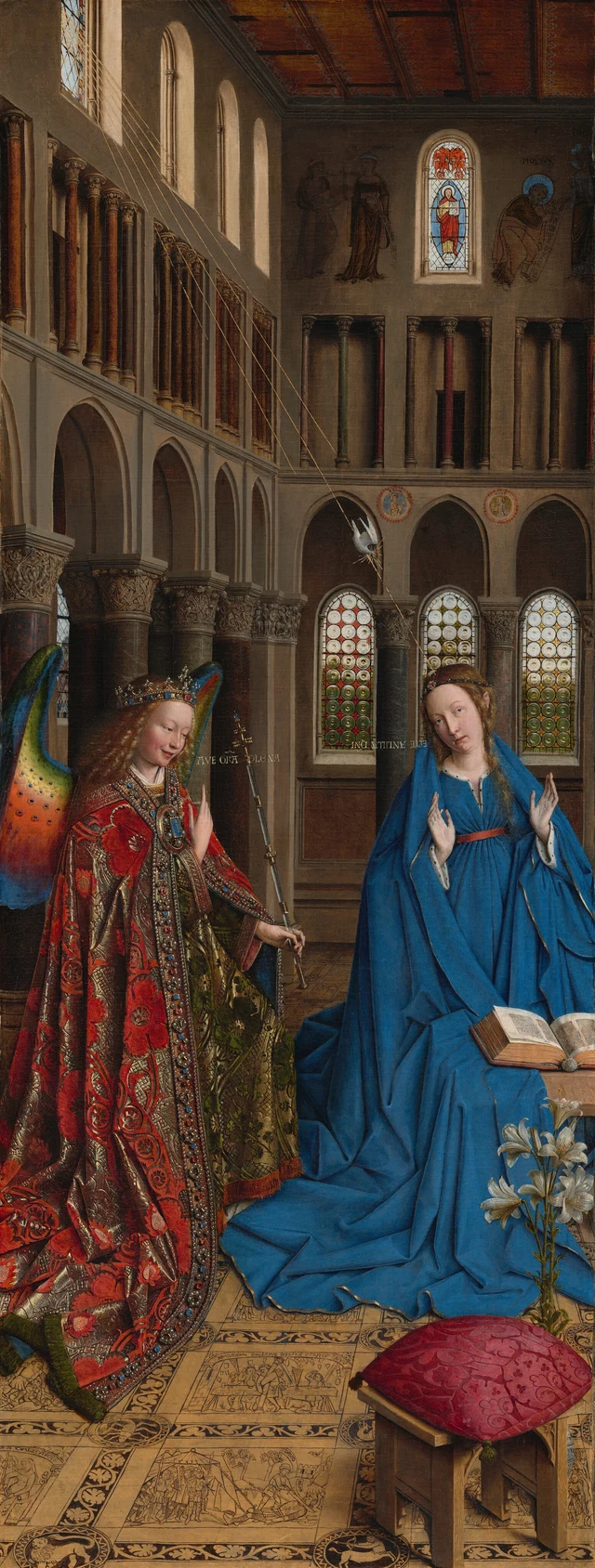
The reading proposed here is that this painting brings a sacred message into an intensely tangible world. At the same time, the different orientations of the two inscriptions remind us that there is a position within that world which we do not occupy. Everything feels remarkably present, yet it has not all been arranged for our convenience as readers.
The subject comes from the Gospel of Luke. The angel Gabriel announces to Mary that she will give birth to Jesus. She asks how this will happen, then gives her answer. The Gospel places the encounter in Nazareth; it does not describe this church, these sumptuous clothes or the open book. Van Eyck lived in the fifteenth-century Low Countries, serving the Burgundian court and also working for other patrons. The materials, clothing and architecture here bring an ancient narrative into the visual world he knew. These additions also extend a single encounter into an image concerned with the Incarnation and redemption. Biblical background; the painting and its artist
1 More than one listener
The angel’s greeting is abbreviated in the painting as “AVE GRA PLENA,” addressing Mary as full of grace. Her answer reads “ECCE ANCILLA DNI”: “Behold the handmaid of the Lord.” Neither sentence has been written on a page or scroll. Both are suspended between the figures, with nothing to hold them up and no drawn enclosure to give their voices a boundary.
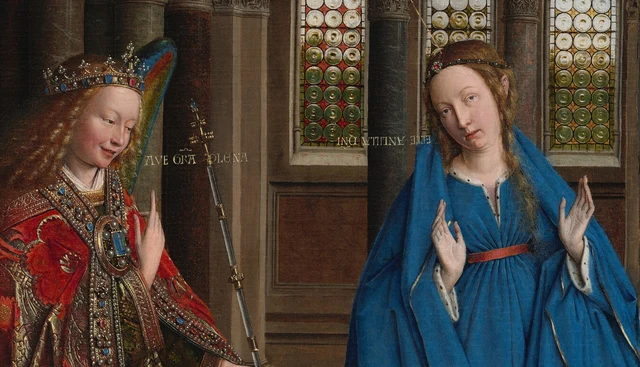
In the painting’s traditional religious interpretation, the inverted answer is addressed to God above, who can read it. The inscriptions and their interpretation This matters because it changes our answer to the question of who is listening. Mary responds to the angel before her, and her words are also directed toward God. We can understand what they mean, but first we have to acknowledge that our reading position is only one among those the picture establishes.
The faces and hands already suggest this difference. Gabriel inclines a little toward Mary. His lips are parted, his cheeks warmly flushed. He raises his right hand with the index finger pointing upward, while his other hand holds a slender staff. Mary opens both hands, separating her fingers. One hand stays closer to her body; the other is lifted toward the right edge of the picture. His gesture points in a definite direction. Her response opens out on either side of her.
Mary’s face turns partly toward us, and her eyes do not meet Gabriel’s head-on. That slight divergence keeps the encounter open. We can see a conversation taking place, yet it is not enclosed by a line of sight joining two pairs of eyes. The raised finger, the inverted words and the light farther above continue the space between the figures upward.
For that reason, it is worth waiting before giving her expression a name. Surprise, submission and contemplation may all enter our response. What the painting offers first is a gently inclined head, open hands and slightly parted lips. Her answer is present in words. We need not make her face carry the whole theology of the scene by itself.
2 Why so much space above their heads
Follow the angel’s finger upward and the figures come to occupy only the lower part of the building. Above the capitals are arcades; above these, smaller columns and windows; finally, a wooden ceiling. The picture is only a little more than a third as wide as it is high. With every upward movement of the eyes, its narrowness becomes more pronounced.
A meeting between two people would not, by itself, require all this room overhead. Here, the height makes another route visible. Fine golden lines descend diagonally from the upper left, crossing a long stretch of architecture to reach a white dove above Mary. The extended lines and the small white wings connect a distant point of entry with a person close to us.
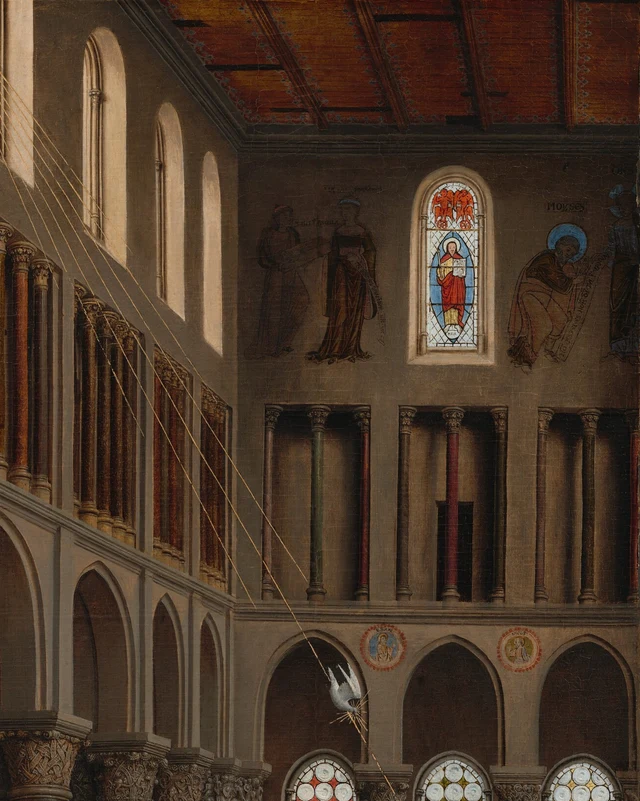
Within Christian imagery, the dove refers to the Holy Spirit, and the seven rays are associated with the Spirit’s gifts. The lines have definite edges: our eyes can trace them like routes. Light and shade on a column or a face behave differently, passing gradually into one another so that stone seems rounded and skin soft. These two ways of painting light coexist. One shows how illumination reveals the shape of things; the other gives a direction to an arrival understood in theological terms.
Spend a little time with the small window at the top. A red-robed figure surrounded by blue appears there, far smaller than either figure below. Dim wall paintings flank the window. Lower down, the windows behind Mary are filled with round panes, their whites, yellows, greens and reds interspersed. Rounded arches above and pointed arches below also lead the eye through different architectural forms.
Scholars often place these contrasts within Christian readings of the Old and New Testaments, law and grace. Such interpretations have historical grounds. They do not require us to describe the building as a design that could never have been constructed. This is a church interior composed by a painter; some of its forms have close parallels in actual architecture. Research on the architecture and imagery
The more immediate experience is that we cannot stay at a single scale. Faces and hands invite us close; the high window and murals ask us to look up and draw back. The tiny sacred figure so far above gains its visual force from position and distance rather than from a size that overwhelms the people below. Throughout the building, “above” becomes a stretch of space that our eyes have to travel.
3 Rich clothing and an expanse of blue
Looking down again, we encounter an entirely different density.
There is scarcely a broad unpatterned area in the angel’s clothing. Red forms curl, golden leaves and stems intertwine, and pearls alternate with blue and red gemstones along the borders. The pattern bends with the folds. Part disappears into shadow; another part turns back toward the light. The richness belongs to cloth that changes direction around a body, taking on thickness and weight.
Beside it, Mary’s blue spreads wide. Her robe falls from her shoulders, gathers at the waist, then extends around her knees and across the floor. Deep blue channels lie between lighter planes of fabric. Near the lower edge, a thin gold border follows the rises and dips, lifting in some places and lying flat in others. It is hard to reconstruct the exact position of her lower body beneath this abundance. It is much easier to feel how much space the fabric occupies around her.
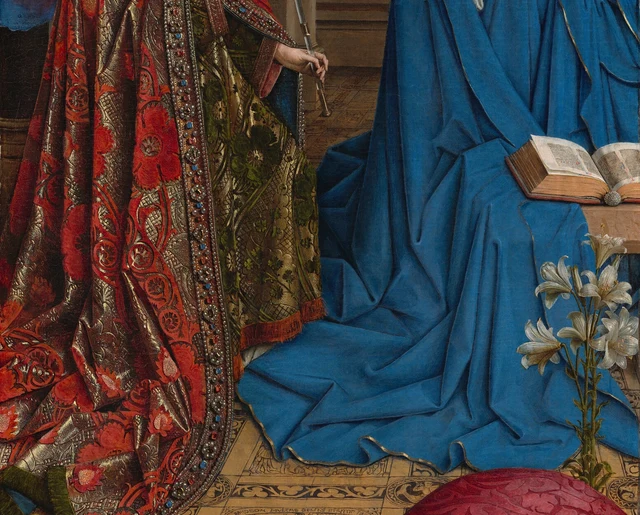
On the left, our eyes pause at one small bright point after another. On the right, they move across broad stretches of fabric. The two colors nevertheless remain connected. The red and gold clothing falls toward the lower left. Mary’s blue extends beyond the space her body occupies and reaches leftward toward the angel. Although the figures do not touch, their clothes draw close below. The exchange above is light; beneath it, wide, heavy lengths of fabric support the meeting.
The open book stands out against the blue, its warm brown page edges accumulating in fine layers. Each leaf is thin, but the book is thick. The two sides of the open book differ slightly, and tiny writing runs across the pages. This object gives reading a familiar physical support. Think back to the gold words suspended before the figures, and a distinction emerges: this painting contains writing attached to pages as well as speech that has passed beyond the page and entered the room.
The lilies introduce lighter curves across the blue robe. Their petals are not uniformly white. Different faces of the petals carry gray shadows, while the flower centers and slender stems offer further small shifts in color. Lilies signify purity in images of the Virgin. But if we take away only the equation “lily means purity,” we may miss how a petal curls or a stem passes across the blue. The symbol has a particular visible form.
Van Eyck’s handling of oil paint gives metal, glass, fabric, book pages and skin distinct qualities of touch. The more convincing those materials become under close examination, the more conspicuous the unsupported letters and rays appear. The painting’s vividness accommodates that difference. Stone lets us imagine reaching out to touch it; words ask us to consider relationships that touch cannot explain.
4 The floor extends the encounter through time
At first, the floor beneath the figures may seem no more than an elaborate pattern. Lower your gaze a little and small bodies, weapons, buildings and fallen people become visible. These are smaller pictures within the painting, answering the murals high above.
The central scene nearest the foreground shows David beheading Goliath. The one immediately behind it depicts Samson bringing down the temple. Identifying the stories takes the help of inscriptions and scholarship. Comparing the force of their actions with the figures above is easier. On the floor are a raised weapon, a fallen body and a building being destroyed. Above it, two hands open and a single finger points upward. The floor scenes and their traditional interpretation
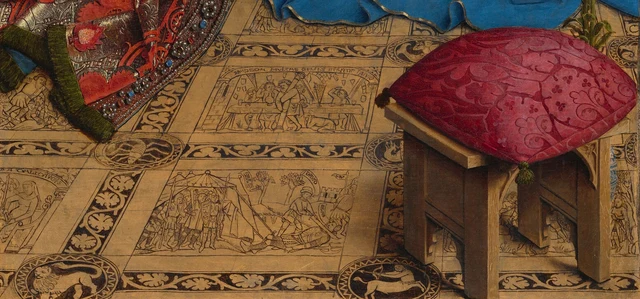
Why should news of a birth have violence beside it? Medieval Christian typology read figures and events in the Old Testament as foreshadowings of the story of Christ. In this reading, David’s victory relates to Christ’s triumph over evil, while Samson’s death as he brings down the temple foreshadows Christ’s Passion. This is a historical way of reading within a faith tradition. It allows the announcement that someone will be born to point also toward that person’s future Passion and Resurrection.
We therefore see more than the moment of a meeting. The stories on the walls belong to the past, the figures speak in the present, and traditional interpretation connects these signs with the future. Instead of arranging every event in a consecutive strip of pictures, the painting distributes different times among different materials. Old stories appear on distant walls, the present has the colored bodies nearest to us, and struggles underfoot are rendered almost as incised lines. Time enters our vision in layers through these differences of space and handling.
Yet the floor never opens into a complete diagram. The blue robe covers tiles farther back, the angel’s hem obscures part of the left side, and the stool with its red cushion conceals a substantial area in the right foreground. The cushion catches the eye more readily than many of the stories. Its red is rich, its corners project, and tassels fall beside the wood. If we hurry to decode every tile, the cloth and furniture in front of us may start to seem inconvenient.
I would rather understand those obstructions as part of what makes the picture work. The stories belong to the world the figures inhabit, where bodies and objects take up space. Mary’s clothing gives her a vivid presence before us while also withdrawing parts of the ancient narratives from view. Knowing that an image contains many meanings does not require them all to be displayed, complete and simultaneously, for our inspection.
5 The answer still faces another way
Return now to the two inscriptions. After our passage through the church, their initial difficulty has company. The small window requires us to look upward; the floor stories ask us to look down and distinguish their scenes. The book’s tiny script and the designs hidden by clothing each keep something at a distance. The painting lets us see a great deal, while continually changing the position from which we look.
The painting also has a history of its own. We can describe how these relationships work together. From a single surviving painting, however, we cannot recover all the conditions in which it was first viewed. It may once have formed part of a larger ensemble; the precise commission and its early history remain uncertain in places. It was also later transferred from panel to canvas. What we encounter has reached us through a long history, rather than remaining an untouched window from the fifteenth century. The work’s history and scholarship
That history does not lessen the precision of the relationships before us. The angel speaks and Mary answers. Cloth spreads over the floor, and light arrives from above. Old stories surround an event taking place in the present. We can see how these elements support one another before settling every question about a tile or a disputed provenance.
My reading is that the reality Van Eyck gives this world differs from the feeling that we have mastered everything in it. As the pages, pearls and fabric become more palpable, another direction within the encounter becomes easier to notice. The sacred is made present through the specific forms of the material world. Some of the relationships it establishes continue beyond the place where we stand.
Look once more at Mary’s upside-down answer. We now know what it says and can translate it fluently into our own language. When we return our eyes to the painting, though, we can let it keep its original direction. Having understood the words, we can still see whom they address.
Optional reading What remains to be seen after we understand the words
The preceding guide stands on its own. This section draws on SAE (Self-as-an-End) aesthetics to explore two further experiences of looking: how we read the meaning of a sentence, and whether its particular form still invites attention once that meaning is clear. SAE’s general account of aesthetics
Begin with the inverted gold lettering. Even after we know its meaning in English, the threadlike letters remain upside down, close to that small interval between a face and a window. Explanation has not removed their orientation, spacing or color. SAE’s “beauty of perception” concerns the way something appears in its own right. We may put aside its use for recognition or practical action, and it still appears in this particular way. The beauty of perception In this painting, we can briefly set the explanation aside and watch the letters hover on the edge of visibility, yet retain enough presence to interrupt easy reading. Theory helps us stay with that experience, so that “I know what it means” does not bring looking to a premature end.
Now notice a reading habit of your own. Someone accustomed to horizontal lines of Latin letters may expect the next line to read in the same direction before identifying each word. Mary’s upside-down answer interrupts that expectation. Past experience is nowhere inscribed on the picture, yet it has already prepared the viewer for a reading that is about to occur. Once we learn the religious interpretation of the direction, meeting the same line again may prompt a different expectation. This time, we may look first for the way it faces.
SAE’s “beauty of cognition” offers a way to pursue this experience. It considers how remembered experience reaches toward what has yet to arrive, and how that experience is drawn on anew when an expectation meets an obstacle. The beauty of cognition Here, the questions concern our own looking. What makes a set of letters immediately appear to be a sentence awaiting a reader? Why can the same strokes, seen a second time, give rise to a different anticipation? Our experience of writing varies, so each of us can test this change against what actually happens while we look.
For me, these two approaches meet at a very specific point. Translation opens the content of the speech to us. The painted letters still preserve an encounter with a direction of its own. An explanation can deepen what the eye experiences, and the eye can keep finding more for the explanation to consider. The next time we return to those small words, it is worth staying a little longer.
Images and sources
The visual descriptions are based on the 1553 × 4096-pixel image supplied by the National Gallery of Art and close examination of four details. The full image is unchanged from the downloaded file. Figures 2–5 are crops only, with no color adjustment, overpainting, restoration or generated content. The color and apparent scale of a digital reproduction depend on the conditions in which it is displayed.
The museum’s open-access images follow its CC0 policy. This image license does not extend to modern scholarly writing. The essay is primarily an independent close reading; factual information and traditional interpretations are linked to the collection record, biblical text and scholarly catalogue. Its judgments do not imply museum endorsement. The 1986 catalogue is used to check imagery and the history of research; its account of the painting’s condition is not used to describe the work today. Later technical papers not obtained in full are listed only as further reading and have not been used to reconstruct painting procedures. See the references and image credits and licensing.
