An extraordinary amount of this wide landscape belongs to the sky. Gray and white clouds spread across it, with blue appearing between them. Trees, grassy slopes and a lake occupy the ground below. To discover whose estate we are looking at, we must search farther back: the red-brick house appears through a gap in the trees, just to the right of center, occupying very little of the picture.
The house is small; the estate does not feel small. We seem to become acquainted with its air, water and ground before finding the building that inhabits them.
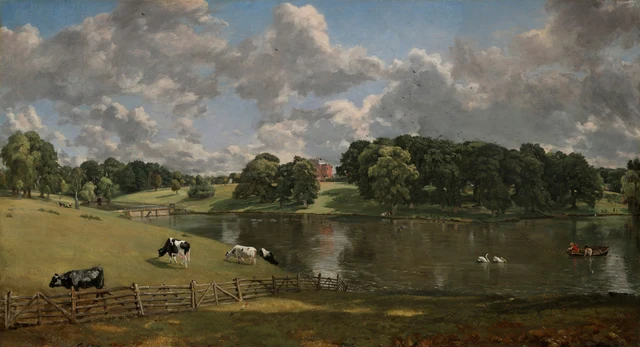
The argument of this essay is that the painting feels natural because it organizes so many different distances with such precision. The building recedes and the sky expands, while the nearby fence, the alternating light and shade on the slopes, and the reflections in the water join them into one recognizable, usable environment. Constable’s achievement is to make this arrangement assist our experience of the landscape, rather than resemble an inventory of the estate’s possessions.
The painting was commissioned by the owner, Major-General Francis Slater Rebow, who knew Constable’s father. Constable had already painted a portrait of Rebow’s daughter. He worked in the park during August and September 1816 and reported the picture finished in a letter of 19 September to his fiancée, Maria Bicknell. The lake itself had been created when the park was landscaped in 1777. With that knowledge, the curving shores, bridge and grassy slopes become evidence of an environment already shaped by people. Painting establishes a further order within that managed place. NGA systematic catalog, pp. 29–32
How the sky stays open
Clouds occupy almost the upper half of the picture without becoming an unbroken gray-white ceiling. Look at the tall cloud near the upper center. Its bright edge swells upward; its interior turns gray, while irregular darker shapes project from its base. Beside it, blue expands from a narrow slit into a broader opening, separating one mass from the next. The clouds at left stretch along longer diagonals, while those at right gather into a heavier group. Their unequal distribution gives the sky a changing rhythm.
The clouds have volume, but their edges vary in firmness. Their lit parts often appear warm white or pale yellow, their shaded portions gray-blue. Some boundaries are distinct; others seem rubbed into the surrounding air. Calling this simply a sunny sky overlooks how much shadow it contains. Gray makes its brightness palpable. Fine weather can accommodate substantial clouds.
Lower down, the sky close to the trees breaks into smaller, paler forms. No straight boundary separates it from the crowns below. A tall tree rises at left, the central group dips, and a broad mass of dark green rises again at right. Along this uneven line, earth and sky meet. The great expanse of air above remains connected to this particular place below.
Sunlight is equally selective on the ground. Long dark bands cross the foreground grass, leaving narrow illuminated patches near the fence. Across the lake, one part of the slope is bright while tree shadows divide another. The changing density of the clouds and the distribution of light over the ground make the good weather feel like a present condition, something happening here. What we can examine is the light as it has been distributed in this image. We do not need to calculate an exact time or invent the direction in which a cloud will move next.
The scale of those clouds also prevents the house from reducing everything else to an architectural backdrop. The sky has substantial weight in the composition. It needs no dramatic storm to place meadow, trees and dwelling within a larger shared atmosphere.
Ground to stand on
Returning from the sky to the bottom of the painting, we immediately feel the solidity of the fence. Its rails are not mechanically repeated parallel lines. They bend and vary in thickness; the uprights lean slightly; braces form triangles of different sizes. Gray-white light catches the faces of the wood, while other surfaces turn brown. Beside the clouds’ loose, soft forms, these short, sharply bounded shapes make the foreground firm.
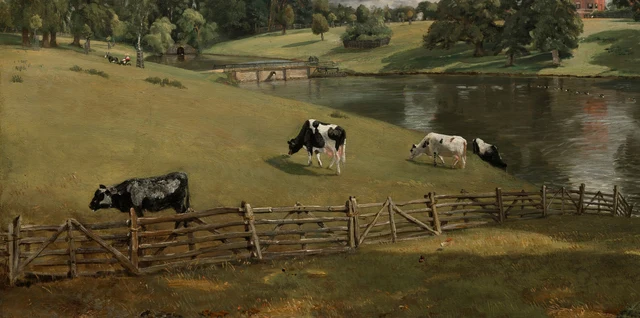
The fence runs rightward from the lower left and changes direction as it approaches the water. Our eye can travel along the rails, but each brace briefly interrupts its movement. Around the gate-like section near the middle, the diagonals change direction; farther right, a short length of fencing retreats toward the shore. Small turns animate a continuous line. It leads us into the picture without dividing it as rigidly as a ruler would.
The shaded ground on our side of the fence gives us a nearby place to stand. Beyond it, the pasture opens upward and to the left. The cattle are not arranged in a row. The rails overlap the lower body of the nearest animal; another stands on open grass; two more approach the water farther away. White patches, black backs and different degrees of overlap make the animals readily distinguishable. This broad meadow contains a sequence of comparable sizes, through which distance becomes legible step by step.
The donkey cart at the far left is smaller again. Tiny accents of red and white still pick out the people, but the details of their movements are compressed into very few marks. Nearby, the bridge crosses a narrow stretch of water. Its dark opening and delicate railing answer the much heavier fence in the foreground. Though vastly different in scale, both structures remain recognizable as things that enable passage or divide space. Near and far acquire practical reference points. Depth depends on more than a formula in which everything becomes paler as it recedes.
Grass also changes with distance. At the bottom of the painting, scattered ochre touches pick out vegetation without smoothing away the dark earth between them. Around the cattle, broader yellow-green passages establish the slope. On the opposite bank, we read the terrain chiefly through the edges of tree shadows and the brightness of the turf. Constable does not supply the same number of grass blades everywhere. He allocates information, making the foreground tangible and the distance approachable while keeping the ground continuous.
How the house’s red enters the water
Although distant, the house is easy to find. Its brick red is caught between dark greens, and its roof and windows supply a few clear horizontal and vertical lines. The unequal heights of the neighboring trees leave an opening for it. Foliage on the left conceals part of the building; the group on its right is taller and denser. We recognize the dwelling and see that it truly stands behind trees.
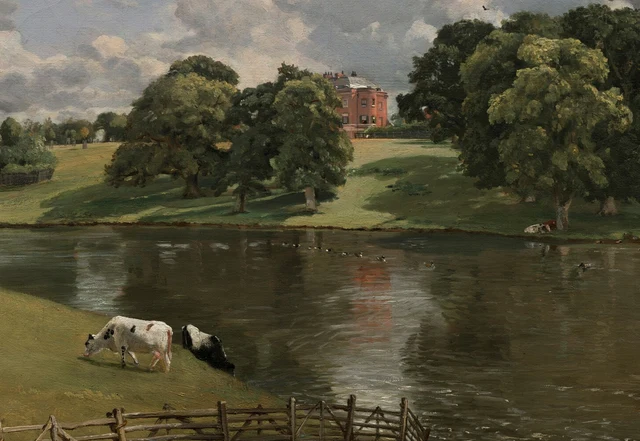
The bright grass in front of the house is particularly important. It extends downhill, remaining visible between several trees until it meets the lake. The crowns are dense, yet spaces beneath the branches allow passage. Our eye does not stop at the outer shell of the woodland; it can follow the ground into it. The small building thus has a spatial connection to the water. It is more than a red sign perched above the trees.
Look lower, and a short passage of red appears in the lake. It does not reproduce a complete upside-down building. Pale horizontal strokes break the red apart, and it loosens as it descends. Reflections of trees form larger dark vertical bands. These downward correspondences connect objects on the bank to the water, while the short horizontal marks unsettle that connection. The surface retains a recognizable orientation and an unstable skin.
The lake widens toward the right from the narrow channel beside the bridge on the left. As a result, the bright meadow seems to extend diagonally into the water, while dense trees and their shadows hold the opposite bank. The two sides are unequal, but the dark water joins them. Imagine the lake as a flat blue strip and much of the picture’s depth would disappear. What we actually see is gray-green, brown and silvery white, with a few reds and whites whose sources we can locate.
The swans introduce small, distinct whites into this dark surface. One neck rises; the other bends forward. The light on their backs sits immediately beside dark water shadows. Farther right, the fishing boat contains a patch of red clothing and another of white. Small floats describe a curved net line that reaches from the direction of the farther bank toward the boat. That curve turns apparently open water into a stretch of space being actively used.
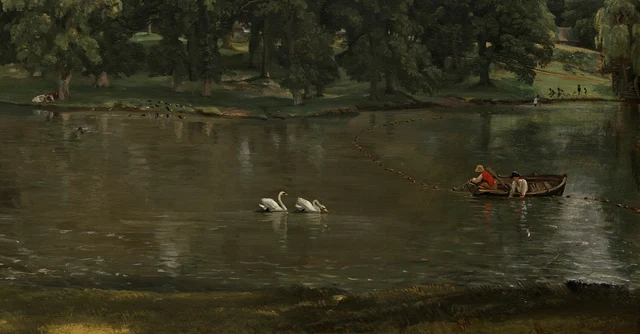
These details are clear without competing equally for attention. The swans depend on white against dark water; the boat on its outline, the red clothing and a few pale strokes. Birds near the bank gradually shrink into specks. Horizontal glints pass between them, keeping people and birds on the same body of water. The essential skill lies in this selectivity: each thing receives enough definition to exist at its particular distance, while the water remains open to the eye’s movement from one place to another.
Joining too much landscape into one picture
The commission was not difficult because the site lacked things to paint. In his letter of 30 August 1816, Constable mentioned the grotto and elms on the left, the house in the center, and the deer house far to the right that had to be included. The owners wanted so much represented that he found himself handling several distances that were difficult to reconcile. He also reported having overcome the difficulty and begun to like the picture. His account records choices made by a painter, rather than the simple transcription of a site. Letters and discussion, pp. 29 and 32
Even the width of the canvas changed. The Gallery’s technical notes confirm that Constable added a strip measuring 10.5 cm on the left and another measuring 9 cm on the right. The additional cow covers the left seam; the fishing boat is painted across the right one. Those are findings supplied by material examination and documentation. A line in the digital reproduction should not casually be identified as the seam itself. Technical notes, p. 29; compositional discussion, p. 32
Yet the picture absorbs more than two extra objects. The cow at left stands close to us and continues the pasture behind the fence. The small boat provides a distinct stopping point in the broad lake to the right. Both extensions respect the existing differences in scale, while sky and shoreline continue beyond them. We see an entire environment before learning that its physical support was widened. An accommodation during making has become continuity during looking.
This helps explain why the picture exceeds the usual expectation of a country-house portrait. The house is an important subject of the commission, yet it is not enlarged until it dominates trees and sky. Its presence passes through the opening in the foliage, the grassy slope and the reflection, connecting it to the larger environment. A bridge allows passage, a fence defines pasture, the lake supports fishing, and trees offer shade. These uses belong to the picture without each becoming a separate dramatic episode.
Such harmony is certainly selective. The painting does not give us the whole of life on the estate. But calling it an ideal estate also misses what the painting has actually achieved. Heavy clouds, broken light on water and the uneven turns of the fence preserve differences of weather and texture within an arranged environment. Its persuasiveness lies in allowing each part its own character while enabling us to travel from near shore to distant house, from shade to illuminated slope. The feeling of nature takes shape through transitions that remain continuous without becoming monotonous.
Optional reading Testing an expectation with SAE
In “The Beauty of Cognition,” Han Qin’s SAE (Self-as-an-End) aesthetics considers how earlier experience shapes expectations that can be revised. We can borrow that question to examine what we have just meant by “natural.” This is a present-day viewing exercise, not an attribution of theory or inner motives to Constable. SAE Judgment and Aesthetics; The Beauty of Cognition
If the landscape initially seemed natural because it appeared to offer a complete view from one fixed position, the evidence of added canvas and the inclusion of multiple features may change that expectation. Before retracting your pleasure in the picture, choose a connection you can still point to: the fence turning beside the lake, for example, or the bright slope below the house and the red in the water. Explain why it continues to make the space coherent.
Perhaps you already understood this as a carefully composed landscape, and the new information surprises you very little. Then ask a more specific question. Which arrangement joins the distances most convincingly? Does any passage still seem too neatly ordered? You may approve or retain reservations. What matters is identifying whether the change concerns an expectation about how the picture was made or an actual spatial effect before your eyes. “Arranged” then becomes neither a slogan for exposing the work nor automatic praise. It names a skill that can be found and discussed within the painting.
Images and sources
Visual observations are based on the National Gallery of Art’s 4096 × 2218-pixel JPEG and three details from it. The full image is the unaltered official download. Crops preserve the decoded source pixels and original ICC profile in lossless PNG files, without resizing, color adjustment, sharpening, restoration or generated content. A screen reproduction differs from the original painting in scale, surface and lighting.
The Gallery identifies this work’s image as public domain and makes it available under its CC0 Open Access policy. That does not extend the same license to the research texts. Historical and material facts follow the collection record and John Hayes’s NGA systematic catalog; the visual interpretation is this essay’s and does not imply institutional endorsement. See also References and Image credits.