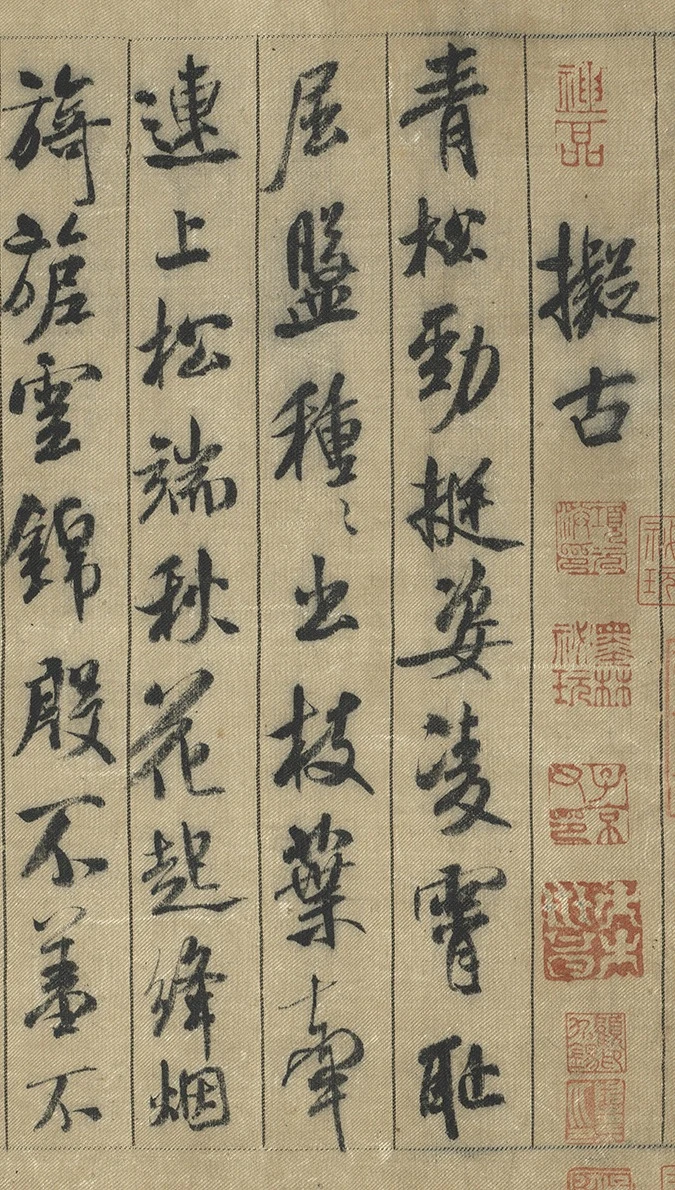
The five characters 青松勁挺姿, “the green pine has a strong, upright bearing,” occupy one narrow ruled column, yet do not make a single straight pillar. The horizontal strokes in 青, “green,” rise towards the right; the two halves of 松, “pine,” sit at different levels. In 挺, “upright,” a lower stroke extends almost to the rule. 姿, “bearing,” then draws inward, before the turns of 凌 below attract the eye again.
凌 begins 凌霄, “trumpet vine.”
The fine straight line stays beside them. Its presence makes the characters’ tilts, expansions and contractions easier to see. The rule remains visible, and their differing postures remain distinct.
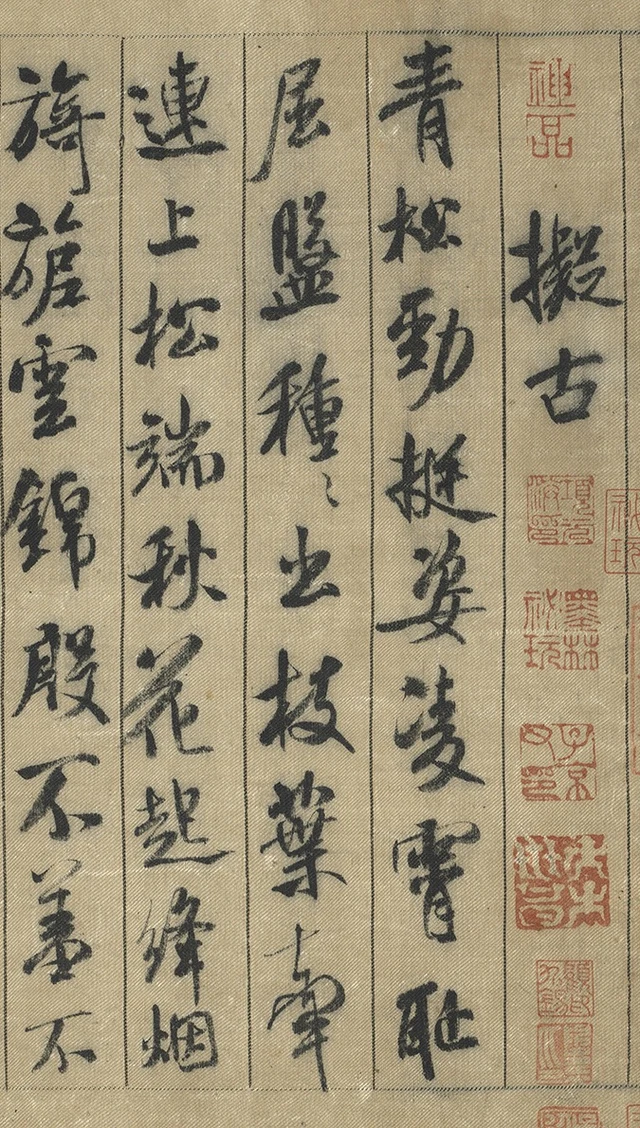
Some of the movement in On Sichuan Silk, or Shusu tie (蜀素帖), comes from this difference held continuously in view. Long lines descend through the silk, while horizontal, oblique and turning strokes keep changing direction within the characters. Isolate each character on a uniform white ground and we would still see beautiful brushwork. We would lose the reference that shows how far it lies from a rule and how its direction changes within this column.
This is Mi Fu’s autograph of 1088, held by the National Palace Museum in Taipei. The museum catalogues the main section as silk damask, 27.8 × 270.8 centimetres. The Sichuan textile is conventionally called Shu su, “plain Sichuan silk”; the museum describes its fine column boundaries as woven in black silk. Lin Xi’s inscription dates the material’s manufacture to 1044. At Lin’s request, Mi Fu wrote eight poems under six titles on this treasured roll, ending with the date “twenty-third day of the ninth month, the wuchen year of Yuanyou,” 1088. Making the textile and writing on it were events at different times. Museum record and transcription; museum’s 2025 exhibition account
We will follow the first four poems. Before turning “liveliness” into a judgment of personality, distinguish two kinds of line: the rules that give the scroll a continuing direction, and the strokes reorganised within each character. How these remain visible together is worth our attention.
“Upright” does not become a row of verticals
Return to Figure 1. The upper horizontals of 青, “green,” rise in a related direction, while the vertical structure below holds the character together. 松, “pine,” is not a solid block: a narrow stretch of silk separates its two sides. The right-hand part of 勁, “strong,” reaches obliquely outward. 挺, “upright,” places its expansion lower down. Across the five characters, the black gathers higher or extends sideways. The forms lean, yet remain readable down the column.
In the next column to the left, 屈, “bend,” is notably tall, while 盤, “coil,” has a dense interior. A small repetition mark after 種 tells us to read that Chinese character a second time, forming 種種, here describing the growth of shoots and leaves. Then 出, “come out,” spreads; 枝, “branch,” and 葉, “leaf,” gather their strokes again. At the bottom, 牽, “draw” or “pull,” approaches the lower boundary through fine, extended lines. The widths of the ruled lanes broadly continue, but the characters’ heights and widths differ. There are no horizontal divisions allocating each character an equal square.
The poem praises the pine as “strong and upright”; the writing shows how an upright bearing can be made from strokes that are not all vertical. Stability within a character does not require every stroke to run parallel to the rules. The calligraphic relation called 欹正, “leaning and uprightness,” becomes something we can compare: oblique strokes and the column’s downward direction coexist, making each other clearer.
These poems carry the title 擬古, “In the ancient manner.” Here is the complete first poem. All four Chinese poems below use common simplified characters, with editorial punctuation, verse lines and expanded repetition marks. They do not reproduce the manuscript’s columns. The photographs preserve historical forms, such as 勁 for 劲, “strong,” and 葉 for 叶, “leaf.”
青松劲挺姿,凌霄耻屈盘。
种种出枝叶,牵连上松端。
秋花起绛烟,旖旎云锦殷。
不羞不自立,舒光射丸丸。
柏见吐子效,鹤疑缩颈还。
青松本无华,安得保岁寒。
The green pine stands strong and straight;
the trumpet vine disdains to coil down low.
It sends out shoots and leaves,
climbing, intertwined, to the pine’s crown.
Autumn flowers rise like crimson smoke,
luxuriant, a deep-red cloud of brocade.
Unashamed that it cannot stand alone,
it shines upon the straight-grown trunk.
The cypress sees and puts out seeds in imitation;
the crane draws back its neck in doubt.
The green pine has no such flowers of its own:
how could it keep them through the winter’s cold?
This translation reads the final question as asking whether flowers that flourish by clinging to a pine can acquire its resistance to winter. 丸丸 takes the sense of straight growth found in “pines and cypresses, straight-grown” in the Book of Odes, rather than meaning round fruit. “No flowers” answers the earlier autumn blossoms, and the question remains a question. The poem describes the exuberance of growing upward with another thing’s support. The characters written on the silk, meanwhile, have their own visible supports and extensions. Book of Odes, “Yin wu,” Chinese text
The poem makes “strong and upright” worth noticing; it does not determine the direction of every stroke. Put 青 and 挺 beside their rules and leaning and uprightness acquire a visible reference: how a horizontal rises obliquely, how a character’s weight sits within a column.
A lane may be filled or mostly left unwritten
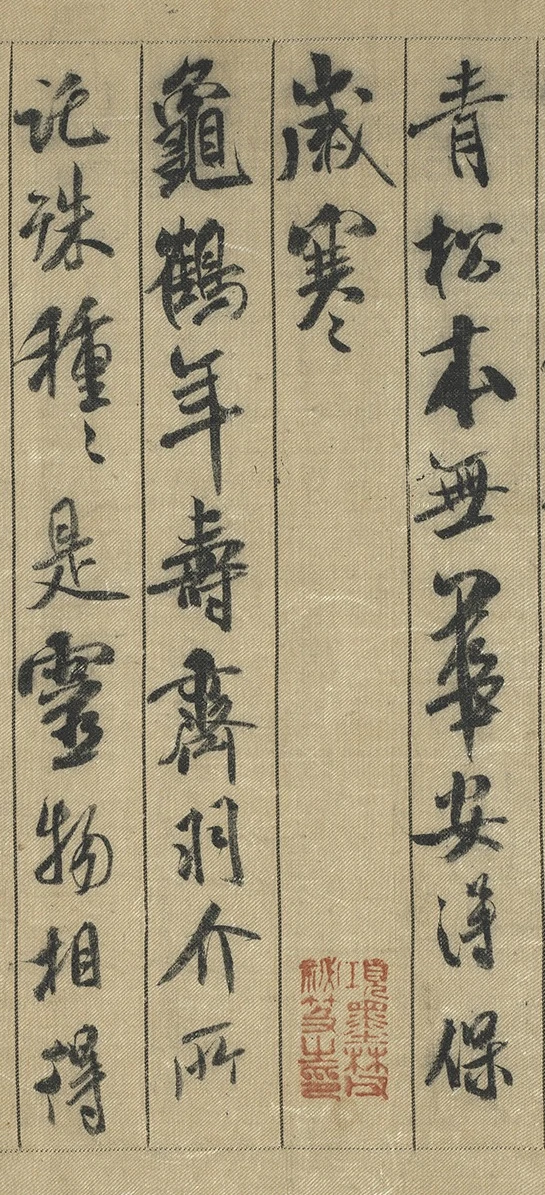
Near the end of the first poem, 青松本無華安得保, “the green pine has no flowers of its own; how can it preserve…,” fills one column. The final 歲寒, “winter’s cold,” occupies only the upper part of the next. Much of the silk below carries no poem text by Mi Fu. Move left again and 龜鶴年壽齊, “tortoise and crane are alike in longevity,” begins the second poem at the top.
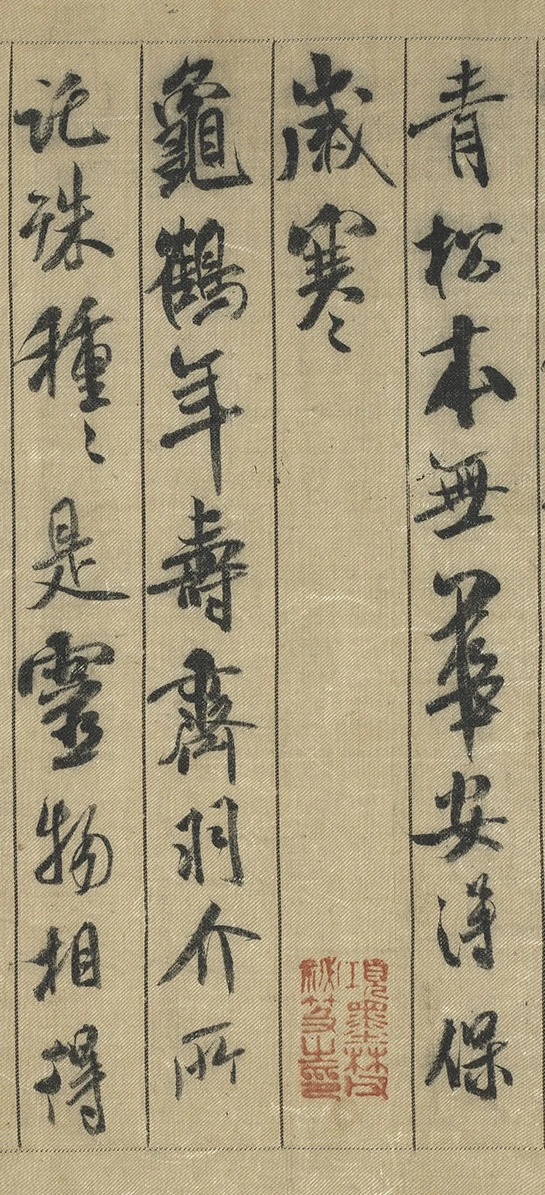
The unwritten area has two clear sides. It is a length of silk within the continuing rules, as long as the lanes beside it. The poem ends, but the lane does not shorten. We see at once where the words stop and how much of their allotted vertical space they leave unused.
A fine stroke at the bottom of 寒, “cold,” bends back downward, without another character beneath to receive it. To the left, 龜, “tortoise,” and 鶴, “crane,” bring back dense, broad black forms. The long descending stroke of 年, “years,” opens that density before 壽, “longevity,” and 齊, “equal,” follow. After the pause, the next poem does not simply repeat the arrangement just seen.
The complete second poem reads:
龟鹤年寿齐,羽介所托殊。
种种是灵物,相得忘形躯。
鹤有冲霄心,龟厌曳尾居。
以竹两附口,相将上云衢。
报汝慎勿语,一语堕泥涂。
Tortoise and crane are equal in their long lives;
feather and shell give them different bodies.
Both are numinous creatures;
in harmony, they forget their bodily forms.
The crane longs to soar into the sky;
the tortoise tires of dwelling with its tail dragged low.
Both holding the same bamboo stick in their mouths,
they travel together up the roads of cloud.
Take care, I tell you, do not speak:
one word, and you fall into the mud.
The ascent is concrete: two different bodies, a bamboo stick, a mouth that must remain closed. The poem develops its wish to rise through these conditions. Between “roads of cloud” and “fall into the mud” lies a single act of speaking.
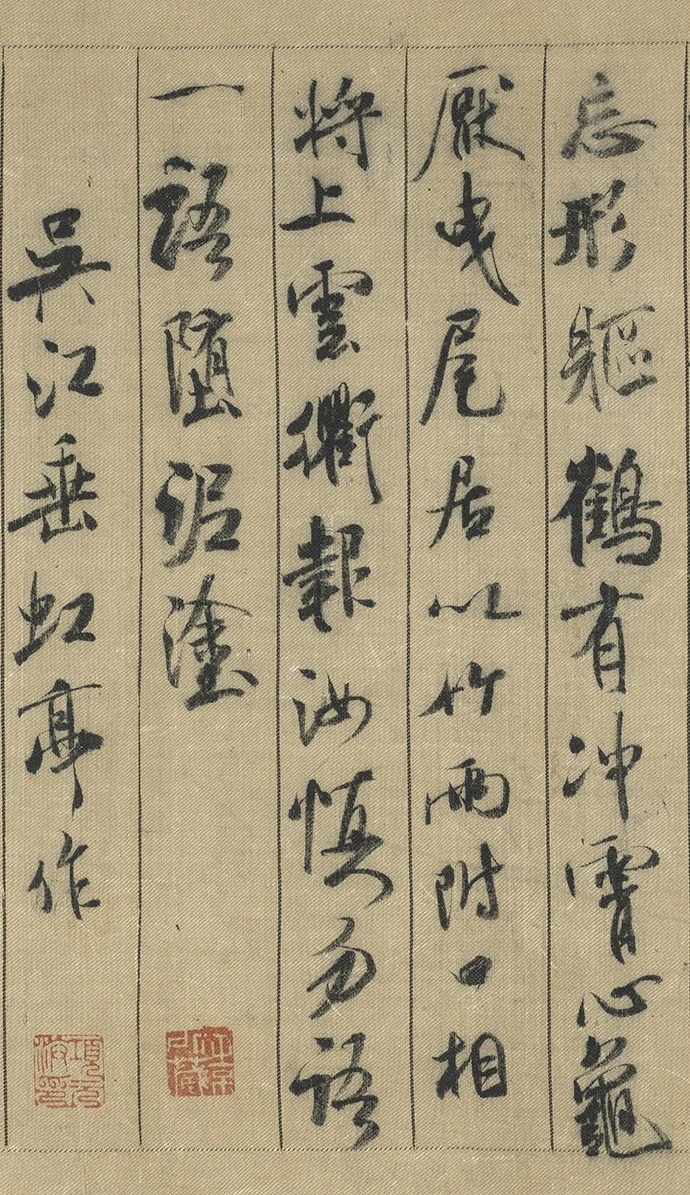
The writing, too, offers an uneven route, though of a different kind. At the far right of Figure 3, the column reads 忘形軀鶴有沖霄心龜, “forget bodily form; the crane has the wish to soar; the tortoise….” 形, “form,” and 軀, “body,” have relatively fine, interrupted lines; 鶴, “crane,” below them is dense. 有, “have,” and 沖, “soar,” become simpler and more open. 心, “heart” or “intention,” spreads to both sides; the final 龜, “tortoise,” gathers again. Different shapes alternate within one lane, without regular turns or a steady increase in size.
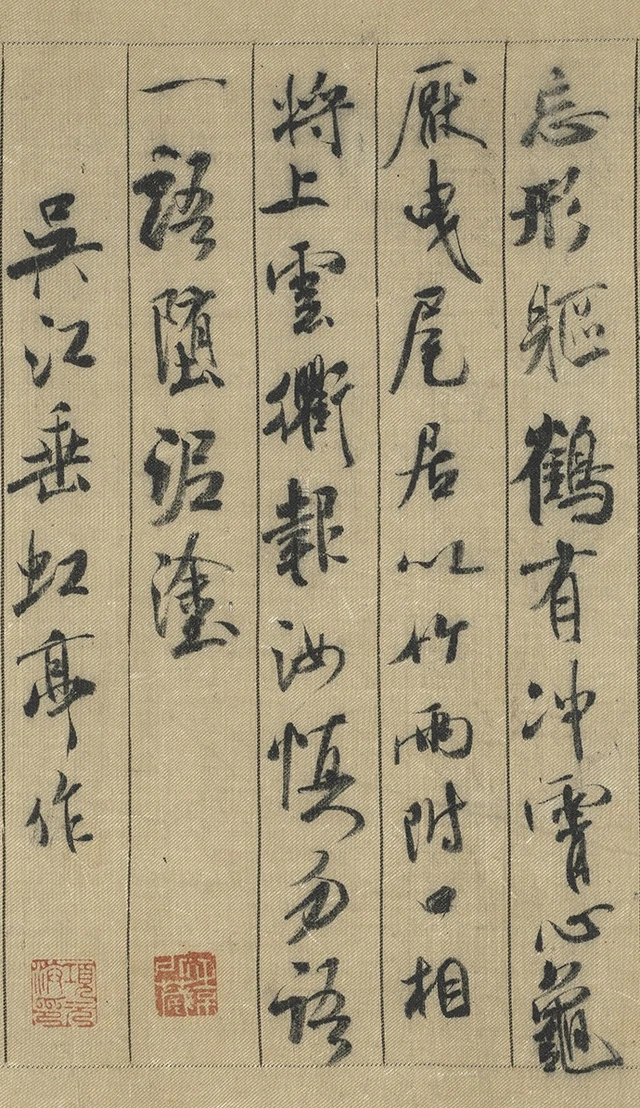
In the neighbouring column, the tall forms of 厭曳尾居, “tired of dwelling with a dragging tail,” divide the height into larger intervals. In 以竹兩附口相 below, “both holding the same bamboo stick in their mouths, together…,” the simple 口, “mouth,” follows the more complex 附, “attach.” A column continues because we can read through these changing widths and placements. The rules have not done the strokes’ work for them.
At 一語墮泥塗, “one word, and you fall into the mud,” the column ends below its midpoint. At the left, the title for the Wujiang poems starts a little below the upper boundary and brings the next two poems into the scroll. The eight poems are articulated through endings, short columns and new titles, so we can find where the next one starts. The continuing rules allow these different endings and beginnings to be compared on the same silk.
Water and sky blur; the strokes keep their places
The two seven-character Wujiang quatrains move from fable to water before the traveller’s eyes. The first brings together a sail, fish, tangerines and autumn colour. The second joins the lake to the celestial Weaver Girl and the moon goddess.
Written at Chuihong Pavilion, Wujiang: first poem
断云一片洞庭帆,玉破鲈鱼金破柑。
好作新诗继桑苎,垂虹秋色满东南。
A broken cloud, a sail towards Dongting;
cut perch, white jade; split tangerines, gold.
A fine time for a new poem to follow Sangzhu:
Chuihong’s autumn colours fill the southeast.
桑苎, Sangzhu, refers to Lu Yu’s sobriquet, the Old Man of Mulberry and Ramie. Jade and gold give the food its separate white and yellow colours. In this manuscript 金, “gold,” is a small correction beside the larger original 霜, “frost.” The edited text reads the correction; the photograph keeps both.
The second poem
泛泛五湖霜气清,漫漫不辨水天形。
何须织女支机石,且戏常娥称客星。
Drifting on the Five Lakes, the frosty air is clear;
in the vast expanse, water and sky have no distinct forms.
Why seek the Weaver Girl’s loom-supporting stone?
Let me jest with the moon goddess and call myself a guest star.
The manuscript’s 常娥 is the moon goddess usually written 嫦娥, Chang’e. The loom stone and guest star carry the lake journey into legends of visiting the celestial river, while the poem keeps its cool autumn air and undivided water and sky. After the two poems, smaller writing records 時為湖州之行, “at the time, on a journey to Huzhou.”
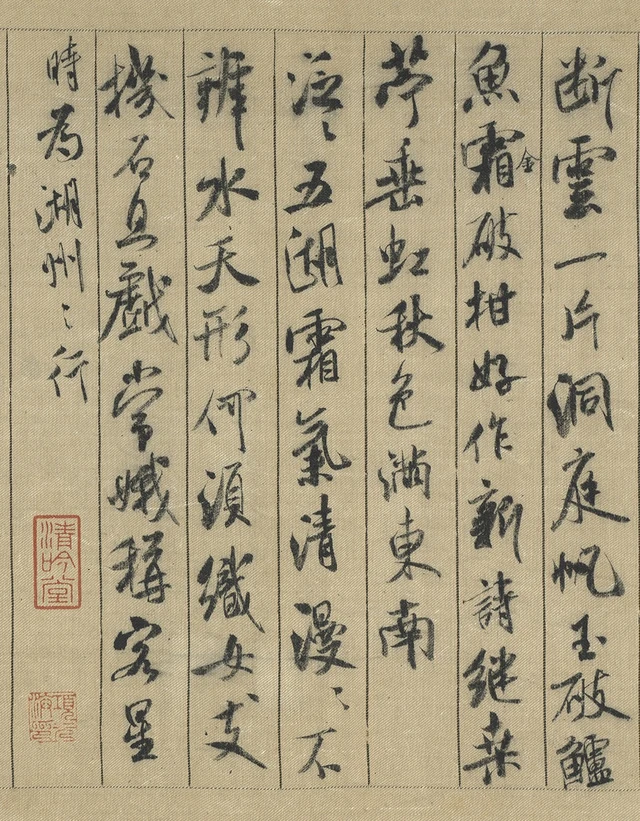
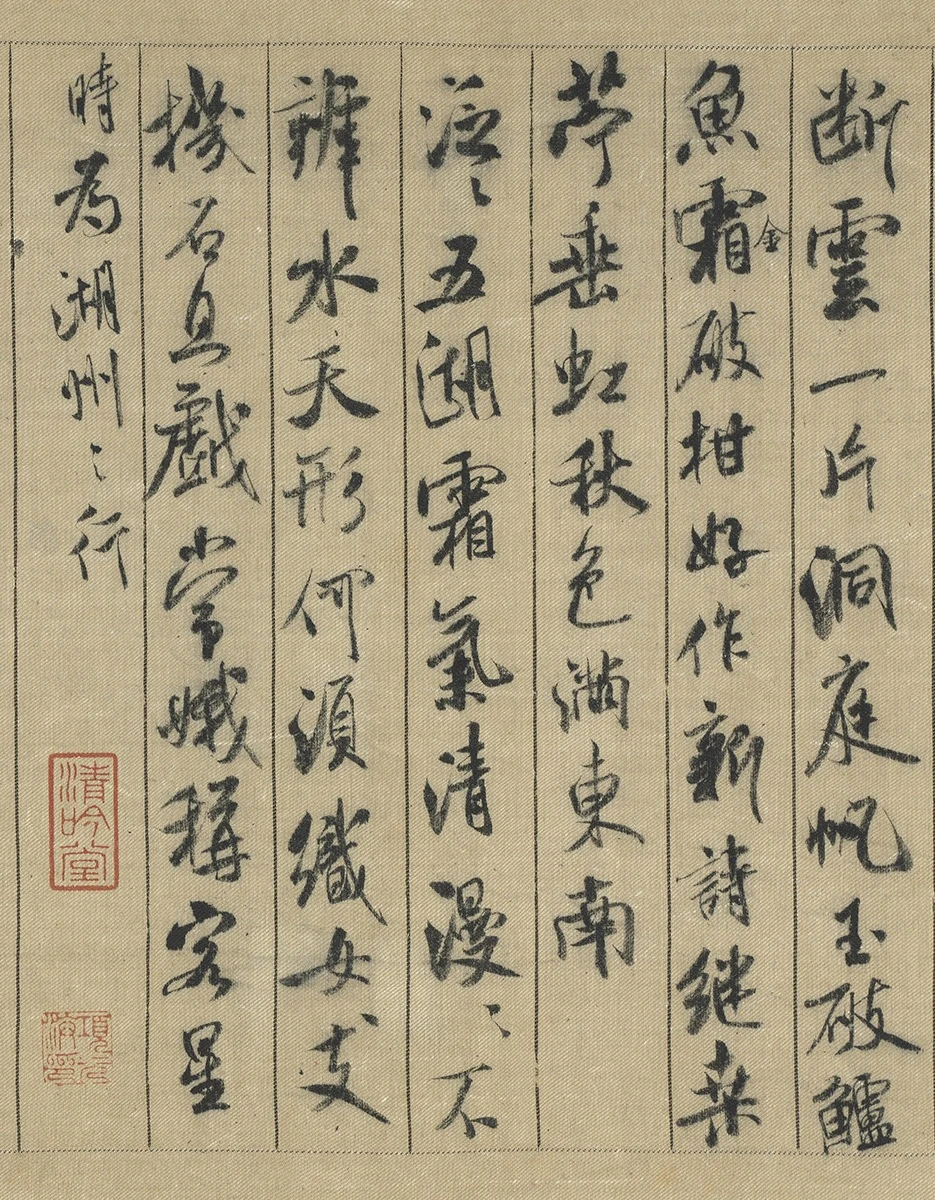
Look down the rightmost column, 斷雲一片洞庭帆玉破鱸. 斷, “broken,” and 雲, “cloud,” gather black at the top; 一, “one,” uses a single horizontal. 片, “piece,” leaves a relatively large opening, while 洞 and 庭, together the place-name Dongting, restore width. Near the lower end, 鱸, “perch,” occupies the remaining space densely. The lane keeps its width, but its ten characters are not ten identical squares.
Near the top of the next column, the small replacement 金, “gold,” uses the narrow interval to the right of the large 霜, “frost,” before the rule. Two sizes coexist because the lane gives a range to the whole column without allocating every part to equal-sized characters. The correction reveals another role for exposed silk: it can become a place for a further character to enter.
Now follow the middle column, 泛〔repetition mark〕五湖霜氣清漫〔repetition mark〕不. 五, “five,” spreads sideways; 湖, “lake,” has elongated internal openings; 霜, “frost,” is more compact; 氣, “air,” sends its lower part to the right; 清, “clear,” returns to a structure divided left and right. In the next column, 辨水天形何須織女支, look at 水, “water,” opening to both sides, the finer 形, “form,” and 何, “why,” the renewed density of 織, “weave,” and the rightward ending of 支, “support.” Parallel rules have not made these openings and contractions into one repeated action.
The silk deserves attention too. Its fine texture shows in the broad spaces outside the characters and through the intervals in lighter, finer strokes. Beside deep black in 霜 and 清 it forms a distinct boundary. The material has not withdrawn behind the writing. Brush lines, exposed textile and fine straight rules together make the surface we see.
The photograph’s variations in width and exposed silk do not directly disclose pressure, speed or the silk’s resistance. What is before us is already rich: follow the rule down, then a horizontal sideways; meet a cluster of complex strokes, then a small opening of silk.
The different bearings in On Sichuan Silk do not wait for a rule to be crossed. Much of the variation happens within continuing lanes: slanting strokes make the vertical reference evident, short columns make the lane’s full length evident, and fine strokes make the material evident. Mi Fu wrote into a textile that already had a form, and that textile remains present among the characters. Their simultaneous presence gives the work part of its movement.
Optional further reading: different histories on one surface
The long area below 歲寒, “winter’s cold,” in Figure 2 provides a useful starting place. It has no next character, but it has fine textile structure, two straight rules and a later red seal. All belong to today’s image; they did not all arrive under Mi Fu’s brush at the same moment.
In “The Wood Still Holds That Dry Year”, I wrote about an object’s past remaining in its present form, and the need to distinguish how it remains rather than replace it with a general “long ago.” Here that thought gives the rules an additional weight: they survive from manufacture before the writing. They were not drawn as aids for our present explanation of Mi Fu’s slanting characters.
Lin Xi’s inscription records the silk’s manufacture in 1044 and its mounting in 1068, when he intended to invite skilled writers to inscribe it; Mi Fu’s closing date is 1088. These texts give evidence for the sequence. Image and inscription meet: our eyes locate the existing rules, while the inscription helps establish a history before Mi Fu wrote. Later collectors’ seals make “Mi Fu wrote nothing here” different from “this is now entirely empty.”
The “beauty of causation” in SAE, Self-as-an-End, adds a sensitivity to different processes of formation within the same surface. Weaving, writing, sealing, and finally photography each leave something different. Distinguishing them lets the characters inhabit a material with a history. The writing responds to something already made and leaves its own arrangement, through which later viewers can still find tilts, widths and unwritten places.
Edition, textual notes and images
- The object is the National Palace Museum’s 宋米芾蜀素帖卷, inventory 故書000071N000000000. The main section is catalogued as silk damask, 27.8 × 270.8 cm. “Silk” and “Sichuan silk” follow conventional usage; the support is not paper. Earlier museum texts differ on Mi Fu’s life dates; this essay uses the current exhibition’s execution date, 1088, without deriving style from an assumed age.
- Four poems are transcribed and translated in full, not all eight on the scroll. Every non-Chinese edition retains these four Chinese poems and complete translations. Historical forms include 勁/劲, “strong”; 龜/龟, “tortoise”; 鶴/鹤, “crane”; 壽/寿, “longevity”; 華/华, “flower”; 斷/断, “broken”; 雲/云, “cloud”; and 鱸/鲈, “perch.” Simplified transcriptions are reading aids. The correction from 霜, “frost,” to 金, “gold,” is followed; repetition marks are expanded; 常娥 is retained. The interpretation of the first poem’s final question is explicitly identified in the main text.
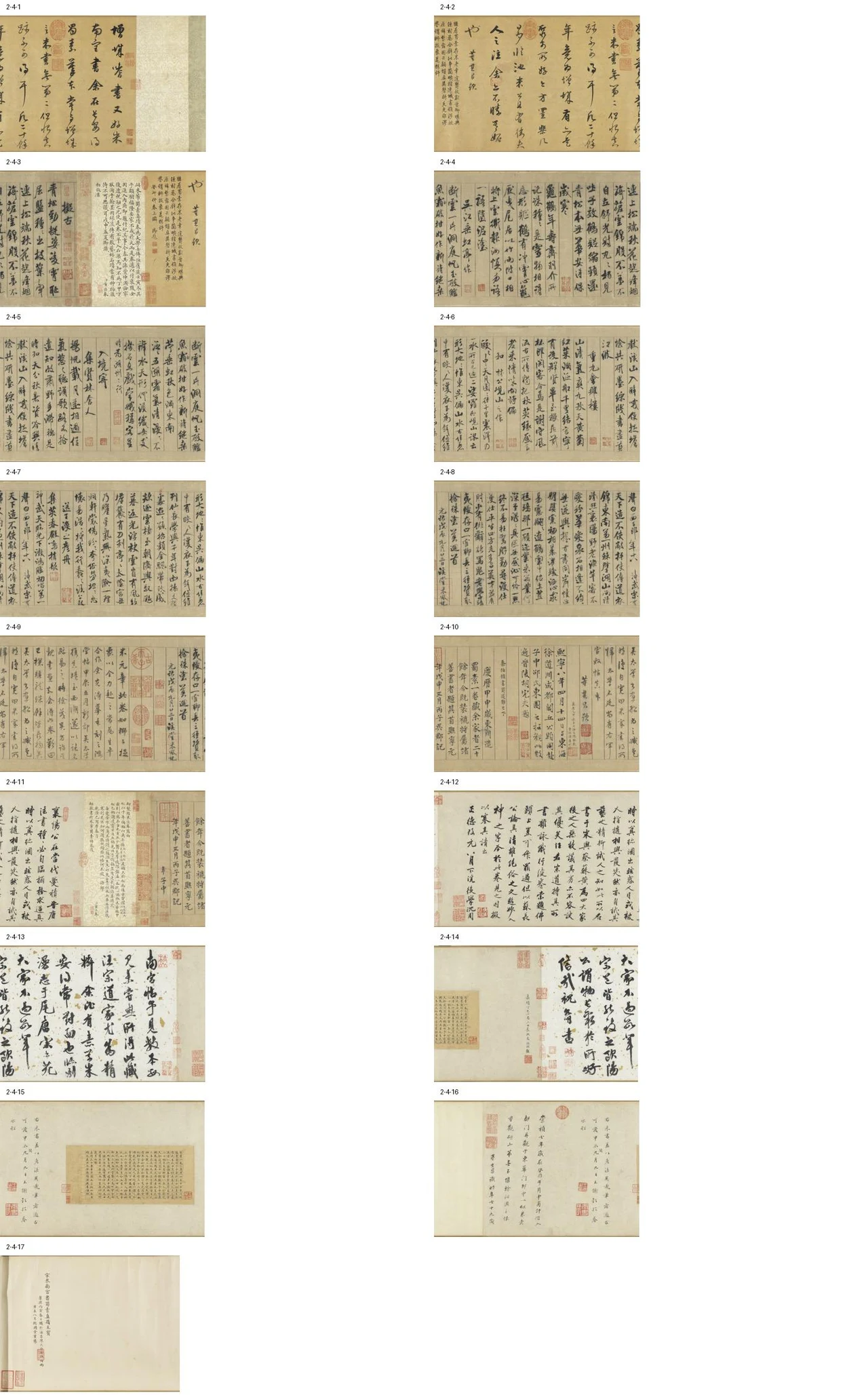
- The four details use museum exhibition photographs 2-4-3, 2-4-4 and 2-4-5, with rectangular cropping and JPEG encoding only. Neighbouring columns and rules remain. No strokes, seals or colours were altered or generated. The package supplies a thumbnail index and official links for all seventeen photographs. They overlap and cannot be assembled to calculate the object’s full length. Open the photograph index: follow numbers from left to right within each row, then downward; inside each view the scroll reads right to left.
- This is a reading of published photographs rather than a record of viewing the original. Observations about leaning forms, open spaces and texture compare what the photographs show; they do not identify a precise mental state, personality or complete production process.
- Image credit: National Palace Museum, Taipei. The museum’s general open-information announcement permits reuse under stated conditions, including attribution, with exceptions. No individually issued image permission was obtained. CC0 or CC BY terms attached to other download channels have not been transferred to these exhibition JPEGs. See the accompanying rights statement.
Further images and reading
- National Palace Museum, Assembly for the Ages, 2025, section two: direct official source of the seventeen photographs.
- Museum collection record: complete transcription of all eight poems, closing inscription, Lin Xi’s inscription, dimensions and material. Download licences must be matched to the actual image source.
- Han Qin, “The Wood Still Holds That Dry Year”: the complete Ray 05 essay used in the optional reading.