The lower-right part of 更 suddenly grows heavy. In figure 1, find the fifth character in the middle column of the left-hand page. Several fine lines above enclose small compartments; the stroke below spreads towards the lower right and ends in a broad, pointed shape. Just as the eye becomes accustomed to those sparse, slender lines, it encounters a marked increase in weight.
Look upwards. The curving line of 宅, “dwelling,” also extends sideways, but without the same broad, thick ending. One column away, the bottom horizontal of 車, “carriage,” lifts at its right end. Not every horizontal is equally thin, nor does every long stroke acquire the same tail. The tension of the Ritual Vessels Stele, or Liqi Stele, begins in the changing proportions between fine lines and heavy strokes within this opening.
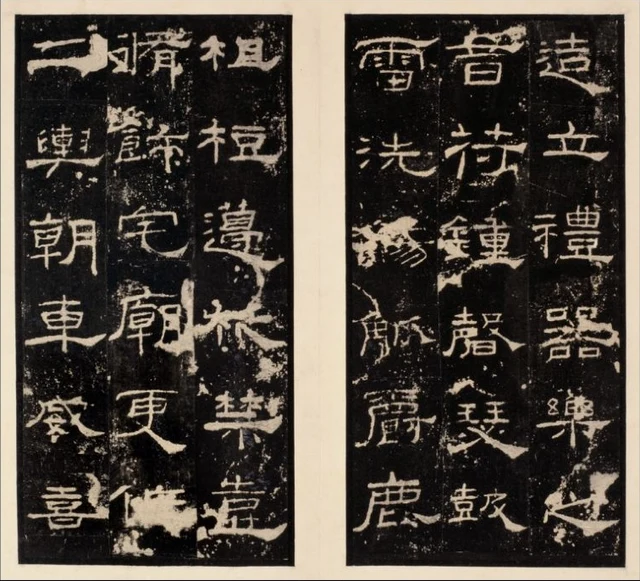
更 here means to renew or make anew. The inscription says that Han Chi “修饰宅庙,更作二舆”: he repaired and refurbished the Confucian temple and made two carriages anew. It records objects, building work and the facilities of ritual. The word's meaning tells us where the account is going; the line that changes from fine to broad gives the eye another turn at which to linger.
A Temple, a Stone, and a Later Album of Paper
The stele was erected in the second year of Yongshou in the Eastern Han dynasty, 156 CE, to record Han Chi, Chancellor of Lu, refurbishing the Confucian temple and providing ritual vessels. The original stone was formerly in the Confucian temple at Qufu, Shandong, and is now kept in Qufu's Han and Wei Stone Inscriptions Exhibition Hall. Official account of the stone's present location The object used here is the Palace Museum's Ming rubbing album, Stele of Han Chi, Chancellor of Lu, Making Ritual Vessels for the Confucian Temple, accession 新00044512. The museum states that it includes the front, back and sides of the stele, with a title label by Zhang Boying. We are looking at paper rubbed from a Han stone during the Ming dynasty, and at its subsequent album form. Palace Museum description; Digital Cultural Relics record
In the rubbing, the incised characters remain light while ink darkens their surroundings. The lines have passed through writing, carving, changes in the stone's surface and the rubbing process. They are not simply equivalent to a perfectly preserved Han ink manuscript. “Fine” and “thick” describe forms we can compare in the image before us; paper, ink, the rubbing maker and photography all participate in their appearance.
The album also cuts long columns into strips and rearranges them as shorter ones. Whole openings are retained below so that every character discussed has neighbors for comparison. The mounting seams are not the original stone's column boundaries. The main inscription and the lists of names must also be distinguished: an account praising temple repairs and the records left by contributors perform different kinds of textual work.
器 Is Complex, but Fine Lines Open It Up
Move to the far-right column on the right-hand page in figure 1. After 造 and 立 come 禮 and 器, followed by 樂 and 之. From the relatively simple 立, “establish,” the column enters the complex 禮, “ritual,” and 器, “vessel or implement,” before returning at the end to the brief 之, a grammatical linking word. The internal capacity of the characters changes several times.
器 contains several small 口 forms, or mouth-shaped enclosures. In this rubbing, their upper and lower groups have not fused into a light patch: fine horizontals and short verticals still divide the interior. After 器, look at 禮 above it. Its 示 component (“show,” used here as a graphic component) on the left is relatively sparse, while fine lines accumulate on the right. Density is not distributed evenly between the two sides. Many strokes do not clog the character; instead, the little dark spaces become entrances through which the eye can explore its structure.
Now look at the neighboring column, 音符鐘磬瑟鼓. It names sounds and instruments belonging to ritual music. The passage quoted here reads: “君于是造立礼器,乐之音符,钟磬瑟鼓.” This means: “The lord then made ritual vessels and implements for music, including bells, stone chimes, zithers and drums.” The ringing of bells and stone chimes, the strings of the se and the vibration of drums each have their names in the text. The visible 瑟, “zither,” also joins a dense upper structure to a final stroke extending towards the lower right. The neighboring 鼓, “drum,” releases a stroke outwards too, but its internal components provide different points of support.
Identifying these instruments does not recover their actual ancient sounds from the characters. It tells us that the passage is not simply repeating the abstract word “ritual” in praise of itself: it lists things to be made and used. The calligraphy turns that inventory into a visible sequence of changing density. Dense places need fine lines to divide them; open places allow a stroke to gain weight abruptly.
更 therefore acquires a neighboring scale of comparison. Enlarged in isolation, it would be easy to see only its lower-right thrust. Keeping 宅, 廟, 車, 禮 and 器 in view tells us what that stroke is heavy in relation to. Weight is not a permanent property attached to a character. It becomes visible through comparison on the same sheet of rubbing paper.
Two 王 Make Stability Differently
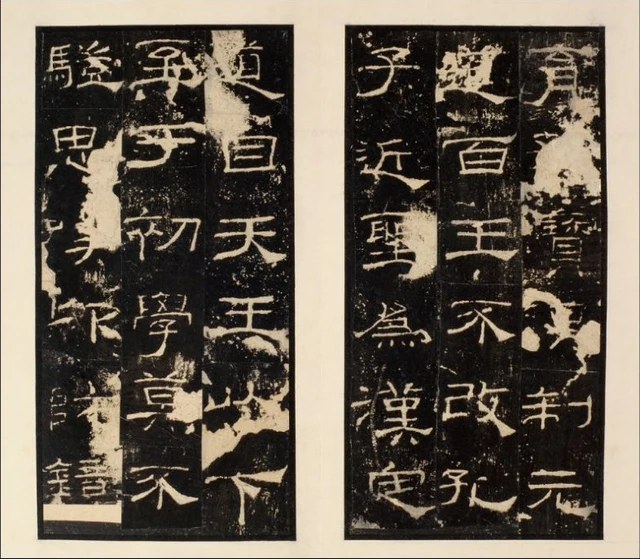
In the middle column of the right-hand page, we can read “百王不改”: “unchanged through a hundred kings.” The phrase praises the endurance of ritual institutions and the sages' way across successive reigns. 王 here has a simple framework: horizontal lines crossed by a central vertical. The upper two horizontals are finer. The bottom one widens as it moves rightwards, and its ending suddenly gives weight to this economical character.
On the left-hand page, another 王 appears beneath 天 in the right column. The right end of its bottom horizontal is again conspicuous, but its downward slant and taper do not coincide with those of the 王 on the facing page. Both retain their recognizable relation of three horizontals. A shared framework does not require them to have the same lower edge.
If 王 is stable, where does that stability reside? Look at where the central vertical crosses the horizontals, then at how far the bottom line extends at either end. The gaze can travel out along a horizontal and return to the interior along the vertical. Stability occurs in this possibility of going out and coming back, not merely in the presence of a thick line underneath. The clearer the upper structure, the more support the suddenly heavy lower stroke has.
This also makes “slender” more precise. The Ritual Vessels Stele does not reduce every line to an identical thinness. It retains many fine lines and, at certain points, broadens, lifts or presses down, while keeping their lengths and directions traceable. Copying only the heaviest strokes would lose the framework.
There are also large, irregular light patches in the image. Some cross the middle of characters; others extend along the edges of paper strips. They are not the same kind of feature as the complete bottom horizontal of 王. The written structure remains available for close looking, while stone wear, lost paper and rubbing effects retain their separate material questions. Not every pale patch needs to be given an intentional brush movement.
“Slender and Strong as Iron”: More Than a Phrase of Praise
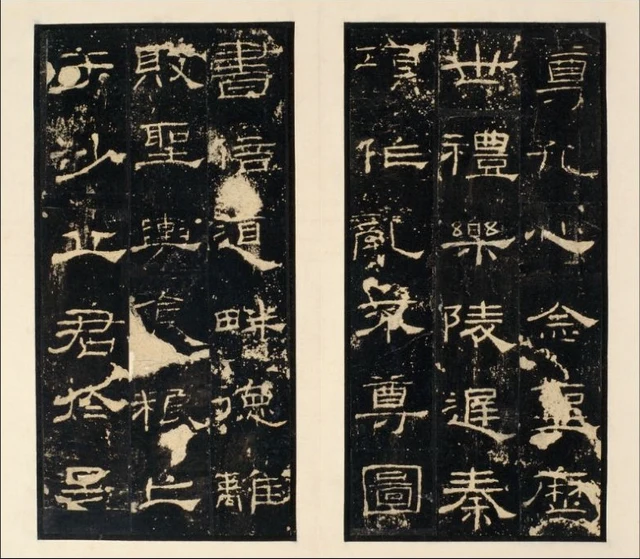
Wang Shu described this stele as “瘦劲如铁,变化若龙”: “slender and strong as iron, changing like a dragon.” Iron names its strength; the dragon names its transformations. Remembering only the first half might leave us imagining a row of hard, straight, thin rods. Wang Shu's assessment quoted by the Palace Museum
Figure 3 reconnects the two halves. In the sequence 禮樂陵遲 on the right, dense 禮 gives way to 樂 with its spreading upper part, then to the left-right division of 陵, and finally to 遲 with its walking component. Each character gives similarly fine lines different work. “礼乐陵迟” means that ritual and music were gradually declining. 陵迟 here is not the name of a form of punishment. The sentence explains why the institutions needed repair, while the characters show that order does not require the elimination of turns and differences.
The lower part of 遲 reaches rightwards, supporting the structure above. 陵 also has an outward final stroke at its lower right, but it begins from a different relationship of components. Compare 心 and 念 further to the right. The first opens through a few separated lines; the second adds a covering part above 心. Although both involve the form 心, the height and center of gravity of the complete characters have changed.
“Strength” can be understood this way: fine lines still distinguish components and establish directions, preventing the gaze from dispersing in empty space. “Change” occurs in how those directions meet and how the endings acquire weight. Both are present together. The old praise need not be discarded. It needs to return repeatedly to lines whose positions we can point out.
Beyond Commemoration: The Contributors' Amounts
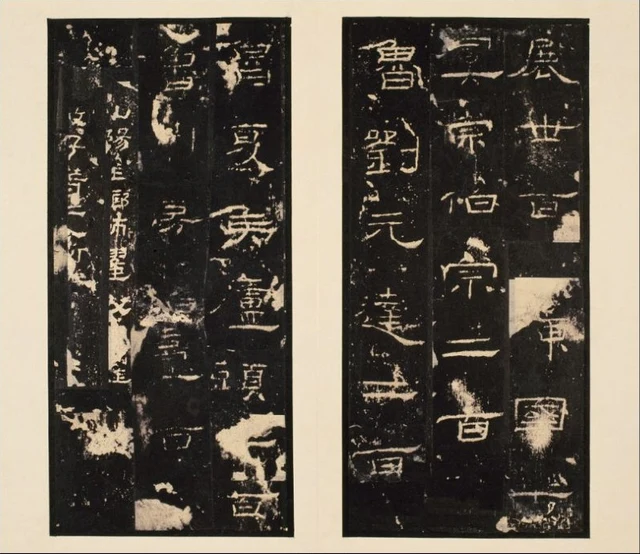
The writing on this page suddenly resembles a succession of entries. “魯劉元達二百” records a place of origin, a contributor's name and a contribution of two hundred; the neighboring column ends with another 二百. Attention moves from the earlier account of ritual and music to particular participants and what they contributed. We need not memorize every name to notice that this monument at the temple also gave its participants an enduring, readable place.
The two 百 differ in their horizontals, enclosed spaces and condition. One sits at the bottom of the left column on the right-hand page, the other at the bottom of the middle column; each follows 二. The number repeats, but neither the written contours nor the surviving surfaces coincide exactly. Smaller, more tightly arranged writing is also visible on the left-hand page, giving the list a local density unlike the main text's six-character album columns.
Thinking again of “changing like a dragon,” we can no longer understand change only as the beauty of one descending stroke. It also involves main text and names, larger and smaller characters, repeated amounts and differing arrangements of writing. These differences alone do not establish how many people wrote the inscription. First, they show that the stone's textual tasks are more complex than those of one continuous eulogy.
Return to 更 at the beginning. It is still those few fine lines and an ending that grows broad. We can now see that the fine lines sustain more than an attractive framework for a single character. They also allow names of objects, a historical account and lists of contributions to take their respective places on the stone. The weight of the Ritual Vessels Stele often lies in those slender lines that refuse to disappear.
Optional Further Reading | The Times a Fine Line Has Passed Through
In The Wood Still Holds That Dry Year, I distinguished a surviving trace from a story casually invented for it. One narrow tree ring cannot by itself prove a drought; neither can a pale patch on a rubbing automatically prove that a writer deliberately used a broken, dry-brush stroke.
Look at figure 2 again and point separately to the fine horizontal of 王, the irregular white patch beside a character and the seam between paper strips. They belong to the same image but have different histories. To determine how far a particular stroke had already broken down when a rubbing was taken, we would need to compare the same character in rubbings of other dates. This page alone cannot assign every break to a particular year.
The causal ray in the SAE framework directs attention to how events remain in later forms. Here its most useful contribution is greater patience in comparison: the shape of the writing has survived, and the way it survived is also present in the image. We can appreciate the organization of 王 while acknowledging that some pale edges require another rubbing before we can explain them. SAE: Judgment and Aesthetics
Edition, transcription, images and permissions
This is a close reading of official images, not an in-person examination of the stone or rubbing. The original stone of 156 CE, the Ming paper rubbing and subsequent mounting, labels and photography are treated separately. The writer's name is unknown; historical suggestions about the number of hands or styles are not presented as established facts.
All four images come from the public high-resolution viewers for Digital Cultural Relics accession 新00044512. The photographic openings were captured after normal rendering in a browser. Only the external toolbar and thumbnail navigation were cropped away; the paper borders, damage, joins and existing marks within the photographs remain. There was no watermark or seal removal, stroke completion, restoration, recoloring or AI generation. Embedded figures are approximately 756–793 pixels wide for reading; inspect the official high-resolution viewers for finer detail. Original screenshots and crop coordinates are documented in IMAGE_NOTES. Album joins are distinguished from the original stone's column boundaries.
Quotations use common written forms and modern punctuation for readability. The catalogue's form 勅 in 韓勅 is retained. 礼乐陵迟 is understood as the decline of ritual and music. Figure 4 is not used to force each part of a recorded name into a personal-name or courtesy-name category, or to reconstruct the exact placement on the stone's four faces from one album photograph.
Copyright belongs to the Palace Museum and other relevant rights holders. No republication permission has been obtained, and no open license is claimed. Public redistribution or commercial publication requires separate rights clearance. Access to a public website for personal research does not constitute a republication license.