The added thumbnails are supplementary photographs of the same original sculpture. Close readings of a particular background or viewpoint still refer to the official images linked in the essay. Click a thumbnail to open the museum’s work page.
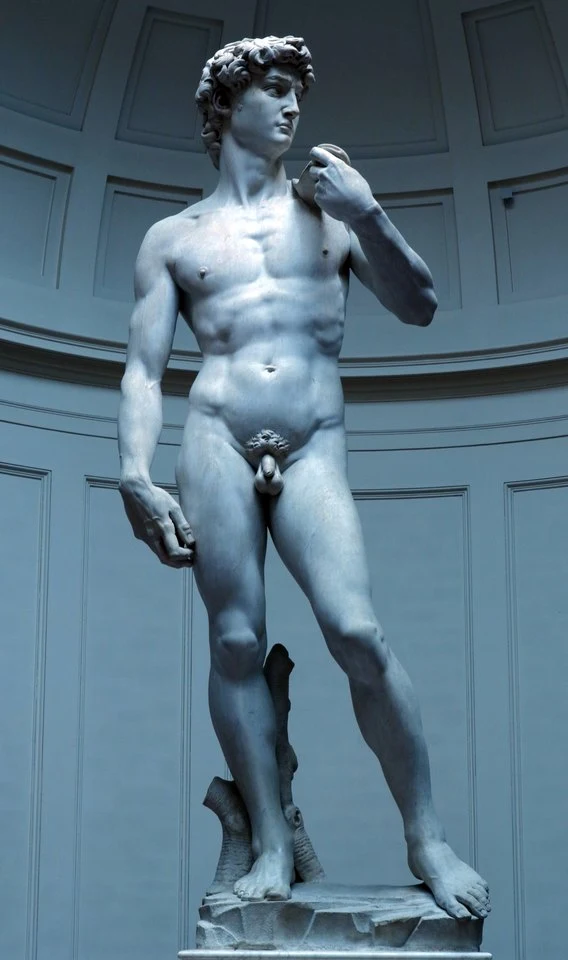
His right hand hangs beside his thigh, but the fingers have not quite relaxed.
His other hand is raised beside his shoulder, its thumb and curled fingers holding something unobtrusive. One arm extends while the other bends: the hanging right arm leads our eyes toward the knees, the bent left arm brings them back to the head. The chest faces largely forward, but the face has already turned to his own left. We first encounter a standing man, then discover that the parts of his body direct their effort in different ways.
View the original: official full-length photograph from Italy’s Ministry of Culture. Viewing guide: In this oblique frontal photograph taken slightly from below, the figure’s right leg appears on the left of the image, his left hand at the upper right. Follow the two hands through the whole body before looking at the face. The original image measures 458 × 1024 pixels and can be enlarged, but it is not an ultra-high-resolution detail photograph.

Michelangelo, David, 1501–1504, white Carrara marble. The Accademia’s current work page records a height of 517 cm including the carved base; inventory number 1076. This essay concerns the original in Florence’s Galleria dell’Accademia. Museum work page
David’s weapon is a sling. The raised left hand beside his shoulder and the right hand beside his thigh make its use possible, but the sculpture does not extend the arc of a swinging sling into the surrounding space. There is no fallen Goliath, no trophy held aloft, no broad twist of attack. Strength has been arranged, but it has not become an outward release of action.
David’s grandeur lies in how a body that has not yet struck can give direction to the empty space around it.
The work originated in early-sixteenth-century Florence. In 1501, the cathedral’s governing body commissioned Michelangelo to take over the carving; in 1504, the finished colossus was installed at the entrance to the Palazzo della Signoria, becoming a symbol of the city’s strength and independence. Moving from a religious building’s commission to the doorway of public power, this standing body entered early into the question of how a city sees itself. Museum account of production and placement
Standing Does Not Mean Equal Distribution
Look upward from the feet. The two sides perform different tasks.
The right foot sits beneath the straighter right leg, its sole meeting the stone base. The left leg bends at the knee; its lower portion slopes outward, and the left foot lies near the base’s edge. The space between the legs is not equally wide throughout. It narrows near the thighs and opens below the knees. The body seems to entrust more weight to its right side, allowing the left to move slightly away from that vertical load-bearing route.
This stance is often called contrapposto. The term can suggest two forces canceling each other until everything becomes still. In this photograph, balance looks more like a division of labor: one leg anchors the body to the ground; the other keeps it from becoming an upright column. The pelvis tilts, the curves on either side of the waist change accordingly, and the chest broadens above. Unequal weight-bearing carries through the torso rather than stopping at the feet.
The abdomen deserves particular attention. Below the ribs are not two equally bright semicircles: one side opens more, the other draws in. Nor do the widths of the waist mirror each other. Shallow undulations across chest and belly let light turn gradually over the surface, while knees, wrists, and hips offer more definite projections and changes of direction. A broad, gently modeled body connects with several tighter joints, giving the stance a rhythm.
Imagine both legs equally straight and the weight divided evenly between the feet. The inclinations above would lose their specific reasons here. This small comparison makes the conditions of steadiness clear: the body does not distribute itself evenly, yet remains secure.
Another part is often passed over. Behind the right calf stands a tree stump, its broken branches joining the leg. Follow it downward and it, too, reaches the same stone base. For the represented figure, the stump can seem part of the surroundings; for the actual sculpture, it provides additional connections and support in stone. We see a body seemingly standing by itself, and also see that marble does not simply copy the way a living person bears weight.
This makes “strength” more interesting. The figure’s muscles may persuade us that he can act, but continuous volumes of stone support this enormous object. The stump does not spoil the body’s freedom. It helps establish the conditions under which that freedom can remain visible over time.
Between Two Hands, an Action Still Folded Away
The right hand commands attention.
It lies near the thigh without merging into the body. The wrist narrows, the back of the hand swells outward, and bent knuckles break the contour into several small turns. At this point, the long forearm suddenly becomes a concentration of directed detail. The hand’s scale and clear outline keep it from easily disappearing even in a full-length photograph.
The left hand occupies an almost opposite position. The elbow points outward, the forearm rises diagonally, and the hand gathers beside the shoulder. The bent arm leaves a small opening separating it from the side of the chest. Only a short portion of the sling appears by the shoulder. Unlike a long sword, it does not announce the figure’s occupation from a distance.
Additional view: official National Gallery of Art publication, page 2, Figure 2 at upper right. The caption explicitly identifies the Accademia’s original David. Enlarge it to compare right hand, left elbow, feet, and tree stump. The publication centers on a different work, David-Apollo. This essay uses only Figure 2 to examine this David, not the sculpture on the cover.
Chest and abdomen separate the hands. The weapon does not occupy the center; instead, the body becomes our route to understanding it, from the grip beside the shoulder, across the chest, down to the other hand. Once we know he carries a sling, parts that initially seemed independently placed connect as one preparation.
Nudity therefore serves a specific purpose. No breastplate separates the arms across the chest, no heavy garment hides the pelvis. The way strength connects through the torso is directly visible. We can hardly identify the hands merely as “hands holding a weapon” and treat the rest of the body as decoration. How the hands wait and how the man stands are the same question.
The turn of the head carries this preparation beyond the body. His chest opens toward us, but his face does not greet us. A long rise and fall runs down the side of the neck; the chin directs attention toward the right of the image. The photograph places no enemy there for us to identify. The opponent’s absence does not deprive the gaze of purpose. Instead, the space without a visible person becomes an extension of the whole body’s relationships.
This is also what distinguishes the pose from ordinary relaxed standing. Secure feet, gathered fingers, and a turned head coexist, giving the body’s pause an object. We do not have to translate the face precisely into fear, anger, or confidence to sense that what concerns him lies elsewhere than among the viewers.
The absence of a definite strike also stretches time. A swing has a beginning, a peak, and a descent. Choosing one phase gives the action a clear position in its course. David folds action into preparation, keeping the viewer within an experience of “not yet.” Knowing the biblical story’s outcome does not automatically dissolve this interval of waiting. Victory belongs to what happens later in the story; the body before us must still sustain attention now.
This Stone Did Not Begin as a Blank
Now reconnect this body with the conditions of its making.
The block Michelangelo inherited had already been roughed out by Agostino di Duccio, and Antonio Rossellino had subsequently attempted to continue the project. The original plan called for the statue to stand on an exterior buttress of the cathedral. Only in 1504 was a new location discussed for the nearly completed colossus. Italian national cultural heritage catalogue
This history sets stricter limits on the phrase “releasing a person from the stone.” Carving continually removes material. Stone already lost does not grow back because the next sculptor has a new idea. Michelangelo faced neither freely chosen dimensions nor a wholly intact shape, but material carrying the results of earlier work.
That does not make every feature of the pose a forced expedient. The available records do not allow us to reconstruct the block piece by piece as he received it, much less point to a particular hand and say its position resulted from a predecessor’s mistake. What matters is that such a constrained starting point did not leave a sense of something merely adequate. The body’s turns, the arms’ extension and contraction, and their limited outward reach became mutually supporting relationships.
Both arms stay close to the torso. Although the left elbow projects, the hand returns beside the shoulder; the right arm descends along the body, leaving its hand near the thigh. The legs do not take a wide stride either. This enormous body thus has a relatively concentrated outline. It feels capable of movement without proving that capacity through the widest possible extension. The compactness retained by the stone and the potential strength displayed by the body meet here.
Look closely at the hair in the photograph. Curling locks form deep, dark pockets, while the chest and abdomen sustain much broader, gentler shifts of light. The same material carries both without asking light to settle in the same way. The head becomes dense, the body open. The face emerges beneath fragmented curls, helping concentrate the direction of its gaze.
The white stone we see today does not preserve all the visual conditions of 1504 unchanged. The museum records that the garland on the head, the sling, and parts including the tree stump were originally gilded. Such information cautions against treating whiteness as an eternally unchanging ideal. The photographs used here cannot reconstruct the brightness or extent of that gold. They show a sculpture that has undergone long display, cleaning, and care. Museum account of making and conservation
From a Planned Height to a Watcher at the Door
A change of location brought the same stance into different forms of public life.
High on the cathedral’s exterior, as originally planned, this body would have belonged to an architectural whole. At the entrance to the Palazzo della Signoria, it stood where civic power met everyday passage. A young biblical warrior took on the task of helping the city describe itself.
That public meaning unfolds spatially. An entrance is somewhere people pass through; the statue remains there, its head looking elsewhere. Passersby can look up at him while he keeps his own direction of attention. His body faces public space without having to answer every person passing. This sustained orientation readily creates a sense of keeping watch.
There is also a contrast of scale. In the story, David confronts an enemy stronger than himself. In the sculpture, he towers over the viewer. A story of the weak overcoming the strong has become an immense body. Rather than making us reproduce David’s smallness before a giant, the work gives this still-unvictorious youth, in advance, a visible weight capable of representing a city.
“Courage,” then, is more than an emotion read from the face. It can also be a way of organizing a public image: preparation, concentration, and secure standing enlarged enough for the city to see. The statue does not display victory’s reckoning, yet can enduringly carry the capacities a city wishes to possess.
In 1873, conservation needs took the original from the square to the Accademia. The gallery designed for it under Emilio de Fabris opened in 1882. The original gained protection and entered a new arrangement of viewing. Museum history
In the two near-frontal photographs used here, a curved wall and continuous architectural lines stand behind the sculpture. The body emerges against those relatively regular lines; horizontal divisions also give knees, hips, and head and shoulders their positions at different heights. The photographs themselves look slightly upward. Hand and chest are closer, the head turns away above, and the base lifts the feet off our ground.
Viewing today does not recreate political life at the palace entrance. Gallery, base, lighting, and viewing distance make this original an object before which we deliberately pause. The change is more than a move indoors. In the square, it participated in a city’s entrance; in the museum, architectural space arranges an arrival around it.
Return to the right hand. After dimensions, material, and history, that hanging hand has still not struck. It is no longer simply a passage of convincing anatomy, but a joint connecting the whole body’s steadiness to future action. David’s greatest weight lies in this sustained condition: strength is visible, while action remains unspent.
Optional Reading: Distinguishing Two Surviving Histories with SAE
This body looks so complete that we can easily forget it was continued from a block already bearing the results of work.
Han Qin’s essay on causal beauty, “The Wood Still Holds That Dry Year,” asks through tree rings, timber beams, and stone steps how the past has actually affected what remains today. It distinguishes verifiable provenance from histories viewers invent for markings, and reminds us that age does not automatically confer beauty. Read the essay on causal beauty
Returning to David, we can first distinguish two easily confused histories. The right hand bends and the left rises; we understand them as preparation for battle. That is the story-time represented by the sculpture. Another time belongs to the marble itself: worked by others, taken over by Michelangelo, then transported, displayed, and maintained. The fingers do not remain bent because they actually waited through a battle, but the material really did undergo carving. Two kinds of time meet in one shape, arriving from different sources.
The effects of earlier rough carving need not resemble a tree ring that can be traced on the finished surface. Removed material is absent, yet still changed the conditions of later work. A further step is to move from “what traces remain?” to “what possibilities have already disappeared?” New carving can remove more stone, but cannot freely retrieve what was removed before.
Look again at the arms. The left folds back to the shoulder, the right descends along the torso, neither hand going far from the body; the legs also open only a limited distance. These compact relationships alone cannot prove that every part was forced by earlier carving. Yet knowing the work did not begin from an intact block of any chosen shape gives this compactness another weight. It is an organization achieved within the material’s existing constraints, which ultimately makes the body seem to have ample room for action. Understanding constraint lets us appreciate the completed form more specifically without inventing a workshop legend for every shape.
The stump brings this question into immediate view. The figure seems to stand on his own legs, while the actual stone adds connections behind them. Capacity within the story and stability within the object require different explanations here. We see a powerful person and also see how material construction sustains that appearance. The two connect without canceling each other.
Another past lies between sculpture and viewer. Moving the original from outdoors to a purpose-designed gallery changed how it reaches us through a choice made for its protection. The curved wall behind it in the photographs, the display base beneath its feet, and the light producing gentle shifts across chest and abdomen all participate in this viewing. They are not all part of the figure’s design in 1504, nor are they merely a background we can casually strip away. These are the conditions under which the original is preserved and approached today.
The ray’s value, then, is not to make David more “ancient,” but to give layers to the completeness before us. It represents a body that has not yet struck; it is also a sculpture left by earlier working, later decisions, and continued care. Look again at the hand hanging beside the thigh. The bent knuckles still sustain that preparation. Earlier passersby have gone; people today pause anew. The pose holds one moment of a story, while actual history allows that moment to remain visible.
Notes on Images and Sources
This essay examines the oblique frontal full-length photograph of the original from Italy’s Ministry of Culture national heritage catalogue and the photograph of the Accademia original in Figure 2, page 2, of the National Gallery of Art’s official publication Michelangelo’s David-Apollo. Both are near-frontal views. No rear, independent side, or macro view is invented from them, and photographs are not treated as measurements made on site. The publication credits its image to Scala / Art Resource, NY.
The Accademia’s current collection page records 517 cm; the Ministry’s older catalogue and the NGA publication give 516 cm. This essay consistently uses the current museum figure. Image sources appear in the viewing links, historical and theoretical sources in the references. Formal judgments are this essay’s readings.
.jpg)