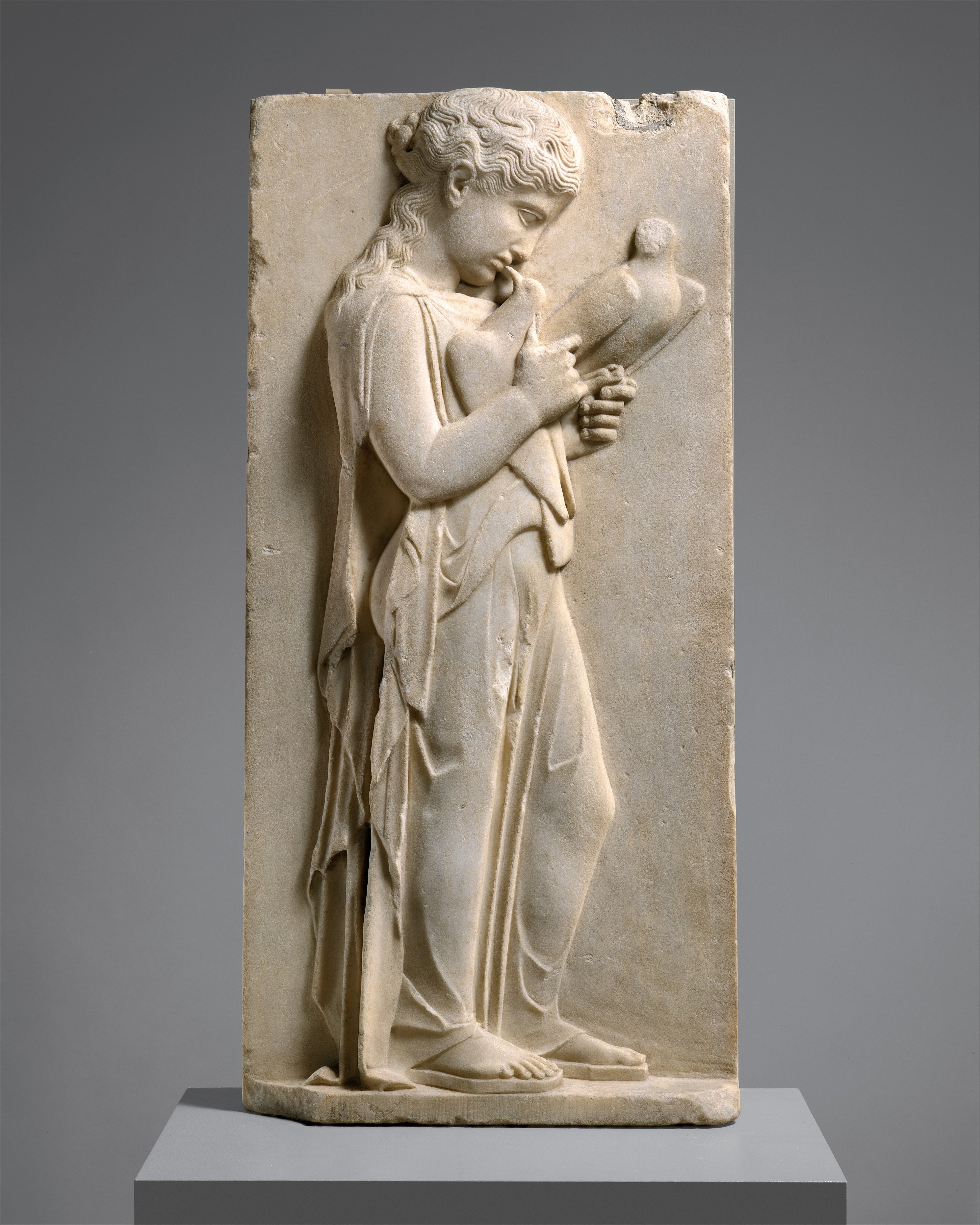
First, find the bird beside the girl’s mouth.
Its body rests against her chest, its tail hangs down, and its tiny head tilts upward, bringing its beak beside her lips. The girl lowers her head. One arm bends upward from below, enclosing the bird and her body within the same curve. The other bird extends toward the upper right of the image, overlapping the first near her hands.
Two birds, two hands, and a face in profile gather within a very small area near the top of the stele. Farther right, however, lies a broad stretch of stone almost without imagery. Intimacy and open space appear side by side.
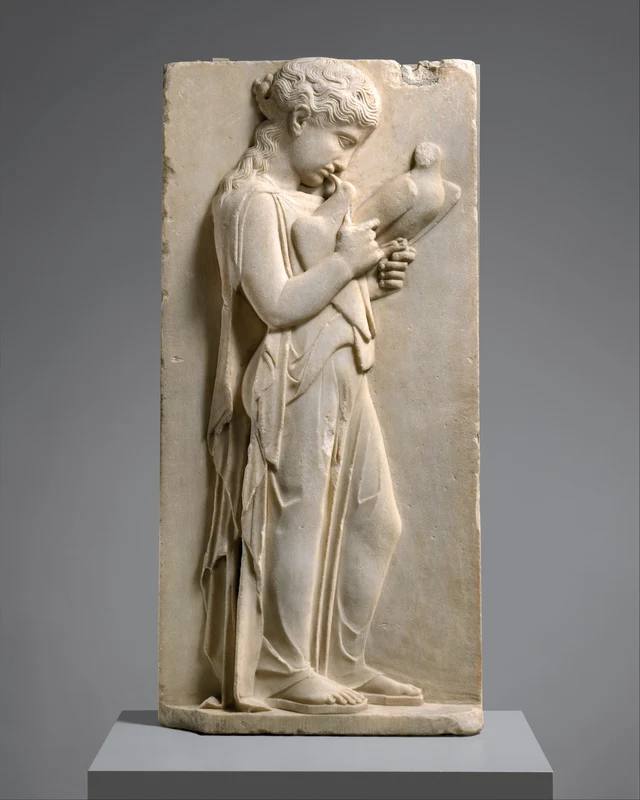
The work’s most moving arrangement is this: rather than making the girl face us to express something, it lets us see her in contact with another small living creature. Her head inclines, her arms draw inward, and both her gaze and her actions concentrate on the space before her chest. As a grave marker, the stele was meant to remain and be seen. Yet the figure it preserves does not give her attention to the people passing by.
The stele dates from the Classical period of ancient Greece. It is not a freestanding sculpture but a relief projecting from the front of a stone slab. Grave stelae marked and commemorated the dead; images from life and personal belongings could enter into that commemoration. The museum identifies the birds as the girl’s pet doves and reads the scene as a tender farewell. This offers a grounded direction for interpretation. To see how the closeness actually takes shape, we still need to follow the stone’s surface. Museum commentary; Death, burial, and commemoration in ancient Greece
1. Closeness Is Distributed Among Several Small Actions
The girl is not holding the two birds straight out as though presenting a single object.
The arm nearer us first descends from the shoulder, bends at the elbow, and rises diagonally to the right. Her forearm crosses her chest, bringing her fingers to the place where the birds overlap. The other hand, farther right and lower down, reveals several bent fingers. Her hands are at different heights, and the birds are not neatly side by side: one presses against her chest; the other extends diagonally outward.
Before gathering all these details into the word “cradling,” look at their different positions. She is doing several things at once: enclosing with her arm, supporting with her palm, bringing her head closer. Holding has not been condensed into a pair of oversized, emphatic hands. It has been distributed among several parts of the body.
The bird beside her mouth matters especially. Its upward-reaching neck is narrow, while the girl’s cheek forms a relatively broad area. Her wide, gently modeled face finally narrows around the tip of the nose, the lips, and the beak. Within the whole relief, this is a very small point of contact. Yet the downward direction of her head and the upward direction of the bird’s both lead our eyes toward it.
Closeness acquires a scale. We are not looking at two large masses pressed together, but at a tiny tip arriving beside a mouth. Farther down, a larger area of the bird’s body rests against her. Contact at a point differs from closeness across a surface, and our looking moves between the minute and the broad.
The other bird opens this close-knit arrangement toward the upper right. Its body makes a diagonal opposite the girl’s lowered face, with stone still visible between them. The bird is not entirely hidden in her embrace, and her arms do not close into a sealed circle. An outward direction remains within the act of holding.
“Tenderness,” then, becomes more than a judgment attached to the work. It has identifiable forms: hands at different heights, arms enclosing without closing, a tiny point of contact, and intervals still left around it. These arrangements can feel gentle, while also showing hands carefully supporting something.
2. The Stone Surface Remains Present
At roughly thirty-two inches high, including its lower section, this stele stands less than a meter tall. A photograph can enlarge the girl until she fills our field of vision. Her actual dimensions remind us how small the meeting of face and beak must be. Within a limited thickness of stone, the carving has to make relationships of front and back clear.
Look at her forearm. It crosses in front of the birds and clothing, its edge casting a fairly distinct shadow. Then look at her face: nose, lips, and chin project to the right, while neck and hair turn back behind them. Arm, birds, clothing, and background do not occupy the same plane, but neither do they extend freely in every direction. Relief organizes a body we might otherwise walk around into an order of overlapping depths that can be read primarily from the front.
This restriction concentrates the contact. If hands, birds, and torso were entirely separate, the gaps could be deep, and we might go around the back to trace the structure of the embrace. Here, a bird’s body lies beside the clothing, and fingers rest along the meeting of forms. Differences of depth allow several things to touch while remaining distinguishable. Visual gentleness depends on a finely judged arrangement of higher and lower surfaces in hard stone.
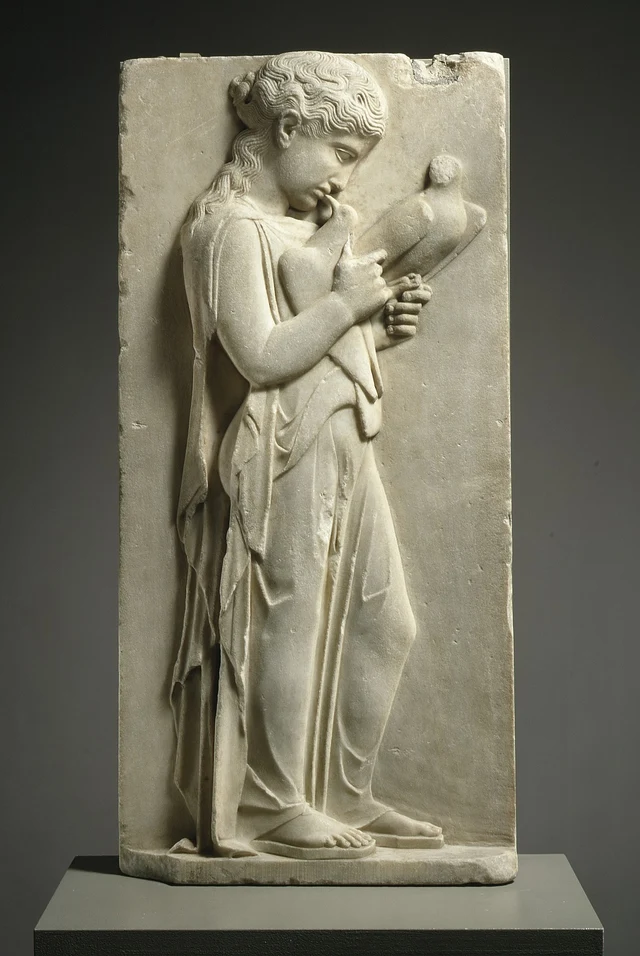
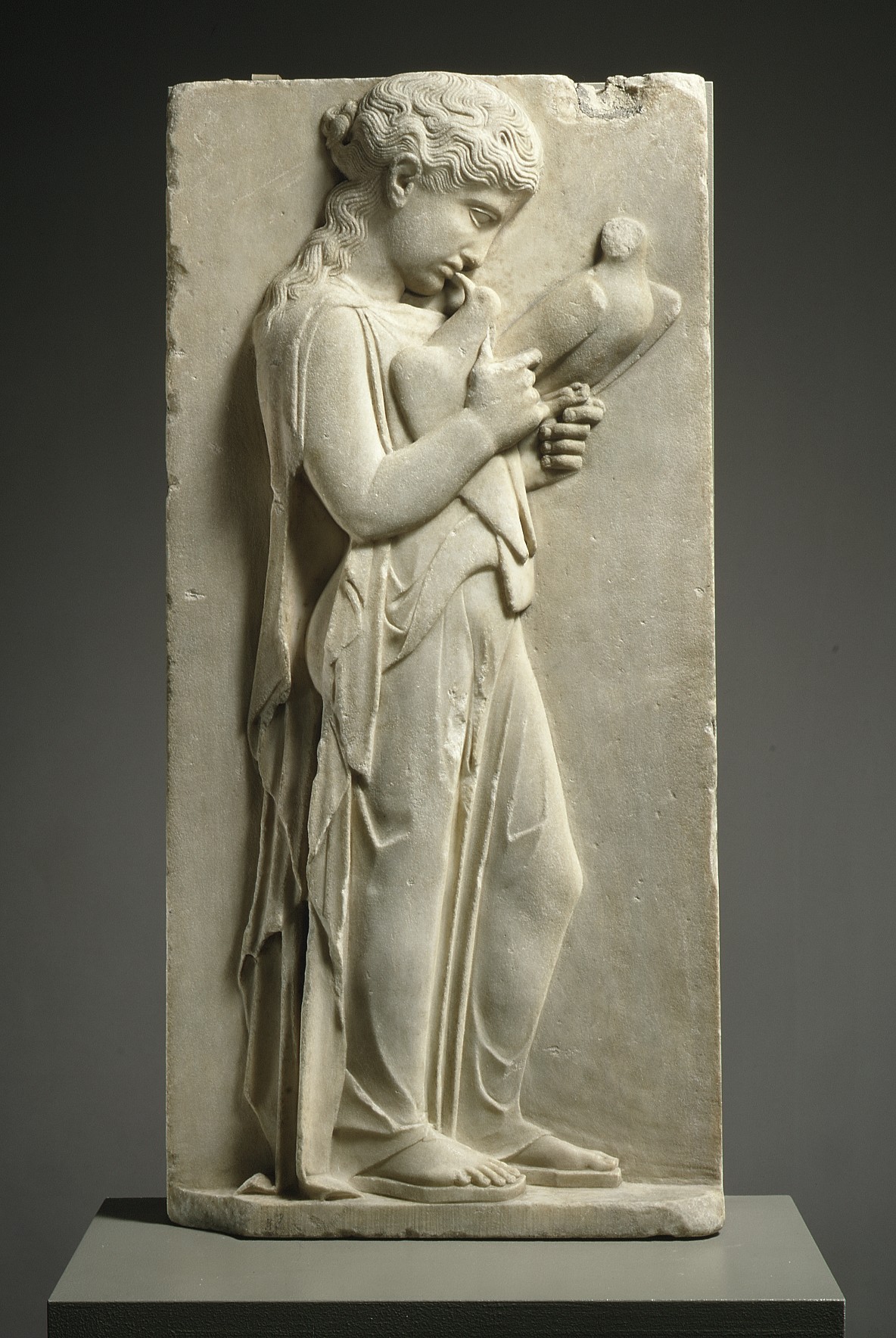
In Figure 2, the shadow between the left side of the body and the hanging garment edge appears deeper, and the fine grooves of the hair are more conspicuous. Compared with Figure 1, the stone’s tone, the contrast, and the framing differ. This has not given us a second work. It does make it easier to notice that a photograph’s apparent thickness and thinness have also passed through lighting and photography.
Even so, one thing remains clear in both images: the background has not been completely concealed. A narrow strip of stone lies behind the girl; a much wider area lies before her, below the birds. This empty area has not been carved into a room, a courtyard, or a sky. It surrounds the figure and is also the stele itself.
Our eyes can follow the arm into the embrace, move rightward along the outer bird, and finally encounter the quiet plane. The concentration of contact stops here. That pause clarifies the relationships before her chest while keeping us aware that the action before us has been preserved on a stone with definite boundaries.
3. The Long Garment Gives Stillness a Body
If we look only at head and hands, we may remember the work as a close-up embrace. Looking down, we find the girl standing there in full.
She wears a long garment called a peplos. The museum notes that it is unbelted and open at the side. It falls from her shoulders without a belt first dividing the upper and lower body. This Greek garment was made from a rectangle of cloth, folded, wrapped, and fastened at the shoulders. The long edges and folded layers in the carving therefore relate to how it was worn, as well as to decoration. Museum commentary; Ancient Greek dress
Below the shoulder, on the left, relatively dense, long folds fall almost vertically to the bottom. On the other side, the garment swells forward, turns more broadly near the knee, and develops curved folds below. One side looks more like cloth hanging straight down; the other reveals the bend of a leg more clearly.
The museum’s audio commentary explains that her weight rests on her right leg while her left bends. Even without remembering which leg is which, we can see this inequality in the clothing: the two sides have not been pulled into equally straight columns. Cloth covers the body while bringing its different loads and directions to the surface. Museum audio transcript
At the bottom, the hem nearly reaches her feet, but both sandals remain visible. Their soles meet the narrow ledge at the foot of the stele, and the toes line up individually. Above, bent fingers maintain the embrace; below, toes extending onto sandals establish her standing. Within one stone, hands and feet each manage a different kind of contact.
The upper and lower areas also suggest different speeds. Face, birds, and hands send our eyes back and forth over short distances. The long garment carries them downward along longer, slower folds before they reach the ground. Cropping the image at the waist would preserve the action beside her mouth but remove this steadiness extending from shoulder to foot.
Lowering her head has not made her whole body curl inward. The straight-hanging cloth edge maintains her height, the variations of her legs remain beneath the garment, and her feet have clear points of support. The upper body draws toward the embrace while the lower body stands its ground. This distinction gives her closeness measure, rather than making it an undifferentiated softness without a supporting frame.
4. The Stele Preserves the Moment When She Was Not Turned Toward Us
Return to her face.
Her eyelid lowers; forehead and nose form a slanting outline. There is no open mouth, no hand raised toward the viewer, and no gaze meeting ours. We can see her, but within this action we cannot become the person she sees.
Placed in the context of the stele’s purpose, this gives the work a particular distance. The monument opens toward those who come later, while the girl’s action remains directed toward the birds she holds. It entrusts a person to others’ memory while preserving the image’s own direction of attention. What the viewer receives is not a face addressing us but an opportunity to witness closeness.
Ancient Greek funerary monuments could evoke memories of life through images of the dead, everyday belongings, or animals. Such imagery does not amount to an individually verified biography in the modern sense. The collection record provides no name, exact age, or circumstances of death for this girl. Her relationship with the birds is very specific within the image, but it cannot supply an unwritten day in her life. Greek funerary imagery and commemoration
This gives the reading of “farewell” an additional weight. The image itself does not enact departure: the birds do not fly away, the hands do not lower, and the feet do not step out of the stele. Farewell arises from its use as a grave marker and meets an action of continuing contact. We know commemoration concerns loss, yet we see hands still supporting and a beak still beside her mouth.
This juxtaposition is more restrained than a depiction of separation. The stele does not need to carve all grief into the face. It gives something we can imagine as an everyday occurrence a persistence that cannot proceed to the next moment. A slight turn of the bird’s head would change that minute point of contact. Stone keeps the shape before the change occurs.
The empty stone to the right is therefore more than simply “negative space.” It prevents the image from expanding into a bustling scene of life, keeping us before this limited action. Girl, birds, and hands gather close; the rest of the world has not been filled in. The force of commemoration here rests on one bounded contact rather than an account of an entire life.
Optional Reading: Another Look Through Two SAE Rays
Perceptual Beauty: How Closeness Appears on Stone
First compare the dark area beneath the forearm in the two photographs, then look at the gentler light across the shoulder. We can distinguish the arm in front from the clothing behind not only because we know how a body is put together, but because projections, turns, and shadows are presenting differences.
Non Dubito’s “As the Light Fades, the Garden Appears Differently” approaches perceptual beauty through a garden at dusk: the way an object appears to us also depends on light and sensory conditions. This does not mean that what we see can be invented at will. The distinction is useful before a relief. Different strengths of shadow in the two photographs do not establish that the stone has become deeper. Yet those differences really can bring certain layers to our attention sooner. Essay on perceptual beauty
Try a small comparison. Look only at the girl’s cheek in Figure 1, then move to her hair. The cheek is a broad surface that darkens gradually; the hair is divided by many fine grooves, with more frequent changes of light and shade. Next look at the bird’s body. It is not filled with lines like the hair, yet its outline and its neighboring hand and clothing still distinguish it. The same marble gives skin, hair, wings, and cloth different appearances.
These differences remain worth looking at after identification is complete. We already know it is hair, but can keep looking at how the grooves turn. We know it is clothing, but can still follow the alternation of broad and narrow folds. The additional question here is how many specific differences lie between “recognizing a girl holding birds” and “seeing how this holding appears.”
This also returns “tenderness” to the conditions of looking. The marble’s physical hardness has not suddenly disappeared. Broad, gentle surfaces, tiny points of contact, enclosing curves, and layers of depth together make contact appear in this way. We are discussing relationships visible in photographs, not assuming we have touched the stone.
Cognitive Beauty: The Beak Has Not Moved Away, but We Have Already Imagined the Next Moment
The other question concerns waiting rather than light.
Seeing the beak beside her mouth, some readers may naturally imagine the bird turning its head next, the girl adjusting her arms, or her face lifting. None of these actions is carved in the stone. They come from our experience of bodily contact and animal movement, prompted by the posture before us.
“The Note Has Not Sounded. You Are Already Waiting.” approaches cognitive beauty through expectation while listening to familiar music. Memory does not merely preserve the past; it also participates in how we meet what has not yet arrived. Expectations can also fail and need to be checked again against the object. Bringing this question to the stele helps separate “what is on the stone” from “what I imagined next.” Essay on cognitive beauty
Try to identify where your next moment begins. If you imagine a bird leaving, is that prompted by the bird extending outward or by the name “grave stele”? If you imagine the girl continuing to hold them, is that prompted by the enclosing hands or by your own experience of holding a pet? We need not insist that everyone anticipate the same action. What matters is giving our expectations a place to return to and check.
Now bring the stele’s purpose into the viewing. It does not provide the action’s next image; it allows the same point of contact to be seen repeatedly. We may therefore experience two kinds of time at once: lived experience makes the contact seem about to change, while the monument holds it here. This tension is experienced by the person looking. It does not give the carved girl and birds actual activities of memory.
This ray asks a further question beyond the previous one. Perceptual beauty helps us distinguish which layers appear now; cognitive beauty asks how, through prior experience, we bring an action that has not happened into our looking. The former can correct the latter: if an imagined release into flight strays too far from the close embrace before us, we should return to the fingers and birds’ bodies. The latter can also renew our appreciation of the former: knowing that contact can change makes this tiny shape beside her lips all the more worth examining.
Both directions ultimately help our looking stay more accurately with the same work: which differences actually appear now, and how are we bringing lived experience before them? Overview of SAE aesthetics
Notes on Images and Sources
This essay uses two photographs supplied by The Metropolitan Museum of Art of the same object, accession number 27.45. Both show the complete stele from near the front. Figure 1 measures 2978 × 3722 pixels; Figure 2 measures 1184 × 1768 pixels. The official download files remain unchanged, without cropping, color adjustment, recompression, or generation. The photographs differ in photographic and display conditions; their tonal differences do not establish changes in the stone.
Material, date, dimensions, clothing, and stance follow the collection record and museum audio commentary; the funerary context follows the museum’s research essay. The analysis of contact, empty areas, and viewing time offers readings grounded in the images. Image permissions and original files are listed in the image credits, and sources in the references.