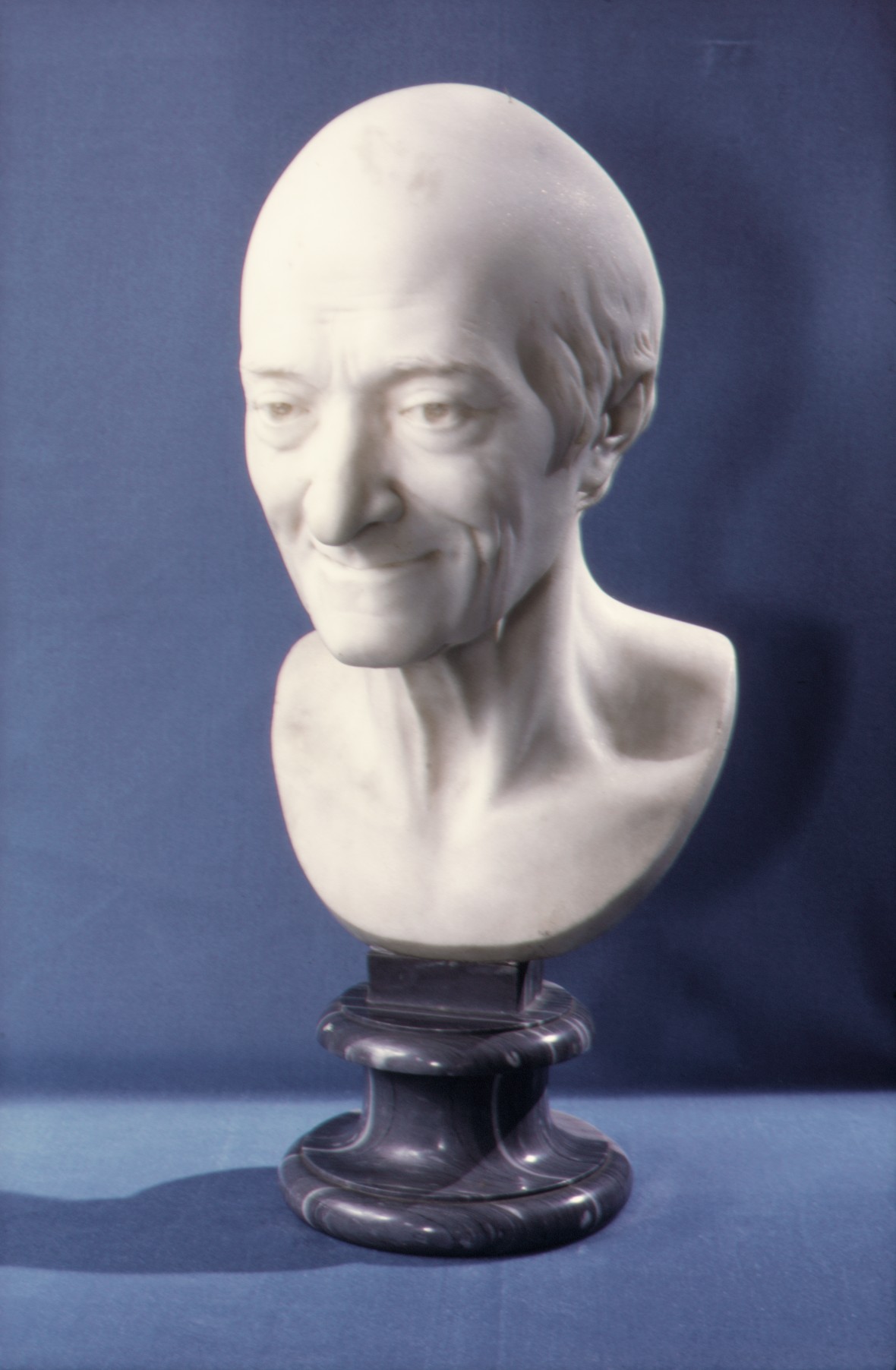
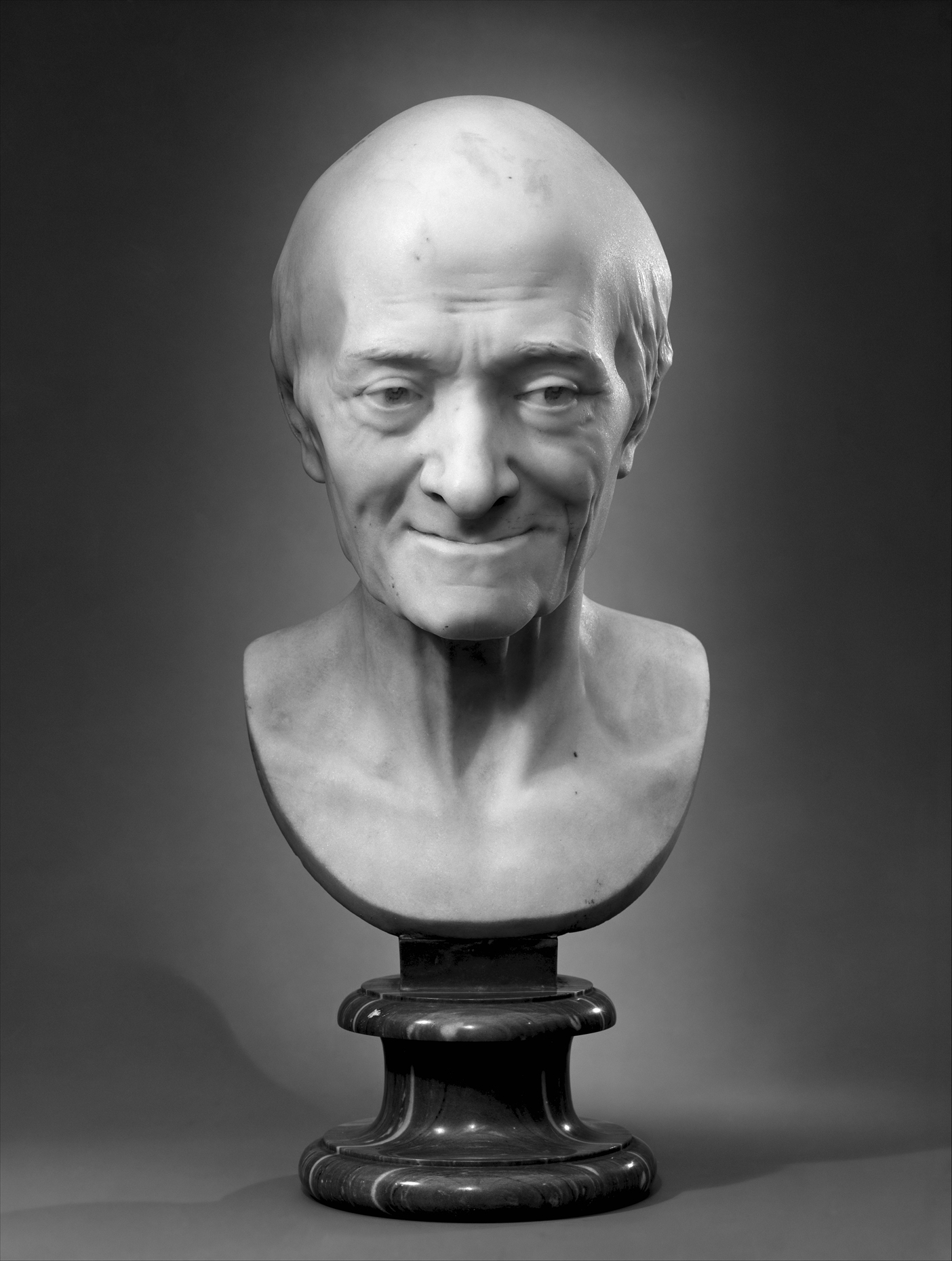
The corners of his mouth have risen, but his eyes retain another direction.
His thin lips meet, their corners lifting outward. Hollows beside the nostrils descend around mouth and chin. Higher up, the eyelids hang low, yet recognizable dark points remain in the eyes. They have not disappeared into the smile. We seem to be welcomed first by a smile, then discover that this face is still attending to something elsewhere.
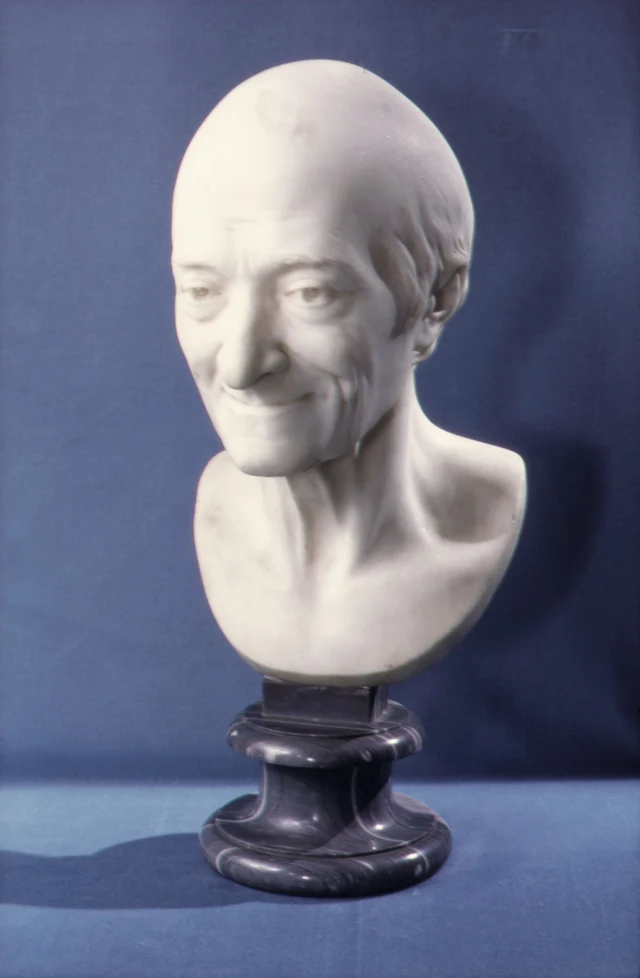
There is no coat over the shoulders, no cravat around the neck, no luxuriant wig on the head. Beyond the face remain only a narrow neck, collarbones, and a small area of chest. As this man is placed before us, most of the information supplied by everyday dress falls away, making the face’s variations especially specific.
Voltaire was a writer and thinker of the eighteenth-century French Enlightenment. Returning to Paris late in life in 1778, he received an enthusiastic welcome. Houdon had several sittings with him before his death. This marble bust, dated 1778, belongs to the image developed during those portrait sessions. It later entered the Stroganov collection in Saint Petersburg, where it was displayed with Houdon’s bust of Diderot. Background to the sittings; This object’s collection history
That history adds weight to our encounter. A particular elderly man’s face became a portrait that could be collected, displayed, and travel far. It needed to make the sitter seem close before us while continuing to bear the name “Voltaire” after leaving his presence.
1. The Smile Does Not Occupy the Whole Face
Begin with the frontal view, pausing separately at mouth and eyes.
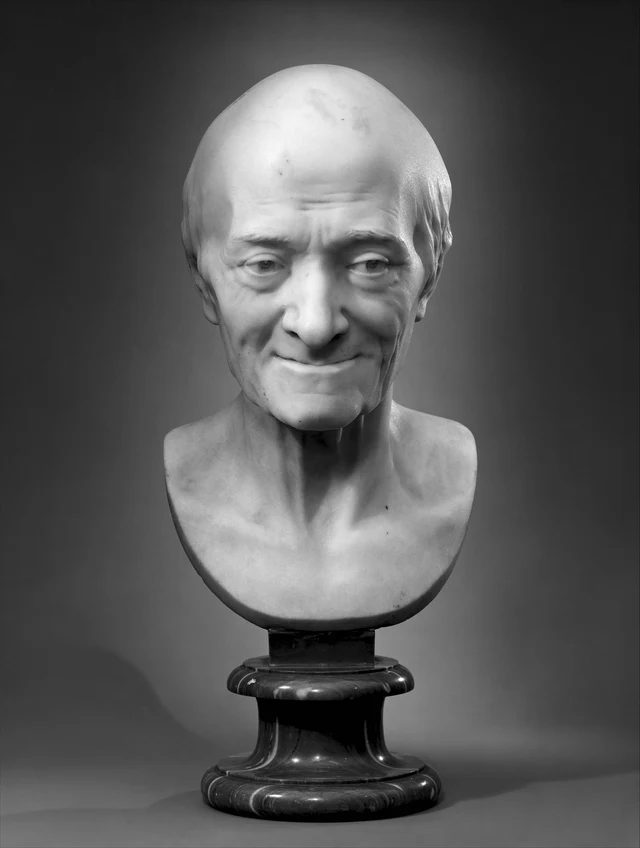
The lips do not part, and no teeth show. The smile concentrates along a very narrow edge: a thin upper lip, with a broader, flatter chin below the lower one. As the corners rise, this central chin becomes more prominent. The smile relies not on an emphatic opening, but on the changes produced by neighboring narrow lines and broad surfaces.
The cheeks are not full. Hollows slope downward outside the nostrils; the cheekbones spread outward, then the surface retreats near the mouth corners. The smile therefore does not turn the face into an evenly inflated sphere. It occurs on a face with edges, hollows, and varying thicknesses. The sagging areas beneath the eyes remain; raised mouth corners have not made them disappear.
Look again at the eyes. A crease rises between the eyebrows, and the brow ridges do not form one straight horizontal. The upper lids cover part of the eyeballs, but a clear direction remains below. Even if we read the mouth as friendly, the eyes can leave us feeling slightly observed or appraised. If we read the mouth as mocking, the eyes do not reinforce it with an extremely cutting action. Different parts sustain the expression together without supplying a final explanation for one another.
The smile’s limited reach is what makes the face rewarding to revisit. It is unmistakably present without commandeering the whole face. When one expression absorbs every shape, a viewer can quickly settle on a complete emotional label. Here, mouth, eyes, cheekbones, and chin keep their own places. We have to move among them to sense the smile’s measure.
“Witty,” “skeptical,” and “gentle” are all possible readings. More interesting is why they can alternate before the same face. Closed lips, lifted corners, and the eyes’ retained direction offer signals that do not entirely coincide. The stone does not change, but our distribution of attention among its parts does.
2. The Face Reaches Forward; the Neck Receives It
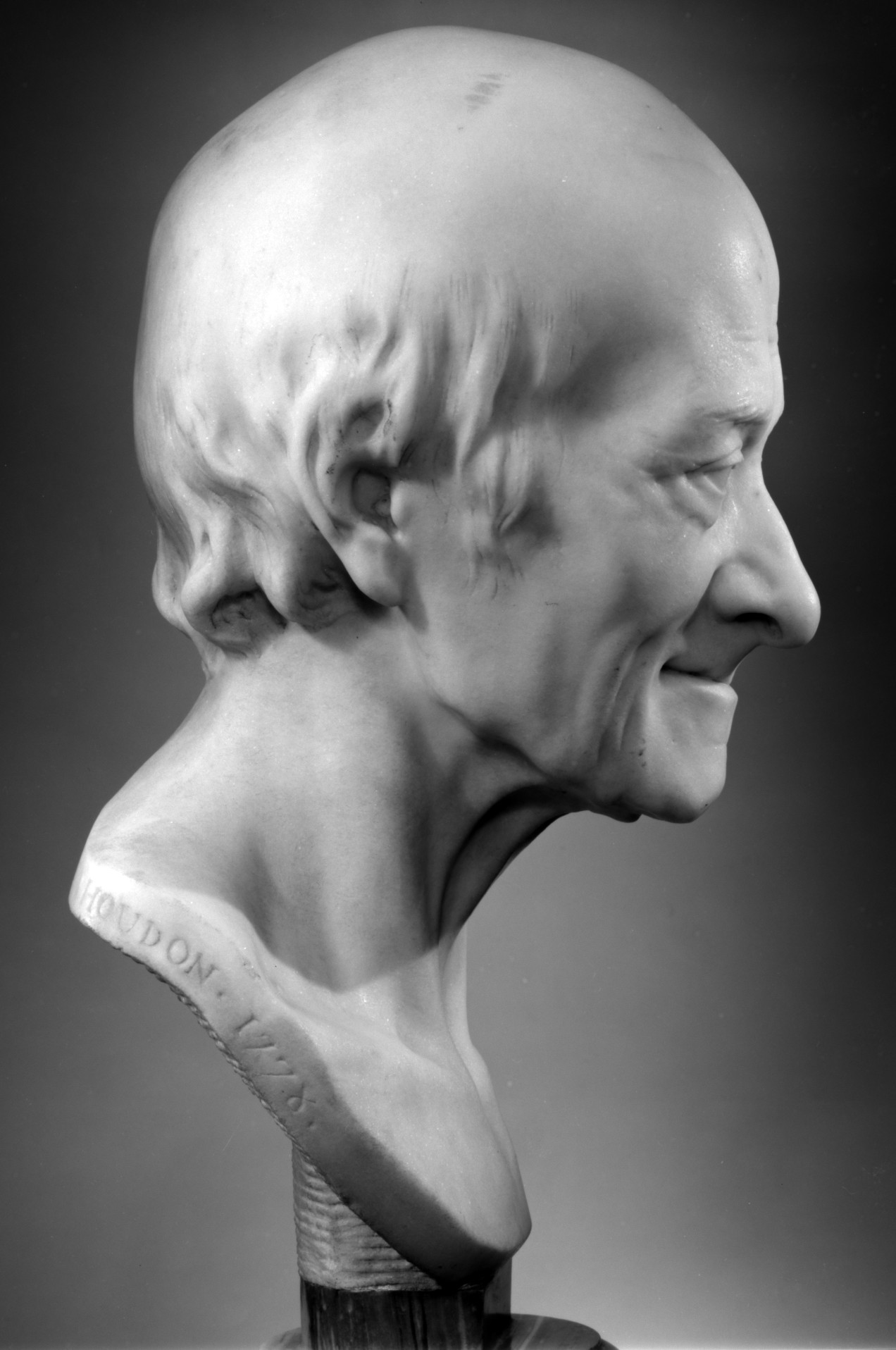
The side view shows that this smile does not lie on a flat surface.
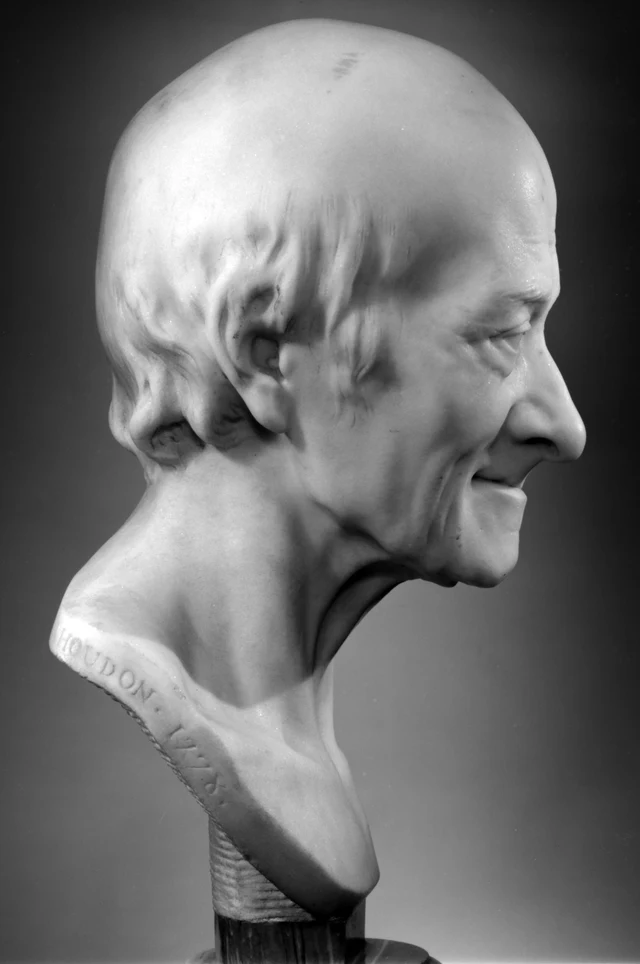
The forehead turns forward and downward, and the nose projects from the outline. Beneath it, the profile abruptly recedes; the lips meet farther back, before the chin advances again. The contour is not a smooth line descending from forehead to chest, but a series of advances and retreats.
These turns give depth to relationships less readily distinguished from the front. The mouth does not occupy the foremost point directly beneath the nose tip, and the chin is not a little afterthought appended to the smile. Nose, mouth, and chin are offset from one another. The smile sits among them, as though temporarily supported by the form of a particular head.
The neck is especially important. A deep dark area lies behind the chin before the slender contours leading down to the chest. The head projects forward, while shoulders and chest spread below. Frontally, the narrow neck can seem merely a feature of an elderly man’s thinness. From the side, it becomes a clearly visible connection between head and lower structure. The face’s orientation, the hollow before the neck, and the chest’s forward reach make a path with several turns.
No collar hides this path, so we can follow it from chin to chest. The smile gains a bodily source: it belongs to a head supported by a neck, rather than an expression suspended in air. The sense of closeness also comes from more than finely rendered eyes and mouth. The whole head seems to reach slightly into our space, while the chest below draws it back within the work’s boundaries.
Notice the cut edge behind the shoulder. Signature and date occupy that edge beside the surface simulating a body. They remind us that this is both a person’s image and a finished, signed object. These identities meet close together, before our eyes even reach the base.
3. As Clothing Withdraws, the Portrait Format Appears
Bare shoulders can easily seem more directly truthful: without formal dress, perhaps only the person remains. But looking at the whole bust in Figure 1 reveals that this bareness, too, is arranged.
Both shoulders stop at approximately corresponding points, and the chest narrows downward into an arc. It does not continue into an abdomen or retain arms. The lower edge is clearly and completely finished, with a small square connection above the dark support. This is not an accidentally incomplete body but a portrait format with definite boundaries.
The Met calls this type à l’antique, in the antique manner. Houdon also made another Voltaire type using the facial image but adding a full wig and contemporary clothing, described as à la française. Museum account of the two types The photographs here consistently show the bare-shouldered bust 1972.61. The clothed version is mentioned only to clarify that this absence is itself a choice within portrait form.
If a coat spread over the shoulders and a cravat encircled the neck, our looking would move outward along folds, buttons, and wig curls. This work removes those routes and joins the curved skull, the neck’s slender lines, and the chest’s broad surfaces. Dress offers no immediate explanation of profession or status. The image instead gains a simplicity suited to long-term display.
Simplicity does not erase age. The bald crown coexists with hair beside the ears; the thin neck has not been idealized into a stout cylinder, nor have facial turns disappeared for the sake of an antique manner. A relatively stable external format surrounds very specific facial variations. The dignity we feel need not depend entirely on uprightness, strength, or formal attire. It can also arise from a person’s features being carefully preserved and given a sufficiently clear field of presentation.
This relates to the uses of a public portrait. Voltaire himself need not stand before every collector; his image can enter distant rooms and stand beside busts of others. The Met suggests that Count Stroganov may have bought this work directly from Houdon during his Paris residence between 1770 and 1779. “May” remains part of that acquisition account. Collection record What is established is that the bust was later displayed in Saint Petersburg with Diderot’s. Portraiture creates a presence that can be arranged: who is placed together, who is remembered, and whose face deserves to remain in a room.
4. The Back Draws the Boundaries of This Presence
In the rear photograph, the head remains complete, but below it appears a surface very unlike skin.
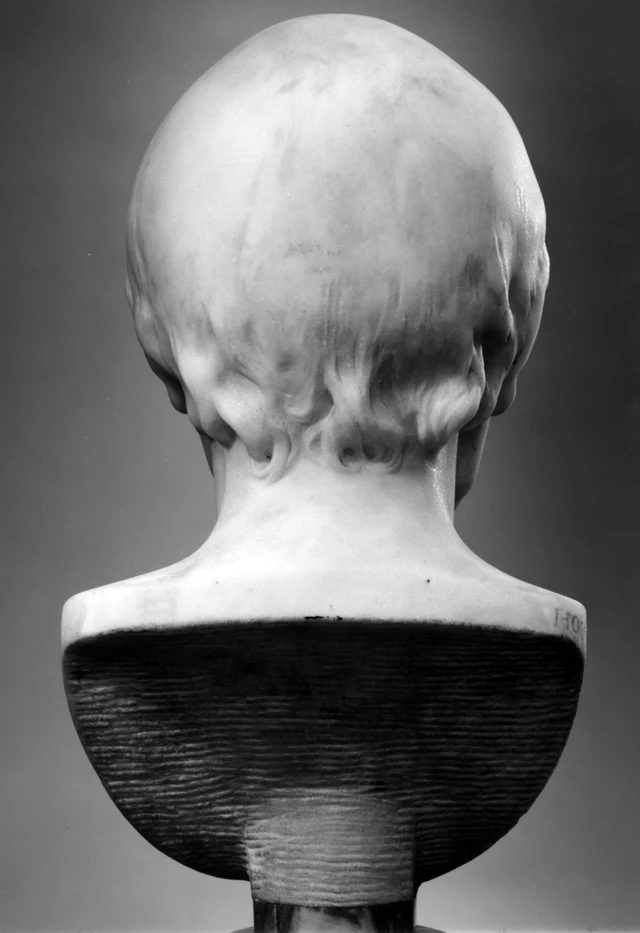
Begin above. The crown forms one broad, continuous curve. Hair gathers lower down, several ends curling back toward the neck and forming small hollows of varying darkness. What seemed a thin ring of hair from the front acquires enough depth to hold shadows at the back. Rather than wrapping the entire head, it leaves an irregular edge where skull meets neck.
Below, the nape broadens gently toward the shoulders. At the lower shoulder edge, the body-simulating surface ends abruptly. Behind the chest lies a broad field of dense horizontal marks; the projection below the center bears similar variations. These serve a different purpose from the small changes rendering skin, eyelids, and lips on the face. Here, we first see stone worked and left with a working surface. Photographs establish the difference but cannot identify the tool and sequence responsible for every mark.
This back changes what “lifelike” means. Houdon did not make every part imitate the body in the same way. The back of the head continues the person’s appearance, while the back of the chest belongs more directly to a sculpture’s construction. Both coexist within one object, with a clear boundary between them.
Recall the front: its curved lower edge seemed to support the sitter neatly. The back shows that this neatness has actual thickness and a working surface behind it. A public portrait can enter a room and be set in a particular place because it has been made into a clearly bounded object. The face’s liveliness and this objecthood do not cancel each other. This stone is precisely what continues to bring an absent person into view.
5. The Person Feels Close, but Distance Remains
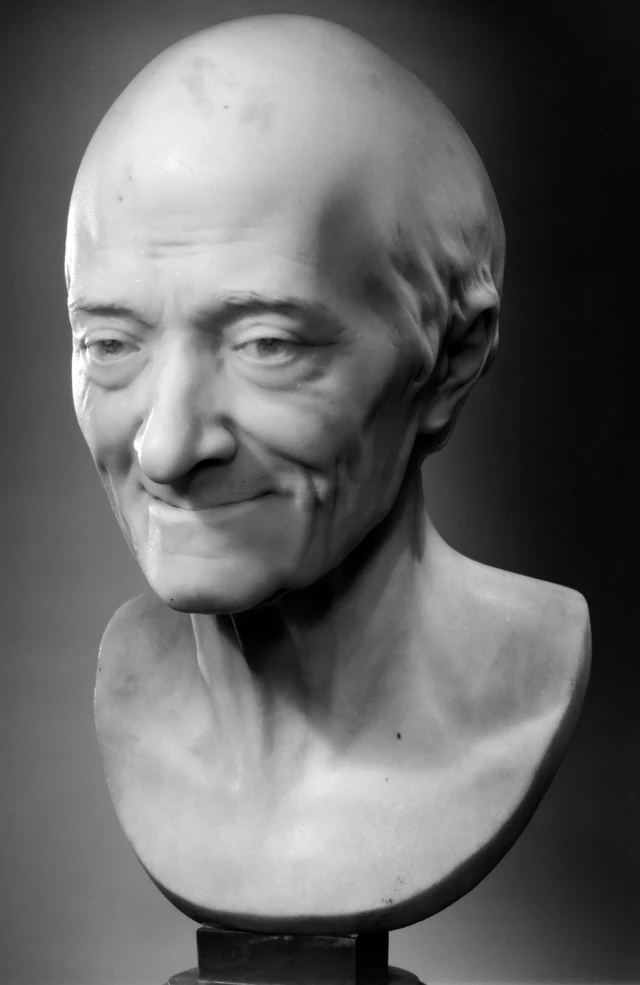
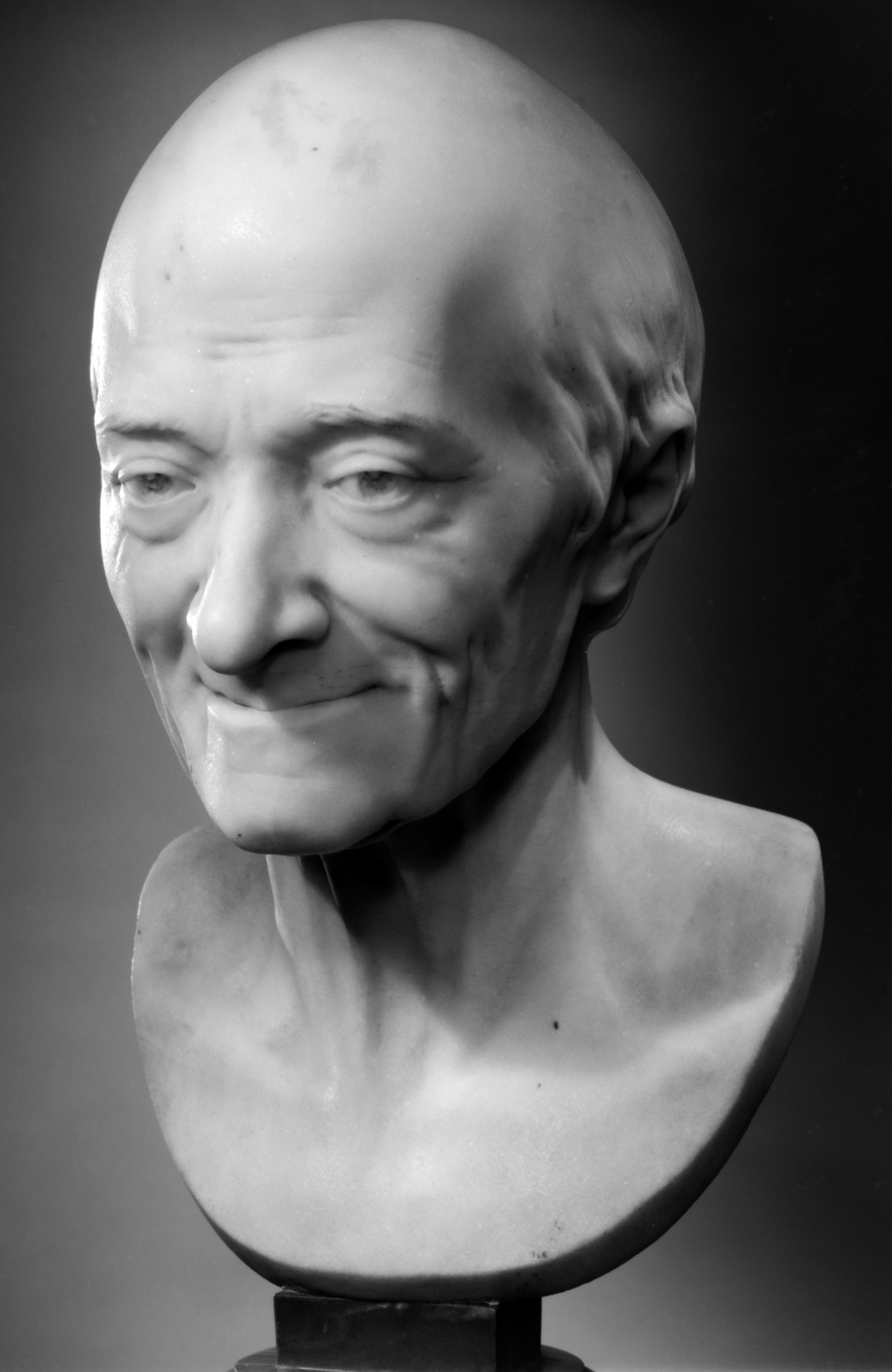
This close-up can make Voltaire seem ready to join our conversation. His thin lips do not open dramatically; his eyes still seem to be judging something under discussion. Compared with laughter or public speech, this limited action more readily draws a viewer close: we seem to have arrived just in time for a fleeting response.
Yet the photograph supplies no conversation. There is no interlocutor, no sentence that amused him, no action following the smile. These vacancies leave the portrait open. At each viewing, someone may approach with a new subject. The same face can thus sustain associations of quick wit, friendliness, or irony over time.
This sense of presence has specific formal conditions. The face retains a limited range of action, the body is gathered into a displayable bust, and name and collection history bring the image into public memory. Together, these things allow a piece of marble less than half a meter high to produce such a strong sense of someone being here.
Look once more at eyes and mouth. They still do not entirely merge into one simple expression. The smile draws us near; the eyes’ retained direction gives the face somewhere of its own to go. Houdon’s Voltaire acquires a particular distance: approachable, but not available for us to complete every response on his behalf.
Optional Reading: Another Look with SAE
This bust raises two related but distinct questions: how does the liveliness before us appear, and what histories do its different markings preserve?
First compare Figures 1 and 5. Both are oblique frontal views, but their framing, lighting, and rendering of color differ. In Figure 1, the stone appears softer and transitions among crown, forehead, and cheek seem gradual. Figure 5 makes the dark areas in eye sockets, beneath the nose, and before the neck more distinct, tightening the face’s turns. They still show the same marble bust. Its greater sharpness in the latter does not mean we can assign all that “sharpness” to a fixed personality. Light and photography contribute to the result.
SAE’s “perceptual beauty” returns these conditions of appearance to the discussion. Han Qin’s essay “As the Light Fades, the Garden Appears Differently” describes how, without arbitrarily altering an object, light and sensory conditions can change the way it appears to us. Returning to the bust, we can ask specifically: which hollow beside the mouth is especially clear in this photograph? Why does the chin seem lighter in another? Identifying such relationships makes “liveliness” something we can continue examining rather than an exclamation of admiration for the artist’s skill. Perceptual beauty: As the Light Fades, the Garden Appears Differently
This direction also lets us linger after recognition. Knowing he is smiling, we can still follow how the lip line meets the deeper hollows at either end, or how the broad crown connects with the narrow neck. Perception need not end its work upon identifying “old man,” “smile,” and “marble.”
The second question calls for Figures 2 and 4 together. Forehead lines, variations under the eyes, and hollows beside the cheeks let us recognize the sitter’s age. Horizontal marks behind the chest directly reveal stone after working. Both sides bear marks, but they do not mean the same thing by “what remains.”
Voltaire’s age did not cause this marble to grow wrinkles. The facial lines were shaped to represent an old person. The horizontal marks on the back belong to the sculpture’s actual material history of being worked. The former direct us toward the represented person; the latter prompt questions about how this object was made. Calling both simply “traces left by time” would obscure one of the work’s most interesting distinctions.
In his essay on causal beauty, “The Wood Still Holds That Dry Year,” Han Qin distinguishes a material history that can be checked from a past that viewers assign to markings. Connecting the width of tree rings with a particular drought requires further evidence; lines in sculpture call for equally careful discrimination. We can establish that this is a marble portrait dated 1778 and see differently worked surfaces on front and back. Photographs cannot assign a particular chisel to every horizontal mark or a particular ordeal in Voltaire’s life to every forehead line. Causal beauty: The Wood Still Holds That Dry Year
This ray offers more than a reminder to guess less. It gives one stone two distinguishable depths. On one hand, the shaped surface lets us see someone’s age; on the other, that surface itself preserves results of the act of making. Recognizing the latter does not invalidate the former. We can appreciate both how a smile takes shape and how material is organized into an object capable of carrying it.
The first ray asks what becomes vivid under these viewing conditions; the second asks what grounded evidence supports the origins of these forms. The former makes the smile’s measure perceptible; the latter gives representation and making their respective places. Together they bring us closer to the bust—not only to a face that seems about to respond, but also to the marble that has preserved it until today.
Notes on Images and Sources
This essay closely examines five photographs supplied by The Metropolitan Museum of Art of marble bust 1972.61: a color overall view, black-and-white front, side, and rear views, and an oblique frontal close-up. The downloaded files are retained without color adjustment, cropping, recompression, retouching, or generation. Descriptions of viewpoints and surfaces are limited to photographs and are not equivalent to viewing or touching the object in person.
The production background draws on the National Gallery of Art’s study of the same portrait type. Photographs, dimensions, and collection history here all refer to Met object 1972.61. The clothed Voltaire version serves only as comparative background for the portrait format. Image sources and permissions are in the image credits; historical and theoretical sources are in the references. Formal analysis and judgments about viewing are the readings proposed by this essay.