One man has already lain down beneath the tree. His legs stretch in different directions, his white shirt conspicuous against the golden ground. One hand rests behind his head; the other hangs among the stubble. The people beside him are still eating. Farther left, two scythes are passing close to the standing grain. We can almost feel several speeds at once: the sweep of a blade, a spoon lifted to the mouth, a body finally allowed to stop.
Keep this reclining man in mind as you look farther away.
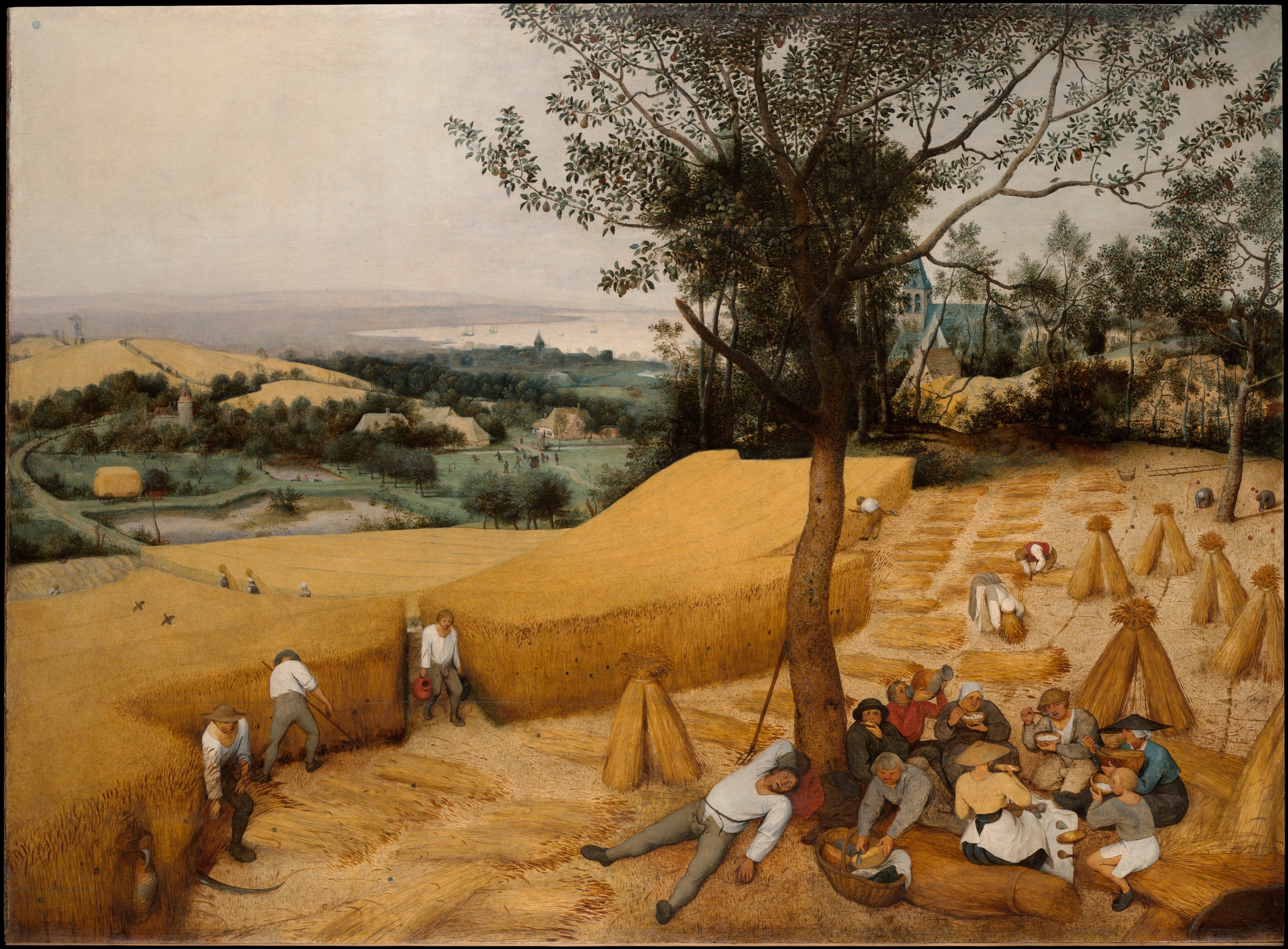
The reading proposed here is that Bruegel makes the harvest intelligible as a whole landscape while allowing the people within it to keep their different rhythms. The season calls for reaping; bodies need food, drink and sleep. These demands meet in a single painting, so that a harvest becomes both what the land produces and a stretch of human time.
Painted in 1565, the work belongs to Bruegel’s seasonal series for the wealthy Antwerp merchant Niclaes Jongelinck. The sixteenth-century Netherlands were under Habsburg rule, with urban commerce, rural production and religious life closely intertwined. We are accustomed to landscape as an independent subject. Here, giving everyday agricultural work so much pictorial space was itself a consequential choice. No saint’s story supplies a center around which all the land must turn. The ways people live through a season are sufficient subjects for a large painting. Bruegel and his world
1 The bodies beneath the tree make us pause
The original is about a meter and sixty centimeters wide. These foreground people are more than the tiny marks we might skim past on a screen. They gather in the lower right around a white cloth: one raises a bowl toward the mouth, another tips up an earthenware jug, another leans forward to cut the round food in a basket. A low, broad-brimmed hat hides one face; others turn in different directions. No common pose unites this meal, and no leading figure presides over it.
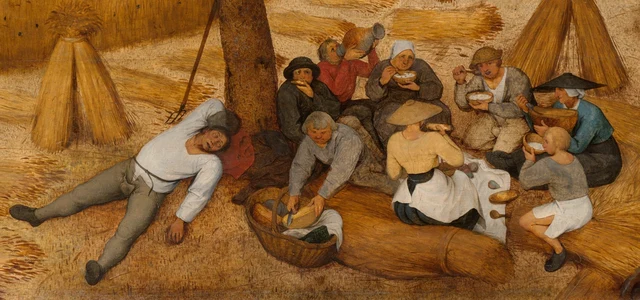
The reclining man’s mouth is slightly open, his shirt loosened, his legs extended far out. The painting has not tidied him into a dignified sleeping position. That slackness matters. A body that must control its weight while standing and working now gives that weight to the ground. Behind him the tree trunk rises; to the right, sheaves stand upright. He alone sprawls. Through him, the heat and drowsiness acquire a bodily place in the picture.
Those eating have not left the worksite. They sit beside cut grain, the meal cloth laid directly down, a tool leaning against the trunk. The tree supports the composition and supplies an ordinary resting place. Its crown covers a broad area of sky, its dark leaves hanging above the meal. A short distance to the left, the ground opens back into an unshaded field.
Pale food in bowls, bread held in the hands and the round food being cut in the basket bring eating close to harvesting. The museum’s food-history audio guide interprets the meal as bread, cheese and porridge possibly made from wheat. What we can directly distinguish are bowls, spoons, a knife, pieces of bread and the gestures of eating and drinking; identifying the menu draws on that interpretation. Museum audio guide and transcript
This is not grain being cut and immediately served. Processing and storage take time, and that interval is absent from the painting. Yet here the crop being gathered lies beside the food that sustains the workers. Abundance becomes more than an attractive expanse of yellow. It concerns a mouth, a bowl and the moment when a body has to stop.
2 The field’s edge is being remade
Move to the lower left. The uncut grain stands densely, almost a high wall. Two reapers work along it, their arms and long-handled scythes drawing diagonals. The nearest blade is low and curved, extending over the pale ground. The other man turns his back to us, legs apart, directing the force of his body into the tool.
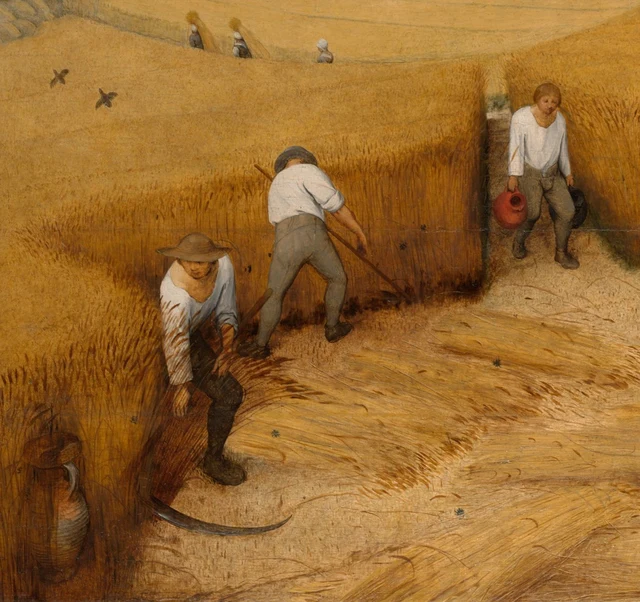
The result of labor is immediately legible along this edge. Dense, brown-gold verticals stand on one side; exposed pale ground and rows of fallen stalks lie on the other. As the workers move, the boundary advances into the field. Its shape is unfinished: the clearing before us has been cut, while the wall behind still awaits the blade.
Look at the stalks lying down. They gather in broad bands along the direction in which they were cut and laid. The curves recur without becoming mechanically identical. Bruegel does not describe every stalk throughout the field. Nearby, short, fine strokes let us distinguish stubble and ears; farther away, grain merges into relatively even areas of color. Human actions become especially clear at the meeting points of these treatments: here the crop stands, there it has fallen, and elsewhere it has been gathered into bundles.
On the right, bent figures collect grain from the ground, beside one upright sheaf after another. A figure in white folds so deeply forward that head and hands almost disappear among the ears. The slope of the back approaches the outline of a neighboring bundle. For a moment, body and crop take similar shapes. The worker belongs to this land without dissolving into it: the hanging weight of clothing, the knees and the reach of the arms still make bending a physical effort.
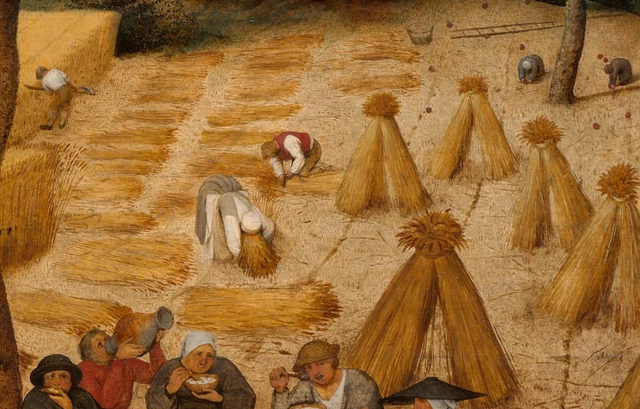
These actions can be joined into an agricultural process, but the painting does not number its steps. Cutting happens on the left, gathering on the right, resting beneath the tree; farther away, figures carry large bundles across the field. They occur together. We can infer a day’s work without imagining that every figure repeats a single worker at a different moment.
That simultaneity makes the sleeper conspicuous. Others are moving; he has stopped. Scholars have also related the sleeper to sloth and the workers to diligence. Museum research catalogue This essay reads his rest as a bodily measure within the harvest: a field can look plentiful at a glance, but people still eat mouthful by mouthful and work in stretches.
3 The eye travels farther than the body
Now look beyond the grain. Behind the golden slopes, roads, clusters of trees, houses and ponds occupy greener ground. On the left, a loaded cart follows a curving road. Small figures gather in an open space toward the center-right. Beyond them, towers, sails and a broad stretch of water fade into gray-blue haze, until the horizon nearly merges with the sky.
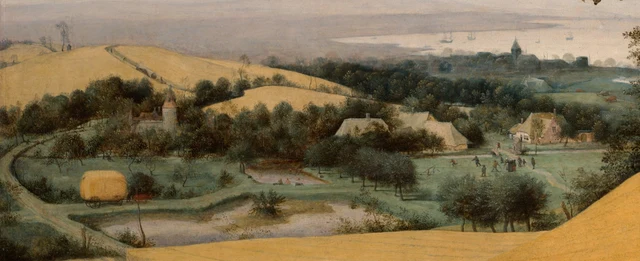
Several devices carry us outward. Figures become smaller, and one overlapping form succeeds another. Warm, dense grain colors give way to cooler, paler greens and blues. Stalks, folds and leaves that remain distinct nearby can no longer be identified individually far away. This loss of clarity with distance is usually called atmospheric perspective. It makes the eye experience intervening air, rather than merely count off foreground, middle ground and background.
Yet the space is not entirely open. The thick trunk, off to the right, interrupts part of the view, and the crown stretches across the upper painting. The near slope hides the connections to the land below. We can see a long way without tracing every step from where we stand. Our eyes jump to the sails; our bodies, if we could walk there, would have to descend, go around trees and cross fields. The breadth of an elevated view coexists with obstacles to movement.
Return to the man beneath the tree. Our gaze has crossed villages and water, while his body remains emphatically close. Distant people can shrink to a few strokes, but the length of his outstretched legs is difficult to overlook. The tree joins these scales. It frames one side of the prospect and anchors the nearby eating and sleeping.
Activities in the distance also loosen any single beat of time. Tiny people appear by a pond; others gather or play near the houses; transport continues along the roads. A museum expert identifies the game as cock-throwing, in which objects are thrown at a rooster. Recognizing its target gives distant leisure a rougher side. Museum expert commentary These actions do not all follow the sweep of the foreground scythes. Ripening grain marks a shared season without requiring everyone to do the same thing at the same instant. Seen again as a whole, The Harvesters has room for an inhabited region.
4 One part of a year, one field in a merchant’s house
Seen alone, The Harvesters can seem an independent summer landscape. It originally belonged to six seasonal paintings, five of which survive. A gift account from 1594 and an estate inventory from 1595 both record six pictures representing the twelve months. Museum documentary record Hunters in the Snow, The Gloomy Day, Haymaking, The Return of the Herd and The Harvesters depict different stages of the year. Leaves, snow, sky and work change together. Human life makes the seasons recognizable. The Kunsthistorisches Museum on the series
The Metropolitan Museum currently places The Harvesters in July or August; the Kunsthistorisches Museum’s arrangement of the six-part cycle assigns it August and September. Both locate it in the season of ripe grain and reaping. For looking, its place within the cycle is more useful than an exact calendar label: the golden crop has matured, work turns toward gathering it, and air and bodies acquire the heaviness we associate with late summer. The Met’s account; the cycle and its seasons
Using agricultural work to distinguish months had a long history before Bruegel. Medieval and Renaissance calendar imagery often represented the year through sowing, reaping or gathering grapes. Bruegel enlarged this way of recognizing time through activity into an extensive landscape series. No isolated figure needs to hold up an emblem announcing summer. How far the reaping has progressed, how much clothing people wear and where they rest already carry the season throughout the picture. Bruegel and calendar subjects
Jongelinck was an urban merchant and collector, and the paintings were made for his country residence. They may originally have decorated its dining room, a setting proposed in the museum’s account. If we imagine looking at this field meal from a comfortable dining interior, the relationship sharpens. Outside the picture, the owner could contemplate the production of a year’s food; inside it, workers eat between tasks. The expansive view is also a position available to someone with leisure to enjoy it.
This context changes how we understand the abundance. Grain grows tall, the fields are extensive, food is available, and bodies appear sturdy. Harsh weather, failed crops, tenancy and the distribution of income are not explored here. The Met’s current interpretation emphasizes both sympathy toward the peasants and an idealized natural harmony offered to an affluent urban patron. However convincing the details, the view is selective. The museum’s interpretation
Recognizing that selection does not exhaust the painting. For a wealthy merchant it could offer a pleasing image of fertile land; for us, the open mouths, heavy legs and backs bent into the grain make it difficult to see only yield. The tension this essay values lies here: the field is organized into a satisfying whole, yet nearby bodies keep asking us to pause and acknowledge their weight and pace.
5 The yellow of a summer noon
One simple question remains: why does this picture look so hot?
Golden yellow occupies much of the surface without becoming one uniform brightness. Uncut grain has dark brown bases and dense vertical strokes. The harvested ground is pale and dry. Sheaves brighten at their edges and darken within; stalks in shadow approach an earthy brown. Related tones pass through different textures. The eye remains within a warm range while still registering the changes that work has made to the land.
Deep green foliage encloses part of this yellow, and gray-blue distance sets it off from another direction. The sky is whitish and gray, lacking the cool transparency of clear blue. Faraway outlines seem softened by air, while the golden foreground presses almost against the frame. Heat is conveyed through bodily posture, the weight of color and changes in visibility together.
White clothing is especially important. A reaper’s shirt on the left, the bent back on the right and the sleeper’s spread upper body pick out several actions from neighboring yellows and browns. As our eyes follow these recurring whites, the apparently broad, still harvest becomes a series of local efforts and releases. The red jug and the drinker’s red shirt provide fewer, more concentrated warm accents.
There are many actions, yet the whole does not seem hectic. Broad fields give them intervals, the tree gathers the right-hand figures together, and distance quiets the small events beyond. We can examine each in turn, then step back and let them become a summer noon again. Moving between these views, we continually adjust the landscape’s scale against that of a person.
Look one last time at the man who first caught our attention. He has still not risen. The grain on the left will never be completely cut. Yet we have seen fallen stalks, tied bundles, bowls lifted to mouths and a distant cart carrying the crop away. This arrested moment contains things already done and things still to continue. Here, for this reading, lies the painting’s significance: it makes one part of the year visible as a whole, while giving the people within it their own time to live. The pause beneath the tree gives the harvest a body.
Optional reading Another look through SAE
The guide above is complete on its own. The following section uses SAE (Self-as-an-End) aesthetics as a contemporary approach to ask what supports our descriptions of heat, fatigue and rhythm. It does not attribute that theory to Bruegel. SAE distinguishes personal response from grounds that viewers can examine together; its “rays” are directions of inquiry, not grades assigned to works. SAE’s general account of aesthetics
Begin with perception. In Figure 2, the sleeper and the diners fill our view, making bodily weight especially prominent. Back in Figure 1, they are enclosed by field, foliage and distance. The same poses register differently in different visible relationships. For a moment, set aside what the grain’s color tells us about ripeness and look simply at its brightness, surrounded by greens and gray-blues. We can examine the area occupied by yellow, the surrounding deep green, the brightness of white shirts and the differences of scale together, rather than explain the response only by saying that we like rural scenes. In SAE’s perceptual approach, pleasure and beauty do not automatically establish one another. Finding the scene comfortable cannot replace an account of how it appears. The beauty of perception
Cognition brings prior experience back into the picture. Someone familiar with harvesting may look at stubble, fallen stalks and bundles and anticipate what comes next. Someone who assumes that harvest time means everyone working continuously may revise that expectation on encountering the sleeper. How experience produces expectations, and how details correct them, gives memory and prediction something specific to address. Merely recognizing agricultural workers does not complete the analysis. The beauty of cognition
Stubble poses another carefully bounded question. In an actual field, cut ends are traces left by cutting. Here they are painted representations of those traces. They can help us consider how an event remains legible in a later shape, provided we preserve the distinction between representation and physical evidence. Distinguishing the marks made in paint from the traces they represent gives the inquiry into causality a concrete place to begin. The beauty of causality
These approaches must return to the whole. An account concerned only with harmony still needs to explain why reaping and sleep share the scene. An account concerned only with hardship must explain the plentiful land and the ease of the distant view. Interpretations can be tested against these particular relationships. Theory is useful when the next look becomes more attentive than the last.
Images and sources
Visual descriptions are based on the 3811 × 2809-pixel image supplied by The Metropolitan Museum of Art. The full image is unchanged from the downloaded file. Figures 2–5 are rectangular crops only, with no color adjustment, restoration, overpainting or generated content. The original JPEG has no embedded ICC color profile; none has been added or converted for this package, and the crops preserve the decoded pixels. Screen display still differs from the original in scale, material and viewing conditions.
The artwork and this image are in the public domain; image use follows the Met’s open-access policy. Image licensing does not grant permission to reproduce research texts. This essay is principally an independent close reading, with historical information drawn from the linked museum sources. Its interpretation is not a claim about the painter’s documented intentions and does not imply museum endorsement. See also the accompanying references and image credits.