遠, meaning “distant” but here part of the name Boyuan, does not stay inside a square. In the lower half of the rightmost column, its long rightward stroke supports the character while giving the neighboring blank a direction. 從, here part of 群從, “kinsmen of the same generation,” stands in the next column; 遊, “roam,” appears another column to the left. Their extensions fall at different heights. While reading downward, the eye is also drawn sideways into comparison.
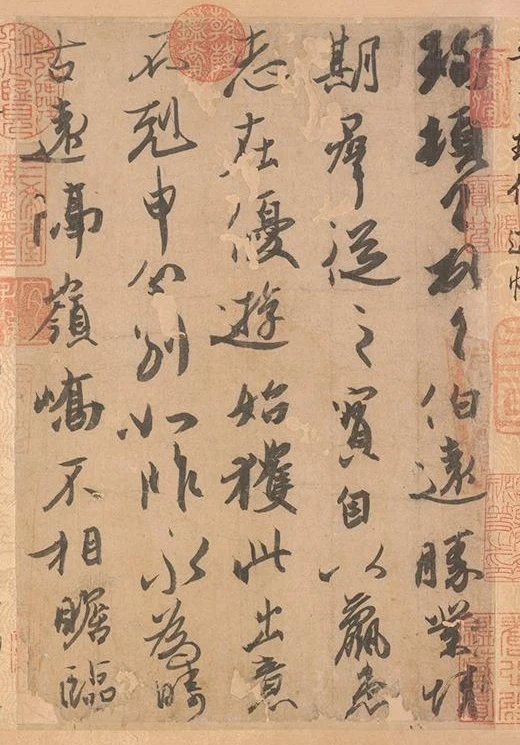
The openness of this letter does not depend on covering the sheet in large strokes. Many characters gather tightly, making a few long lines conspicuous. Unequal spaces between columns establish distances across which the eye can travel. I begin with those lateral openings, then return to how the columns contain them.
Wang Xun belonged to the Langya Wang family in the Eastern Jin, living in the later fourth century; the Palace Museum gives his dates as 350–401. His grandfather Wang Dao and father Wang Qia were also known for calligraphy. The museum identifies this work as Wang Xun’s autograph: running script on paper, five columns and forty-seven characters, 25.1 × 17.2 cm, inventory number 新00145155. The letter bears no year. Collection record
Its later status as one of the Qing palace’s Three Rarities belongs to its history. Looking at the writing need not begin by letting that reputation decide what we see. In front of us are five unequal written routes.
Reading all forty-seven characters
The transcription follows the museum in modern simplified forms. Punctuation is editorial; 克 corresponds to the manuscript reading 剋.
珣顿首顿首,伯远胜业情期,群从之宝。自以羸患,志在优游。始获此出,意不克申。分别如昨,永为畴古。远隔岭峤,不相瞻临。
Xun bows his head, and bows again. Boyuan’s achievements and aspirations are treasured among his kinsmen of the same generation. Frailty and illness have made an unhurried, untroubled life desirable. Only now has this opportunity to go out been obtained, yet the intended thoughts could not be fully expressed. Our parting seems like yesterday, but has become a remote past. Mountain ridges lie between us; we cannot visit one another.
This is one continuous reading of a compressed text. 群從 means kinsmen of the same generation; 羸患, frailty and illness; 克申, being able to extend or express; 疇古, the remote past; 嶺嶠, mountain ridges. These forty-seven characters do not settle Boyuan’s identity, the subject of 自, the event meant by 此出, or whether 永為疇古 implies mourning. The translation leaves the omitted subject unspecified instead of constructing a certain story about an appointment or death.
Even without filling every gap, a movement is clear: aspirations and illness lead to thoughts inadequately expressed, then separation and obstruction. 如昨, “like yesterday,” brings time close; 疇古 pushes it away. 不相瞻臨, inability to visit, makes distance a matter of relations between people. Near and far are already more than geography.
A dense opening still leaves room for long strokes
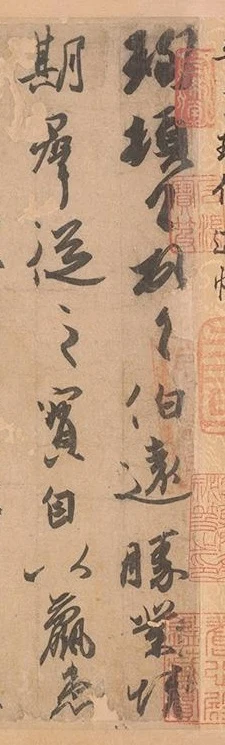
珣 at the top right is dark and substantial; the greeting below occupies a narrower area. Farther down, 伯 is relatively compact, while 遠 suddenly spreads its lower part outward. The whole character has not simply been enlarged: the upper part remains gathered, while the supporting stroke reaches farther. Tightness and openness occur within one sign.
In the second column, 期 has clearly differentiated sides; 群 draws downward; 從 releases another relatively long stroke. Its extension is displaced vertically from 遠 to the right, rather than forming a straight horizontal bar. As black moves sideways, the white changes shape: one patch seems supported, another allows the eye to pass between characters.
This displacement matters. Identical long strokes at identical heights might establish a repeated band. Here, heights, lengths, and sequences differ. Before one opening becomes a repeated pattern, another place has tightened again.
The first column’s final 勝業情 is denser than 伯, gathering near the foot without completing its meaning. 期 belongs at the next column’s top. Density at the bottom does not make a full stop: the eye still crosses the intervening white. Language supplies a reason to continue; shapes supply the pace of that continuation.
The traditional pairing of qi and zheng, obliquity and uprightness, has a concrete entry here. Characters incline and spread, yet the eye can still follow a column. Stability need not mean that every line is vertical. It may arise when a neighboring character catches a reading route after a displacement.
Restore the neighbors around the openness of 遊
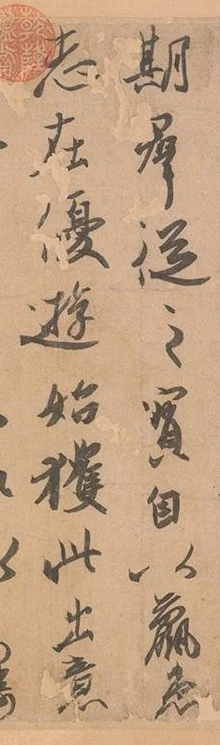
In the third column, 志在 leads into the comparatively dense 優 and the conspicuous supporting extension beneath 遊. The meaning “roam at ease” readily comes to mind. But explaining its shape solely through that meaning leaves something unseen: how do 始, here “only now,” and 獲, “obtain,” below gather the ink again, and how does 羸患 in the neighboring column approach the lower edge?
After 遊, the writing does not remain equally relaxed. 始 occupies a shorter passage. 獲 clusters its strokes, with a more restrained lateral extension. 此出意 then differentiates widths toward the bottom. The sequence is opening, gathering, and continuing downward, rather than an emotional keyword making every form adopt the same attitude.
Compare two complex characters. 羸 low in the right column stacks its components into a narrow, dense form. 獲 on the left is also intricate but occupies a different width and height. Many strokes do not produce identical black blocks. The room around the left-hand extension becomes more visible because of the tight form beside it.
Continuity in running script is therefore not a count of connecting threads. Many signs are separate: one ends and another begins. Alternating compact clusters and longer lines still lead the eye onward. Direction and the breadth of empty intervals share the work of connection.
After the long strokes the writing gathers again
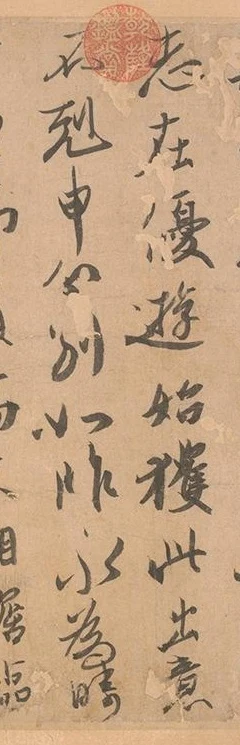
意不克申, “the thoughts could not be fully expressed,” crosses a column boundary: 意 at the third column’s foot joins 不 at the fourth column’s top. The phrase concerns an inability to extend or express, yet reading requires a substantial upward displacement. This need not have been designed to illustrate meaning; language and placement nevertheless work together now. We know more remains, and the eye has not finished its journey.
In the fourth column, 不、克、申 change direction distinctly. Below, 分、別、如、昨 shift their placements; the column is no straight cord. The relatively spare 分 and the longer vertical element of 別 establish different measures. Density changes again in 永為疇, with 疇 close to the lower edge.
古 begins the next column. As with 情/期 near the opening, separated positions must be rejoined into a phrase. Here the change of column introduces the ending: only mountain ridges and the inability to meet remain. The letter draws toward its final sentences.
Two instances of 遠 open toward different neighbors
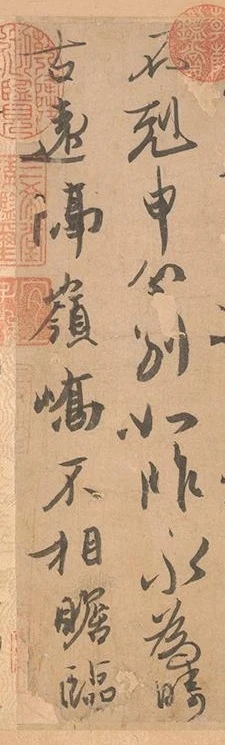
Compare 遠 in the last column with 遠 in 伯遠 at the rightmost edge. In 伯遠 it is part of a name; in 遠隔, “separated by a distance,” it conveys spatial separation. Both spread horizontally below, but occupy different positions. The first-column instance sits in the lower half, between a simple 伯 above and the denser 勝業情 below. Its long stroke opens an interval before that density arrives. The final-column 遠 sits in the upper half, between 古 above and 隔, with its more conspicuous vertical structure, below. A lateral line meets the next character’s downward movement.
Their long strokes are not equal-length, equal-angle duplicates. The first-column stroke extends with a slight upward tendency; the last-column stroke appears flatter, near the left paper edge and later red seals. Compare the characters, then their respective neighbors: the same structural outline leads toward a dense column ending in one case and introduces most of the final column in the other.
隔、嶺、嶠 then gather differing densities. 不相瞻臨 brings a degree of contraction, with 臨 ending below. Opening does not accumulate indefinitely. Several differently directed extensions return to the scale of this small letter.
That closing leaves the earlier long strokes effective. They are distributed supports, not a prelude growing toward a final explosion. Across the whole sheet, 從、遊、遠 extend outward and are caught by tighter neighboring forms. Spaciousness and movement become intelligible as an unequal distribution.
Today, later inscriptions, paintings, and colophons adjoin the sheet. The museum records that Qianlong acquired it in 1746 and housed it with Clear Skies after Quick Snow and the Mid-Autumn Letter in the Three Rarities Hall. The small letter entered a larger apparatus of viewing, but Wang Xun’s text remains these five columns. Qing writing beside it cannot continue the Jin letter, and the surrounding seals are not its original brushwork arrangement. Museum history
The transcription tells us which characters follow which. The ink shows that they do not arrive at equal distances. Dense passages invite closeness, long lines send the eye outward, and column changes reconnect words elsewhere. The writing stays still; reading travels near and far several times.
Optional reading: Looking at this 遠 while the other remains in comparison
Look first at 遠 in Figure 2’s right column and remember its lower lateral stroke. Then turn to 遠 in Figure 5’s left column. The two details do not occupy the same location, yet comparison remains possible. The first, no longer immediately before us, persists as a remembered shape in judging whether the second seems flatter or more upturned.
In “The Note Has Not Sounded. You Are Already Waiting.”, I wrote about memory’s participation in what comes before us, rather than its merely storing the past. SAE’s Judgment and Aesthetics places the continued activity of what is absent along its cognitive direction. Looking at these two 遠 makes the memory within comparison something we can check. Theory
Memory may be inaccurate, so return to Figure 1 and see both together. A stroke remembered as particularly long may owe that impression to tighter neighboring characters or more room beneath it. Comparison makes a round trip: carry a form elsewhere, then let the whole sheet correct that form. As the same character appears twice across five columns, memory and present seeing meet; “openness” becomes two specific relationships rather than one general impression.
Image and transcription notes
- This reading uses the museum’s digital images, not firsthand examination. The official viewer is linked through its collection page. Local images restore the publicly available highest-resolution Deep Zoom tiles to their original coordinates, then crop rectangular details. The full scroll is 12658 × 827 pixels; that ratio is not the ratio of Wang Xun’s sheet.
- Figure 1 shows the complete main text; Figures 2–5 retain adjacent columns. No recoloring, reconstruction, seal removal, local distortion, or generated imagery was used. Removing one-pixel overlaps during tile assembly restores the photograph rather than repairing the historical object.
- Text, character count, and dimensions follow the museum. Punctuation and translation are editorial. The identities, date, and occasion have not been made certain through later stories. The translation retains the original’s omitted subject.
- Separate reproduction permission has not been obtained. Public viewing is not publication authorization. Rights must be checked before external republication. Files, coordinates, and sources are recorded in IMAGE_NOTES.md.