SocaLabs Identity:当波形变成公式,剩下来的是什么
SocaLabs Identity: What Remains When the Waveform Becomes a Formula
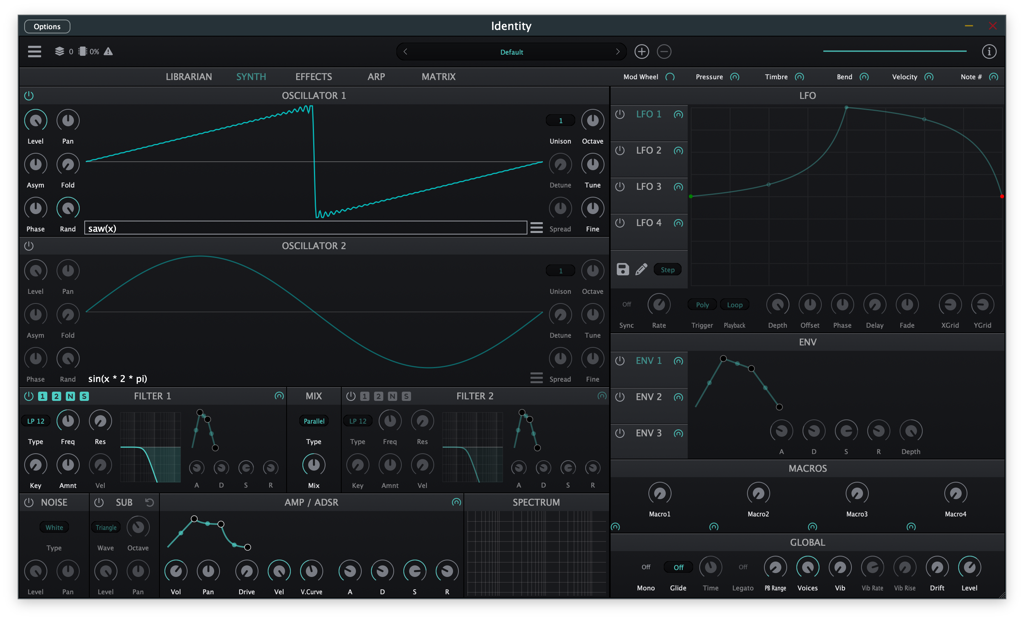
SocaLabs Identity 是 FigBug——维多利亚(BC)的开发者,2005年起活跃于 KVR Audio 社区——为2026年 KVR 开发者挑战赛提交的作品,7月7日首次公开。这是他参加该挑战赛的第一次,也是一个六年前就开始动手、"后来大多数时间在角落积灰,直到我终于找到动力把它做完"的项目。Identity 是一台减法合成器,但它的振荡器工作方式不同:在每一台其他减法合成器里,波形选择是一个下拉菜单(锯齿、三角、方波、正弦、脉冲),Identity 把那个菜单换成了一个文字框。你输入数学公式——`sine(x)`、`saw(x/2) * triangle(x*3)`、`pulse(x, LFO_1) + sine(x * macro_1)`——插件计算这条公式,生成周期波形,施加内部反混叠处理,那就是振荡器的输出。波形 = 公式。从记谱到声音的那扇窗户,被刻意留开了。
要理解这里的余项之美,必须先看到它在凿的已构是什么。在六十年的模拟与数字合成历史里,五种基本波形——正弦、锯齿、三角、方波、脉冲——已经深深沉淀为"振荡器波形"这个范畴。从 Moog 到 Serum,几乎所有减法合成器的振荡器界面都提供大致相同的列表。合成器教学把"选择波形"教为一个类别级动作,而不是"选择方程"。这种自然化——波形作为声音的已命名种类,而非数学选择——就是已构:六十年的实践把数学选择变成了范畴上的给定。没有人需要命名这个过程,因为从来没有必要去质疑它。
Identity 的凿子只有这一个动作:把下拉菜单换成文字框。这个替换让一件原本从未变为可见的事情忽然显眼了:`saw(x)` 和 `saw(x/2) * sine(x*3)` 是同一类对象。前者出现在每一台合成器的默认状态里;后者在 Identity 之前,在任何合成器里都无处输入。两者都是数学表达式,都能生成波形——但合成器的界面一直在隐藏这件事,把前者呈现为按钮,把后者变成无处安放的想象。Identity 的文字框打开了这个空间:所有可以用基本函数的组合、乘积、嵌套表达的波形,都忽然可以存在了。标准波形调色板的自然化被暴露为历史上的选择,而不是声学上的必然。
余项在这里分两层。第一层是你输入的公式与你听到的声音之间的距离。公式只是入口——之后,信号还要经过非对称整形、波形折叠、相位偏移、模拟漂移(analog drift)、两个带各自包络的多模滤波器、完整的调制矩阵、十一个可重排的效果器。你输入 `sine(x) * saw(x/2) + triangle(x*3)`,听到的声音里包含这条公式,但已经被整个合成器的其余部分再次改写了。公式是乐谱,声音是演奏,两者之间的那个差,就是余项。第二层来自 FigBug 自己的话:"我完全不知道这东西有没有音乐上的用处,还是只是我想试的一个书呆子实验。"这种自我不确定——做出来了,但不知道它属于什么类别——是余项之美的自我描述。作品完成了,发布了,但创作者本人仍然无法为它命名。
命名缺口在媒体报道层面最为明显。所有的报道都只能用功能描述("公式振荡器"、"数学表达式波形")而非类别名称来处理 Identity。最接近的既有类别是"用户可编程振荡器",见于若干硬件模块,但那些依然在"振荡器波形"的框架内移动——提供更宽的自定义空间,而不是拆掉框架本身。Identity 的动作不同:它把波形还原为数学,让公式成为界面,而不是扩展波形的种类。KVR 论坛的讨论停留在功能层面,FigBug 自称"书呆子实验",Synth Anatomy 的报道称赞了不寻常的振荡器设计,但无法安置它进入任何已有类型。这种从创作者内部开始、在媒体外部持续的命名失败,是余项之美最可靠的症状之一。
这个余项的窗口可能关闭得比通常更快。AI 辅助合成——根据文字描述生成声音或波形——正在成为商业工具的标准功能,而其隐含轨迹是:数学描述与波形形状之间的关系被黑箱接管,用户描述声音意图,模型寻找公式。一旦这成为惯例,公式作为界面的可见性就关闭了——那扇从记谱到声音刻意留开的窗户,再次合上。Identity 存在于这个关闭之前的间隙。FigBug 六年前开始做,让它积灰,因为他不知道它是什么。他现在发布了它,因为动力终于来了。那段积灰的时间,那种作者本人的不确定,是余项在空间上的形状:还没有被命名,还没有被消化,正在做的事情,实践还没有为之找到位置。
socalabs.com ↗SocaLabs Identity is a synthesizer plugin submitted by FigBug — a Victoria, BC developer active in the KVR Audio community since 2005 — to the KVR Developer Challenge 2026, first published July 7. It is his first challenge entry and a project "I started working on six years ago, and it mostly sat in a dusty corner until I finally got the motivation to finish it." Identity is a subtractive synthesizer, but its oscillators work differently. Where every other subtractive synth presents a dropdown of waveform shapes — saw, triangle, square, sine, pulse — Identity presents a text field. You type a mathematical formula: sine(x), saw(x/2) * triangle(x*3), pulse(x, LFO_1) + sine(x * macro_1). The plugin calculates your formula into a periodic waveform, applies internal anti-aliasing, and that becomes the oscillator's output. Waveform = formula. The window between notation and sound is left deliberately open.
To understand why this is structurally 余项之美 — beauty of the remainder — you need to see the already-construct it is chiseling. In sixty years of analog and digital synthesis, five waveforms — sine, saw, triangle, square, pulse — have sedimented so deeply into practice that they present themselves as acoustic facts rather than mathematical choices. From the Moog to Serum, every subtractive synthesizer oscillator offers approximately the same list. Synthesis pedagogy teaches "selecting a waveform" as a category-level action, not "choosing an equation." This naturalization — waveform as a named kind of sound, not a formula — is the construct: sixty years of practice converted mathematical choice into categorical given. Nobody had to name this process because it never needed to be questioned.
Identity's chisel is this one substitution: the dropdown for a text field. This makes suddenly visible what was always true but thoroughly hidden: saw(x) and saw(x/2) * sine(x*3) are the same class of object. The first appears in every synthesizer's default state; the second had nowhere to be entered before Identity. Both are mathematical expressions; both produce waveforms. But the synthesizer interface had been hiding this — presenting the first as a button and the second as an unenterable idea. Identity's text field opens the space: any waveform expressible as a combination, product, or nesting of the basic functions now exists. The naturalization of the standard palette is exposed as a historical choice, not an acoustic necessity.
The remainder operates in two layers. The first is the distance between the formula you type and the sound you hear. The formula is only the entrance — after it, the signal still passes through asymmetric shaping, wave-folding, phase manipulation, analog drift, two multimode filters with their own envelopes, a full modulation matrix, and eleven reorderable effects. You enter sine(x) * saw(x/2) + triangle(x*3), and what you hear contains that formula, but it has been rewritten by everything that came after. The formula is the score; the sound is the performance; the gap between them is the remainder. The second layer is FigBug's own account: "I have no idea if this is musically useful or just a nerdy experiment I wanted to try." This self-uncertainty — the creator cannot say what category their work belongs to — is the remainder's self-description. The work is finished, published; the maker still cannot name it.
The naming gap is most visible at the press level. All coverage settles for functional descriptors — "formula oscillator," "math-expression waveforms" — rather than genre names. The closest existing category is the "user-programmable oscillator," found in some hardware modules, but those still operate within the waveform-as-type frame, offering broader customization of a fixed set. Identity's move is different: it dissolves the waveform-as-type frame by making the formula the interface itself, rather than expanding the range of available waveform types. The KVR forum thread stays functional. FigBug calls it "a nerdy experiment." The Synth Anatomy write-up praises the unusual oscillator design without placing it in any genre. This naming failure — beginning inside the creator and persisting in press coverage — is one of the most reliable symptoms of 余项之美.
The window for this remainder may close faster than usual. AI-assisted synthesis — generating sounds or waveforms from text descriptions — is becoming standard in commercial tools, and the implicit trajectory is that the relationship between mathematical description and waveform shape gets absorbed into a black box: the user specifies sonic intent, the model finds the formula. Once that is routine, the formula-as-interface becomes invisible again — the window between notation and sound, left deliberately open, closes. Identity exists in this interval. FigBug built it six years ago and let it sit because he didn't know what it was. He published it now because the motivation finally arrived. That uncertain sitting-in-the-corner — the creator's own not-yet-knowing — is the spatial shape of the remainder: not yet named, not yet digested, doing something that practice has not yet found a place for.
socalabs.com ↗